Spatial Audio & Immersive Music for Latin, African, Asian & World Genres: Salsa, Samba, Afrobeat, Reggae, Gamelan & Taiko
Spatial9 Team · · 17 min read
Key takeaways
- Latin, African, Caribbean, Middle Eastern, Asian, European and Pacific styles shine in 3D when layered percussion or a large ensemble surrounds the listener.
- Lead vocal, bass and the main beat stay anchored in front so the dance groove stays solid.
- Dub is the most spatial genre in the family; samba, salsa, Afrobeat, taiko, gamelan and Balkan brass spread the widest; bolero, fado and Indian classical music stay the most intimate.
- Each of the 70 genre guides includes a placement map, an immersion profile and step-by-step tips.
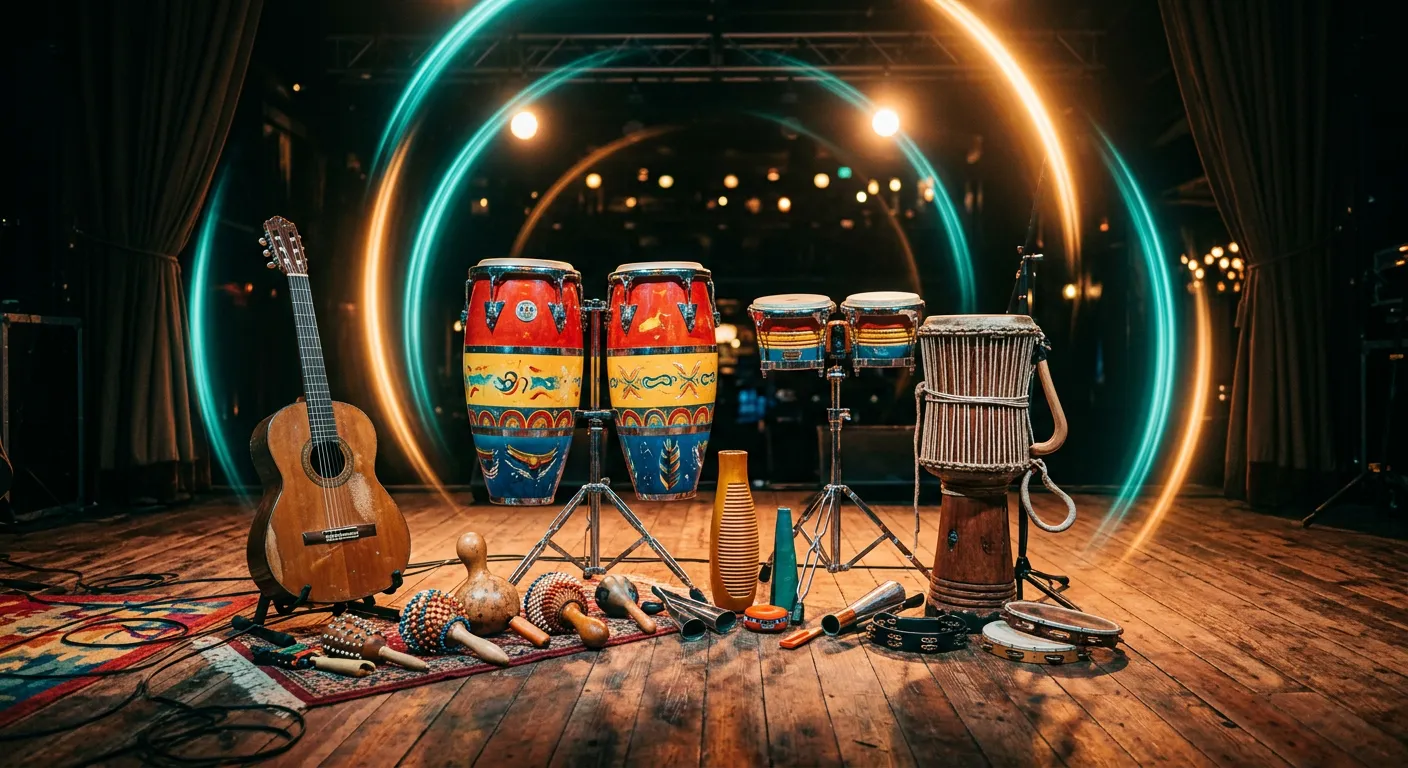
Many of these styles are played by large groups of musicians, with several percussionists locking into one groove. In stereo those parts compete for room. In 3D, the congas, shakers, bells and drums can sit all around the listener, the way they would in a live circle or on a crowded dance floor.
This overview covers 70 genre guides. Each one has its own placement map, immersion profile and step-by-step tips. If you are new to 3D sound, start with what spatial audio is, or see how every genre changes a spatial mix.
What these genres have in common in 3D
- Percussion all around. Hand drums, shakers, guiros and bells spread around and slightly behind the listener.
- An anchored centre. Lead vocal, bass and the main beat stay in front so the dance groove stays solid.
- Call and response. Choruses, horn sections and backing singers can answer from the sides, which suits these traditions perfectly.
- Respect for the room. Traditional styles keep a natural space; modern urban and club styles such as afrobeats, kuduro, mahraganat, reggaeton, dembow, Latin trap, gqom and Brazilian funk use tighter, club-style rooms.
Immersion scores for every genre in this family
Every genre guide scores five dimensions from 1 (barely used) to 5 (used to the full): width, height, movement, low-end focus and space or reverb. The table compares them side by side.
| Genre | Styles covered | Width | Height | Movement | Low end | Space |
|---|---|---|---|---|---|---|
| Afrobeat | Fela Afrobeat, Afro-Funk & Afro-Jazz | 5 | 2 | 3 | 4 | 3 |
| Afrobeats | Afropop, Afro R&B, Alté & Bongo Flava | 4 | 3 | 2 | 4 | 3 |
| Amapiano | Private School, Kwaito & Bacardi | 4 | 3 | 3 | 5 | 3 |
| Andean Music | Huayno, Saya & Nueva Canción | 4 | 3 | 3 | 2 | 4 |
| Arabic Classical Music | Tarab, Maqam & Muwashshah | 3 | 2 | 1 | 2 | 4 |
| Arabic Pop | Khaleeji, Egyptian Pop & Levantine Pop | 4 | 3 | 2 | 3 | 3 |
| Axé & Frevo | Samba-Reggae, Pagodão & Bloco Afro | 5 | 3 | 4 | 4 | 3 |
| Bachata | Traditional, Sensual & Urban Bachata | 4 | 2 | 1 | 3 | 3 |
| Balkan Brass | Trubači, Čoček & Balkan Beats | 5 | 2 | 3 | 4 | 3 |
| Bhangra | Punjabi Folk Bhangra, UK Bhangra & Punjabi Pop | 4 | 2 | 3 | 5 | 2 |
| Bolero | Trío Romántico, Filin & Bolero Ranchero | 2 | 2 | 1 | 2 | 3 |
| Bollywood | Filmi, Bhojpuri & Indian Pop | 5 | 4 | 3 | 4 | 4 |
| Bossa Nova & MPB | MPB, Tropicália & Choro | 3 | 3 | 1 | 2 | 3 |
| Brazilian Funk | Funk Carioca, Mandelão & Brega Funk | 3 | 2 | 4 | 5 | 2 |
| Cantopop | Hong Kong Ballads, 1980s Cantopop & Canto-Rock | 3 | 3 | 2 | 3 | 3 |
| Chinese Traditional Music | Guqin, Jiangnan Sizhu & Chinese Orchestra | 4 | 3 | 1 | 2 | 4 |
| Corridos Tumbados | Corridos Bélicos, Sierreño & Trap Corridos | 3 | 2 | 2 | 4 | 2 |
| Cumbia | Cumbia Villera, Sonidera & Cumbia Rap | 4 | 2 | 2 | 3 | 2 |
| Dancehall | Ragga, Raggamuffin & Reggae Dancehall | 4 | 3 | 3 | 5 | 3 |
| Dangdut | Classic Dangdut, Dangdut Koplo & Dangdut Remix | 4 | 2 | 3 | 4 | 2 |
| Dembow | Dominican Dembow, Rap Dominicano & Mambo de Calle | 4 | 3 | 4 | 5 | 2 |
| Desert Blues | Tishoumaren, Wassoulou & Malian Blues | 4 | 2 | 2 | 3 | 4 |
| Dub | Roots Dub, Steppers Dub & Dub Poetry | 5 | 4 | 5 | 5 | 5 |
| Enka | Kayōkyoku, Ryūkōka & Mood Kayō | 3 | 2 | 1 | 2 | 4 |
| Ethio-Jazz | Tizita, Ethiopian Pop & Eskista | 4 | 2 | 2 | 3 | 3 |
| Fado | One voice and two guitars in a small, quiet room | 2 | 2 | 1 | 2 | 3 |
| Flamenco | Nuevo Flamenco, Rumba Flamenca & Flamenco Fusion | 4 | 2 | 1 | 2 | 3 |
| Forró | Baião, Xote & Forró Universitário | 3 | 2 | 3 | 3 | 3 |
| French Chanson | Chanson Réaliste, Cabaret & Nouvelle Chanson | 3 | 2 | 1 | 2 | 3 |
| Gamelan | Javanese Gamelan, Balinese Gong Kebyar & Sundanese Degung | 5 | 3 | 2 | 4 | 4 |
| Gengetone & Singeli | Genge, Arbantone & Singeli | 3 | 2 | 4 | 5 | 2 |
| Gnawa | Lila Ceremony, Gnawa Fusion & Gnawa Jazz | 4 | 3 | 2 | 4 | 4 |
| Gqom | A heavy broken kick, a dark room that answers | 4 | 3 | 4 | 5 | 4 |
| Guaracha | Aleteo, Tribal House & Raptor House | 5 | 3 | 4 | 4 | 3 |
| Hawaiian Music | Slack-Key Guitar, Hawaiian Steel Guitar & Hapa Haole | 3 | 2 | 1 | 2 | 3 |
| Highlife | Palm-Wine, Burger Highlife & Guitar Band Highlife | 4 | 2 | 2 | 3 | 3 |
| Indian Classical | Hindustani & Carnatic Music | 2 | 3 | 1 | 2 | 3 |
| Japanese Traditional Music | Gagaku, Koto Music & Shakuhachi Honkyoku | 3 | 3 | 1 | 1 | 4 |
| Jùjú & Fújì | Jùjú, Fújì & Apala | 4 | 2 | 3 | 3 | 3 |
| Kizomba & Semba | Semba, Urban Kiz & Tarraxinha | 3 | 2 | 1 | 4 | 3 |
| Klezmer | Freylekhs, Doina & Klezmer Revival | 4 | 2 | 2 | 2 | 3 |
| Kompa & Zouk | Konpa Direk, Zouk Love & Cadence-Lypso | 3 | 2 | 2 | 4 | 3 |
| Kuduro | Angolan Kuduro, Lisbon Batida & Afro-Kuduro | 5 | 3 | 4 | 5 | 2 |
| Latin & Reggaeton | Dembow in the floor, percussion all around | 4 | 3 | 3 | 4 | 3 |
| Latin Pop | Pop Latino, Mexican Pop & Spanish Pop | 4 | 3 | 2 | 3 | 3 |
| Latin Rock | Rock en Español, Latin Alternative & Chicano Rock | 4 | 2 | 3 | 4 | 3 |
| Latin Trap | Trap Latino, Latin Drill & Argentine Trap | 4 | 3 | 3 | 5 | 4 |
| Luk Thung & Mor Lam | Classic Luk Thung, Mor Lam Sing & Isan Pop | 4 | 2 | 2 | 3 | 3 |
| Mahraganat | Electro-Shaabi, Egyptian Shaabi & Egyptian Rap | 4 | 2 | 4 | 5 | 2 |
| Mandopop | C-Pop Ballads, Taiwanese Pop & Zhongguo Feng | 4 | 3 | 2 | 3 | 3 |
| Mbalax | Sabar, Senegalese Pop & Gambian Mbalax | 4 | 2 | 3 | 3 | 2 |
| Mbaqanga & Maskandi | Township Jive, Maskandi & Marabi | 4 | 2 | 2 | 3 | 3 |
| Merengue | Perico Ripiao, Merengue de Orquesta & Merenhouse | 4 | 2 | 3 | 3 | 3 |
| Qawwali | Sufi Qawwali, Ghazal & Sufi Rock | 4 | 3 | 2 | 2 | 3 |
| Raï | Cheb Raï, Pop-Raï & Raï'n'B | 4 | 2 | 2 | 3 | 3 |
| Reggae | Roots, Lovers Rock & Reggae Fusion | 4 | 3 | 4 | 5 | 4 |
| Regional Mexican | Mariachi, Ranchera, Banda & Corridos | 4 | 2 | 1 | 4 | 3 |
| Rumba & Afro-Cuban | Guaguancó, Son Cubano & Changüí | 4 | 2 | 2 | 2 | 3 |
| Salsa | Timba, Salsa Dura & Salsa Romántica | 5 | 3 | 2 | 3 | 3 |
| Samba | Pagode, Samba-Enredo & Samba de Roda | 5 | 2 | 3 | 4 | 3 |
| Sertanejo | Sertanejo Universitário, Modão & Feminejo | 4 | 3 | 2 | 3 | 4 |
| Ska | Rocksteady, Two-Tone & Ska Punk | 4 | 2 | 2 | 3 | 3 |
| Soca & Calypso | Power Soca, Groovy Soca & Chutney Soca | 4 | 3 | 3 | 4 | 2 |
| Soukous & Congolese Rumba | Rumba Congolaise, Soukous & Ndombolo | 4 | 2 | 3 | 3 | 3 |
| Steelpan | Steel Band, Panorama & Pan Jazz | 5 | 3 | 2 | 3 | 4 |
| Taiko | Kumi-Daiko, Matsuri Bayashi & Eisa | 5 | 3 | 3 | 5 | 4 |
| Tango | Argentine Tango, Nuevo Tango & Electrotango | 4 | 2 | 3 | 3 | 4 |
| Tejano | Conjunto, Norteño & Tex-Mex | 3 | 2 | 2 | 3 | 3 |
| Tuvan Throat Singing | Khoomei, Sygyt & Kargyraa | 3 | 4 | 1 | 3 | 4 |
| Vallenato | Paseo, Puya & Vallenato Romántico | 3 | 2 | 2 | 3 | 2 |
Average across the family: width 3.9, height 2.5, movement 2.4, low-end focus 3.4, space or reverb 3.1.
Where the genres differ most
- Width: highest (5 out of 5) in 12 genres, including Salsa, Guaracha, Samba and Axé & Frevo, lowest in Bolero, Indian Classical and Fado (2 out of 5).
- Height: highest in Dub, Bollywood and Tuvan Throat Singing (4 out of 5), lowest (2 out of 5) in 39 genres, including Bachata, Cumbia, Regional Mexican and Brazilian Funk.
- Movement: highest in Dub (5 out of 5), lowest (1 out of 5) in 15 genres, including Bachata, Regional Mexican, Bossa Nova & MPB and Bolero.
- Low-end focus: highest (5 out of 5) in 13 genres, including Brazilian Funk, Dembow, Latin Trap and Amapiano, lowest in Japanese Traditional Music (1 out of 5).
- Space or reverb: highest in Dub (5 out of 5), lowest (2 out of 5) in 12 genres, including Cumbia, Brazilian Funk, Corridos Tumbados and Vallenato.
Salsa, samba, axé, steelpan, guaracha, Bollywood, Afrobeat, kuduro, taiko, gamelan and Balkan brass spread the widest, with a full band, a samba bateria, a steel orchestra, a big horn line, a ring of drums or a bronze orchestra around the listener. Dub is the most extreme genre in the family: it scores the full 5 for width, movement, low end and space, because the mix itself is the instrument and echoes fly around the room. Dembow, Latin trap, amapiano, kuduro, gengetone, singeli, mahraganat, reggae, dancehall, Brazilian funk, taiko and bhangra push the bass hardest. Tuvan throat singing reaches higher than almost any other style here, because the whistling overtones float above the drone. Bolero, fado and Indian classical music stay intimate, with a few players close to the listener, Arabic classical music keeps a small takht of players close together inside a resonant hall, and Japanese traditional music has the lightest low end in the family, with koto, shakuhachi and gagaku winds floating in a calm, open space.
The genre guides, section by section
Latin and Brazilian
Latin American and Brazilian music: salsa, merengue, bachata, rumba and cumbia; tango, bolero, Andean music and vallenato; regional Mexican, Tejano and corridos tumbados; the urban sound of Latin trap, dembow, guaracha and Brazilian funk; Latin rock and Latin pop; and from Brazil, samba, forró, sertanejo, axé, frevo and the gentle sway of bossa nova and MPB.
- Andean Music: Paired panpipes under a wide mountain sky.
- Axé & Frevo: A carnival street with drums all around.
- Bachata: A romantic voice wrapped in guitar lines.
- Bolero: A romantic trio around one microphone.
- Bossa Nova & MPB: A soft voice and guitar on a warm evening.
- Brazilian Funk: A heavy kick and MC, chops bouncing around.
- Corridos Tumbados: A guitar trio with a trap low end.
- Cumbia: An accordion and percussion around the dance floor.
- Dembow: A street party ringed with dry hits.
- Forró: An accordion trio in a June festival dance hall.
- Guaracha: A driving kick, Latin percussion all around.
- Latin & Reggaeton: Dembow in the floor, percussion all around.
- Latin Pop: A star vocal with guitar and percussion around it.
- Latin Rock: A rock core with Latin percussion around it.
- Latin Trap: A dark room around the voice and 808.
- Merengue: A fast dance band across a wide stage.
- Regional Mexican: A live band on stage in front of you.
- Rumba & Afro-Cuban: A rumba circle in a Havana courtyard.
- Salsa: A full orquesta with percussion all around.
- Samba: A singer and surdo inside a ring of percussion.
- Sertanejo: A vocal duo at the front of an arena stage.
- Tango: An orquesta típica across a milonga hall.
- Tejano: Accordion and bajo sexto on a dance hall stage.
- Vallenato: Three musicians at a parranda.
African and Caribbean
From West Africa, highlife, Afrobeat, jùjú, fújì, mbalax and the desert blues of Mali and the Sahara; from Central and Southern Africa, soukous, Congolese rumba, kuduro, kizomba, semba, mbaqanga, maskandi, amapiano and gqom; from East Africa, Ethio-jazz, gengetone and singeli; from North Africa, Gnawa and raï; plus afrobeats and the Caribbean family of reggae, dancehall, ska, dub, soca, calypso, kompa, zouk and steelpan, where deep bass and rolling percussion drive the groove.
- Afrobeat: An Afrobeat big band in a packed Lagos club.
- Afrobeats: A ring of percussion around a smooth vocal.
- Amapiano: Log drums in your chest, keys all around.
- Dancehall: A sound system party all around you.
- Desert Blues: A guitar band around a Saharan campfire.
- Dub: A sound system with echoes flying all around.
- Ethio-Jazz: An Ethio-jazz band in an Addis Ababa club.
- Gengetone & Singeli: A Nairobi and Dar es Salaam street party.
- Gnawa: A lila ceremony in a Moroccan courtyard.
- Gqom: A heavy broken kick, a dark room that answers.
- Highlife: A highlife band on an open-air dance floor.
- Jùjú & Fújì: A Yoruba party band around the dance floor.
- Kizomba & Semba: A semba band in a Luanda dance hall.
- Kompa & Zouk: A warm dance hall with the band around you.
- Kuduro: A Luanda street party around the listener.
- Mbalax: A mbalax band on a Dakar nightclub stage.
- Mbaqanga & Maskandi: A jive band across a township hall.
- Raï: A raï band at a wedding party in Oran.
- Reggae: Bass you feel, echoes that travel.
- Ska: A dance band with the horns all around.
- Soca & Calypso: A carnival road with the crowd behind you.
- Soukous & Congolese Rumba: A rumba band across a Kinshasa dance floor.
- Steelpan: A steel orchestra all around you.
World traditions
Traditions with their own instruments and spaces. From South Asia, Bollywood, Indian classical music, qawwali and bhangra; from East Asia, Mandopop, Cantopop, Chinese traditional music, Japanese traditional music, taiko and enka; from Southeast Asia, gamelan, dangdut, luk thung and mor lam; from Central Asia, Tuvan throat singing; from the Arab world, Arabic classical music, Arabic pop and Egyptian mahraganat; from Europe, Portuguese fado, Spanish flamenco, Balkan brass, klezmer and French chanson; and from the Pacific, Hawaiian music.
- Arabic Classical Music: A takht ensemble in a warm concert hall.
- Arabic Pop: A Cairo studio mix with strings and darbuka.
- Balkan Brass: A brass band in a Serbian village square.
- Bhangra: A bhangra dance floor at a Punjabi wedding.
- Bollywood: A soundtrack spectacle around the singers.
- Cantopop: A Cantopop night at a Hong Kong arena.
- Chinese Traditional Music: A Chinese ensemble in a garden pavilion hall.
- Dangdut: A dangdut band on a night stage in Java.
- Enka: An enka singer on a warm concert hall stage.
- Fado: One voice and two guitars in a small, quiet room.
- Flamenco: Voice, guitar and handclaps in a circle.
- French Chanson: A chanson singer in a small Paris cabaret.
- Gamelan: A gamelan ensemble in a Javanese pendopo.
- Hawaiian Music: A Hawaiian trio on an open-air lanai.
- Indian Classical: A soloist floating on a drone that fills the room.
- Japanese Traditional Music: A gagaku and koto ensemble in a shrine hall.
- Klezmer: A klezmer band at a Jewish wedding.
- Luk Thung & Mor Lam: A luk thung show at an Isan temple fair.
- Mahraganat: A Cairo street wedding around the listener.
- Mandopop: A Mandopop ballad on a Taipei concert stage.
- Qawwali: A qawwali party in a Sufi shrine courtyard.
- Taiko: A taiko ensemble on a concert hall stage.
- Tuvan Throat Singing: A throat singer on the open Tuvan steppe.
How to make immersive Latin, Caribbean, African, Asian and world music from stereo
You do not need an immersive studio or the original multitrack session. Spatial9 uses AI to turn a stereo song into spatial audio. It separates the arrangement, places each element in 3D space following the profile of your genre, and exports a finished mix as Eclipsa Audio, ADM, binaural for headphones or Ambisonics. If you have stems, export them cleanly for even more control.
Frequently asked questions
Which world music genres work best in spatial audio?
Percussion-rich styles such as salsa, cumbia, afrobeats, amapiano, highlife and soukous gain a lot, because their many rhythm parts can surround the listener. Large ensembles such as taiko, gamelan and Balkan brass can fill the whole circle. Intimate styles such as fado, flamenco, enka and French chanson gain a sense of being in the room with the players.
Where should percussion go in an immersive Latin mix?
Congas, timbales, bongos and shakers usually spread around the listener, with some parts to the sides and slightly behind. The main pulse, such as the clave, stays clear and easy to follow.
Which Latin genres keep the most intimate mix?
Bolero, Andean music and bossa nova keep the low end gentle, and bolero is among the narrowest styles in the family. The voice stays close, with a few guitars or panpipes around it, so the listener feels like they are sitting near the players.
How is a samba or carnival mix different from a club mix?
Samba, axé and frevo score the full 5 for width, because a bateria or bloco of drummers can surround the listener the way a parade does. Club styles such as dembow and Latin trap keep a tighter room and put the weight into the kick, the 808 and the bass instead.
Does reggae work in spatial audio?
Yes. The bass and drums stay centred and heavy, while dub-style echoes, skanking guitars and horns can move around the listener, which is close to how dub engineers already think about space. Dub itself goes further than any other genre here, with the full 5 out of 5 for width, movement, low end and space.
How should desert blues and Gnawa sound in spatial audio?
Both are hypnotic styles built on repetition. In desert blues, the interlocking Tuareg guitars sit to either side, with the clapping chorus around the listener and a wide, open space like a night sky. In Gnawa, the deep guembri stays in the centre while the iron qraqeb castanets ring on both sides, and the call-and-response chorus surrounds the listener as it would at a lila ceremony.
Does Arabic music work in immersive audio?
Yes. In Arabic classical music the oud, qanun, nay and violin sit in a close arc around the singer, like a takht ensemble, and the room carries the long, ornamented maqam lines. Arabic pop is brighter and wider, with darbuka, strings and handclaps around a lead vocal, while Egyptian mahraganat hits hardest, with a pounding kick and Auto-Tuned voices firing across the room.
How should gamelan and taiko sound in spatial audio?
Both are big ensembles that work best when they surround the listener. In a Javanese or Balinese gamelan, the bronze gongs sit low and deep in the centre while the metallophones and kettle gongs spread in a wide arc, and their shimmering, interlocking parts ring through an open pavilion. In taiko, the huge o-daiko sits close to the listener in the centre and carries the full weight of the low end, the small shime-daiko keeps time in front, and the big nagado drums, the flute and the players' shouts fill the sides and the space behind.
How do throat singing and qawwali work in immersive audio?
In Tuvan throat singing, the deep drone of the voice stays in the centre while the whistling overtones can rise slightly above it, which is why the style scores 4 out of 5 for height. In qawwali, the lead singer and harmonium stay in front, the tabla and dholak keep the pulse close, and the clapping chorus spreads around the listener, as it would at a Sufi gathering.
Can I make an immersive version of a Latin or African track without stems?
Yes. Spatial9 separates a stereo song with AI, places percussion, bass and vocals in 3D and exports Eclipsa Audio, ADM, binaural or Ambisonics.
Hear your genre in 3D
Pick the guide closest to your music above, then upload a track to Spatial9 to hear an immersive version in minutes.
Dolby and Dolby Atmos are trademarks of Dolby Laboratories. Spatial9 is not affiliated with or endorsed by Dolby Laboratories.