Spatial Audio & Immersive Music for Latin Trap: Trap Latino, Latin Drill & Argentine Trap
Spatial9 Team · · 10 min read
Part of the series Spatial audio and immersive music by genre.
Key takeaways
- In a spatial Latin trap mix the lead vocal and the 808 bass stay locked in the centre, while the snare, hi-hat rolls, vocal doubles, ad-libs and dark melodies spread around the listener.
- Because the brain can follow one voice among many when they come from different directions, an effect known as the cocktail party effect, moving ad-libs to the sides and behind keeps every word of the lead clear.
- Latin trap is a slow, dark, Spanish-language take on trap built around sliding 808s, so the room can be wide and moody, with pads and reverb tails rising overhead.
- The Latin trap immersion profile scores width 4, height 3, movement 3, low-end focus 5 and space 4 out of 5.
Latin trap is Spanish-language trap music that took shape in Puerto Rico in the mid-2010s, when artists from the reggaeton scene began rapping and singing over beats built in the style of Atlanta trap. Earlier tracks by artists such as Arcángel, De La Ghetto and Ñengo Flow pointed the way, and in 2016 and 2017 a wave of artists including Bad Bunny, Anuel AA, Ozuna, Bryant Myers and Farruko made it one of the biggest sounds in Latin music, helped by producers such as DJ Luian and Mambo Kingz. The sound is built from long, sliding 808 bass notes, fast hi-hat rolls, sparse snares and claps, dark minor-key melodies and Auto-Tuned vocals surrounded by ad-libs, usually in a slow half-time feel. From Puerto Rico it spread to Spain, Mexico, Colombia, Chile and Argentina, each scene adding its own slang and flavour. Latin trap suits spatial audio because the beat is sparse: there is room around the voice and the bass for every hat roll, ad-lib and pad to have its own place. This guide covers how spatial audio for Latin trap works, where to place each element and how to make an immersive Latin trap mix. For the basics, see what spatial audio is.
Why Latin trap works in spatial audio
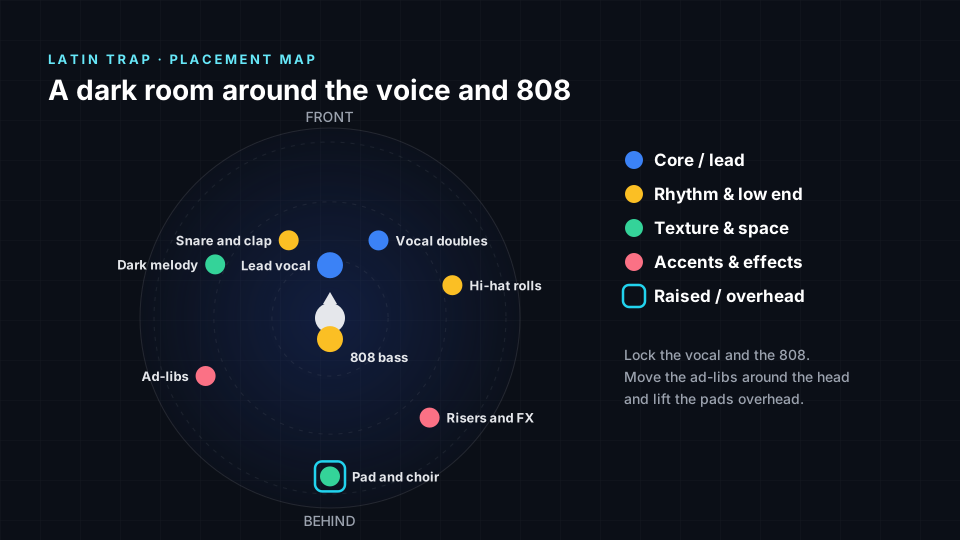
Latin trap is a voice floating over a heavy, empty beat. The 808 holds the low end, the snare lands on the half-time backbeat, the hi-hats roll and stutter, and the vocal is stacked with doubles and ad-libs that comment on every line. In stereo the doubles and ad-libs crowd the lead, and the dark pads blur into one haze. In an immersive mix the lead vocal and the 808 stay solid in the centre, the doubles sit just beside them, the ad-libs move around the head and the pads open up above.
The rule: a solid centre of voice and 808, with ad-libs and atmosphere all around. Keep the main vocal and the bass in the middle, set the drums in fixed, close positions, and use the space around and above the listener for ad-libs, melodies and reverb.
Immersive music for Latin trap: what listeners hear
- A voice close to your ear. The lead vocal sits front and centre, intimate and clear, with doubles just beside it.
- An 808 you feel. The sliding bass stays centred and heavy, sitting under everything.
- Ad-libs that move around you. Shouts, echoes and side comments come from the sides and behind, sometimes drifting across.
- A dark room that opens up. Pads, choirs and reverb tails rise above the listener, giving the slow beat a wide, moody space.
Where to place each element in a Latin trap mix
| Element | Position | Height | Why it works |
|---|---|---|---|
| Lead vocal | Front centre | Ear level | The flow and the melody carry the song |
| 808 bass | Centre | Ear level | Long sliding bass notes that hold the low end |
| Snare and clap | Front left of centre | Ear level | The half-time backbeat |
| Vocal doubles | Front right of centre | Ear level | Stacked takes that thicken the hook |
| Hi-hat rolls | Right, with small movement | Ear level | Fast rolls and stutters that drive the groove |
| Dark melody | Left | Ear level | Piano, bell, guitar or synth loop in a minor key |
| Ad-libs | Behind left, moving | Ear level | Shouts and comments around the main vocal |
| Risers and FX | Behind right, sweeping | Ear level | Reverse effects and risers into each hook |
| Pad and choir | Behind | Overhead | Atmosphere and reverb tails above the beat |
The psychoacoustics behind Latin trap placement
Every position in the table above follows how the ear and brain locate sound. Here is the reason behind the main choices for Latin trap.
- The 808 stays centred. The ear finds almost no direction in frequencies below roughly 80 to 100 Hz, so spreading the 808 gains nothing and only weakens it on phones, cars and club systems.
- Ad-libs away from the lead. The brain can follow one voice among many when they come from different directions. This is the cocktail party effect (Bronkhorst). Moving the ad-libs to the sides and behind keeps every word of the main vocal clear.
- Pads that sit above. The ear judges height mainly from how the outer ear colours the upper frequencies of a sound. These are spectral elevation cues (Hebrank and Wright). Bright, airy pads and choir textures place easily overhead, while the low 808 stays grounded.
- Risers that pull you into the hook. The brain treats rising and approaching sounds as more urgent and hears them as closer than they are. This is the perceptual bias for rising tones and looming sounds (Neuhoff). A riser that sweeps forward from behind makes each hook land harder.
The immersion profile for Latin trap
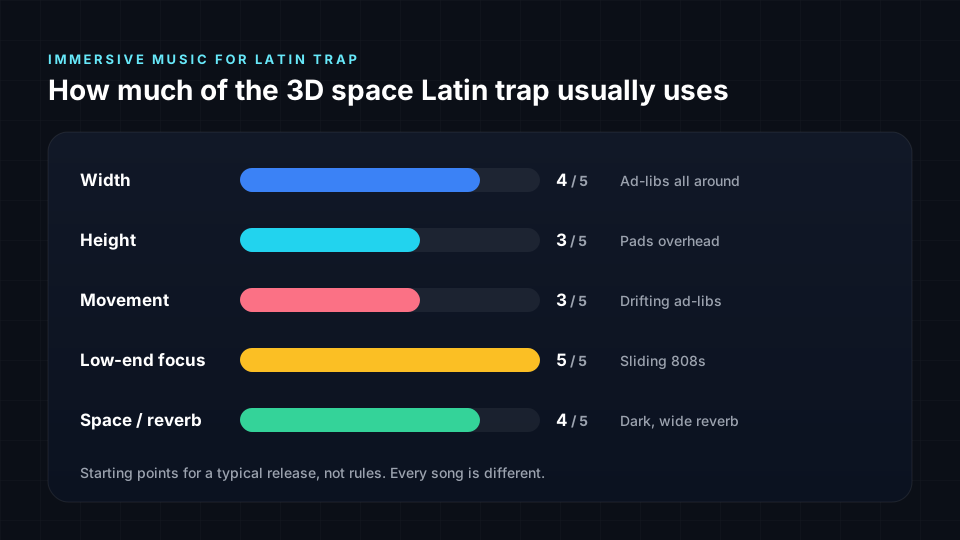
Low-end focus scores 5, because the 808 is the heart of the music. Width scores 4: ad-libs, melodies and effects can reach well around the listener. Space also scores 4, since dark reverbs and long vocal tails are part of the sound, unlike drier club styles. Height scores 3, coming from pads and choirs above the beat. Movement is 3: ad-libs and risers move, but the drums and the lead stay still.
Tips for an immersive Latin trap mix
- Lock the lead vocal and 808 in the centre. Both carry the song and must stay strong when played back in stereo.
- Keep the vocal doubles close. Set them just beside the lead so the hook sounds thicker, not split apart.
- Send the ad-libs around the head. Place them to the sides and behind, and let some drift across the back.
- Keep the drums tight. Fixed, close positions for the snare and hats keep the half-time groove hard and steady.
- Use height for atmosphere. Put pads, choirs and reverb tails above and behind, and keep the low end out of them.
Latin Trap styles: trap Latino, Latin drill and Argentine trap
The core placement holds for every style here: voice and 808 in the middle, ad-libs and atmosphere around the listener. What changes is how hard the drums hit, how much the rapper or the melody leads and how much space the beat needs.
Trap Latino
Trap Latino is the original Puerto Rican sound and its many offshoots: slow, dark beats, sliding 808s, rolling hats and a vocal that moves between rapping and Auto-Tuned singing. Lyrics often deal with street life, money and heartbreak. Use the full layout here: lead vocal and 808 centred, doubles close, ad-libs moving behind, and pads and choir above. Give the reverb room to breathe, but keep the drums tight.
Latin Drill
Latin drill brings the sound of UK and New York drill into Spanish-language music. The beats use sliding 808s, sharp syncopated snares and skittering hi-hats, with darker, more aggressive rapping. Because the drums and the bass slides are busier, keep the room smaller than in trap Latino. Hold the 808 and vocal firmly in the centre, set the snare and hats close in front, and keep ad-libs short and to the sides.
Argentine Trap
Argentine trap grew out of the freestyle battle scene in Buenos Aires, such as El Quinto Escalón, in the mid-2010s. Artists such as Duki, Khea, Ysy A, Cazzu, Nicki Nicole and Paulo Londra took it to a wide audience, and producer Bizarrap's sessions made it famous across the Spanish-speaking world. The style mixes hard trap beats with melodic hooks and quick-fire rap. Keep the vocal centred and very clear, since wordplay matters, and let melodic hooks open up a little wider with more height.
Related styles such as reggaeton-trap crossovers, emo trap and the Mexican corridos tumbados scene follow the same idea: keep the voice and the 808 centred, then use the space around and above for ad-libs and atmosphere.
How to make immersive Latin trap from stereo
Spatial9 can create spatial audio from a stereo track in a few steps:
- Upload your stereo master or your stems.
- Spatial9's AI separates and places each part, pulling the lead vocal, doubles, ad-libs, 808, snare, hats and melody apart and setting the voice and bass in the centre with ad-libs and pads around and above.
- Preview it in binaural on headphones.
- Export Eclipsa Audio, ADM, binaural or Ambisonics.
- Publish a video. Create a YouTube-ready video with your immersive audio and publish it directly.
For related guides, read spatial audio for trap and spatial audio for Latin music. Every guide is listed in spatial audio and immersive music by genre.
Frequently asked questions
Does this guide cover trap Latino, Latin drill and Argentine trap?
Yes. Trap Latino uses the full layout with a centred voice and 808, moving ad-libs and pads above. Latin drill keeps a smaller room for its busier drums and bass slides. Argentine trap keeps the rap very clear and lets melodic hooks open up wider.
Can I make a Latin trap mix in Dolby Atmos or Eclipsa Audio?
Yes. The placements in this guide work for both. Spatial9 exports ADM, the standard file used by Dolby Atmos studios, as well as Eclipsa Audio for YouTube, so one immersive Latin trap mix covers both. If you plan to release the Atmos version on Apple Music, build it from your original stems or multitracks, because Apple does not accept Atmos made from a finished stereo master. See where to publish spatial audio. You may also hear this called a 3D Latin trap mix or Latin trap in spatial audio.
Is spatial audio good for Latin trap?
Yes. Latin trap leaves a lot of room around the voice and the 808. Spatial audio fills that room with ad-libs, melodies and atmosphere from every direction while keeping the core heavy and clear.
Where should the 808 go in an immersive Latin trap mix?
Keep it in the centre at ear level. Low frequencies carry almost no direction, and a centred 808 stays strong when the mix folds down to stereo, phones or car speakers.
Where should the ad-libs go?
Put them to the sides and behind at ear level, away from the lead vocal, and let a few drift slowly across. That way they add energy without covering the main lyrics.
How is Latin trap different from dembow in spatial audio?
Latin trap is slower and darker, with long 808 notes and wide reverbs, so it suits a bigger space and pads overhead. Dembow is faster and drier, with a pounding kick and constant shouts, so it needs a small room and a tight ring of hits.
Can I convert a finished Latin trap song to spatial audio?
Yes. Spatial9 uses AI to separate the vocal, ad-libs, 808, drums and melody from a stereo master. Heavily layered vocals never separate perfectly, so keep the doubles close to the lead and the layout simple.
Dolby and Dolby Atmos are trademarks of Dolby Laboratories. Spatial9 is not affiliated with or endorsed by Dolby Laboratories.
Sources
- Blauert, J. (1997). Spatial Hearing: The Psychophysics of Human Sound Localization, revised edition. MIT Press. Low-frequency, elevation, distance and motion cues.
- Mills, A. W. (1958). On the minimum audible angle. Journal of the Acoustical Society of America, 30(4), 237-246.
- Hebrank, J. and Wright, D. (1974). Spectral cues used in the localization of sound sources on the median plane. Journal of the Acoustical Society of America, 56(6), 1829-1834.
- Bronkhorst, A. W. (2000). The cocktail party phenomenon: a review of research on speech intelligibility in multiple-talker conditions. Acta Acustica united with Acustica, 86, 117-128.
- Litovsky, R. Y., Colburn, H. S., Yost, W. A. and Guzman, S. J. (1999). The precedence effect. Journal of the Acoustical Society of America, 106(4), 1633-1654.
- Barron, M. and Marshall, A. H. (1981). Spatial impression due to early lateral reflections in concert halls. Journal of Sound and Vibration, 77(2), 211-232.
- Neuhoff, J. G. (1998). Perceptual bias for rising tones. Nature, 395, 123-124.
- Bregman, A. S. (1990). Auditory Scene Analysis: The Perceptual Organization of Sound. MIT Press.
- Rivera-Rideau, P. R. (2015). Remixing Reggaetón: The Cultural Politics of Race in Puerto Rico. Duke University Press.
Turn the lights down
Upload a track to Spatial9 and hear the 808 hold the centre while the ad-libs surround you in minutes. Then export it or publish it straight to YouTube.