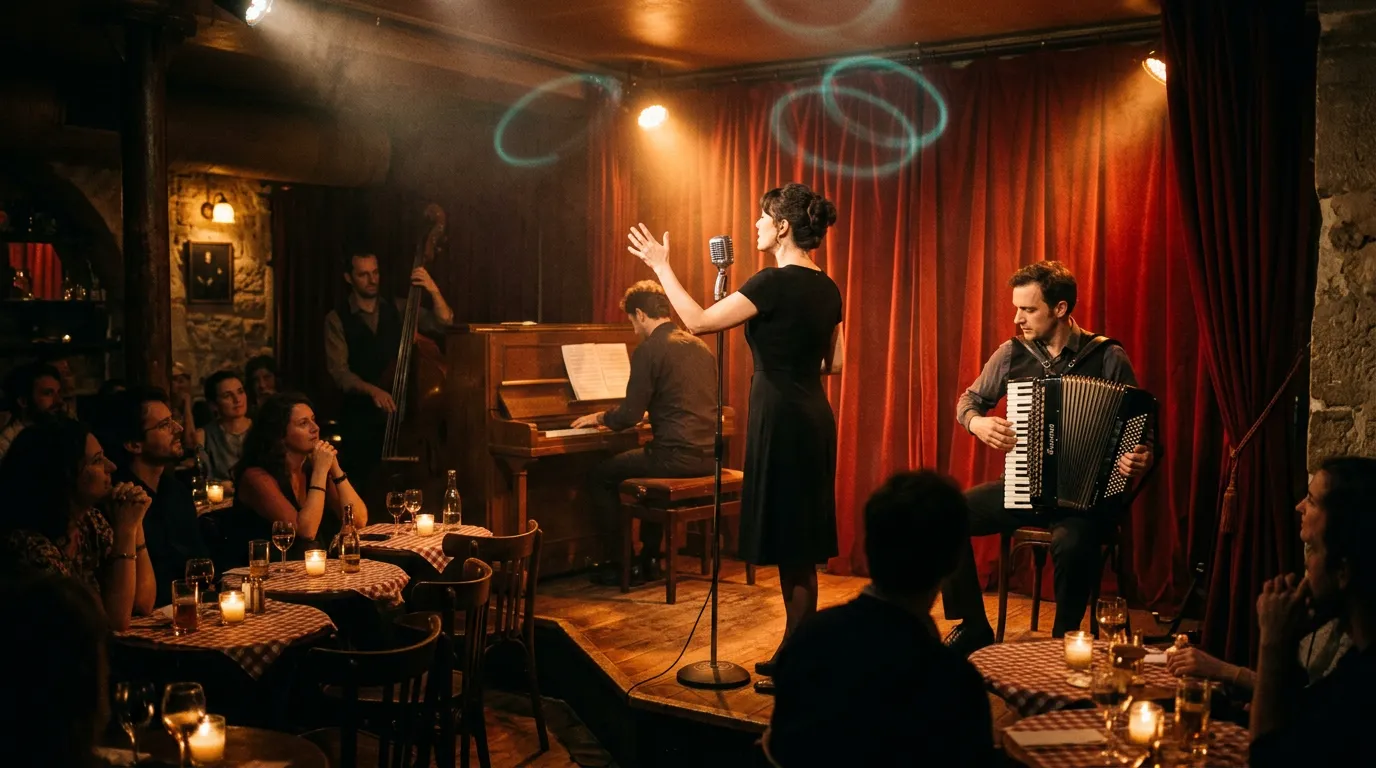
Spatial Audio & Immersive Music for French Chanson: Chanson Réaliste, Cabaret & Nouvelle Chanson
Spatial9 Team · · 12 min read
Part of the series Spatial audio and immersive music by genre.
Key takeaways
- Spatial audio for French chanson places the voice close at front centre with a soft, centred double bass, the piano front left, the accordion front right, guitar and strings at the sides and a small cabaret room behind.
- The cocktail party effect means a voice is easier to follow when it comes from a different direction from the band, so keeping the singer centred and the accordion and piano to the sides protects the words.
- Chanson is still, word-led music, so avoid panning moves, keep the vocal fairly dry and use a small, warm room rather than a large hall.
- The French chanson immersion profile scores width 3, height 2, movement 1, low-end focus 2 and space 3 out of 5.
Chanson is the French tradition of the sung text, where the words matter as much as the melody. Its roots reach back to the troubadours and trouvères of the Middle Ages, but the modern form grew up in the cafés-concerts and cabarets of Paris at the end of the nineteenth century. Le Chat Noir opened in Montmartre in 1881, and Aristide Bruant sang his rough songs of the city streets there before opening his own club, Le Mirliton. In the 1920s and 1930s singers such as Fréhel, Damia and Édith Piaf made chanson réaliste, dark songs of love and loss in poor Paris districts, while the accordion of the bal musette dance halls became the sound most people link with Paris. Charles Trenet brought a lighter, swinging style in the late 1930s. After the Second World War the small cabarets of Saint-Germain-des-Prés and the Left Bank launched Juliette Gréco, Georges Brassens, Jacques Brel, Léo Ferré, Barbara and Charles Aznavour, the great writers of chanson à texte. From the late 1990s a new generation, including Vincent Delerm, Benjamin Biolay and Bénabar, was grouped under the name nouvelle chanson. The usual instruments are voice, piano, accordion, guitar and double bass, often with strings, clarinet or a small brass section. Chanson suits spatial audio because it is intimate music made for small rooms, where the singer seems to talk straight to each listener. This guide covers how spatial audio for French chanson works, where to place each element and how to make an immersive French chanson mix. For the basics, see what spatial audio is.
Why French chanson works in spatial audio
Chanson is built around a voice telling a story. The band supports the words rather than competing with them. A piano or accordion carries the harmony, a double bass walks or plucks gently underneath, and strings or a clarinet add colour between the lines. Many songs grow slowly, from a quiet spoken verse to a full, dramatic final chorus. In stereo the accordion, piano and strings often pile up in the middle with the voice, and the words lose their edge. In an immersive mix the singer stays close and centred while the instruments sit in a calm arc around them, so the story stays clear even when the arrangement swells.
The rule: the words at the centre, the band in a small arc behind them. Keep the voice close and dry enough to understand every syllable, set the piano and accordion on the front sides and place the whole group inside a small, warm room.
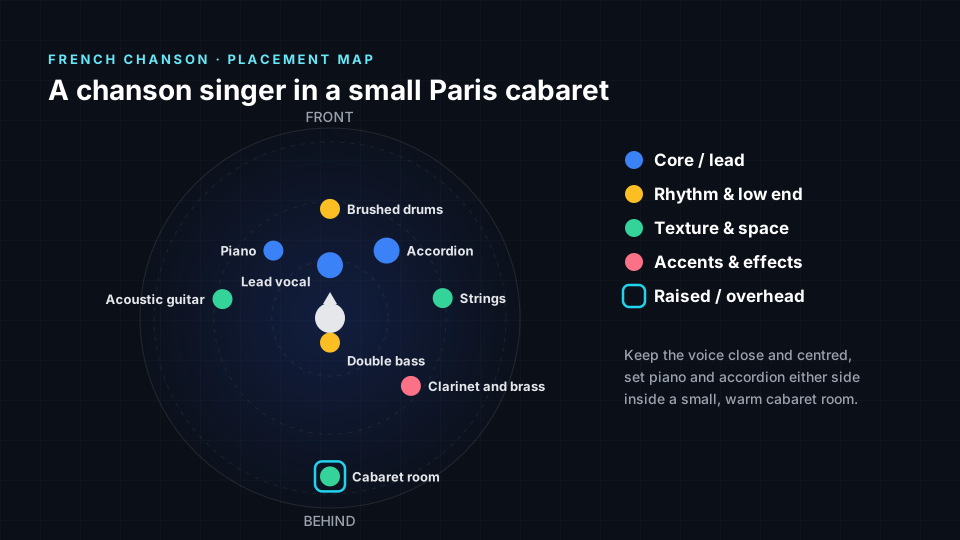
Immersive music for French chanson: what listeners hear
- A voice that speaks to you. The singer sits close and centred, so the words feel like they are meant for one listener, as they would at a front table in a cabaret.
- Piano and accordion as two partners. The piano on one side and the accordion on the other answer the voice without masking it, and each keeps its own colour.
- A swell that stays clear. When the strings and brass come in for a big final chorus, they open up at the sides, so the voice is never buried.
- A small, warm room. A short, natural reverb places the band in an intimate club rather than a large hall, which keeps the feeling close.
Where to place each element in a French chanson mix
| Element | Position | Height | Why it works |
|---|---|---|---|
| Lead vocal | Front centre | Ear level | The story and the words lead every song |
| Double bass | Centre | Low | A soft, steady floor under the voice |
| Piano | Front left | Ear level | Harmony and rhythm beside the singer |
| Accordion | Front right | Ear level | The classic Paris colour, answering the voice |
| Acoustic guitar | Left | Ear level | Gentle chords and picking, as in Brassens |
| Brushed drums | Front centre, behind the voice | Ear level | Light swing that keeps out of the way |
| Strings | Right | Ear level | Swells and counter lines in big choruses |
| Clarinet and brass | Behind right | Ear level | Short fills and cabaret colour |
| Cabaret room | Behind | Raised | A small, warm club around the band |
The psychoacoustics behind French chanson placement
Every position in the table above follows how the ear and brain locate sound. Here is the reason behind the main choices for chanson.
- Voice apart from the band. Listeners can follow one voice in a crowd of sounds far more easily when it comes from a different direction. This is the cocktail party effect (Bronkhorst). Keeping the singer centred and the accordion, piano and strings to the sides protects the words, which are the heart of chanson.
- Accordion and piano in different places. The brain groups sounds into streams by pitch, timbre and direction. This is auditory stream segregation (Bregman). Setting the reedy accordion apart from the piano lets the ear follow two partners at once instead of a single blurred chord.
- Double bass stays centred. The ear finds almost no direction in frequencies below roughly 80 to 100 Hz, so the low notes of the double bass gain nothing from being spread. A centred bass keeps the arrangement steady under the voice (Blauert).
- Small instrument offsets still read clearly. At the front the ear can tell apart sources only a degree or two apart. This is the minimum audible angle (Mills). A modest arc of piano, accordion and guitar is enough to separate them, so chanson does not need an extreme, wide layout.
The immersion profile for French chanson
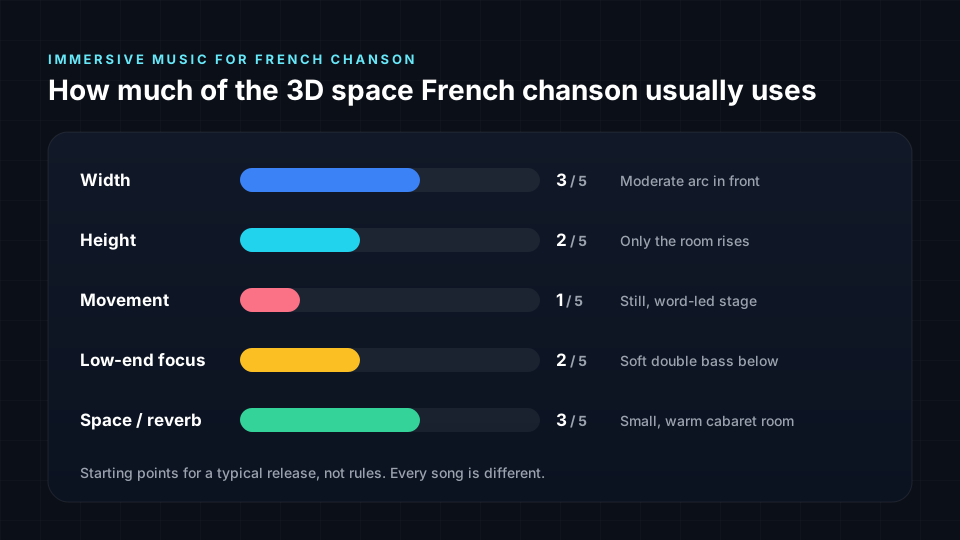
Width scores 3 because the band forms a moderate arc in front of the listener rather than a full circle. Height is 2, since only the room reverb rises above ear level and the players sit on a low stage. Movement is 1: chanson is still music, and the drama comes from the voice and the arrangement building, not from sounds travelling around the room. Low-end focus is 2, because the double bass is soft and supportive rather than heavy. Space scores 3, as the music belongs in small clubs and theatres, so the room should be warm and present but never large.
Tips for an immersive French chanson mix
- Put the words first. Keep the lead vocal close, centred and fairly dry, so every syllable is easy to understand.
- Split the piano and accordion. Place them on opposite front sides so they answer each other and the voice instead of blending into one mass.
- Keep everyone in place. Avoid panning moves. Let the arrangement and the singer's delivery carry the drama of the song.
- Open the sides for big choruses. Bring the strings and brass in at the sides and a little behind, so the swell surrounds the listener while the voice stays in front.
- Use a small, warm room. A short club reverb suits chanson. Keep its pre-delay short and its low end light, so the bass and voice stay tight.
French chanson styles: Chanson réaliste, Cabaret and Nouvelle chanson
The core placement holds for every style here: the voice close at the centre, the band in a small arc around it. What changes is the size of the band, the amount of orchestra and how close or large the room should feel.
Chanson Réaliste
Chanson réaliste was the dominant popular song of Paris between the two world wars. Its songs told stories of the street, of sailors, prostitutes, lost lovers and poverty, often sung by women with powerful, raw voices. Fréhel and Damia were its early stars, and Édith Piaf, discovered singing on a Paris street corner in 1935 by the club owner Louis Leplée, became its most famous voice. The accordion, the piano and later a small orchestra carried the songs. Place the voice close and centred, with the accordion front right and the piano front left. For later orchestral recordings, set the strings in a moderate arc behind the band. Keep the room warm but not too large, so the voice stays raw and direct. Old 78 rpm recordings are often mono, so separate the voice gently and keep the layout simple.
Cabaret
Cabaret is the room as much as the music: a small club where a singer performs close to the audience, often with a single piano. The tradition began with Le Chat Noir in Montmartre, opened by Rodolphe Salis in 1881, where Aristide Bruant sang and poets read their work. Yvette Guilbert later became a star of the Paris café-concert stage. After the Second World War the Left Bank clubs of Saint-Germain-des-Prés launched Juliette Gréco, and L'Écluse became the stage where Barbara built her following. Many singer-songwriters, including Brassens and Brel, played small Paris clubs in their early years. For a cabaret mix, keep the voice very close and centred, the piano just front left and any guitar or double bass nearby. Use a short, intimate room with clear early reflections, so the listener feels seated at a front table.
Nouvelle Chanson
Nouvelle chanson, or nouvelle chanson française, is the name French critics gave to a wave of singer-songwriters from the late 1990s onward. Artists such as Vincent Delerm, Benjamin Biolay, Bénabar, Thomas Fersen, Camille and Jeanne Cherhal took the focus on words from Brassens, Brel and Barbara and mixed it with modern pop arrangements, electronics and indie production. Dominique A is often named as a forerunner. The palette is wider here: piano, guitars, strings, programmed beats and vocal layers. Keep the lead voice close and centred, piano and guitars on the front sides and strings in a moderate arc. Electronic textures and backing vocals can sit behind or slightly raised, and the room can be a little more modern and open, as long as the words stay clear.
Related traditions such as Belgian and Québécois chanson, Italian canzone d'autore and the Portuguese fado follow the same idea: keep the voice close and centred, the band in a small arc behind it and an intimate room around the listener.
How to make immersive French chanson from stereo
Spatial9 can create spatial audio from a stereo track in a few steps:
- Upload your stereo master or your stems.
- Spatial9's AI separates and places each part, pulling the voice, accordion, piano, double bass and strings apart even from older recordings, and setting the band in a warm arc around a close, centred singer.
- Preview it in binaural on headphones.
- Export Eclipsa Audio, ADM, binaural or Ambisonics.
- Publish a video. Create a YouTube-ready video with your immersive audio and publish it directly.
For related guides, read spatial audio for fado and spatial audio for gypsy jazz. Every guide is listed in spatial audio and immersive music by genre.
Frequently asked questions
Does this guide cover Chanson Réaliste, Cabaret and Nouvelle Chanson?
Yes. Chanson réaliste puts a raw voice at the centre with accordion and piano on either side. Cabaret keeps the singer very close with a piano in a small, intimate club. Nouvelle chanson adds guitars, strings and electronic textures around a close, centred voice.
Can I make a French chanson mix in Dolby Atmos or Eclipsa Audio?
Yes. The placements in this guide work for both. Spatial9 exports ADM, the standard file used by Dolby Atmos studios, as well as Eclipsa Audio for YouTube, so one immersive chanson mix covers both. If you plan to release the Atmos version on Apple Music, build it from your original stems or multitracks, because Apple does not accept Atmos made from a finished stereo master. See where to publish spatial audio. You may also hear this called a 3D chanson mix or French chanson in spatial audio.
Is spatial audio good for French chanson?
Yes. Chanson is intimate music where the words come first. Spatial audio lets the voice stay close and clear while the accordion, piano and strings each keep their own place, so the listener feels seated in the room with the singer.
Where should the accordion go in an immersive chanson mix?
Put the accordion on one front side, opposite the piano and a little behind the voice. Its reedy tone sits in the same range as the singer, so a clear offset keeps both easy to hear.
Should the vocal reverb be large for chanson?
No. A short, warm room works best. Large halls blur the consonants, and chanson depends on every word being understood. Save a little extra space for the strings in the biggest choruses.
How is French chanson different from fado in spatial audio?
Chanson usually places the voice with piano, accordion and double bass, sometimes with strings, in a small cabaret room. Fado centres on the voice with the Portuguese guitar and classical guitar close on either side, in a quiet, dark taverna. Both keep the singer close and still, but fado uses an even smaller group.
Can I convert an old Piaf-era recording to spatial audio?
Yes. Spatial9 uses AI to separate the voice, accordion and orchestra from a stereo or mono recording. Separation is never perfect with early recordings, so keep the layout simple and the room moderate.
Dolby and Dolby Atmos are trademarks of Dolby Laboratories. Spatial9 is not affiliated with or endorsed by Dolby Laboratories.
Sources
- Blauert, J. (1997). Spatial Hearing: The Psychophysics of Human Sound Localization, revised edition. MIT Press. Low-frequency, elevation, distance and motion cues.
- Mills, A. W. (1958). On the minimum audible angle. Journal of the Acoustical Society of America, 30(4), 237-246.
- Hebrank, J. and Wright, D. (1974). Spectral cues used in the localization of sound sources on the median plane. Journal of the Acoustical Society of America, 56(6), 1829-1834.
- Bronkhorst, A. W. (2000). The cocktail party phenomenon: a review of research on speech intelligibility in multiple-talker conditions. Acta Acustica united with Acustica, 86, 117-128.
- Barron, M. and Marshall, A. H. (1981). Spatial impression due to early lateral reflections in concert halls. Journal of Sound and Vibration, 77(2), 211-232.
- Neuhoff, J. G. (1998). Perceptual bias for rising tones. Nature, 395, 123-124.
- Bregman, A. S. (1990). Auditory Scene Analysis: The Perceptual Organization of Sound. MIT Press.
- Hawkins, P. (2000). Chanson: The French Singer-Songwriter from Aristide Bruant to the Present Day. Ashgate.
- Looseley, D. L. (2003). Popular Music in Contemporary France: Authenticity, Politics, Debate. Berg.
Take a seat at the front table
Upload a track to Spatial9 and hear the singer close at the centre with the piano and accordion around you in minutes. Then export it or publish it straight to YouTube.