Spatial Audio & Immersive Music for Balkan Brass: Trubači, Čoček & Balkan Beats
Spatial9 Team · · 12 min read
Part of the series Spatial audio and immersive music by genre.
Key takeaways
- In a Balkan brass mix the lead trumpet sits at front centre, the flugelhorns and tenor horns fan out on both sides, the tapan drum sits behind and the tuba stays low in the centre.
- Brass instruments share a similar bright tone, so giving each section its own direction uses auditory stream segregation to stop the horns merging into one wall.
- Balkan brass belongs in an open-air square with short reflections, and only soloists and electronic layers should move.
- The Balkan brass immersion profile scores width 5, height 2, movement 3, low-end focus 4 and space 3 out of 5.
Balkan brass is the music of the brass bands, or trubači, of Serbia, North Macedonia, Romania, Bulgaria and their neighbours. Brass instruments came to the region in the 19th century with Ottoman and Austrian military bands, and Serbia formed its first military bands in the 1830s. Village musicians soon took up the trumpet, and by the early 20th century brass bands were playing at weddings, christenings, saints' day feasts and fairs. Roma musicians, many from families who had been professional musicians for generations, became central to the tradition, especially in southern Serbia around Vranje, Vladičin Han and Surdulica, and in North Macedonia. A typical band has trumpets and flugelhorns on the melody, tenor horns and baritones playing offbeat chords, a tuba or helicon on the bass line and a large double-headed drum called the tapan. Some bands add saxophone and clarinet. In 1961 the first Dragačevo Trumpet Festival was held in the churchyard of Guča in western Serbia, with only four bands. It has since grown into one of the biggest brass festivals in the world. Bands such as the Boban Marković Orkestar from Vladičin Han, the Kočani Orkestar from North Macedonia and Fanfare Ciocărlia from the Romanian village of Zece Prăjini took the sound to stages around the world from the 1990s. This guide covers how spatial audio for Balkan brass works, where to place each element and how to make an immersive Balkan brass mix. For the basics, see what spatial audio is.
Why Balkan brass works in spatial audio
A Balkan brass band is loud, fast and crowded. The lead trumpet plays fast ornamented melodies. A second trumpet or a pair of flugelhorns doubles it or answers it. The tenor horns pump short chords on the offbeat, the tuba walks underneath, and the tapan hits hard on the downbeat with a thin stick clicking on the other side. In stereo all of this piles into the middle, and the horns turn into one wall of brass. In an immersive mix the band spreads out the way it stands on a stage or walks through a street: melody at the front, harmony on the sides, the drum behind and the tuba holding the floor.
The rule: the melody in front, the brass all around. Keep the lead trumpet and the tuba in the centre, fan the flugelhorns and tenor horns out wide on both sides and let the band sit inside an open-air square.
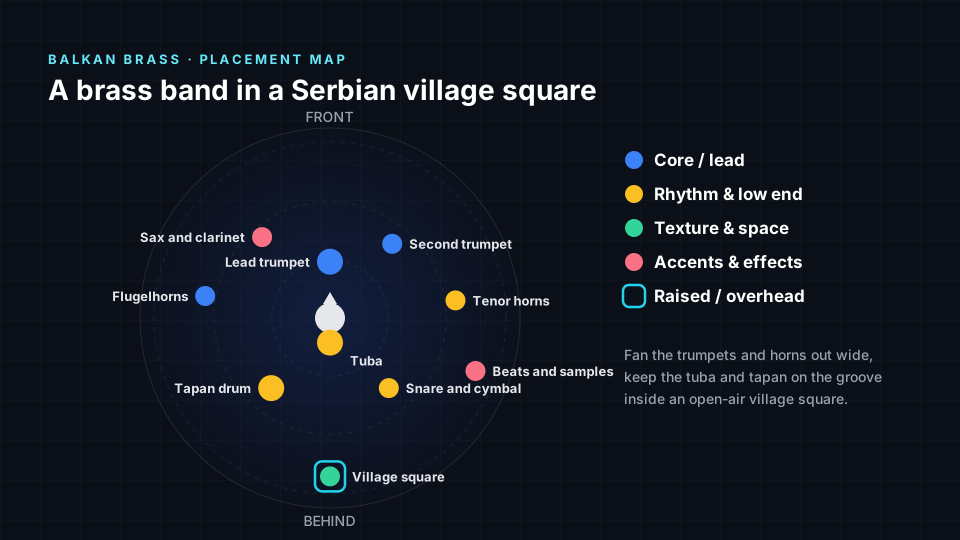
Immersive music for Balkan brass: what listeners hear
- A trumpet calling from the front. The lead trumpet sits close and clear, so every fast run and bent note cuts through the band.
- Horns on both sides. The flugelhorns answer from the left and the tenor horns pump their offbeat chords from the right, so the harmony wraps around the listener instead of blurring.
- A drum you can feel behind you. The tapan and the tuba lock together, with the drum just behind and the tuba low in the centre, giving the dance its weight.
- A band on the move. Soloists step forward and fall back, and the whole band can seem to approach as it gets louder, like a procession coming down the street.
Where to place each element in a Balkan brass mix
| Element | Position | Height | Why it works |
|---|---|---|---|
| Lead trumpet | Front centre | Ear level | The main melody and its fast ornaments |
| Second trumpet | Front right | Ear level | Doubles or answers the lead line |
| Sax and clarinet | Front left | Ear level | Solo lines in Macedonian and čoček bands |
| Flugelhorns | Left | Ear level | Warm second melody and harmony |
| Tenor horns | Right | Ear level | Offbeat chords that drive the dance |
| Tapan drum | Behind left | Ear level | The heavy downbeat and stick accents |
| Snare and cymbal | Behind right | Ear level | Crisp accents and fills |
| Beats and samples | Behind right, far | Ear level | Electronic layers in Balkan Beats |
| Tuba | Centre | Low | The bass line that holds the band together |
| Village square | Behind | Raised | Open air with reflections from walls |
The psychoacoustics behind Balkan brass placement
Every position in the table above follows how the ear and brain locate sound. Here is the reason behind the main choices for Balkan brass.
- Tuba stays centred. The ear finds almost no direction in frequencies below roughly 80 to 100 Hz, so the low notes of the tuba gain nothing from being spread. Keeping it centred and tight with the tapan holds the dance steady (Blauert).
- Trumpets and horns in different places. The brain groups sounds into streams by pitch, timing and direction. This is auditory stream segregation (Bregman). Brass instruments share a similar bright tone, so giving the lead trumpet, flugelhorns and tenor horns their own directions is the best way to stop them merging into one block.
- A wide fan of brass. The ear is most precise at telling apart sounds near the front, where it can detect differences of about one degree. This is the minimum audible angle (Mills). Spreading the horns well apart, and further to the sides, keeps each section distinct even when they play in unison.
- A band that seems to approach. Listeners hear sounds that grow louder as moving closer, and they overestimate how near a rising sound has come. This is the looming effect for rising intensity (Neuhoff). The crescendos of a brass band in full cry already carry this sense of a procession coming toward you.
The immersion profile for Balkan brass
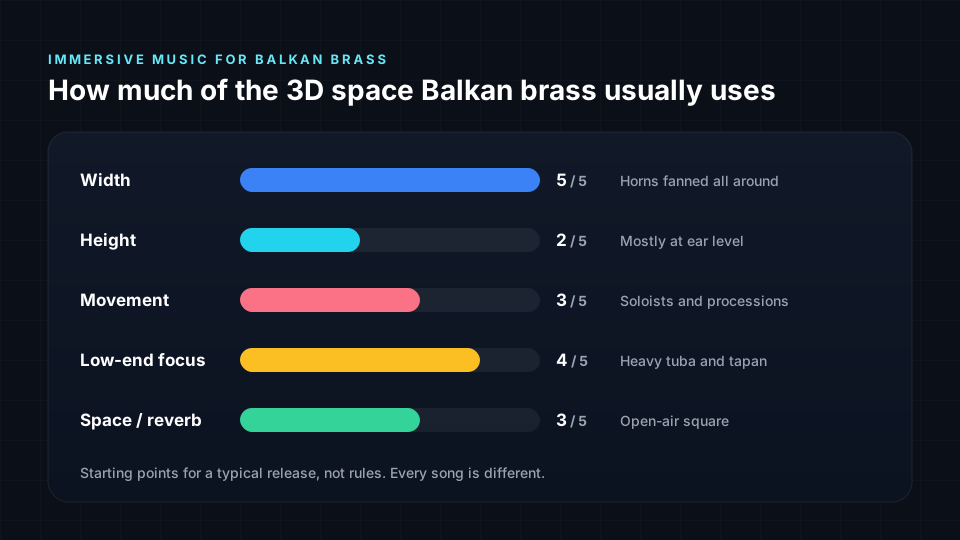
Width scores 5, the highest value, because a brass band is a wide line of loud instruments, and spreading the trumpets, flugelhorns and tenor horns all around the listener is the main gain from spatial audio. Low-end focus scores 4: the tuba and the tapan carry the dance, and they need to stay heavy and centred. Movement is 3, since soloists step forward, bands march through streets and crowds, and Balkan Beats tracks add moving electronic layers. Space is 3, because most of this music is played outdoors in squares, courtyards and tents, where there are some reflections but no long reverb. Height is 2, as the music sits mostly at ear level, with only a little lift from the open air above the band.
Tips for an immersive Balkan brass mix
- Give the lead trumpet the front. Keep it close and centred, with its fast runs and ornaments clear, and let it be the only instrument at front centre.
- Split the horn sections. Put the flugelhorns on one side and the tenor horns on the other, so the melody, harmony and offbeat chords each have their own direction.
- Lock the tuba and tapan. Keep the tuba centred and low and set the tapan just behind, so the downbeat lands as one solid hit.
- Move only the soloists. Let a saxophone, clarinet or trumpet solo step a little closer, then return, and keep the rest of the band in place.
- Use an open-air room. A short, bright outdoor reverb with a few distinct reflections suits brass. Avoid long hall reverbs, which blur the fast notes and the offbeat.
Balkan brass styles: Trubači, Čoček and Balkan Beats
The core placement holds for every style here: the lead melody in front, the horns spread wide and the tuba and drum on the groove. What changes is the line-up, the rhythm and how much electronic sound is in the mix.
Trubači
Trubači is the Serbian word for trumpet players, and it names the brass band tradition of Serbia. Western Serbian bands from the Dragačevo region, around Guča, play kolo circle dances and marches with a strong, straight feel. Roma bands from southern Serbia, such as the Boban Marković Orkestar and later the band led by his son Marko Marković, play faster, more ornamented music with a strong Ottoman and Roma influence. The Guča festival, held every summer since 1961, is where these bands compete. Seat the lead trumpet in front, the second trumpet and flugelhorns on both sides, the tenor horns on the other side and the tuba in the centre. A tapan behind and an open-air room complete the picture.
Čoček
Čoček is a Roma dance music of North Macedonia, southern Serbia, Kosovo and Bulgaria. Its name comes from the köçek, the dancers of the Ottoman period. It is a solo dance with a slow, swaying groove, often in 2/4 or 4/4, while related Turkish and Bulgarian forms often use a 9/8 pulse. In North Macedonia the singer Esma Redžepova made čoček famous, and the Kočani Orkestar brought its brass version to world stages. Many čoček bands use saxophone and clarinet as well as trumpets. Put the lead voice or solo saxophone at front centre, the trumpets on the front sides and the horns further out. Keep the tuba and tapan heavy, because the swaying bass and drum pattern is what the dancers follow.
Balkan Beats
Balkan Beats grew up in the clubs of Western Europe. In 1993 the Bosnian DJ Robert Soko started his BalkanBeats parties in Berlin, mixing brass band records with hip hop, dub and electronic beats. In Frankfurt the producer Shantel ran the Bucovina Club nights, and Romanian and Serbian bands began to tour the same circuit. Here the brass is often sampled or played over a programmed beat. Keep the kick and the tuba or bass in the centre, the brass in a wide arc in front and on the sides, and the electronic layers, samples and effects behind. This style can use more movement than the others, so a filtered loop or a horn stab can travel slowly around the back.
Related traditions such as Romanian lăutari music and the wedding bands of Bulgaria follow the same idea: keep the lead melody in front, the rhythm and bass solid in the centre and the band spread around the listener.
How to make immersive Balkan brass from stereo
Spatial9 can create spatial audio from a stereo track in a few steps:
- Upload your stereo master or your stems.
- Spatial9's AI separates and places each part, pulling the lead trumpet, horns, tuba and tapan apart even from live festival recordings, and fanning the brass around a centred tuba.
- Preview it in binaural on headphones.
- Export Eclipsa Audio, ADM, binaural or Ambisonics.
- Publish a video. Create a YouTube-ready video with your immersive audio and publish it directly.
For related guides, read spatial audio for klezmer and spatial audio for brass band. Every guide is listed in spatial audio and immersive music by genre.
Frequently asked questions
Does this guide cover Trubači, Čoček and Balkan Beats?
Yes. Trubači seats the lead trumpet in front with the flugelhorns and tenor horns spread wide and the tuba in the centre. Čoček adds saxophone, clarinet and often a singer, with a heavy swaying groove. Balkan Beats places the brass over a centred beat, with samples and effects behind.
Can I make a Balkan brass mix in Dolby Atmos or Eclipsa Audio?
Yes. The placements in this guide work for both. Spatial9 exports ADM, the standard file used by Dolby Atmos studios, as well as Eclipsa Audio for YouTube, so one immersive Balkan brass mix covers both. If you plan to release the Atmos version on Apple Music, build it from your original stems or multitracks, because Apple does not accept Atmos made from a finished stereo master. See where to publish spatial audio. You may also hear this called a 3D Balkan brass mix or Balkan brass in spatial audio.
Is spatial audio good for Balkan brass?
Yes. A brass band is a wide group of loud instruments with similar tones, so it often sounds crowded in stereo. Spatial audio gives each section its own direction, keeps the lead trumpet clear and puts the listener in the middle of the band.
Where should the tuba go in an immersive Balkan brass mix?
Put the tuba in the centre, close to the listener and low. Its deepest notes carry little direction, and the whole band depends on it locking with the tapan.
How loud should the brass be?
Brass bands are very loud in real life, and in a mix the high brass can tire the ear fast. Spreading the horns to different places lets you keep each one a little quieter while the band still sounds full.
How is Balkan brass different from klezmer in spatial audio?
Balkan brass is a loud, open-air sound built on trumpets, horns, tuba and a big drum, so it suits a very wide layout with a heavy centre. Klezmer is usually led by clarinet and violin with a lighter bass, so it suits a smaller, closer layout inside a wedding hall.
Can I convert an old Balkan brass recording to spatial audio?
Yes. Spatial9 uses AI to separate the trumpets, horns, tuba and drum from a stereo or mono recording. Separation is never perfect with dense brass recordings, so keep the layout simple and the room short.
Dolby and Dolby Atmos are trademarks of Dolby Laboratories. Spatial9 is not affiliated with or endorsed by Dolby Laboratories.
Sources
- Blauert, J. (1997). Spatial Hearing: The Psychophysics of Human Sound Localization, revised edition. MIT Press. Low-frequency, elevation, distance and motion cues.
- Mills, A. W. (1958). On the minimum audible angle. Journal of the Acoustical Society of America, 30(4), 237-246.
- Hebrank, J. and Wright, D. (1974). Spectral cues used in the localization of sound sources on the median plane. Journal of the Acoustical Society of America, 56(6), 1829-1834.
- Bronkhorst, A. W. (2000). The cocktail party phenomenon: a review of research on speech intelligibility in multiple-talker conditions. Acta Acustica united with Acustica, 86, 117-128.
- Barron, M. and Marshall, A. H. (1981). Spatial impression due to early lateral reflections in concert halls. Journal of Sound and Vibration, 77(2), 211-232.
- Neuhoff, J. G. (1998). Perceptual bias for rising tones. Nature, 395, 123-124.
- Bregman, A. S. (1990). Auditory Scene Analysis: The Perceptual Organization of Sound. MIT Press.
- Silverman, C. (2012). Romani Routes: Cultural Politics and Balkan Music in Diaspora. Oxford University Press.
Strike up the band
Upload a track to Spatial9 and hear the trumpets fan out around you with the tuba and tapan driving the dance in minutes. Then export it or publish it straight to YouTube.