
Spatial Audio & Immersive Music for Afrobeats: Complete Guide
Spatial9 Team · · Updated
Part of the series Spatial audio and immersive music by genre.
Afrobeats and amapiano are built on interlocking rhythms: shakers, talking drums, congas, log drums and syncopated guitar lines. In stereo, those layers stack on top of each other. In spatial audio, they can sit side by side in a ring, just like a live percussion circle. This guide explains how spatial audio for Afrobeats works, where to put each element and how to make immersive Afrobeats music from a stereo track. For the basics, see what spatial audio is.
Why Afrobeats is a natural fit for spatial audio
Many West African and South African rhythm traditions are played in a circle, with each drum answering the others. Spatial audio can recreate that circle. Each part gets its own direction, so the listener can feel how the rhythms interlock.
The low end matters too. Log drums and bass stay centred, giving the track its weight while percussion moves around them.
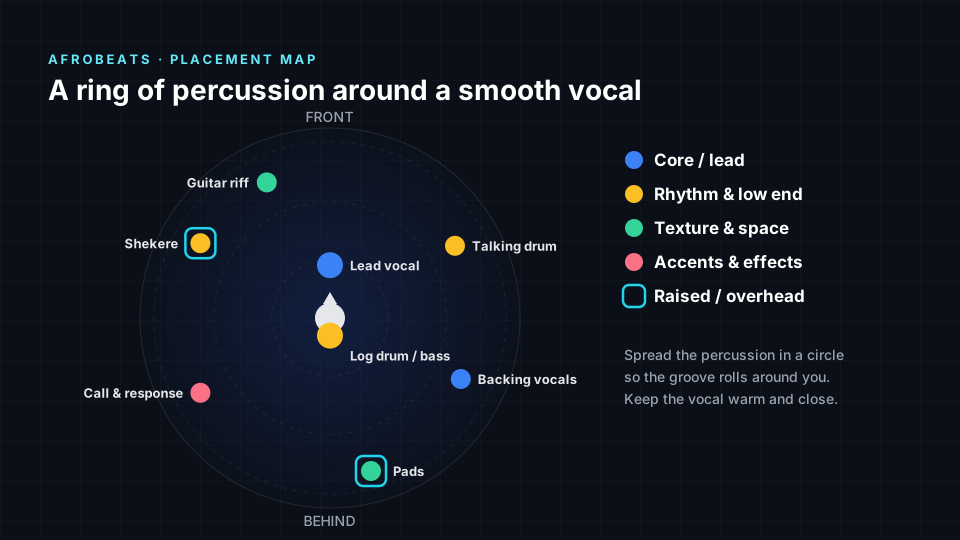
Immersive music for Afrobeats: what listeners hear
- A percussion circle. Shakers, talking drums and congas come from different directions, so the groove rolls around you.
- A smooth, close vocal. The lead stays in front and intimate, the way Afrobeats vocals are usually delivered.
- Call and response in space. Backing vocals answer from the sides and behind, like a crowd singing back.
- Deep weight in the centre. Log drums and bass feel solid on headphones and on big systems.
Where to place each element in an Afrobeats mix
| Element | Position | Height | Why it works |
|---|---|---|---|
| Lead vocal | Front centre | Ear level | Warm, intimate focus |
| Log drum and bass | Centre | Ear level | The weight of the track |
| Shekere and shakers | Front left | Raised | Bright top end with air |
| Talking drum | Right side | Ear level | Answers the shakers |
| Guitar riff | Front left | Ear level | Keeps the melody close |
| Backing vocals | Behind right | Ear level | Call and response feel |
| Pads | Behind | Raised | Soft warmth around the listener |
The psychoacoustics behind Afrobeats placement
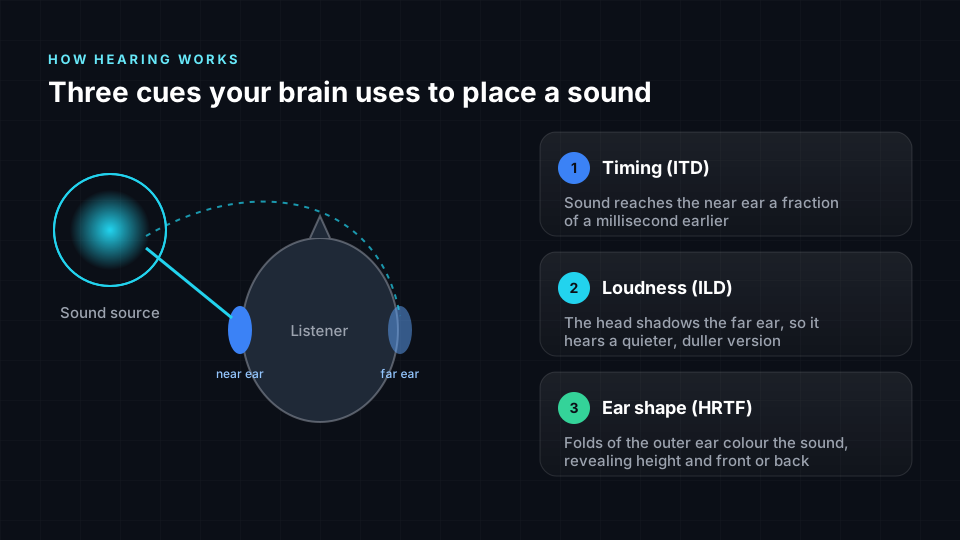
Every position in the table above follows how the ear and brain locate sound. Here is the reason behind the main choices for Afrobeats.
- Lead vocal in front. Hearing is sharpest straight ahead: listeners can tell apart sources about 1 degree apart in front of them, but need far larger gaps at the sides (Mills, 1958). Afrobeats vocals are melodic and intimate, so they get the most precise position.
- Log drum and bass in the centre. In real rooms and on most playback systems, sub-bass below roughly 80 to 100 Hz gives the brain very little usable direction, which is why a single subwoofer can serve a whole speaker layout. The log drum carries the weight of the track and translates to every system when it stays centred.
- Shekere and shakers raised. The outer ear filters high frequencies differently depending on how high a sound is, and the brain reads those changes as elevation. Bright, treble-rich sounds lift convincingly, while dull, bassy sounds do not. Their high-frequency detail is exactly what the ear needs to hear them above.
- Talking drum on the right, guitar riff on the left. Sounds that overlap in pitch mask each other less when they arrive from different directions, so spreading them keeps every part clear without extra EQ. Both live in the mid range, so splitting them stops their rhythms from smearing together.
The immersion profile for Afrobeats
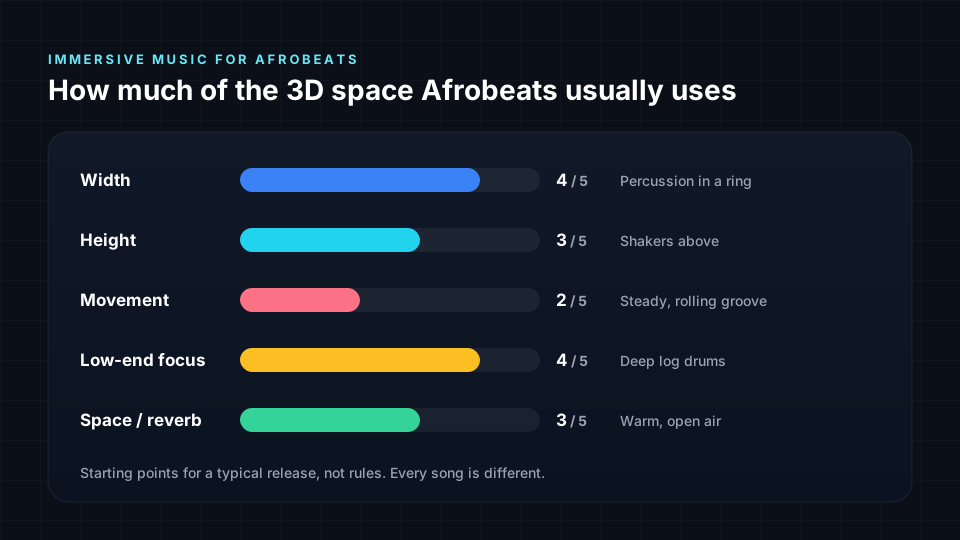
Afrobeats scores high on width and low-end focus. Movement is gentle: the rhythm itself provides the motion, so parts mostly stay in place. Space should feel warm and open-air rather than dark and huge.
Tips for an immersive Afrobeats mix
- Build the circle first. Place percussion around the listener before adding melodic parts.
- Keep the log drums centred. Moving low end weakens the groove on big systems.
- Let the rhythm do the moving. Too much automated motion fights the natural swing.
- Place call and response behind. It feels like the crowd answering the singer.
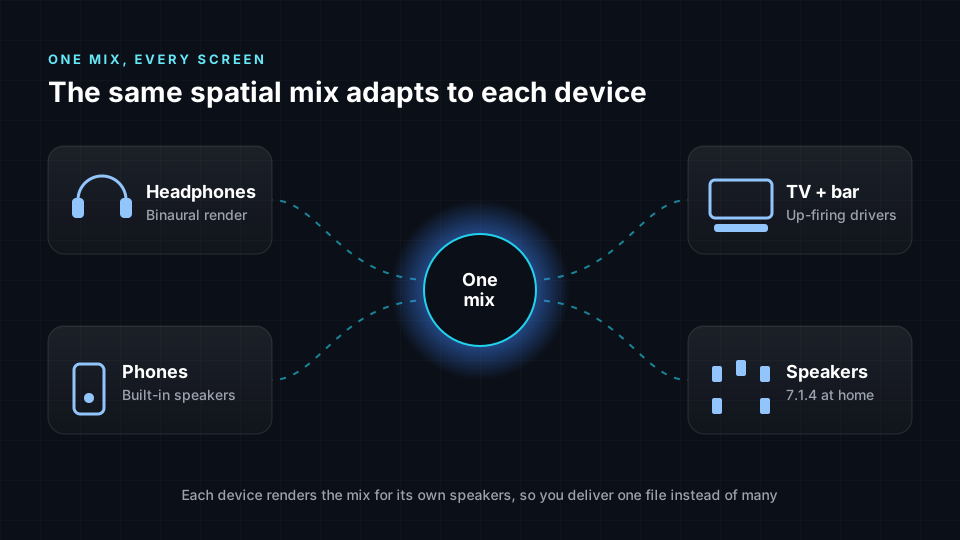
- Check on earbuds. Most fans stream on phones, through binaural rendering.
How to make immersive Afrobeats from stereo
Spatial9 can create spatial audio from a stereo track in a few steps:
- Upload your stereo master or your stems.
- Spatial9's AI separates and places each part, recognising percussion, vocals and bass.
- Preview it in binaural on headphones.
- Export Eclipsa Audio, ADM, binaural or Ambisonics.
- Publish a video. Create a YouTube-ready video with your immersive audio and publish it directly.
For related guides, read spatial audio for Latin and reggaeton and spatial audio for R&B. Every guide is listed in spatial audio and immersive music by genre.
Frequently asked questions
Can I make an Afrobeats mix in Dolby Atmos or Eclipsa Audio?
Yes. The placements in this guide work for both. Spatial9 exports ADM, the standard file used by Dolby Atmos studios, as well as Eclipsa Audio for YouTube, so one immersive Afrobeats mix covers both. You may also hear this called a 3D Afrobeats mix or Afrobeats in spatial audio. It is the same idea.
Is spatial audio good for Afrobeats?
Yes. Afrobeats is built on layered percussion, which sounds clearer and more alive when each part has its own direction.
Where should the log drum go in an immersive mix?
Keep log drums and bass in the centre at ear level. They carry the weight of the track and should never drift.
Does amapiano work in spatial audio?
Yes. Amapiano shares the same strengths: deep log drums, percussion layers and pads, all of which benefit from 3D placement.
Can I convert a finished Afrobeats track to spatial audio?
Yes. Spatial9 uses AI to generate an immersive mix from a stereo master and exports it as Eclipsa Audio, ADM, binaural or Ambisonics.
Will listeners hear the 3D effect on regular headphones?
Yes. Devices render the mix binaurally, so the effect works on any regular headphones.
Dolby and Dolby Atmos are trademarks of Dolby Laboratories. Spatial9 is not affiliated with or endorsed by Dolby Laboratories.
Sources
- Blauert, J. (1997). Spatial Hearing: The Psychophysics of Human Sound Localization, revised edition. MIT Press. Low-frequency, elevation, distance and motion cues.
- Mills, A. W. (1958). On the minimum audible angle. Journal of the Acoustical Society of America, 30(4), 237-246.
- Hebrank, J. and Wright, D. (1974). Spectral cues used in the localization of sound sources on the median plane. Journal of the Acoustical Society of America, 56(6), 1829-1834.
- Bronkhorst, A. W. (2000). The cocktail party phenomenon: a review of research on speech intelligibility in multiple-talker conditions. Acta Acustica united with Acustica, 86, 117-128.
- Litovsky, R. Y., Colburn, H. S., Yost, W. A. and Guzman, S. J. (1999). The precedence effect. Journal of the Acoustical Society of America, 106(4), 1633-1654.
- Barron, M. and Marshall, A. H. (1981). Spatial impression due to early lateral reflections in concert halls. Journal of Sound and Vibration, 77(2), 211-232.
- Neuhoff, J. G. (1998). Perceptual bias for rising tones. Nature, 395, 123-124.
- Bregman, A. S. (1990). Auditory Scene Analysis: The Perceptual Organization of Sound. MIT Press.
Let the groove roll around your listeners
Upload a track to Spatial9 and hear your percussion form a circle in minutes. Then export it or publish it straight to YouTube.