Spatial Audio & Immersive Music for Highlife: Palm-Wine, Burger Highlife & Guitar Band Highlife
Spatial9 Team · · 11 min read
Part of the series Spatial audio and immersive music by genre.
Key takeaways
- In a spatial highlife mix the lead guitar sits front left and the horns front right, with the singer centred, the bass and bell pattern holding the groove and a warm open-air dance floor around the band.
- Because the brain sorts sounds into separate streams by pitch, timing and direction, an effect known as auditory stream segregation, spreading the interlocking guitars apart lets each bright pattern be heard clearly.
- Highlife is relaxed, melodic dance music, so the space should be a warm, medium-sized venue with gentle side reflections rather than a huge hall or a dry studio.
- The highlife immersion profile scores width 4, height 2, movement 2, low-end focus 3 and space 3 out of 5.
Highlife grew up in the coastal towns of the Gold Coast, now Ghana, in the early twentieth century. It blended Akan rhythms and melodies with the guitar picking of Kru sailors from Liberia, church hymns, sea shanties and the brass bands of colonial regiments. The name dates from the 1920s, when people outside the elite clubs of Accra and Cape Coast watched dance orchestras play local tunes for well-dressed couples and called it high life. Two branches grew side by side. Dance band highlife used trumpets, saxophones and a full rhythm section, while guitar band highlife was played by smaller groups with guitars, percussion and voices, often as part of travelling concert parties. In the 1950s E.T. Mensah and the Tempos made dance band highlife the sound of independence era West Africa, and E.K. Nyame became the leading name in guitar band highlife. The music spread to Nigeria, where Bobby Benson, Victor Olaiya, Rex Lawson and later Osita Osadebe built their own styles. Underneath it all runs a bell or clave timeline, a melodic bass and guitars that interlock in bright, repeating patterns. Highlife suits spatial audio because its parts are clear, separate voices that talk to each other, and the dance floor is part of the music. This guide covers how spatial audio for highlife works, where to place each element and how to make an immersive highlife mix. For the basics, see what spatial audio is.
Why highlife works in spatial audio
Highlife is built on interlocking patterns. The lead guitar spins short, sweet melodic phrases while a second guitar repeats a chopped chord pattern. The bass walks a melodic line rather than holding one note, and a bell or clave taps the timeline that every player follows. Horns answer the singer in short, bright phrases. In mono these parts blend into one cheerful, busy texture. In an immersive mix each pattern gets its own place, so the listener can follow the guitar, the horns and the bass at the same time.
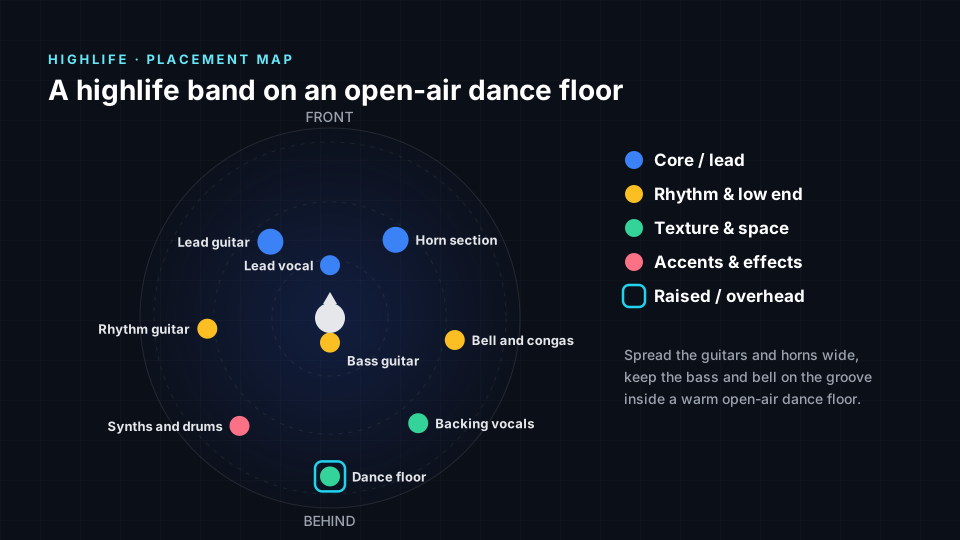
The rule: guitars and horns spread wide, the groove held in the middle. Set the lead guitar and horns across a wide front stage, keep the bass and bell anchored near the centre and place it all on a warm, medium-sized dance floor.
Immersive music for highlife: what listeners hear
- Guitars you can follow. The lead guitar sparkles on the left while the rhythm guitar chops on the other side, so the weave of patterns is easy to hear.
- Horns that answer the singer. Trumpets and saxophones reply from the front right, turning each verse into a call and response.
- A groove that never stops. The bass guitar and the bell pattern sit close to the centre, steady and relaxed, so the dance never loses its footing.
- A warm night out. A medium, warm reverb places you on an open-air dance floor or in a busy club, with the crowd and the room around you.
Where to place each element in a highlife mix
| Element | Position | Height | Why it works |
|---|---|---|---|
| Lead vocal | Front centre | Ear level | The singer telling the story of the song |
| Bass guitar | Centre | Ear level | The melodic bass line that drives the dance |
| Lead guitar | Front left | Ear level | Sweet melodic phrases and short runs |
| Horn section | Front right | Ear level | Trumpet and saxophone answers and riffs |
| Rhythm guitar | Left | Ear level | The chopped chord pattern under the lead |
| Bell and congas | Right | Ear level | The timeline and the hand drum groove |
| Backing vocals | Behind right | Ear level | Chorus replies that surround the singer |
| Synths and drums | Behind left | Ear level | Keyboards and drum machines in burger highlife |
| Dance floor | Behind | Raised | A warm open-air room around the band |
The psychoacoustics behind highlife placement
Every position in the table above follows how the ear and brain locate sound. Here is the reason behind the main choices for highlife.
- Bass guitar stays centred. The ear finds almost no direction in frequencies below roughly 80 to 100 Hz, as Blauert's work on spatial hearing shows. The bass gains nothing from being spread, and a centred bass keeps the dance steady.
- Lead and rhythm guitars on opposite sides. The brain groups sounds into streams by pitch, timing and direction. This is auditory stream segregation (Bregman). Setting the two guitars apart lets the ear hear two patterns locking together instead of one bright blur.
- A singer heard over a busy band. Listeners pick out one voice among many more easily when the competing sounds come from other directions. This is the cocktail party effect (Bronkhorst). Keeping the horns and guitars to the sides helps the vocal stay clear in the centre.
- A warm room with side reflections. Early reflections arriving from the sides make a sound feel wider and more enveloping. This is spatial impression from early lateral reflections (Barron and Marshall). Gentle side reflections give the band the feeling of a real venue without blurring the guitar picking.
The immersion profile for highlife
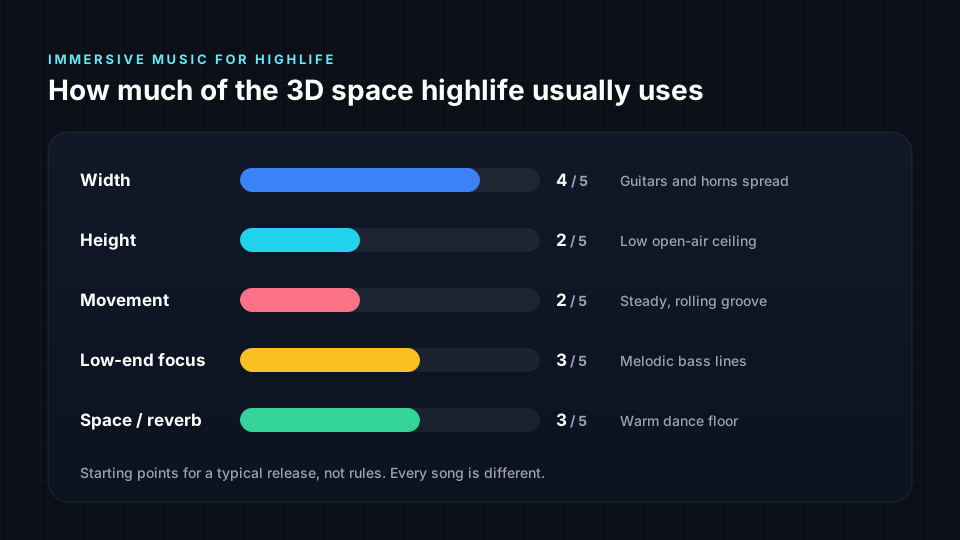
Width scores 4 because a highlife band spreads naturally across a stage, with guitars, horns and percussion each taking their own spot. Space is 3: the music was made for clubs, hotel ballrooms and open-air dance floors, which are warm but not huge. Low-end focus is 3, since the bass guitar is melodic and important but the music has no heavy sub bass. Movement is 2, because the groove is steady and rolling and the parts stay in place. Height is 2, from the gentle reflection of a low roof or an evening sky with a little bounce from nearby walls.
Tips for an immersive highlife mix
- Split the guitars. Put the lead guitar front left and the rhythm guitar further left or right, so each pattern stays clear.
- Keep the bass and bell steady. Hold the bass guitar in the centre and the bell pattern close to it, so dancers always find the timeline.
- Let the horns answer. Set the horn section front right, opposite the lead guitar, so their riffs reply to the singer.
- Keep the singer warm and close. The vocal should sit just in front of the band, clear but never detached from it.
- Use a warm, medium room. A friendly reverb suits highlife, but keep it short enough that the guitar picking stays crisp.
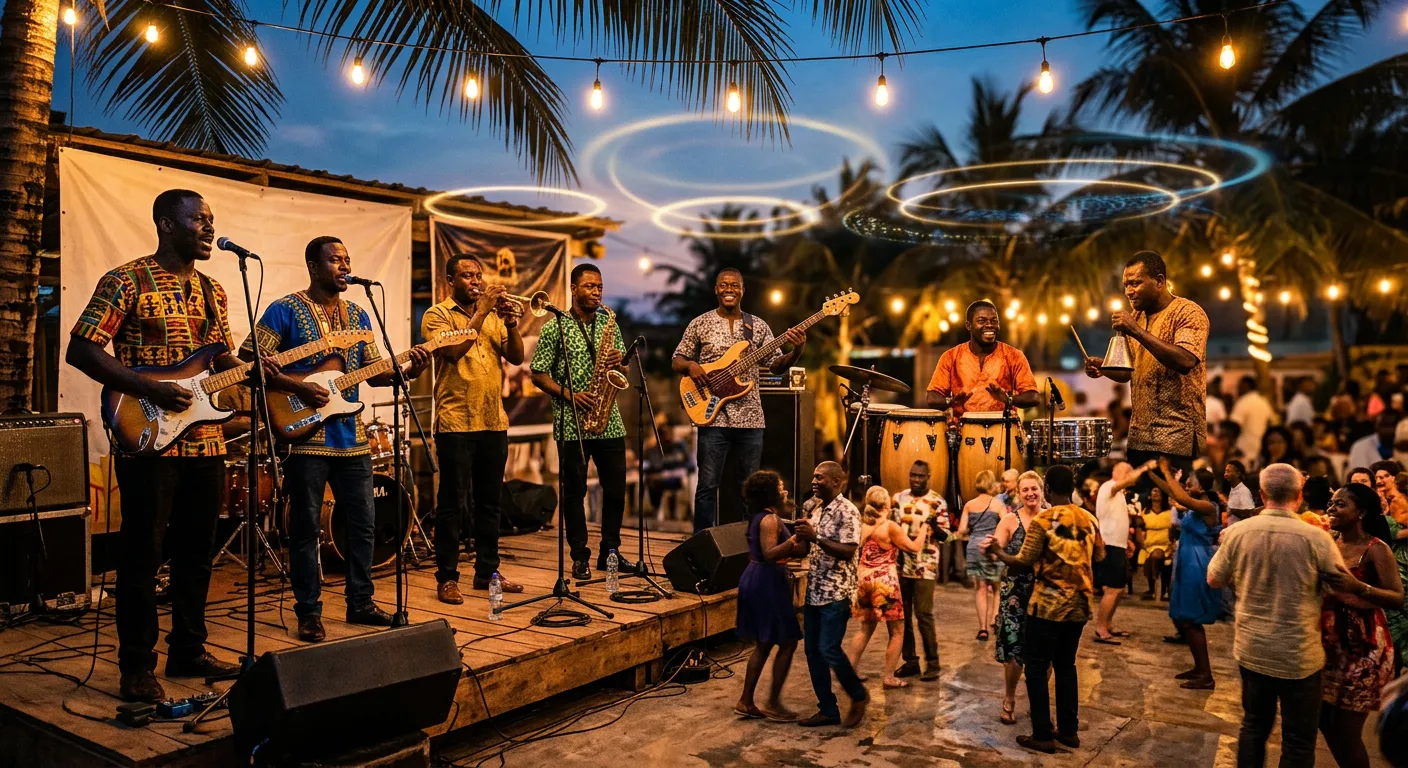
Highlife styles: Palm-wine, burger highlife and guitar band highlife
The core placement holds for every style here: lead voices at the front, the groove anchored in the middle. What changes is the size of the band, the mix of acoustic, electric and electronic sound and how much room the style needs.
Palm-Wine
Palm-wine music is the acoustic root of highlife, named after the palm wine served in the bars where it was played. It grew in the port towns of West Africa, from Sierra Leone to the Gold Coast, where local players learned two-finger guitar picking from Kru sailors. A typical group has an acoustic guitar, a voice and simple percussion such as a bottle, a box drum or a shaker, sometimes with a frame drum or a thumb piano bass. Keep the layout small and intimate: guitar just left of centre, singer in the centre, percussion slightly right and a short, warm room like a small bar.
Burger Highlife
Burger highlife was created in the late 1970s and 1980s by Ghanaian musicians living in Germany, especially in Hamburg, which gave the style its name. It added synthesisers, drum machines and a polished studio sound to highlife guitar and vocals, and George Darko's Akoo Te Brofo from 1983 became one of its best-known songs. Keep the guitar and singer at the front, the bass and drum machine kick in the centre, and spread synth pads and keyboard lines around the sides and back. Short delays and a bright, clean reverb suit the 1980s sound.
Guitar Band Highlife
Guitar band highlife is the rural and popular branch, played by small groups with guitars, bass, percussion and voices. E.K. Nyame's band in the 1950s linked it to the concert party, a touring mix of comedy, drama and music, and later groups such as Nana Ampadu's African Brothers, formed in 1963, took it into the electric era. The sound is lighter than dance band highlife, with no large horn section. Place the lead guitar front left, the second guitar right, the bass in the centre and the bell and congas behind right, inside a warm, open room.
Related styles such as dance band highlife, Nigerian Igbo highlife and the hiplife of the 1990s follow the same idea: keep the lead instruments at the front, the groove anchored in the middle and the dance floor around the listener.
How to make immersive highlife from stereo
Spatial9 can create spatial audio from a stereo track in a few steps:
- Upload your stereo master or your stems.
- Spatial9's AI separates and places each part, pulling the lead guitar, rhythm guitar, horns, bass, percussion and singer apart even from old mono recordings, and setting the guitars and horns across a wide stage with the groove in the centre.
- Preview it in binaural on headphones.
- Export Eclipsa Audio, ADM, binaural or Ambisonics.
- Publish a video. Create a YouTube-ready video with your immersive audio and publish it directly.
For related guides, read spatial audio for Afrobeat and spatial audio for soukous and Congolese rumba. Every guide is listed in spatial audio and immersive music by genre.
Frequently asked questions
Does this guide cover palm-wine, burger highlife and guitar band highlife?
Yes. Palm-wine uses a small, close layout for acoustic guitar and voice. Burger highlife keeps the guitar and singer in front and spreads synths and drum machines around the sides and back. Guitar band highlife sets two guitars on opposite sides with the bass and bell in the centre.
Can I make a highlife mix in Dolby Atmos or Eclipsa Audio?
Yes. The placements in this guide work for both. Spatial9 exports ADM, the standard file used by Dolby Atmos studios, as well as Eclipsa Audio for YouTube, so one immersive highlife mix covers both. If you plan to release the Atmos version on Apple Music, build it from your original stems or multitracks, because Apple does not accept Atmos made from a finished stereo master. See where to publish spatial audio. You may also hear this called a 3D highlife mix or highlife in spatial audio.
Is spatial audio good for highlife?
Yes. Highlife is built from clear, interlocking parts: two guitars, a melodic bass, horns, a bell pattern and a singer. Spatial audio gives each part its own place, so the weave of patterns becomes easier to follow and the dance floor feels real.
Where should the two guitars go in an immersive highlife mix?
Put the lead guitar front left at ear level and the rhythm guitar further to the side, on the left or the right. Keeping them apart lets the ear hear how the patterns lock together. In a palm-wine song with a single guitar, bring it close to the centre.
How is highlife different from Afrobeat in spatial audio?
Highlife is lighter and more melodic, with sweet guitar lines, relaxed tempos and songs of normal length, so it suits a warm, medium room. Afrobeat, which grew partly out of highlife in Lagos, adds a heavier funk drum kit, a bigger horn section and long hypnotic grooves, so it needs a wider stage and a stronger low end.
Is highlife Ghanaian or Nigerian?
Both. Highlife started in the Gold Coast, now Ghana, and spread to Nigeria in the 1950s, where it became hugely popular, especially in the east. Each country developed its own styles, but the core of guitars, horns and a bell timeline is shared.
Can I convert a 1950s highlife recording to spatial audio?
Yes. Spatial9 uses AI to separate the guitars, horns, bass, percussion and singer from a mono master. Separation is never perfect with older recordings, so keep the layout simple and the room moderate.
Dolby and Dolby Atmos are trademarks of Dolby Laboratories. Spatial9 is not affiliated with or endorsed by Dolby Laboratories.
Sources
- Blauert, J. (1997). Spatial Hearing: The Psychophysics of Human Sound Localization, revised edition. MIT Press. Low-frequency, elevation, distance and motion cues.
- Mills, A. W. (1958). On the minimum audible angle. Journal of the Acoustical Society of America, 30(4), 237-246.
- Bronkhorst, A. W. (2000). The cocktail party phenomenon: a review of research on speech intelligibility in multiple-talker conditions. Acta Acustica united with Acustica, 86, 117-128.
- Litovsky, R. Y., Colburn, H. S., Yost, W. A. and Guzman, S. J. (1999). The precedence effect. Journal of the Acoustical Society of America, 106(4), 1633-1654.
- Barron, M. and Marshall, A. H. (1981). Spatial impression due to early lateral reflections in concert halls. Journal of Sound and Vibration, 77(2), 211-232.
- Bregman, A. S. (1990). Auditory Scene Analysis: The Perceptual Organization of Sound. MIT Press.
- Collins, J. (1992). West African Pop Roots. Temple University Press.
Join the dance
Upload a track to Spatial9 and hear the guitars and horns spread across the dance floor in minutes. Then export it or publish it straight to YouTube.