
Spatial Audio & Immersive Music for Forró: Baião, Xote & Forró Universitário
Spatial9 Team · · 10 min read
Part of the series Spatial audio and immersive music by genre.
Key takeaways
- In a spatial forró mix the lead vocal and the zabumba stay centred, while the sanfona, triângulo, pandeiro and guitar sit close around the listener with the triangle lifted slightly above.
- Because the outer ear reads elevation from the shape of high frequencies, an effect known as spectral elevation cues, a small lift is enough to float the bright triângulo above the trio.
- Forró is a dance music built around a close accordion, drum and triangle trio, so the room should be a warm, lively dance hall with a short reverb that keeps the groove tight.
- The forró immersion profile scores width 3, height 2, movement 3, low-end focus 3 and space 3 out of 5.
Forró is the dance music of the Brazilian Northeast. Its sound was shaped in the 1940s by Luiz Gonzaga, the accordionist from Exu in Pernambuco known as the King of Baião, who recorded the song Baião with lyricist Humberto Teixeira in 1946 and took the rhythms of the sertão to the radio stations of Rio de Janeiro. The classic line-up is the trio nordestino: sanfona, the piano accordion, the zabumba, a wide bass drum struck on top with a mallet and on the underside with a thin stick, and the triângulo, the triangle that keeps a constant shimmering pulse. Jackson do Pandeiro added the pandeiro and a sharp, syncopated vocal style, and Dominguinhos and Marinês carried the music on through later decades. Forró is played above all at the festas juninas, the June festivals of São João, with the largest held in Caruaru and Campina Grande. Many classic records are mono or narrow stereo, and the three instruments often blur into one rattling block. Forró suits spatial audio because each member of the trio holds a different register and a different job: low drum, middle accordion, high metal. This guide covers how spatial audio for forró works, where to place each element and how to make an immersive forró mix. For the basics, see what spatial audio is.
Why forró works in spatial audio
Forró is built from three interlocking parts. The zabumba plays a deep thump with an answering slap from underneath, the triângulo marks every subdivision, and the sanfona carries both the melody and the chords, filling the gaps between the vocal lines. Couples dance close together, so the groove has to stay tight and steady. In stereo these parts often pile into the middle, and the triangle can turn into a harsh hiss. In an immersive mix the vocal and zabumba anchor the centre, the sanfona sits slightly to one side and the triangle floats above, so every layer of the groove can be heard at once.
The rule: a centred voice and zabumba, the sanfona leading just beside them. Keep the trio close in front of the listener, lift the triangle a little, and set the band in a warm, busy dance hall where the room itself feels full of people.
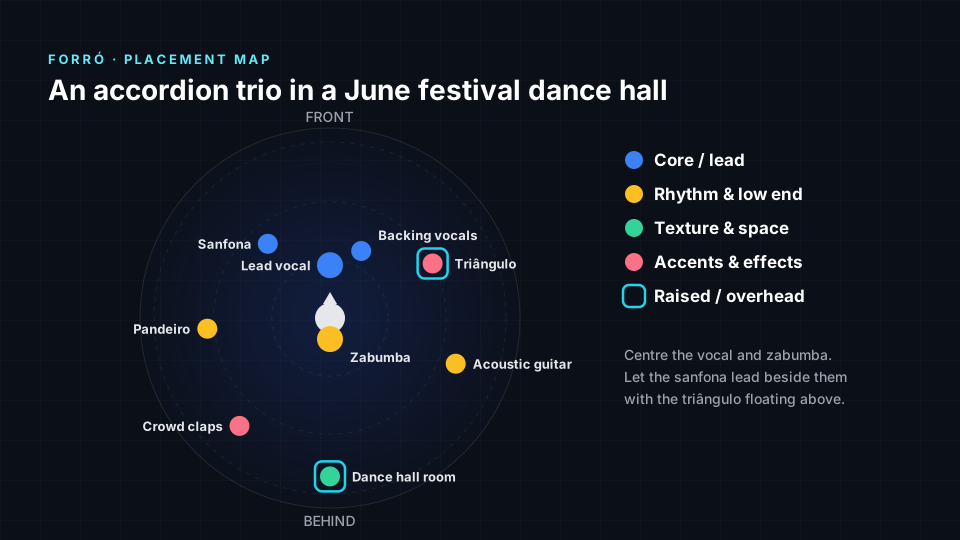
Immersive music for forró: what listeners hear
- A singer right in front. The lead vocal sits in the centre, close and direct, with the call and response of the backing singers beside it.
- An accordion that breathes. The sanfona leans in on its fills and introductions, then settles back under the vocal.
- A groove you can pick apart. The zabumba thump, the triangle shimmer and the pandeiro jingles each come from their own place instead of one tangle.
- A dance hall around you. A lively, short reverb with clapping behind places you inside a crowded forró hall or a São João square.
Where to place each element in a forró mix
| Element | Position | Height | Why it works |
|---|---|---|---|
| Lead vocal | Front centre | Ear level | The story and the focus of every song |
| Zabumba | Centre | Ear level | The low thump and slap that drive the dance |
| Sanfona | Front left, swaying on fills | Ear level | Melody, chords and the classic introductions |
| Backing vocals | Front right of centre | Ear level | Call and response close to the lead |
| Triângulo | Front right | Raised | A bright, constant pulse floating over the trio |
| Pandeiro | Left | Ear level | Jingles and syncopated accents |
| Acoustic guitar | Right | Ear level | Chord strums and bass runs under the sanfona |
| Crowd claps | Behind left | Ear level | The festival audience joining the groove |
| Dance hall room | Behind | Raised | A warm, crowded room around the band |
The psychoacoustics behind forró placement
Every position in the table above follows how the ear and brain locate sound. Here is the reason behind the main choices for forró.
- Zabumba stays centred. The ear finds almost no direction in frequencies below roughly 80 to 100 Hz, so the deep body of the zabumba gains nothing from being spread. Its higher slap can follow the drum to the same place.
- Sanfona apart from the vocal. The brain groups sounds into streams by pitch, timing and direction. This is auditory stream segregation (Bregman). The accordion and the voice share the same middle range, and moving the sanfona a little to the side lets the ear follow the melody and the fills as two separate lines.
- Triângulo slightly raised. The outer ear shapes high frequencies differently depending on height, and the brain reads these changes as elevation. These are spectral elevation cues (Hebrank and Wright). The triangle is almost all high frequencies, so a small lift places it naturally above the band and keeps it from crowding the vocal.
- A short room with clear first arrivals. When a sound and its reflections arrive close together, the brain locates the sound by whichever reaches the ear first. This is the precedence effect (Litovsky). A short, lively room adds the energy of a dance hall while the zabumba and triangle still sound precise.
The immersion profile for forró
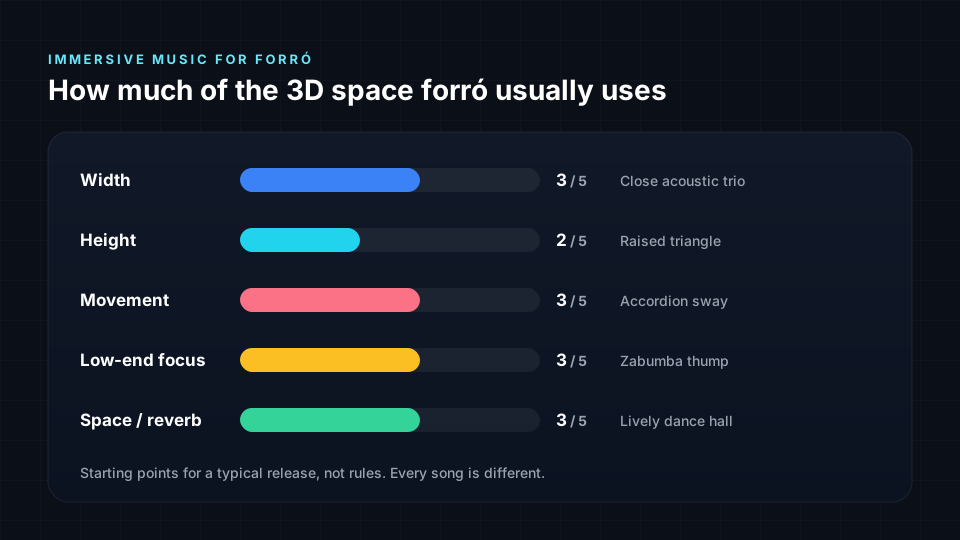
Width scores 3 because the trio plays close together, not across a wide stage. Low-end focus is 3: the zabumba gives a firm, round pulse that the dancers feel, but it is an acoustic drum, not a sub bass. Movement also scores 3, coming from the sanfona leaning in on its fills and the sway of the dance rhythm. Height is low, with only the triangle and the room lifted slightly. Space scores 3, since a busy hall adds energy, but a long reverb would smear the fast triangle and zabumba pattern.
Tips for an immersive forró mix
- Keep the vocal and zabumba locked together. They form the spine of the song, so neither should move.
- Give the sanfona its own side. Set it just off centre so its melody and the vocal do not mask each other.
- Lift the triângulo, but keep it quiet. A small raise lets it shimmer above the band without turning harsh.
- Move the accordion on its fills, not all the time. A gentle lean forward on introductions and answers is enough.
- Use a warm, short dance hall room. Add crowd claps behind if the recording has them, and avoid long halls and artificial effects.
Forró styles: baião, xote and forró universitário
The core placement holds for every style here: voice and zabumba in the middle, the trio close around the listener. What changes is the tempo, the weight of the drum and how polished the room should feel.
Baião
Baião is the rhythm Luiz Gonzaga made famous, with a syncopated zabumba pattern that stresses the off-beats and melodies built on the modal scales of the Northeast. It is the foundation of the whole forró family. Many classic baião records are mono, with the accordion and voice up front and the percussion close behind. Keep the sanfona prominent and slightly to one side, the zabumba firm in the centre and the triangle raised a little. A small, dry room suits the older recordings.
Xote
Xote is the slower, swaying member of the family, descended from the schottische, a European couple dance that reached Brazil in the nineteenth century. Its relaxed two-beat feel is ideal for dancing close. Give xote more breathing room: let the sanfona sway gently on its phrases, keep the zabumba softer and rounder, and use a slightly longer, warmer reverb. The vocal should feel intimate and near.
Forró Universitário
Forró universitário grew up in the late 1990s in the university towns and clubs of São Paulo and the South East, where young audiences rediscovered the traditional trio. Bands such as Falamansa, whose Xote dos Milagres became a national hit around 2000, added acoustic and electric guitar, bass and sometimes drums. This style can take a wider layout: place the guitars further around the sides, keep the bass and zabumba centred together and use a cleaner club room with a little more space.
Related styles such as arrasta-pé, xaxado and forró pé-de-serra follow the same idea: centre the voice and zabumba, then keep the trio close around the listener.
How to make immersive forró from stereo
Spatial9 can create spatial audio from a stereo track in a few steps:
- Upload your stereo master or your stems.
- Spatial9's AI separates and places each part, pulling the vocal, sanfona, zabumba, triângulo and pandeiro apart even from old mono recordings and setting them close around the listener in a lively dance hall.
- Preview it in binaural on headphones.
- Export Eclipsa Audio, ADM, binaural or Ambisonics.
- Publish a video. Create a YouTube-ready video with your immersive audio and publish it directly.
For related guides, read spatial audio for sertanejo and spatial audio for samba. Every guide is listed in spatial audio and immersive music by genre.
Frequently asked questions
Does this guide cover baião, xote and forró universitário?
Yes. Baião puts the sanfona up front with a firm zabumba in a small, dry room. Xote sways more slowly with a warmer room and a closer vocal. Forró universitário takes a wider club layout with guitars and bass around the trio.
Can I make a forró mix in Dolby Atmos or Eclipsa Audio?
Yes. The placements in this guide work for both. Spatial9 exports ADM, the standard file used by Dolby Atmos studios, as well as Eclipsa Audio for YouTube, so one immersive forró mix covers both. If you plan to release the Atmos version on Apple Music, build it from your original stems or multitracks, because Apple does not accept Atmos made from a finished stereo master. See where to publish spatial audio. You may also hear this called a 3D forró mix or forró in spatial audio.
Is spatial audio good for forró?
Yes. Forró packs accordion, drum, triangle and voice into a fast, dense dance groove. Spatial audio gives each part its own direction and height, so the rhythm becomes clearer and the dance hall feels real.
Where should the sanfona go in an immersive forró mix?
Put it just to one front side at ear level, close to the vocal but not on top of it. Let it lean forward slightly on introductions and fills, then settle back under the singing.
How should I place the zabumba?
Keep it in the centre, close to the listener. Its deep body cannot be located anyway, and keeping the top stroke and the slap from underneath together makes the drum sound like one instrument.
How is forró different from sertanejo in spatial audio?
Forró is dance music built on a close acoustic trio, so it suits a compact layout and a short, lively room. Modern sertanejo is arena pop led by a vocal duo, so it needs a wider stage, a fuller band and a bigger reverb.
Can I convert an old Luiz Gonzaga style recording to spatial audio?
Yes. Spatial9 uses AI to separate the vocal, sanfona, zabumba and triângulo from a mono master. Separation is never perfect with older recordings, so keep the layout simple and close.
Dolby and Dolby Atmos are trademarks of Dolby Laboratories. Spatial9 is not affiliated with or endorsed by Dolby Laboratories.
Sources
- Blauert, J. (1997). Spatial Hearing: The Psychophysics of Human Sound Localization, revised edition. MIT Press. Low-frequency, elevation, distance and motion cues.
- Mills, A. W. (1958). On the minimum audible angle. Journal of the Acoustical Society of America, 30(4), 237-246.
- Hebrank, J. and Wright, D. (1974). Spectral cues used in the localization of sound sources on the median plane. Journal of the Acoustical Society of America, 56(6), 1829-1834.
- Bronkhorst, A. W. (2000). The cocktail party phenomenon: a review of research on speech intelligibility in multiple-talker conditions. Acta Acustica united with Acustica, 86, 117-128.
- Litovsky, R. Y., Colburn, H. S., Yost, W. A. and Guzman, S. J. (1999). The precedence effect. Journal of the Acoustical Society of America, 106(4), 1633-1654.
- Barron, M. and Marshall, A. H. (1981). Spatial impression due to early lateral reflections in concert halls. Journal of Sound and Vibration, 77(2), 211-232.
- Neuhoff, J. G. (1998). Perceptual bias for rising tones. Nature, 395, 123-124.
- Bregman, A. S. (1990). Auditory Scene Analysis: The Perceptual Organization of Sound. MIT Press.
- Crook, L. (2005). Brazilian Music: Northeastern Traditions and the Heartbeat of a Modern Nation. ABC-CLIO.
Join the dance
Upload a track to Spatial9 and hear the sanfona, zabumba and triângulo fill the dance hall around you in minutes. Then export it or publish it straight to YouTube.