Spatial Audio & Immersive Music for Gengetone & Singeli: Genge, Arbantone & Singeli
Spatial9 Team · · 12 min read
Part of the series Spatial audio and immersive music by genre.
Key takeaways
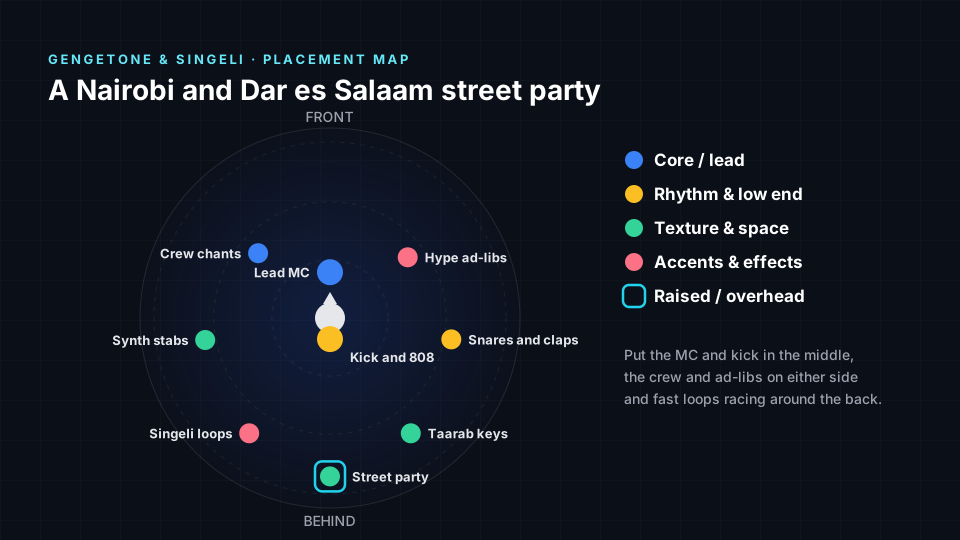
- In a spatial gengetone and singeli mix the lead MC sits front centre over a centred kick and 808, with the crew chants front left, the hype ad-libs front right and the fast loops and synths spread around the sides and back.
- Because the brain splits sounds into separate streams by direction, an effect known as auditory stream segregation, call and response between the MC and the crew stays clear even when the beat races at singeli speed.
- This is loud, close street and party music, so the space should be short and dry, like a matatu, a small club or an open air kigodoro party, with movement coming from the loops rather than from reverb.
- The gengetone and singeli immersion profile scores width 3, height 2, movement 4, low-end focus 5 and space 2 out of 5.
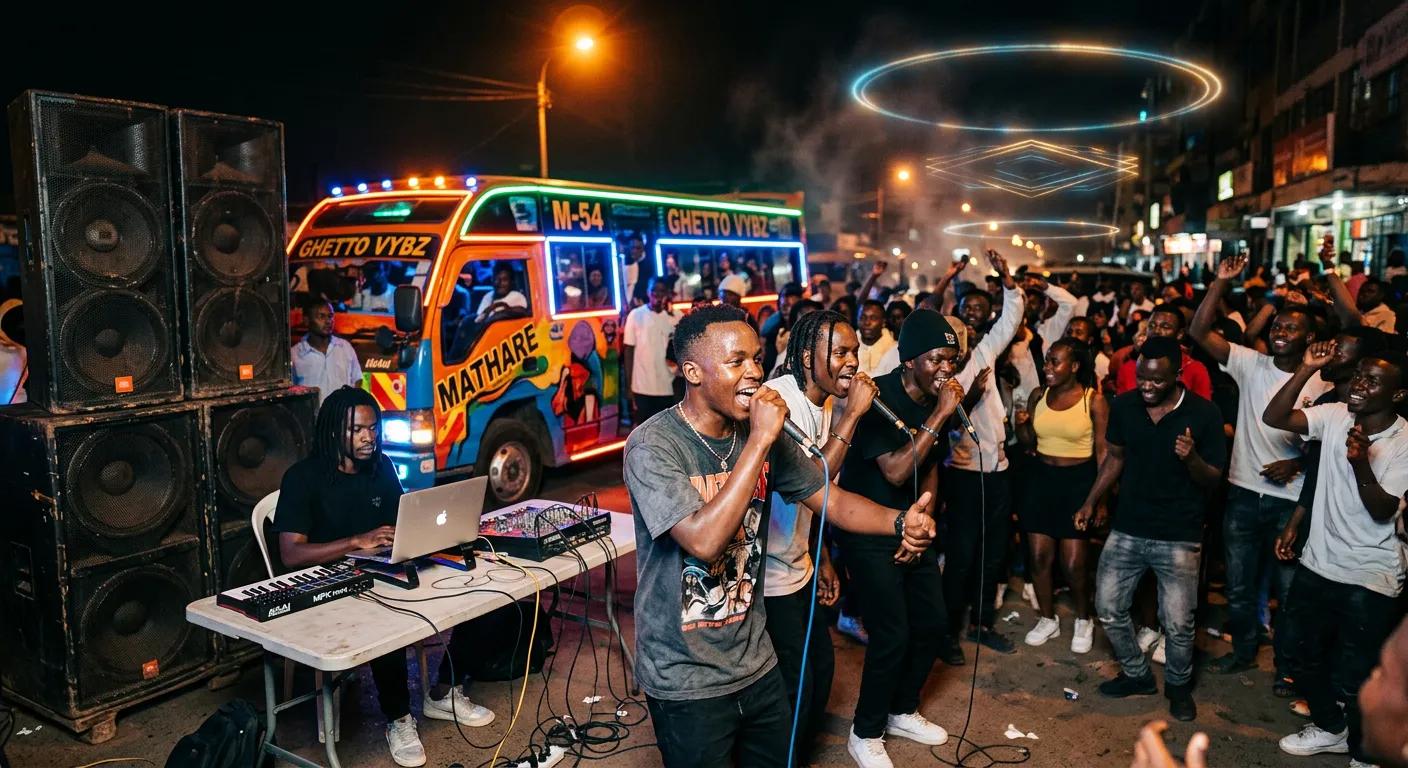
Gengetone and singeli are two of the loudest youth sounds in East Africa. In Kenya, hip hop in Swahili and Sheng, the Nairobi street slang that mixes Swahili, English and other local languages, grew through the 1990s. In the early 2000s the rapper Nonini and the producer Clemo at Calif Records in Nairobi shaped genge, a bouncy, homegrown rap style in Sheng. Around 2018 and 2019 a new wave of crews from the Eastlands estates of Nairobi, among them Ethic Entertainment, Sailors and Boondocks Gang, turned that energy into gengetone: rowdy, chant heavy party tracks with a dancehall lean, spread through YouTube, clubs and the loud sound systems of matatu minibuses. More recently arbantone has pushed Nairobi street music faster again. Across the border in Tanzania, singeli grew from the street parties of Dar es Salaam in the 2000s, especially in the Manzese area. Producers working on laptops sped up older rhythms such as mchiriku and taarab inspired keyboard lines to around 200 to 300 BPM, while MCs rapped and sang at dizzying speed. From 2017 the Kampala label Nyege Nyege Tapes carried singeli to festivals and listeners abroad. Gengetone and singeli suit spatial audio because they are voice and bass music built on call and response, and the crowd is part of the track. This guide covers how spatial audio for gengetone and singeli works, where to place each element and how to make an immersive gengetone and singeli mix. For the basics, see what spatial audio is.
Why gengetone and singeli works in spatial audio
Both styles are built on voices trading lines over a hard beat. In gengetone a lead MC throws out a line and the whole crew shouts the answer, often a catchphrase the crowd already knows. In singeli an MC races over a loop so fast that the kick almost becomes a drum roll, with keyboard riffs and vocal chops spinning around it. The low end is huge and the room is small. In stereo the MC, the crew, the ad-libs and the loops pile into one loud wall in the middle. In an immersive mix the MC holds the front, the crew and ad-libs answer from either side, the kick stays solid in the centre and the fast loops circle behind.
The rule: MC and kick in the middle, the crew on the sides, the loops in motion. Keep the voice and the bass locked together at the centre, spread the call and response across the front and let the quickest parts move around the listener in a short, dry space.
Immersive music for gengetone and singeli: what listeners hear
- A crew all around the MC. The lead voice stays in front while the gang vocals shout back from the left and the ad-libs bounce in from the right.
- Bass you feel in the chest. The kick and 808 sit dead centre, heavy and tight, so the beat hits hard on headphones and in a car.
- Loops that race past. Singeli keyboard riffs and chopped samples spin around the sides and back, adding speed without crowding the voice.
- A small, sweaty room. A short, dry space puts you inside a matatu, a packed club or an open air street party, close to the speakers.
Where to place each element in a gengetone and singeli mix
| Element | Position | Height | Why it works |
|---|---|---|---|
| Lead MC | Front centre | Ear level | The Sheng or Swahili lead line, clear and close |
| Kick and 808 | Centre | Ear level | The heavy low end that drives the dance |
| Crew chants | Front left | Ear level | Gang vocals answering the lead MC |
| Hype ad-libs | Front right | Ear level | Shouts, catchphrases and doubled words |
| Synth stabs | Left | Ear level | Short chords and dancehall style riffs |
| Snares and claps | Right | Ear level | Backbeat and rolls that push the groove |
| Singeli loops | Behind left | Ear level | Fast keyboard and vocal chops in motion |
| Taarab keys | Behind right | Ear level | Melodic keyboard lines from coastal music |
| Street party | Behind | Raised | A short, lively room around the crew |
The psychoacoustics behind gengetone and singeli placement
Every position in the table above follows how the ear and brain locate sound. Here is the reason behind the main choices for gengetone and singeli.
- Kick and 808 stay centred. The ear finds almost no direction in frequencies below roughly 80 to 100 Hz, which is why spatial hearing research on low frequency cues (Blauert) shows little benefit in spreading sub bass. Keeping it in the middle makes the low end solid and loud.
- Crew and ad-libs on opposite sides. The brain groups sounds into streams by pitch, timing and direction. This is auditory stream segregation (Bregman). Setting the crew apart from the lead MC lets the ear follow call and response instead of one shouting mass.
- The MC stays readable over a busy beat. Listeners pick out one voice among many far more easily when competing sounds come from other directions. This is the cocktail party effect, reviewed by Bronkhorst. Moving chants and loops away from the centre keeps fast Sheng and Swahili lyrics clear.
- Build-ups that seem to rush in. Listeners hear sounds that grow louder as moving closer, and they overestimate how near a rising sound has come. This is the looming effect for rising intensity (Neuhoff). A singeli riser or a gengetone drop already carries that push, so it needs no extra panning.
The immersion profile for gengetone and singeli
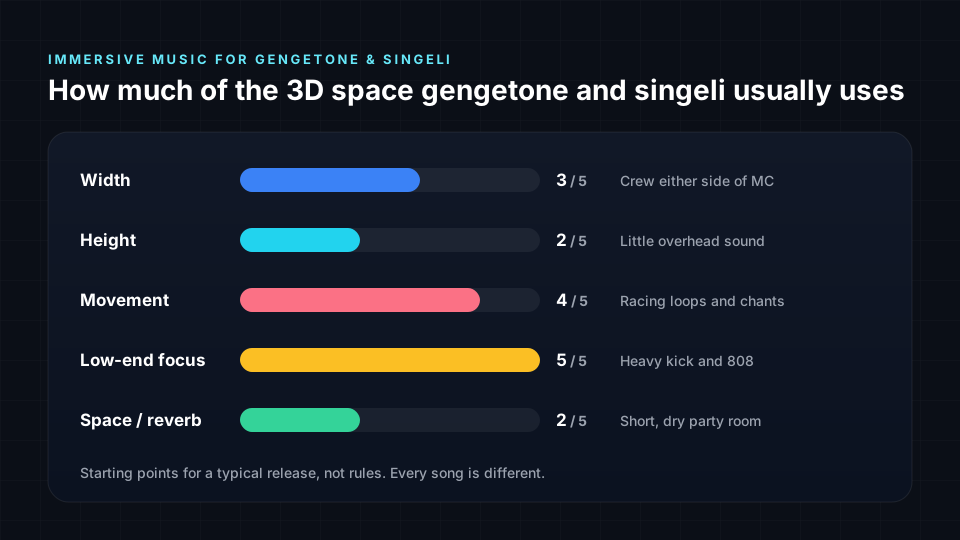
Low-end focus scores 5 because the kick and 808 drive everything, and the music is made to shake matatu speakers and club systems. Movement is 4: singeli loops race at extreme tempos and gengetone chants bounce between voices, so there is plenty of motion to place. Width is 3, since the crew and ad-libs spread across the front but the core stays tight around the MC and the bass. Height is 2, as little of the music needs to come from above. Space is 2, because these are close, dry productions made for small rooms and street parties rather than large halls.
Tips for an immersive gengetone and singeli mix
- Lock the MC and kick together. Keep the lead voice front centre and the kick and 808 directly beneath it, so the track hits as hard as it does in stereo.
- Give the crew a side. Put the gang vocals front left and the ad-libs front right, so every shout has a clear answer.
- Let the fast loops move. Singeli riffs and chopped samples can circle slowly around the back, but keep their motion smooth so the speed comes from the beat, not the panning.
- Keep the room short and dry. Long reverb blurs fast lyrics and rapid kicks. Use a small, bright space and short delays instead.
- Protect the low end. Do not spread the 808 or sub bass. Keep claps and snares just off centre so they cut through without fighting the kick.
Gengetone and singeli styles: genge, arbantone and singeli
The core placement holds for every style here: the lead voice and the kick in the centre, the crew around them. What changes is the tempo, how much the loops move and how dense the production becomes.
Genge
Genge is the Kenyan rap style that took shape in Nairobi in the early 2000s, linked above all with Nonini and the producer Clemo at Calif Records. The name comes from Sheng slang for a crowd or a group, and the music was made for crowds: simple, bouncy beats, catchy hooks and lyrics in Sheng that spoke directly to young city listeners. Jua Cali and other artists helped make it a mainstream sound in Kenya. Genge is the root of gengetone, which added more chants and a heavier dancehall bounce. For genge, keep the layout simple: the MC front centre, the kick and bass beneath, a sung or chanted hook slightly wider at the front and the drums tight around the centre. A short, warm room suits it.
Arbantone
Arbantone is a newer Kenyan street style that rose in Nairobi around 2023 and 2024, spreading fast through social media and dance videos. It is quicker and more frantic than classic gengetone, built on bouncy drum loops, heavy bass and chopped vocal samples, and it often reworks hooks from older songs. Vocals are in Sheng, with short, repeated lines meant for dancing. Arbantone can take a busier layout: keep the MC and kick centred, set the chopped samples and vocal hooks moving across the sides and let shakers and percussion fill the back. Keep the room dry so the fast patterns stay sharp.
Singeli
Singeli is the Tanzanian street music of Dar es Salaam, developed in the 2000s by producers and MCs in neighbourhoods such as Manzese. It is played at extreme tempos, often from 200 to 300 BPM, with rapid kicks, sampled keyboard lines drawn from taarab and other coastal styles, and MCs who rap or chant in Swahili at great speed. It grew at all night street parties known as vigodoro, and from 2017 releases on Nyege Nyege Tapes brought it to international audiences. For singeli, hold the MC front centre and the kick tight in the middle, then spread the keyboard riffs and vocal chops around the back and sides with slow, smooth motion. A short, lively outdoor space suits it, with almost no reverb.
Related styles such as Tanzanian bongo flava, Kenyan drill and the wider East African party scene follow the same idea: keep the voice and the bass in the centre, the crew around the MC and the space short and close.
How to make immersive gengetone and singeli from stereo
Spatial9 can create spatial audio from a stereo track in a few steps:
- Upload your stereo master or your stems.
- Spatial9's AI separates and places each part, pulling the lead MC, crew chants, ad-libs, kick, 808 and loops apart, and setting the crew on the sides with the voice and bass locked in the centre.
- Preview it in binaural on headphones.
- Export Eclipsa Audio, ADM, binaural or Ambisonics.
- Publish a video. Create a YouTube-ready video with your immersive audio and publish it directly.
For related guides, read spatial audio for kuduro and spatial audio for gqom. Every guide is listed in spatial audio and immersive music by genre.
Frequently asked questions
Does this guide cover genge, arbantone and singeli?
Yes. Genge keeps a simple layout with the MC and kick in the centre and a hook at the front. Arbantone spreads chopped samples and vocal hooks across the sides in a dry room. Singeli holds the MC and kick tight while fast keyboard loops circle around the back.
Can I make a gengetone and singeli mix in Dolby Atmos or Eclipsa Audio?
Yes. The placements in this guide work for both. Spatial9 exports ADM, the standard file used by Dolby Atmos studios, as well as Eclipsa Audio for YouTube, so one immersive gengetone and singeli mix covers both. If you plan to release the Atmos version on Apple Music, build it from your original stems or multitracks, because Apple does not accept Atmos made from a finished stereo master. See where to publish spatial audio. You may also hear this called a 3D gengetone mix, 3D singeli or gengetone in spatial audio.
Is spatial audio good for gengetone and singeli?
Yes. Both styles are built on a lead voice, a shouting crew and a heavy beat. Spatial audio lets the crew answer from the sides and the loops move around you, while the MC and the bass stay as loud and direct as in stereo.
Is singeli from Kenya or Tanzania?
Singeli is Tanzanian. It grew in Dar es Salaam in the 2000s. Gengetone, genge and arbantone are Kenyan styles from Nairobi. The two scenes share Swahili, a love of crowd chants and heavy bass, which is why they are often heard side by side.
How fast is singeli, and does the speed cause problems in spatial audio?
Singeli often runs from about 200 to 300 BPM. That speed is fine in spatial audio as long as the kick stays centred and the room stays dry. Long reverbs or fast panning on the kick would smear the rhythm, so keep the motion on the loops.
How is gengetone different from gqom in spatial audio?
Gengetone is voice led, with a lead MC and crew chants over a bouncy beat, so the layout centres on call and response at the front. Gqom from Durban is darker, mostly instrumental club music built on broken kicks and deep bass, so it suits a wider, more echoing space with less focus on vocals.
Can I convert a gengetone track from YouTube or a matatu mix to spatial audio?
Yes, if you own the rights or have permission. Spatial9 uses AI to separate the MC, crew, drums and bass from a stereo master. Heavily compressed or low bitrate files separate less cleanly, so start from the best quality master you can get.
Dolby and Dolby Atmos are trademarks of Dolby Laboratories. Spatial9 is not affiliated with or endorsed by Dolby Laboratories.
Sources
- Blauert, J. (1997). Spatial Hearing: The Psychophysics of Human Sound Localization, revised edition. MIT Press. Low-frequency, elevation, distance and motion cues.
- Mills, A. W. (1958). On the minimum audible angle. Journal of the Acoustical Society of America, 30(4), 237-246.
- Bronkhorst, A. W. (2000). The cocktail party phenomenon: a review of research on speech intelligibility in multiple-talker conditions. Acta Acustica united with Acustica, 86, 117-128.
- Litovsky, R. Y., Colburn, H. S., Yost, W. A. and Guzman, S. J. (1999). The precedence effect. Journal of the Acoustical Society of America, 106(4), 1633-1654.
- Neuhoff, J. G. (1998). Perceptual bias for rising tones. Nature, 395, 123-124.
- Bregman, A. S. (1990). Auditory Scene Analysis: The Perceptual Organization of Sound. MIT Press.
- Ntarangwi, M. (2009). East African Hip Hop: Youth Culture and Globalization. University of Illinois Press.
- Perullo, A. (2011). Live from Dar es Salaam: Popular Music and Tanzania's Music Economy. Indiana University Press.
Join the street party
Upload a track to Spatial9 and hear the MC, the crew and the bass surround you in minutes. Then export it or publish it straight to YouTube.