Spatial Audio & Immersive Music for Klezmer: Freylekhs, Doina & Klezmer Revival
Spatial9 Team · · 12 min read
Part of the series Spatial audio and immersive music by genre.
Key takeaways
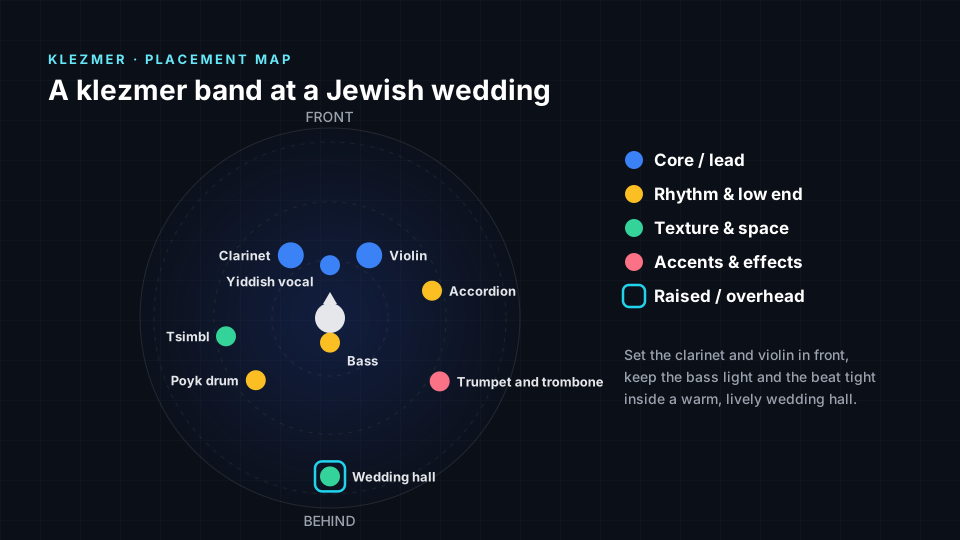
- In a klezmer mix the clarinet and violin share the front, the tsimbl and accordion sit on both sides, the brass and poyk sit behind and the bass stays low in the centre.
- The clarinet and violin often play in the same range, so a small difference in direction uses auditory stream segregation to keep the two lead voices apart.
- Klezmer belongs in a warm, medium-sized wedding hall with clear side reflections, and only the soloist should move.
- The klezmer immersion profile scores width 4, height 2, movement 2, low-end focus 2 and space 3 out of 5.
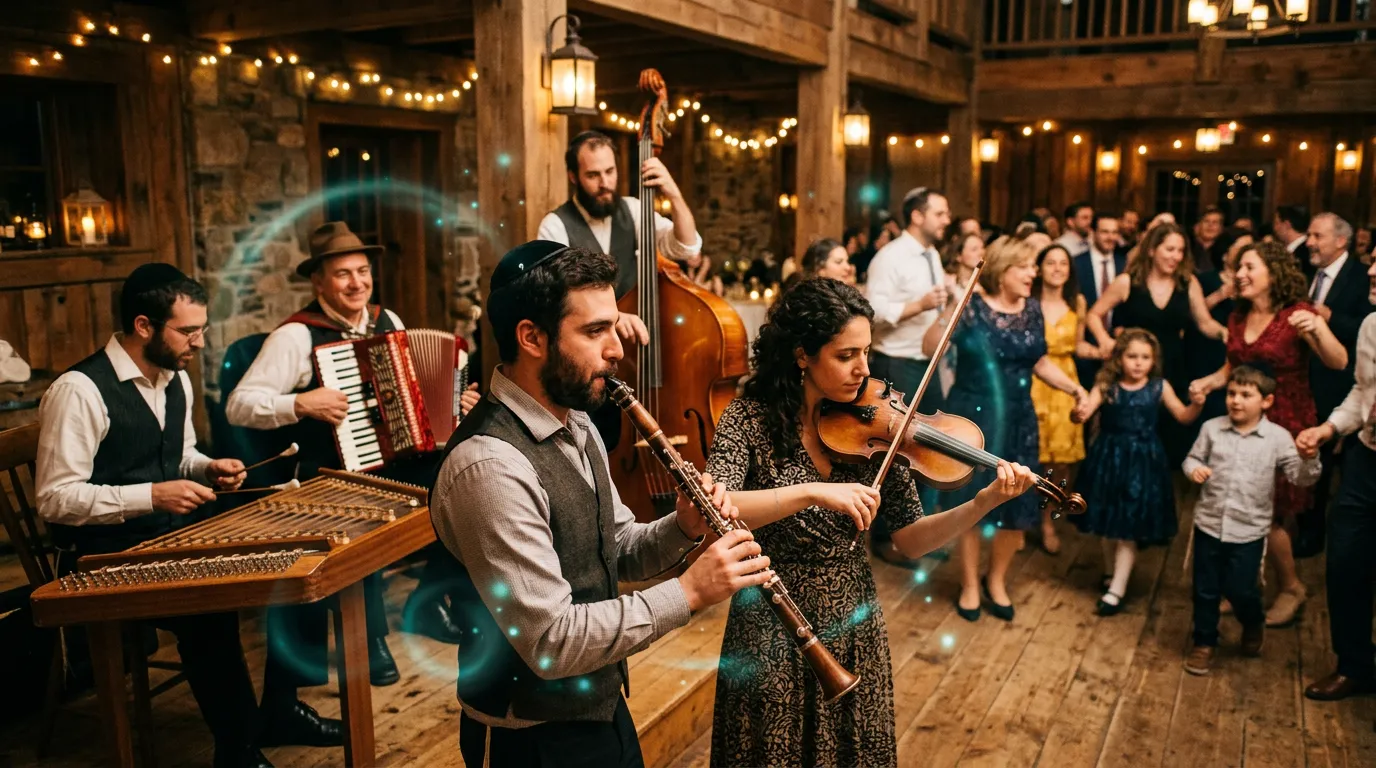
Klezmer is the instrumental music of the Ashkenazi Jews of Eastern Europe. The word comes from the Hebrew kli zemer, meaning vessel of song, and in Yiddish a klezmer was a professional musician. Klezmorim played for Jewish weddings and celebrations across the lands that are now Ukraine, Poland, Moldova, Romania, Belarus and Lithuania, and by the 17th century Jewish musicians in cities such as Prague had their own guilds. A wedding could last for days, with the music guiding each stage, from seating the bride to the dancing after the ceremony, often alongside a badkhn, the wedding jester and master of ceremonies. The repertoire drew on synagogue chant, Yiddish song and the dance music of Ottoman, Romanian, Ukrainian and Polish neighbours. In the 19th century a typical band, or kapelye, was led by the violin, with a second violin, bass or cello and tsimbl, a hammered dulcimer. The clarinet grew in importance through that century. Between the 1880s and the 1920s millions of Jews emigrated to America, and in New York clarinettists such as Naftule Brandwein and Dave Tarras made celebrated recordings. The Holocaust destroyed the communities where klezmer had lived in Europe. From the late 1970s a revival in the United States brought the music back to dance floors and concert stages. This guide covers how spatial audio for klezmer works, where to place each element and how to make an immersive klezmer mix. For the basics, see what spatial audio is.
Why klezmer works in spatial audio
Klezmer is built on a lead voice and the players who support it. The clarinet or violin carries the melody, full of ornaments that imitate the cry and sob of the human voice. The accordion or a second fiddle plays offbeat chords. The bass and the poyk, a bass drum often fitted with a cymbal, keep the dance steady. In a full band, trumpet and trombone add bright counter lines. In stereo the clarinet and violin often sit on top of each other, and the fine ornaments are lost. In an immersive mix the two lead instruments stand side by side in front, the accompaniment forms a half circle around them and the hall gives the music its warmth.
The rule: two voices in front, the dance around them. Set the clarinet and violin a little apart at the front, keep the bass light and centred and seat the band inside a warm, medium-sized hall.
Immersive music for klezmer: what listeners hear
- Two lead voices you can tell apart. The clarinet and violin sit a little apart at the front, so you can follow every bend, trill and sob in each line.
- A shimmer and a pulse on the sides. The tsimbl rings from the left and the accordion pumps its chords from the right, filling the space without covering the melody.
- A light, steady dance floor. The bass and poyk keep the beat close and centred, never heavier than the dance needs.
- A room full of people. The wedding hall surrounds the band with warm reflections, so a slow doina feels intimate and a fast freylekhs feels like a crowd in motion.
Where to place each element in a klezmer mix
| Element | Position | Height | Why it works |
|---|---|---|---|
| Yiddish vocal | Front centre | Ear level | The sung line in Yiddish songs |
| Clarinet | Front left | Ear level | The crying lead voice and its ornaments |
| Violin | Front right | Ear level | The older lead voice of the kapelye |
| Tsimbl | Left | Ear level | Hammered strings that add shimmer |
| Accordion | Right | Ear level | Offbeat chords that drive the dance |
| Trumpet and trombone | Behind right | Ear level | Counter lines in the American style |
| Poyk drum | Behind left | Ear level | Bass drum and cymbal on the beat |
| Bass | Centre | Low | A light, steady bass line |
| Wedding hall | Behind | Raised | A warm room full of dancers |
The psychoacoustics behind klezmer placement
Every position in the table above follows how the ear and brain locate sound. Here is the reason behind the main choices for klezmer.
- Clarinet and violin apart. The brain groups sounds into streams by pitch, timing and direction. This is auditory stream segregation (Bregman). The clarinet and violin often play in the same range, so a small difference in direction lets the ear hear two voices instead of one blended line.
- Small gaps are enough at the front. The ear is most precise at telling apart sounds near the front, where it can detect differences of about one degree. This is the minimum audible angle (Mills). That is why the two lead instruments only need a modest spread to stay distinct, and the band does not have to be pushed to the far sides.
- A singer heard through the band. Listeners can follow one voice in a crowded scene far more easily when it comes from a different direction to the other sounds. This is the cocktail party effect (Bronkhorst). Keeping a Yiddish vocal at front centre, away from the clarinet and violin, keeps the words clear.
- A hall with side reflections. Early reflections arriving from the sides make a sound feel wider and more enveloping. This is spatial impression from early lateral reflections (Barron and Marshall). Clear side reflections give the band the warmth of a wedding hall while keeping the fast ornaments crisp.
The immersion profile for klezmer
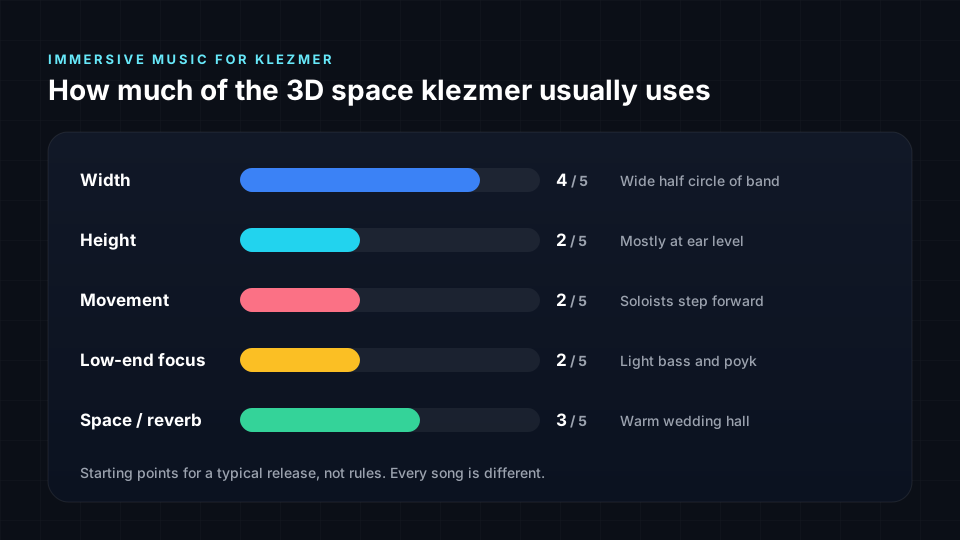
Width scores 4 because the band forms a wide half circle, with the leads in front and the tsimbl, accordion and brass on the sides. Space is 3, since klezmer belongs in a medium-sized hall or room full of dancers, warm but not cathedral-like. Height is 2, as the music sits mostly at ear level, with only a little lift from the room above. Movement is 2: the players stay in place, and the motion comes from the shift between a free, slow doina and a fast dance, and from a soloist stepping forward. Low-end focus is 2, because the bass and poyk play a light, supporting role, and the weight of the music sits in the melody rather than in the bass.
Tips for an immersive klezmer mix
- Share the front. Set the clarinet slightly left and the violin slightly right, so both lead voices are close and clear but never on top of each other.
- Keep the ornaments clean. Klezmer lives in its small details, the krekhts, trills and slides. Use little reverb on the leads and let the hall come from the room, not from the instrument.
- Let the tsimbl ring. Place the tsimbl to one side and give it a little space, so its shimmer fills the gaps without masking the melody.
- Keep the bass light. Centre the bass and poyk and keep them tight. Too much low end turns a dance into a march.
- Use a warm wedding hall. A medium room with clear side reflections suits most klezmer. Make it a little more intimate for a solo doina and a little bigger for a full dance band.
Klezmer styles: Freylekhs, Doina and Klezmer Revival
The core placement holds for every style here: the lead voices in front, the accompaniment around them and a warm room. What changes is the tempo, the size of the band and how much freedom the soloist has.
Freylekhs
The freylekhs, from the Yiddish word for joyful, is the classic klezmer circle dance, played at weddings while the guests join hands and dance in rings. It moves in a lively 2/4, often with the 3+3+2 accent pattern that klezmer musicians share with the bulgar. Tunes are usually built from several short sections, with the clarinet or violin leading and the band pushing the beat. Put the clarinet and violin a little apart at the front, the accordion or second fiddle on the offbeat to one side and the tsimbl or brass on the other. Keep the bass and poyk centred and tight, and use a lively hall so the music feels like a crowd dancing around you.
Doina
The doina is a slow, free piece in which the soloist improvises over a held chord. Klezmer musicians took the form from Romanian and Moldavian music, where the doina is a lyrical, often sorrowful song, and turned it into a showpiece for clarinet or violin. It has no fixed beat. The soloist stretches and bends each phrase, using sobbing ornaments that echo cantorial singing. A doina often leads straight into a dance such as a hora or a freylekhs. Put the soloist close and centred, with the sustained chord from the accordion or tsimbl spread softly behind. A more intimate room suits the opening, and the band can open up when the dance begins.
Klezmer Revival
The klezmer revival began in the United States in the late 1970s, when young musicians went back to the 78 rpm records of Brandwein, Tarras and others, and to older musicians who still remembered the music. The Klezmorim formed in Berkeley in 1975, the Klezmer Conservatory Band was founded by Hankus Netsky in Boston in 1980, and Kapelye, Brave Old World and the Klezmatics followed. In 1985 Henry Sapoznik founded KlezKamp to teach the music and Yiddish culture, and in 1995 the violinist Itzhak Perlman recorded In the Fiddler's House with several revival bands. Revival bands range from traditional dance bands to groups that mix klezmer with jazz, punk and new composition. Keep the clarinet and violin in front, the rhythm section centred and any guitars, drum kit or brass on the sides, with a concert hall or club room around them.
Related traditions such as Romanian lăutari music and Balkan brass follow the same idea: keep the lead melody in front, the accompaniment around it and the room warm and lively.
How to make immersive klezmer from stereo
Spatial9 can create spatial audio from a stereo track in a few steps:
- Upload your stereo master or your stems.
- Spatial9's AI separates and places each part, pulling the clarinet, violin, tsimbl, accordion and bass apart even from old 78 rpm transfers, and setting the two lead voices side by side at the front.
- Preview it in binaural on headphones.
- Export Eclipsa Audio, ADM, binaural or Ambisonics.
- Publish a video. Create a YouTube-ready video with your immersive audio and publish it directly.
For related guides, read spatial audio for Balkan brass and spatial audio for gypsy jazz. Every guide is listed in spatial audio and immersive music by genre.
Frequently asked questions
Does this guide cover Freylekhs, Doina and Klezmer Revival?
Yes. The freylekhs seats the clarinet and violin at the front with a tight, centred rhythm section in a lively hall. The doina puts one soloist close and centred over a soft held chord. Klezmer revival bands keep the same core and add guitars, drums or brass on the sides.
Can I make a klezmer mix in Dolby Atmos or Eclipsa Audio?
Yes. The placements in this guide work for both. Spatial9 exports ADM, the standard file used by Dolby Atmos studios, as well as Eclipsa Audio for YouTube, so one immersive klezmer mix covers both. If you plan to release the Atmos version on Apple Music, build it from your original stems or multitracks, because Apple does not accept Atmos made from a finished stereo master. See where to publish spatial audio. You may also hear this called a 3D klezmer mix or klezmer in spatial audio.
Is spatial audio good for klezmer?
Yes. Klezmer depends on small ornaments in two lead voices that often play in the same range. Spatial audio gives each voice its own place, keeps the accompaniment clear and puts the listener in the room with the band.
Where should the clarinet go in an immersive klezmer mix?
Put the clarinet at the front, slightly to one side of the violin, and close to the listener. In a doina or a solo feature it can move to front centre.
How much reverb does klezmer need?
A moderate amount. Klezmer suits a warm, medium room, but too much reverb blurs the fast ornaments. Keep the leads fairly dry and let the hall come from early side reflections.
How is klezmer different from Balkan brass in spatial audio?
Klezmer is usually led by clarinet and violin with a light bass, so it suits a closer layout inside a warm hall. Balkan brass is built on loud trumpets, horns, tuba and a big drum, so it suits a very wide, open-air layout with a heavy centre.
Can I convert an old klezmer 78 rpm recording to spatial audio?
Yes. Spatial9 uses AI to separate the clarinet, violin and accompaniment from a stereo or mono recording. Separation is never perfect with old 78 rpm transfers, so keep the layout simple, the room small and the surface noise in the centre.
Dolby and Dolby Atmos are trademarks of Dolby Laboratories. Spatial9 is not affiliated with or endorsed by Dolby Laboratories.
Sources
- Blauert, J. (1997). Spatial Hearing: The Psychophysics of Human Sound Localization, revised edition. MIT Press. Low-frequency, elevation, distance and motion cues.
- Mills, A. W. (1958). On the minimum audible angle. Journal of the Acoustical Society of America, 30(4), 237-246.
- Hebrank, J. and Wright, D. (1974). Spectral cues used in the localization of sound sources on the median plane. Journal of the Acoustical Society of America, 56(6), 1829-1834.
- Bronkhorst, A. W. (2000). The cocktail party phenomenon: a review of research on speech intelligibility in multiple-talker conditions. Acta Acustica united with Acustica, 86, 117-128.
- Barron, M. and Marshall, A. H. (1981). Spatial impression due to early lateral reflections in concert halls. Journal of Sound and Vibration, 77(2), 211-232.
- Neuhoff, J. G. (1998). Perceptual bias for rising tones. Nature, 395, 123-124.
- Bregman, A. S. (1990). Auditory Scene Analysis: The Perceptual Organization of Sound. MIT Press.
- Slobin, M. (2000). Fiddler on the Move: Exploring the Klezmer World. Oxford University Press.
- Feldman, W. Z. (2016). Klezmer: Music, History, and Memory. Oxford University Press.
Join the dance
Upload a track to Spatial9 and hear the clarinet and violin side by side in front of you with the wedding hall all around in minutes. Then export it or publish it straight to YouTube.