Spatial Audio & Immersive Music for Merengue: Perico Ripiao, Merengue de Orquesta & Merenhouse
Spatial9 Team · · 11 min read
Part of the series Spatial audio and immersive music by genre.
Key takeaways
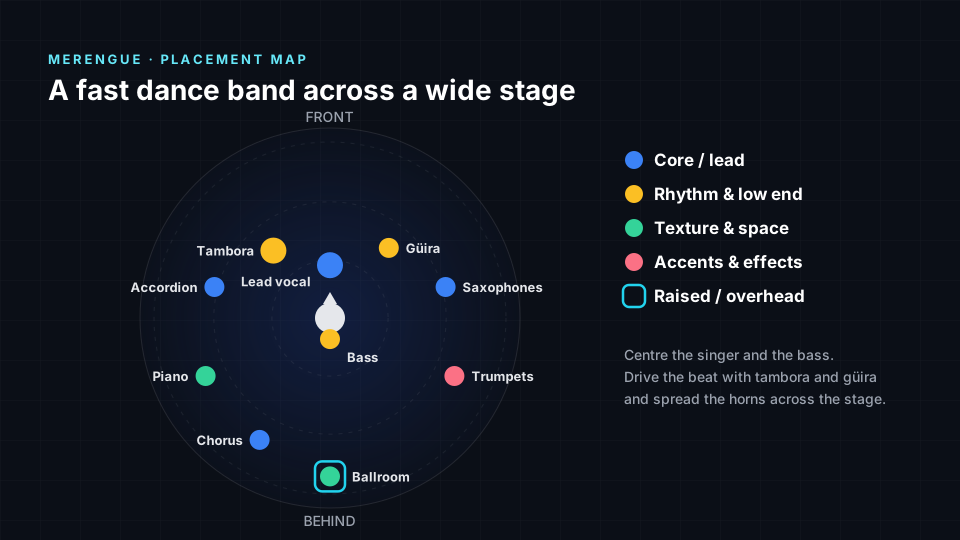
- In a spatial merengue mix the lead vocal and the bass stay centred, the tambora and güira drive from the front, and the accordion, saxophones, trumpets and chorus spread across a wide stage.
- Because the brain sorts sounds into streams by pitch, timing and direction, an effect known as auditory stream segregation, placing the tambora and the güira on opposite sides keeps the two halves of the merengue rhythm clear at high speed.
- Merengue is fast dance music for the floor, so the space should feel like a lively ballroom or open-air stage, with energy at the sides and a tight, punchy centre.
- The merengue immersion profile scores width 4, height 2, movement 3, low-end focus 3 and space 3 out of 5.
Merengue is the national music and dance of the Dominican Republic. It took shape in the nineteenth century, and its rural form grew up in the Cibao valley around Santiago, where the button accordion, brought in through trade with Europe, joined two local rhythm instruments: the tambora, a two-headed drum played with a stick on one side and the bare hand on the other, and the güira, a metal scraper brushed with a wire comb. Early accordionists such as Ñico Lora shaped the style. Under the Trujillo dictatorship, from 1930 to 1961, merengue was promoted as the national music and arranged for big ballroom orchestras by leaders such as Luis Alberti. From the 1960s Johnny Ventura's smaller, faster combo with horns changed the sound, and Wilfrido Vargas, Los Hermanos Rosario, Milly Quezada and Juan Luis Guerra took it across Latin America. A song often moves from a short introduction, the paseo, into the sung merengue and then the jaleo, a driving call and response section with riffing saxophones. The beat is a quick 2/4. In 2016 UNESCO recognised the music and dance of merengue as intangible cultural heritage. Merengue suits spatial audio because its parts are fast, bright and layered, and they need room to stay clear. This guide covers how spatial audio for merengue works, where to place each element and how to make an immersive merengue mix. For the basics, see what spatial audio is.
Why merengue works in spatial audio
Merengue is a machine for dancing. The tambora plays its rolling, syncopated pattern, the güira scrapes a constant driving rhythm, and the bass locks with them on every beat. Above that, the accordion or the saxophones play fast riffs, the trumpets punch out accents and the chorus answers the singer in the jaleo. In stereo these fast parts pile up in the same bright range and the rhythm can turn into a blur. In an immersive mix the singer and bass hold the centre, the tambora and güira drive from either side of the front and the horns spread out across a wide stage.
The rule: a centred voice and bass, tambora and güira driving from the front, horns across a wide stage. Keep the rhythm close and tight, let the sax and accordion riffs trade from side to side in the jaleo, and set it all in a lively ballroom.
Immersive music for merengue: what listeners hear
- A rhythm you can feel on both sides. The tambora rolls from the front left and the güira scrapes from the front right, so the beat has two clear halves.
- A singer right in front. The lead vocal sits in the centre, bright and close, over the busy band.
- Riffs that trade across the stage. In the jaleo the saxophones and accordion answer each other from either side, with trumpets punching in behind.
- A dance floor around you. A lively, bright room places you in a ballroom or an open-air stage on a Saturday night.
Where to place each element in a merengue mix
| Element | Position | Height | Why it works |
|---|---|---|---|
| Lead vocal | Front centre | Ear level | The lyric and the call in the jaleo |
| Bass | Centre | Ear level | The pulse locked with the tambora |
| Tambora | Front left | Ear level | Stick and hand pattern that drives the dance |
| Güira | Front right | Ear level | The constant scrape that keeps the speed |
| Accordion | Left, stepping in for riffs | Ear level | Fast melody and runs in perico ripiao |
| Saxophones | Right, stepping in for riffs | Ear level | Rapid jaleo riffs and lines |
| Trumpets | Behind right | Ear level | Punchy accents and horn hits |
| Piano | Behind left | Ear level | Syncopated chords in orchestral merengue |
| Chorus | Behind left | Ear level | Answers to the singer in the jaleo |
| Ballroom | Behind | Raised | A lively, bright dance hall |
The psychoacoustics behind merengue placement
Every position in the table above follows how the ear and brain locate sound. Here is the reason behind the main choices for merengue.
- Bass stays centred. The ear finds almost no direction in frequencies below roughly 80 to 100 Hz, so the bass gains nothing from being spread and stays locked with the tambora in the middle.
- Tambora and güira on opposite sides. The brain groups sounds into streams by pitch, timing and direction. This is auditory stream segregation (Bregman). At merengue speed the drum and the scraper can blur into one rattle, and separating them lets the ear follow both patterns.
- A singer clear of the chorus. Listeners can pick out one voice among competing sounds when it comes from a different direction. This is the cocktail party effect (Bronkhorst). Keeping the chorus behind and to the side makes the call and response of the jaleo easy to follow.
- A bright room with side reflections. Early reflections arriving from the sides make a sound feel wider and more enveloping. This is spatial impression from early lateral reflections (Barron and Marshall). A few bright side reflections give the band the energy of a dance hall without blurring the fast rhythm.
The immersion profile for merengue
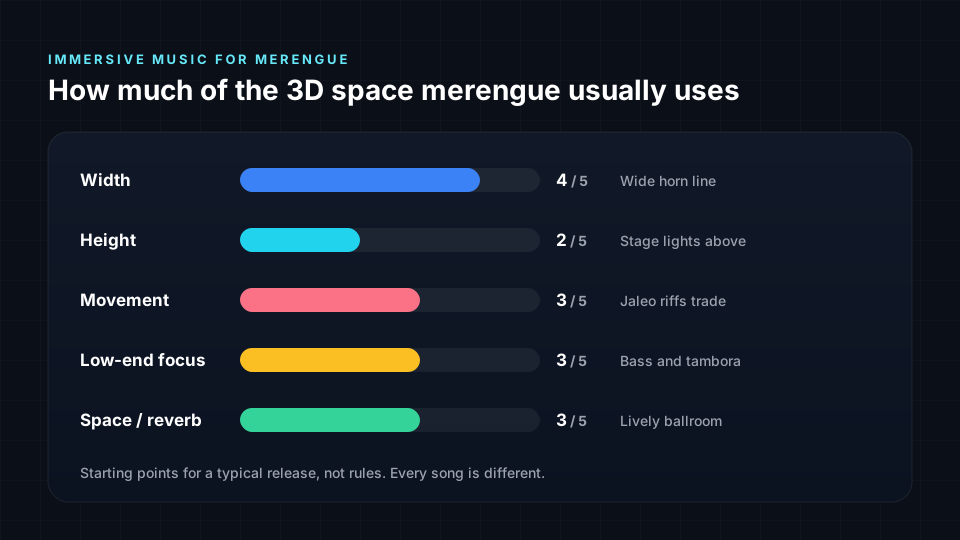
Width scores 4 because a merengue band spreads its rhythm, horns and chorus across a wide stage. Movement is 3, coming from the sax and accordion riffs trading in the jaleo rather than sounds flying around the head. Low-end focus is 3: the bass and tambora drive the dance, but merengue is fast and light rather than heavy. Space is 3, a lively ballroom that adds energy without washing out the speed. Height is 2, with only a light reflection above.
Tips for an immersive merengue mix
- Keep the lead vocal front and centre. The singer leads the dance and the jaleo, so they never move.
- Split the tambora and güira. Set them on opposite front sides so the two rhythms stay sharp at full speed.
- Let the riffs trade across the stage. Place the saxophones and accordion on opposite sides and bring each forward a little when it takes the riff.
- Keep the trumpets behind the riffs. Punchy horn hits work best slightly behind and to the side, so they accent rather than crowd.
- Use a lively, short room. A bright dance hall suits merengue; long reverbs smear the fast patterns.
Merengue styles: perico ripiao, merengue de orquesta and merenhouse
The core placement holds for every style here: voice and bass in the middle, tambora and güira at the front. What changes is the lead instrument, the size of the band and how much electronic sound the style uses.
Perico Ripiao
Perico ripiao, also called merengue típico, is the rural merengue of the Cibao: accordion, tambora, güira, often an alto saxophone, and a bass, which was once a marímbula box and is now usually an electric bass. Accordionists such as Tatico Henríquez, Francisco Ulloa, El Prodigio and Fefita la Grande are among its stars. Keep the small group close: accordion front left and stepping in for its runs, saxophone front right, tambora and güira just inside them and bass centred. A small, lively room suits the style.
Merengue de Orquesta
Merengue de orquesta is the big band sound, from the ballroom orchestras of the mid twentieth century to the horn-driven combos of Johnny Ventura, Wilfrido Vargas and Juan Luis Guerra. Saxophones and trumpets replace the accordion as the lead, with piano, bass, congas, tambora and güira underneath and a chorus for the jaleo. Spread the saxophones on one side and the trumpets on the other, keep the tambora and güira at the front, the piano to one side and the chorus behind. A bright ballroom or stage suits the sound.
Merenhouse
Merenhouse grew up among Dominican communities in New York in the 1990s, when groups such as Proyecto Uno and Fulanito mixed the tambora, güira and accordion with house beats, hip hop and rap. This style can take a wider, more electronic layout: keep the voice and rap in the centre, the house kick and bass centred low, the tambora and güira at the front sides, and synths and samples spread around the back. A tight, club-like space suits the sound.
Related styles such as merengue de calle and mambo de calle follow the same idea: centre the voice and bass, keep the tambora and güira driving from the front and spread the rest across the stage.
How to make immersive merengue from stereo
Spatial9 can create spatial audio from a stereo track in a few steps:
- Upload your stereo master or your stems.
- Spatial9's AI separates and places each part, pulling the vocal, tambora, güira, accordion, saxophones, trumpets and bass apart even from older recordings, and setting the rhythm at the front with the horns across a wide stage.
- Preview it in binaural on headphones.
- Export Eclipsa Audio, ADM, binaural or Ambisonics.
- Publish a video. Create a YouTube-ready video with your immersive audio and publish it directly.
For related guides, read spatial audio for bachata and spatial audio for salsa. Every guide is listed in spatial audio and immersive music by genre.
Frequently asked questions
Does this guide cover perico ripiao, merengue de orquesta and merenhouse?
Yes. Perico ripiao keeps a close accordion group with tambora and güira in a small room. Merengue de orquesta spreads saxophones and trumpets across a wide ballroom stage. Merenhouse adds house beats and synths around a centred voice and low end.
Can I make a merengue mix in Dolby Atmos or Eclipsa Audio?
Yes. The placements in this guide work for both. Spatial9 exports ADM, the standard file used by Dolby Atmos studios, as well as Eclipsa Audio for YouTube, so one immersive merengue mix covers both. If you plan to release the Atmos version on Apple Music, build it from your original stems or multitracks, because Apple does not accept Atmos made from a finished stereo master. See where to publish spatial audio. You may also hear this called a 3D merengue mix or merengue in spatial audio.
Is spatial audio good for merengue?
Yes. Merengue layers a fast drum, a scraper, bass, riffing saxophones or accordion and a chorus in a bright, busy range. Spatial audio gives each part its own direction, so the rhythm stays clear even at full speed.
Where should the tambora go in an immersive merengue mix?
Put it at the front left at ear level, opposite the güira and close to the listener. It drives the whole band, so keep it steady and near rather than moving it around.
How should I handle the jaleo section?
Let the saxophones and accordion, or the saxophones and trumpets, trade riffs from opposite sides, with the chorus behind answering the singer. Keep the tambora and güira fixed at the front so the dance pulse never moves.
How is merengue different from bachata in spatial audio?
Both are Dominican, but merengue is fast and driven by tambora, güira and horns, so it suits a wide, energetic stage. Bachata is slower and guitar-led, with requinto and bongo, so it suits a closer, more intimate layout.
Can I convert an old merengue recording to spatial audio?
Yes. Spatial9 uses AI to separate the vocal, tambora, güira, accordion or horns and bass from a stereo or mono master. Separation is never perfect with older recordings, so keep the layout simple and the rhythm close.
Dolby and Dolby Atmos are trademarks of Dolby Laboratories. Spatial9 is not affiliated with or endorsed by Dolby Laboratories.
Sources
- Blauert, J. (1997). Spatial Hearing: The Psychophysics of Human Sound Localization, revised edition. MIT Press. Low-frequency, elevation, distance and motion cues.
- Mills, A. W. (1958). On the minimum audible angle. Journal of the Acoustical Society of America, 30(4), 237-246.
- Hebrank, J. and Wright, D. (1974). Spectral cues used in the localization of sound sources on the median plane. Journal of the Acoustical Society of America, 56(6), 1829-1834.
- Bronkhorst, A. W. (2000). The cocktail party phenomenon: a review of research on speech intelligibility in multiple-talker conditions. Acta Acustica united with Acustica, 86, 117-128.
- Litovsky, R. Y., Colburn, H. S., Yost, W. A. and Guzman, S. J. (1999). The precedence effect. Journal of the Acoustical Society of America, 106(4), 1633-1654.
- Barron, M. and Marshall, A. H. (1981). Spatial impression due to early lateral reflections in concert halls. Journal of Sound and Vibration, 77(2), 211-232.
- Neuhoff, J. G. (1998). Perceptual bias for rising tones. Nature, 395, 123-124.
- Bregman, A. S. (1990). Auditory Scene Analysis: The Perceptual Organization of Sound. MIT Press.
- Austerlitz, P. (1997). Merengue: Dominican Music and Dominican Identity. Temple University Press.
Get on the dance floor
Upload a track to Spatial9 and hear the tambora, güira and saxophones fill the dance floor around you in minutes. Then export it or publish it straight to YouTube.