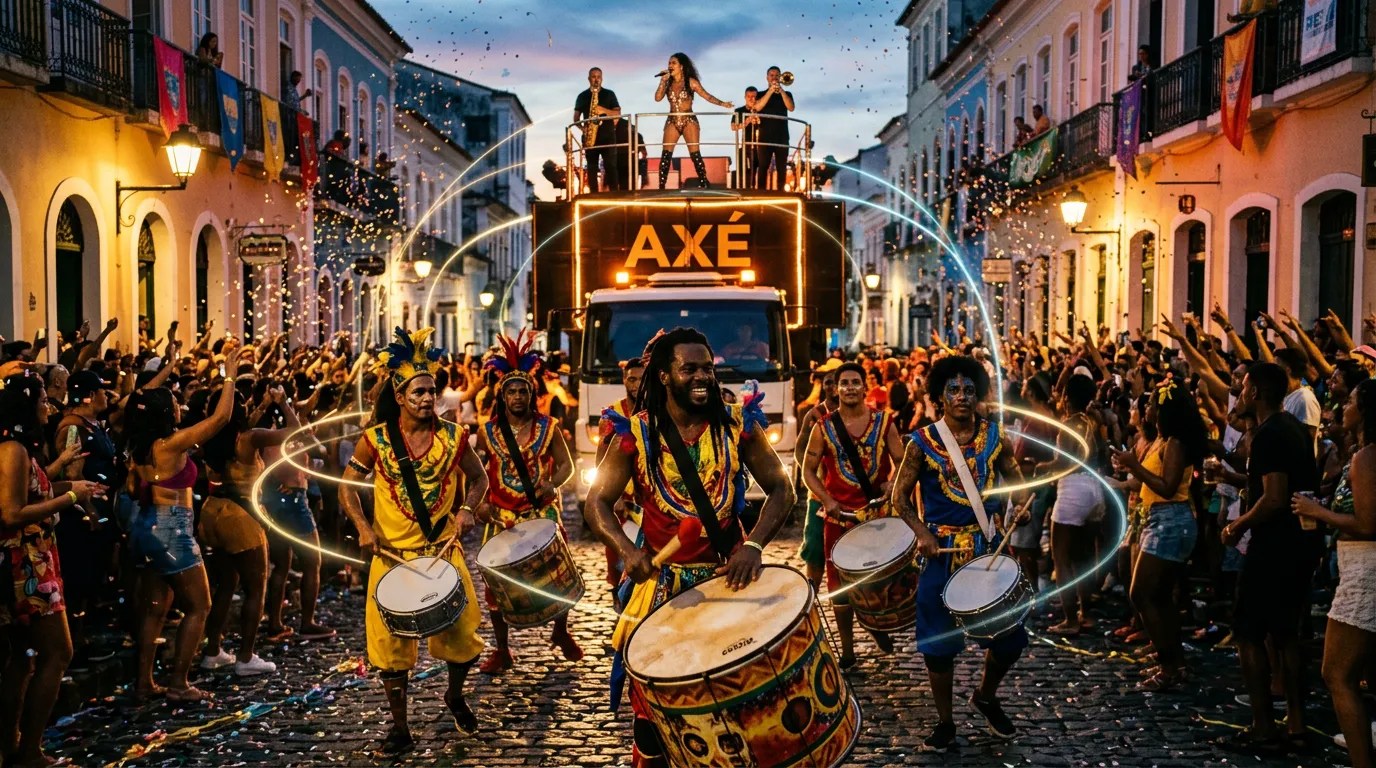
Spatial Audio & Immersive Music for Axé & Frevo: Samba-Reggae, Pagodão & Bloco Afro
Spatial9 Team · · 11 min read
Part of the series Spatial audio and immersive music by genre.
Key takeaways
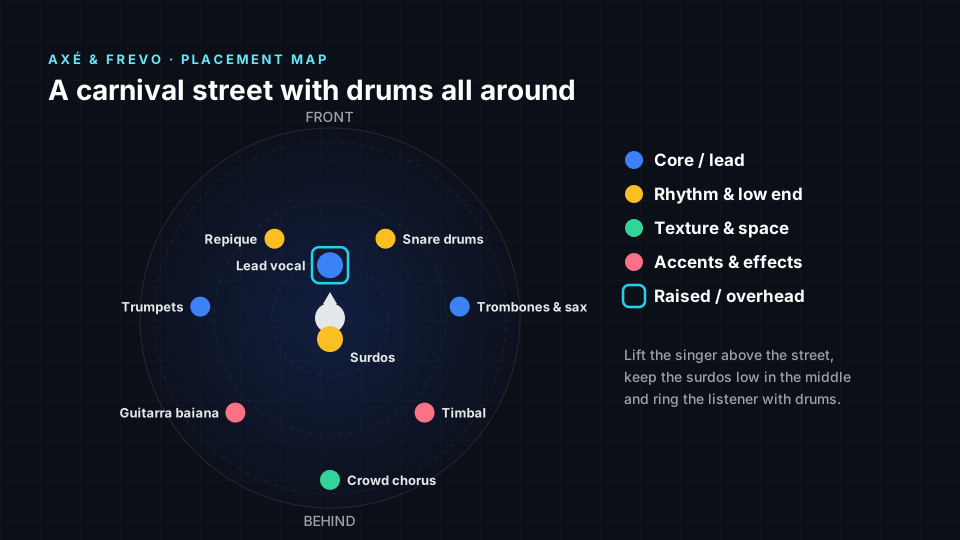
- In a spatial axé and frevo mix the lead vocal sits in front and slightly raised, as if on a trio elétrico, while the surdos hold the centre and the repiques, snares, timbal and brass spread wide around the listener.
- Because the brain sorts sounds into separate streams by pitch, timing and direction, an effect known as auditory stream segregation, setting the repique and snares apart keeps each drum pattern clear.
- Axé and frevo are outdoor carnival musics, so the space should feel like a wide, open street with the crowd behind the listener rather than a reverberant hall.
- The axé and frevo immersion profile scores width 5, height 3, movement 4, low-end focus 4 and space 3 out of 5.
Axé and frevo are the carnival musics of north-east Brazil. Frevo comes from Recife and Olinda in Pernambuco, where it grew out of military band marches, polka and maxixe in the late nineteenth century. The word, from the Portuguese "ferver", to boil, appeared in print in Recife in 1907. Frevo de rua is fast instrumental music for trumpets, trombones and saxophones over snare and surdo, played for dancers who leap with small umbrellas. UNESCO added frevo to its intangible cultural heritage list in 2012. Axé music is the pop of Salvador da Bahia. It grew from the trio elétrico, the sound truck that Dodô and Osmar first drove through the Salvador carnival in 1950 playing frevo on electric instruments, and from the drumming of the blocos afro. Luiz Caldas' "Fricote" of 1985 is often named as the start of the sound, and Daniela Mercury and Ivete Sangalo took it national. Both musics are made to move through a street, which is why they suit spatial audio so well. This guide covers how spatial audio for axé and frevo works, where to place each element and how to make an immersive axé and frevo mix. For the basics, see what spatial audio is.
Why axé and frevo works in spatial audio
Carnival music is built in layers that are meant to be heard outdoors and in motion. In samba-reggae the deep surdos play interlocking parts, the repique calls and the snares fill the gaps. In frevo the trumpets and trombones throw short phrases at each other over a racing snare. A singer on top of a trio elétrico leads tens of thousands of people who sing back. In stereo this becomes one loud wall. In an immersive mix the drums can form a ring, the brass can answer from both sides and the singer can sit just above the crowd.
The rule: a raised singer in front, a ring of drums around you and a street that moves. Keep the surdos low and central, spread the higher drums and brass wide and put the crowd behind the listener.
Immersive music for axé and frevo: what listeners hear
- A singer above the crowd. The lead vocal sits in front and a little raised, like a star singing from the top of a trio elétrico.
- Drums all around. Surdos thump at the centre while repiques, snares and timbal answer from different sides instead of one block of noise.
- Brass that calls and answers. In frevo the trumpets and the trombones and saxophones trade phrases from left and right.
- A street, not a studio. The crowd sings behind you and the band seems to move past, so the mix feels like carnival rather than a stage.
Where to place each element in an axé and frevo mix
| Element | Position | Height | Why it works |
|---|---|---|---|
| Lead vocal | Front centre | Raised | The singer on top of the trio elétrico, leading the crowd |
| Surdos | Centre | Below ear level | The deep bass drums that carry the whole parade |
| Repique | Front left | Ear level | Calls, breaks and signals to the drum line |
| Snare drums | Front right | Ear level | The fast caixa pattern that drives frevo and samba-reggae |
| Trumpets | Left, moving slightly | Ear level | Bright frevo melodies and stabs |
| Trombones & sax | Right, moving slightly | Ear level | Answering lines and the middle of the brass |
| Timbal | Behind right | Ear level | Sharp slaps and accents from the Bahian hand drum |
| Guitarra baiana | Behind left | Ear level | High electric lead from the trio elétrico tradition |
| Crowd chorus | Behind | Ear level | Thousands of fans singing the chorus back |
The psychoacoustics behind axé and frevo placement
Every position in the table above follows how the ear and brain locate sound. Here is the reason behind the main choices for axé and frevo.
- Surdos stay centred and low. The ear finds almost no direction in frequencies below roughly 80 to 100 Hz, so the deep surdo fundamentals gain nothing from being spread.
- Repique and snares on opposite sides. The brain groups sounds into streams by pitch, timing and direction. This is auditory stream segregation (Bregman). The repique and the snares share a sharp, high attack, and setting them apart lets the ear follow the call and the groove separately.
- A slightly raised singer. The outer ear shapes the high frequencies of a sound differently depending on its height, and the brain reads these changes as elevation. These are spectral elevation cues (Hebrank and Wright). A gentle lift places the singer on the truck above the street without losing the words.
- A parade that comes closer. Listeners hear a sound that grows louder as changing more than one that fades by the same amount. This is the perceptual bias for rising, or looming, tones (Neuhoff). A slow build as the band seems to approach makes the arrival of a bloco feel physical.
The immersion profile for axé and frevo
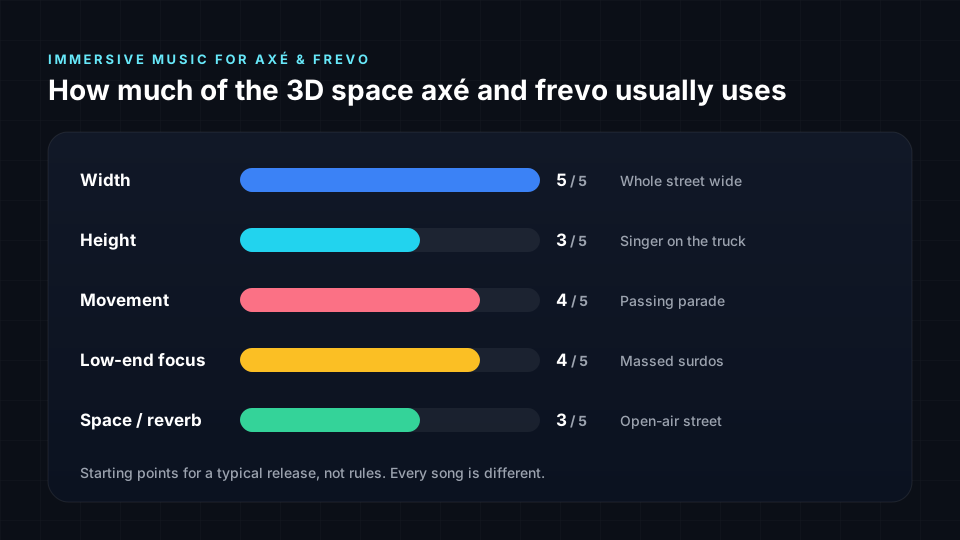
Width scores 5 because carnival music is a street full of drummers and horn players, and it should surround the listener. Low-end focus is 4: the surdos and the bass on the trio elétrico are the heartbeat of the music. Movement scores 4, since a parade is always in motion and brass phrases bounce from side to side. Height scores 3, coming mainly from the singer on the truck above the street. Space is 3, because an outdoor street has width and crowd noise but few hard reflections, so a long reverb would only blur the drums.
Tips for an immersive axé and frevo mix
- Lift the singer slightly. Place the lead vocal in front and a little above ear level, but keep the words clear.
- Keep the surdos in the middle. The low drums are the pulse of the parade, so hold their weight centred and solid.
- Build a ring of drums. Spread the repique, snares and timbal around the listener so each pattern has its own direction.
- Split the brass for frevo. Put the trumpets on one side and the trombones and saxophones on the other so their phrases can answer each other.
- Put the crowd behind you. Fans singing the chorus from behind make the listener part of the carnival rather than an observer.
Axé & Frevo styles: samba-reggae, pagodão and bloco afro
The core placement holds for every style here: the singer in front, the low drums at the centre and the higher percussion spread around the listener. What changes is the balance between drums, brass and electric band, and how much the music moves.
Samba-Reggae
Samba-reggae was developed in Salvador in the 1980s, above all by the percussionist and band leader Neguinho do Samba with Olodum. It slows samba down and sets it against a reggae feel, played by large drum groups of surdos in several pitches, repiques and snares, sometimes with timbal. Olodum's drummers reached the world on Paul Simon's The Rhythm of the Saints in 1990. Put the surdos at the centre and around the back in a low ring, place the repique in front as the leader and spread snares to the sides. A broad, open space suits it best.
Pagodão
Pagodão, or Bahian pagode, grew in Salvador in the 1990s from samba de roda and pagode, with a fast, swinging rhythm made for dancing. Groups such as É o Tchan, Harmonia do Samba and later Psirico mixed cavaquinho, pandeiro and timbal with keyboards, bass and call-and-response vocals. Keep the lead vocal and bass centred, put the cavaquinho and pandeiro close in front on opposite sides and spread the percussion further out. Use a tighter room and less movement than carnival drumming.
Bloco Afro
The blocos afro are Black carnival groups of Salvador that celebrate African heritage through drums, song and costume. Ilê Aiyê, founded in the Liberdade neighbourhood in 1974, was the first, followed by Olodum, Malê Debalê, Muzenza and others. Treat it as a mass drum choir: the singer front and centre, the chorus just behind, and the drums wide around the listener with the deep surdos low in the middle.
Related styles such as frevo de bloco, frevo-canção, afoxé and the samba of Rio carnival follow the same idea: centre the voice and the deepest drums, then spread the higher percussion and horns around the listener.
How to make immersive axé and frevo from stereo
Spatial9 can create spatial audio from a stereo track in a few steps:
- Upload your stereo master or your stems.
- Spatial9's AI separates and places each part, pulling the vocal, surdos, snares, brass, timbal and guitar apart and setting them around the listener as if in the middle of a carnival street.
- Preview it in binaural on headphones.
- Export Eclipsa Audio, ADM, binaural or Ambisonics.
- Publish a video. Create a YouTube-ready video with your immersive audio and publish it directly.
For related guides, read spatial audio for samba and spatial audio for brass band. Every guide is listed in spatial audio and immersive music by genre.
Frequently asked questions
Does this guide cover samba-reggae, pagodão and bloco afro?
Yes. Samba-reggae puts a low ring of surdos around the listener with the repique leading in front. Pagodão takes a tighter, stage-like layout with cavaquinho and pandeiro close in front. Bloco afro music works as a mass drum choir with a central singer and wide drums.
Can I make an axé and frevo mix in Dolby Atmos or Eclipsa Audio?
Yes. The placements in this guide work for both. Spatial9 exports ADM, the standard file used by Dolby Atmos studios, as well as Eclipsa Audio for YouTube, so one immersive axé and frevo mix covers both. If you plan to release the Atmos version on Apple Music, build it from your original stems or multitracks, because Apple does not accept Atmos made from a finished stereo master. See where to publish spatial audio. You may also hear this called a 3D axé and frevo mix or axé and frevo in spatial audio.
Is spatial audio good for axé and frevo?
Yes. Carnival music layers many drums, horns and voices that were meant to be heard from all directions in the street. Spatial audio gives each part its own place, so the patterns stay clear even at full volume.
Where should the surdos go in an immersive mix?
Keep their low weight at the centre and slightly below ear level. If the group uses several surdo pitches, you can spread their attacks a little around the back, but the deepest drum should stay in the middle.
How do I make a frevo brass band sound immersive?
Split the brass. Put the trumpets on one side and the trombones and saxophones on the other, keep the snare and surdo centred and let the phrases answer each other across the space.
How is axé different from samba in spatial audio?
Rio samba is built around the huge bateria of a samba school, so it suits a deep ring of drums. Axé adds an electric band, keyboards and pop vocals from the trio elétrico, so it needs a stronger centre and a raised lead voice.
Can I convert an old carnival recording to spatial audio?
Yes. Spatial9 uses AI to separate the voice, drums, brass and guitar from a stereo master. Live street recordings separate less cleanly, so keep the layout simple.
Dolby and Dolby Atmos are trademarks of Dolby Laboratories. Spatial9 is not affiliated with or endorsed by Dolby Laboratories.
Sources
- Blauert, J. (1997). Spatial Hearing: The Psychophysics of Human Sound Localization, revised edition. MIT Press. Low-frequency, elevation, distance and motion cues.
- Mills, A. W. (1958). On the minimum audible angle. Journal of the Acoustical Society of America, 30(4), 237-246.
- Hebrank, J. and Wright, D. (1974). Spectral cues used in the localization of sound sources on the median plane. Journal of the Acoustical Society of America, 56(6), 1829-1834.
- Bronkhorst, A. W. (2000). The cocktail party phenomenon: a review of research on speech intelligibility in multiple-talker conditions. Acta Acustica united with Acustica, 86, 117-128.
- Litovsky, R. Y., Colburn, H. S., Yost, W. A. and Guzman, S. J. (1999). The precedence effect. Journal of the Acoustical Society of America, 106(4), 1633-1654.
- Barron, M. and Marshall, A. H. (1981). Spatial impression due to early lateral reflections in concert halls. Journal of Sound and Vibration, 77(2), 211-232.
- Neuhoff, J. G. (1998). Perceptual bias for rising tones. Nature, 395, 123-124.
- Bregman, A. S. (1990). Auditory Scene Analysis: The Perceptual Organization of Sound. MIT Press.
- Crook, L. (2005). Brazilian Music: Northeastern Traditions and the Heartbeat of a Modern Nation. ABC-CLIO.
Bring carnival home
Upload a track to Spatial9 and hear the surdos, brass and crowd surround you in minutes. Then export it or publish it straight to YouTube.