Spatial Audio & Immersive Music for Andean Music: Huayno, Saya & Nueva Canción
Spatial9 Team · · 11 min read
Part of the series Spatial audio and immersive music by genre.
Key takeaways
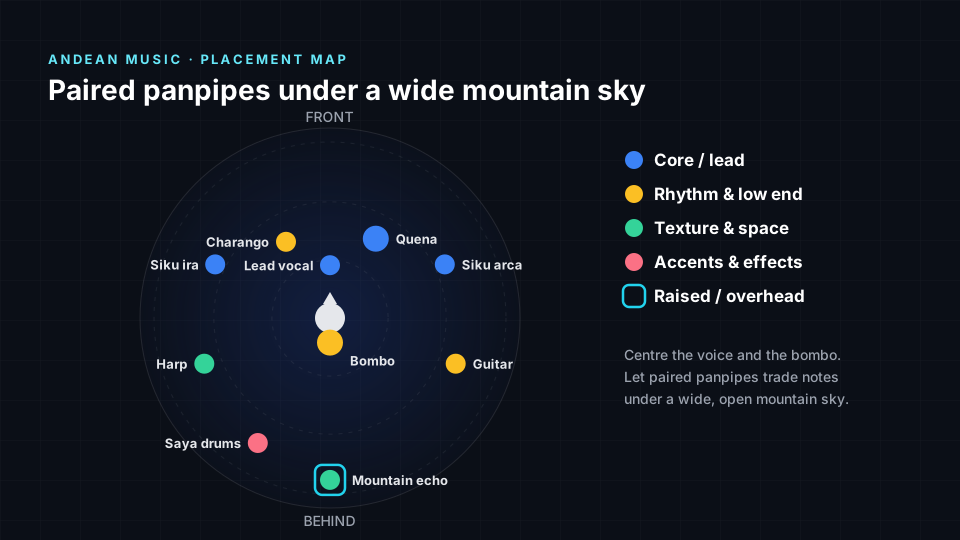
- In a spatial Andean mix the voice and the bombo stay centred, the quena sings from just in front, and the two halves of the siku panpipes trade notes from the left and right.
- Because the brain links or splits sounds into streams by pitch, timing and direction, an effect known as auditory stream segregation, the paired sikus need a moderate spread: wide enough to hear two players, close enough to hear one tune.
- Andean music comes from open mountain air, festivals and processions, so the space should feel wide and airy, with long, soft echoes and a sense of sky above.
- The Andean music immersion profile scores width 4, height 3, movement 3, low-end focus 2 and space 4 out of 5.
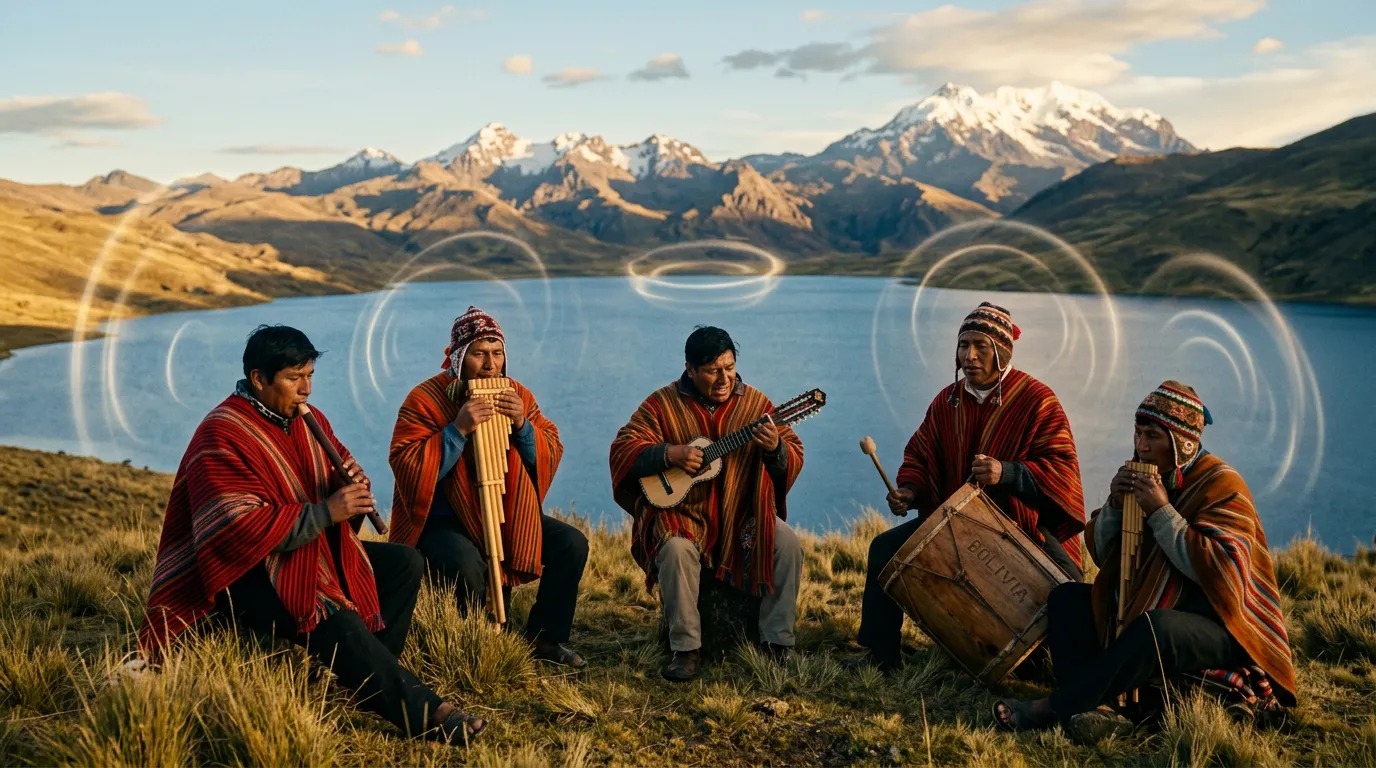
Andean music is the folk and popular music of the Andes mountains, above all in Peru, Bolivia and Ecuador, with branches in northern Chile and Argentina. Its oldest instruments come from before the Spanish conquest: the quena, a notched flute blown from the end, and the siku or zampoña, a panpipe in two rows. Aymara and Quechua players around Lake Titicaca play the siku in pairs, one holding the ira and the other the arca, each with only half the notes, so a melody is built by passing notes back and forth. After the conquest came string instruments, including the charango, a small, bright lute with ten strings, along with guitar, harp and violin. The bombo, a deep wooden drum, keeps the pulse. In the twentieth century Andean styles moved to the cities: huayno recordings boomed in Lima in the 1950s and 1960s, and from the 1960s groups such as Los Kjarkas in Bolivia and Inti-Illimani in Chile carried the sound across the world. Andean music suits spatial audio because one of its key techniques is already spatial: a tune split between two players. This guide covers how spatial audio for Andean music works, where to place each element and how to make an immersive Andean mix. For the basics, see what spatial audio is.
Why Andean music works in spatial audio
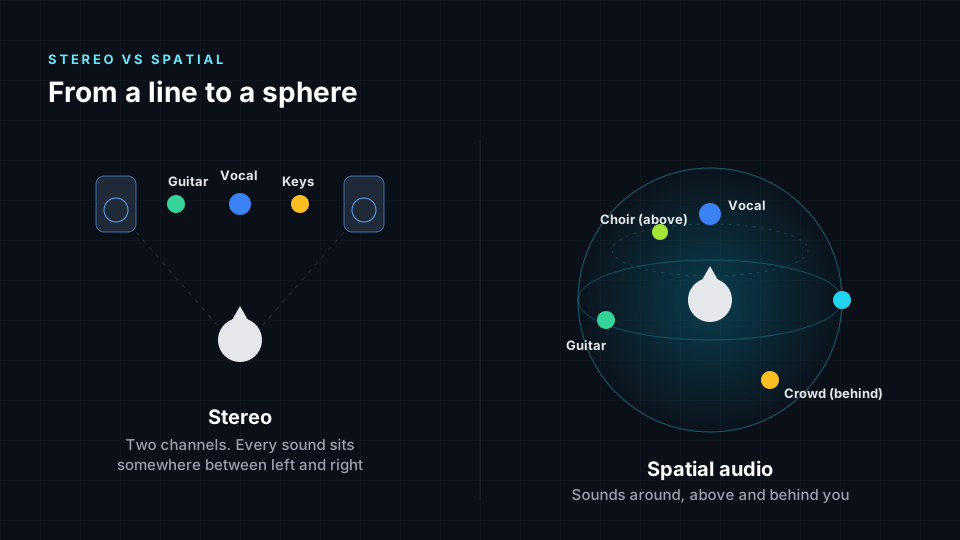
Andean music is a conversation between breath and strings. The quena carries a long, breathy melody, the sikus throw notes from one player to the other, the charango strums a fast, shimmering rhythm and the bombo beats a heartbeat underneath. Festivals and processions add more drums, more panpipes and many voices. In stereo the flutes and panpipes gather in the middle and the interlocking of the sikus is hard to hear. In an immersive mix the voice and bombo hold the centre, the quena sits just in front and the two halves of the siku answer each other from either side.
The rule: a centred voice and bombo, paired panpipes trading notes from either side. Keep the quena and charango close in front, set the sikus in a moderate spread so the tune still joins up, and let the space open out like mountain air.
Immersive music for Andean music: what listeners hear
- A flute that breathes in front. The quena sits just ahead, so you hear the air and the soft attack of every note.
- A tune passed across you. The ira and arca panpipes trade notes from left and right, and the melody joins up between them.
- Strings that shimmer close by. The charango strums from the front left, bright and quick, with the guitar or harp further out.
- Mountain air all around. Long, soft echoes above and behind place you on an open plateau or in a village square at festival time.
Where to place each element in an Andean music mix
| Element | Position | Height | Why it works |
|---|---|---|---|
| Lead vocal | Front centre | Ear level | The song and the story in Spanish, Quechua or Aymara |
| Bombo | Centre | Ear level | The deep, steady heartbeat of the band |
| Quena | Front right | Ear level | The breathy lead melody |
| Charango | Front left | Ear level | Fast, bright strumming close to the listener |
| Siku ira | Left of front | Ear level | Half of the melody, passed to the arca |
| Siku arca | Right of front | Ear level | The other half, answering the ira |
| Guitar | Right | Ear level | Bass runs and chords under the charango |
| Harp | Left | Ear level | Bass and melody in Peruvian huayno |
| Saya drums | Behind left | Ear level | Afro-Bolivian drums and scraper |
| Mountain echo | Behind | Raised | Open air and soft, distant reflections |
The psychoacoustics behind Andean music placement
Every position in the table above follows how the ear and brain locate sound. Here is the reason behind the main choices for Andean music.
- Bombo stays centred. The ear finds almost no direction in frequencies below roughly 80 to 100 Hz, so the deep body of the bombo gains nothing from being spread and anchors the band best in the middle.
- Sikus in a moderate spread. The brain groups sounds into streams by pitch, timing and direction. This is auditory stream segregation (Bregman). Set the ira and arca too far apart and the melody splits into two broken lines; a moderate spread lets the ear hear one tune passed between two players.
- Echoes that do not pull the source. When a sound and its reflection arrive close together, the ear hears the first as the source and folds the echo into it. This is the precedence effect (Litovsky). Distant, delayed echoes add mountain air while the flutes stay clearly in front.
- Air above the band. The outer ear shapes the spectrum of a sound differently depending on its height, and the brain reads these changes as elevation. These are spectral elevation cues (Hebrank and Wright). Placing soft, bright reflections slightly overhead gives the feeling of open sky.
The immersion profile for Andean music
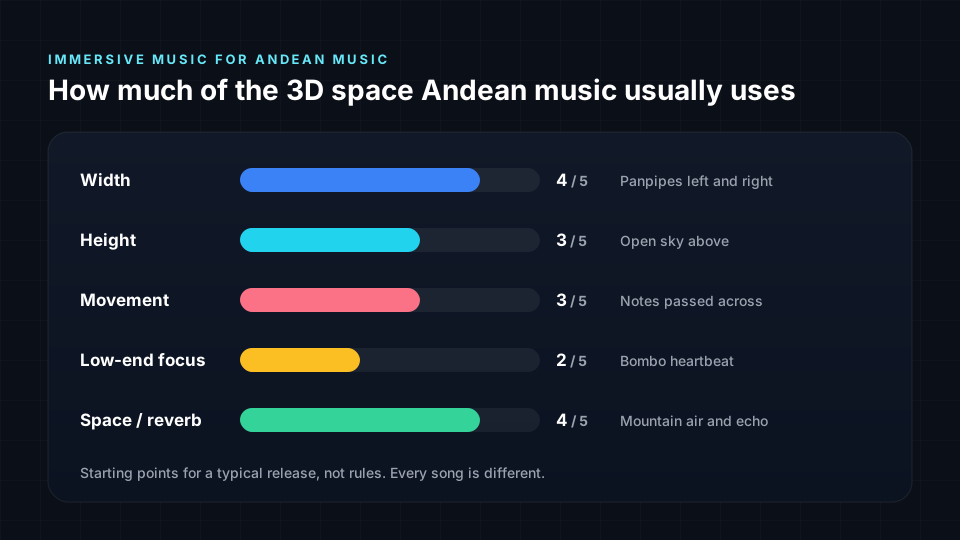
Width scores 4 because the paired panpipes and festival ensembles spread across the front and sides. Space also scores 4: this is music of open air, squares and processions, with long, soft echoes. Height is 3, higher than most folk music, because a sense of sky above suits the sound. Movement scores 3, from notes passing between the ira and arca and from moving festival bands. Low-end focus is 2, since the bombo gives a heartbeat rather than a heavy bass.
Tips for an immersive Andean music mix
- Keep the voice and bombo centred. The song and the heartbeat hold the band together, so neither should move.
- Split the sikus, but not too far. Place the ira and arca on either side of the front, close enough that the melody still joins up.
- Keep the quena close and breathy. Let the listener hear the air in the flute; do not push it into the distance.
- Set the charango and guitar apart. Put the bright charango near the front and the guitar further out on the other side.
- Open up the space. Use long, soft echoes behind and a touch above, but keep early reflections light so the strumming stays crisp.
Andean Music styles: huayno, saya and nueva canción
The core placement holds for every style here: voice and drum in the middle, flutes and strings around the front. What changes is the instrumentation, the rhythm and how much room the style needs.
Huayno
Huayno, also written huayño or wayno, is the most widespread song and dance form of the Peruvian and Bolivian Andes, with roots that reach back before the conquest. It moves in a lively 2/4 with a short-long lilt and often ends with a faster closing section, the fuga. Regional bands use quena, charango, harp, violin, guitar or brass, and singers such as Flor Pucarina and Picaflor de los Andes made it a recording music. Keep the high, bright voice centred, the harp or guitar to one side and the violin or quena opposite. A village square or a lively hall suits the sound.
Saya
Saya is the music of the Afro-Bolivian communities of the Yungas valleys, built on drums, a scraper and call and response singing between a leader and a chorus. Its name was later also used for the saya caporal, the music of the Caporales dance, played by brass bands and by groups such as Los Kjarkas. For traditional saya, put the lead singer in the centre, the chorus around the front and the drums spread behind. For caporal music, place the brass across the front and the snare and bass drums behind, with room for a moving festival feel.
Nueva Canción
Nueva canción, the new song movement, grew up in Chile in the 1960s around Violeta Parra and Víctor Jara and spread across Latin America. Groups such as Inti-Illimani and Quilapayún joined political and poetic songwriting with quena, siku, charango and bombo, and their exile in Europe after 1973 carried the Andean sound abroad. Keep the voice or vocal group close in the centre, the charango and guitars at the front and the flutes and panpipes just wider. A clear, concert-hall space suits the songs.
Related styles such as the Ecuadorian sanjuanito, the Andean cumbia known as chicha and the cueca follow the same idea: centre the voice and drum, then spread the flutes and strings across an open space.
How to make immersive Andean music from stereo
Spatial9 can create spatial audio from a stereo track in a few steps:
- Upload your stereo master or your stems.
- Spatial9's AI separates and places each part, pulling the voice, quena, panpipes, charango, guitar and bombo apart even from older recordings, and setting the flutes and panpipes across the front under an open, airy space.
- Preview it in binaural on headphones.
- Export Eclipsa Audio, ADM, binaural or Ambisonics.
- Publish a video. Create a YouTube-ready video with your immersive audio and publish it directly.
For related guides, read spatial audio for folk and spatial audio for world electronic music. Every guide is listed in spatial audio and immersive music by genre.
Frequently asked questions
Does this guide cover huayno, saya and nueva canción?
Yes. Huayno centres a bright voice with harp, violin or quena around it in a lively square. Saya puts call and response singing at the front and drums behind. Nueva canción keeps a close voice or vocal group with charango and guitars, and flutes just wider.
Can I make an Andean music mix in Dolby Atmos or Eclipsa Audio?
Yes. The placements in this guide work for both. Spatial9 exports ADM, the standard file used by Dolby Atmos studios, as well as Eclipsa Audio for YouTube, so one immersive Andean mix covers both. If you plan to release the Atmos version on Apple Music, build it from your original stems or multitracks, because Apple does not accept Atmos made from a finished stereo master. See where to publish spatial audio. You may also hear this called a 3D Andean music mix or Andean music in spatial audio.
Is spatial audio good for Andean music?
Yes. Andean music layers breathy flutes, interlocking panpipes and bright strings, and it comes from open air. Spatial audio lets the panpipes answer each other from either side and gives the music the wide, airy space it was made for.
Where should the panpipes go in an immersive Andean mix?
Put the ira and arca on either side of the front at ear level, about the same distance from the listener. Keep the spread moderate so the alternating notes still join into one melody.
Where should the charango go?
Put it front left at ear level, close to the listener and opposite the quena. Its fast, bright strumming sounds best near, with the guitar further out on the other side.
How is Andean music different from Celtic folk in spatial audio?
Both use flutes and strings in a natural space, but Andean music relies on paired panpipes that pass a melody between players and on open-air echoes. Celtic folk often centres on fiddle, pipes and voice in a smaller session room.
Can I convert an old Andean field recording to spatial audio?
Yes. Spatial9 uses AI to separate the voice, flutes, strings and drum from a mono or stereo master. Separation is never perfect with older field recordings, so keep the layout simple and the space natural.
Dolby and Dolby Atmos are trademarks of Dolby Laboratories. Spatial9 is not affiliated with or endorsed by Dolby Laboratories.
Sources
- Blauert, J. (1997). Spatial Hearing: The Psychophysics of Human Sound Localization, revised edition. MIT Press. Low-frequency, elevation, distance and motion cues.
- Mills, A. W. (1958). On the minimum audible angle. Journal of the Acoustical Society of America, 30(4), 237-246.
- Hebrank, J. and Wright, D. (1974). Spectral cues used in the localization of sound sources on the median plane. Journal of the Acoustical Society of America, 56(6), 1829-1834.
- Bronkhorst, A. W. (2000). The cocktail party phenomenon: a review of research on speech intelligibility in multiple-talker conditions. Acta Acustica united with Acustica, 86, 117-128.
- Litovsky, R. Y., Colburn, H. S., Yost, W. A. and Guzman, S. J. (1999). The precedence effect. Journal of the Acoustical Society of America, 106(4), 1633-1654.
- Barron, M. and Marshall, A. H. (1981). Spatial impression due to early lateral reflections in concert halls. Journal of Sound and Vibration, 77(2), 211-232.
- Neuhoff, J. G. (1998). Perceptual bias for rising tones. Nature, 395, 123-124.
- Bregman, A. S. (1990). Auditory Scene Analysis: The Perceptual Organization of Sound. MIT Press.
- Turino, T. (1993). Moving Away from Silence: Music of the Peruvian Altiplano and the Experience of Urban Migration. University of Chicago Press.
Breathe the mountain air
Upload a track to Spatial9 and hear the quena, panpipes and charango open out around you in minutes. Then export it or publish it straight to YouTube.