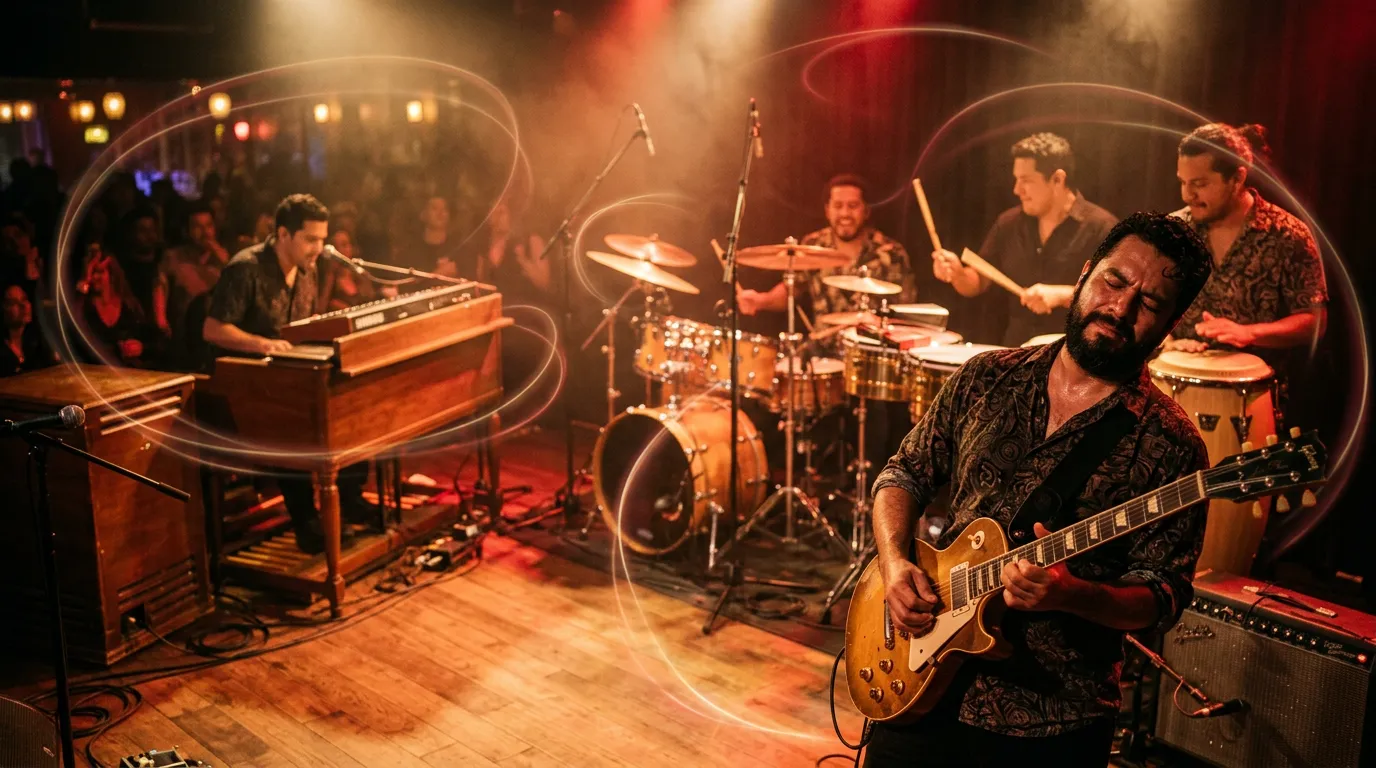
Spatial Audio & Immersive Music for Latin Rock: Rock en Español, Latin Alternative & Chicano Rock
Spatial9 Team · · 10 min read
Part of the series Spatial audio and immersive music by genre.
Key takeaways
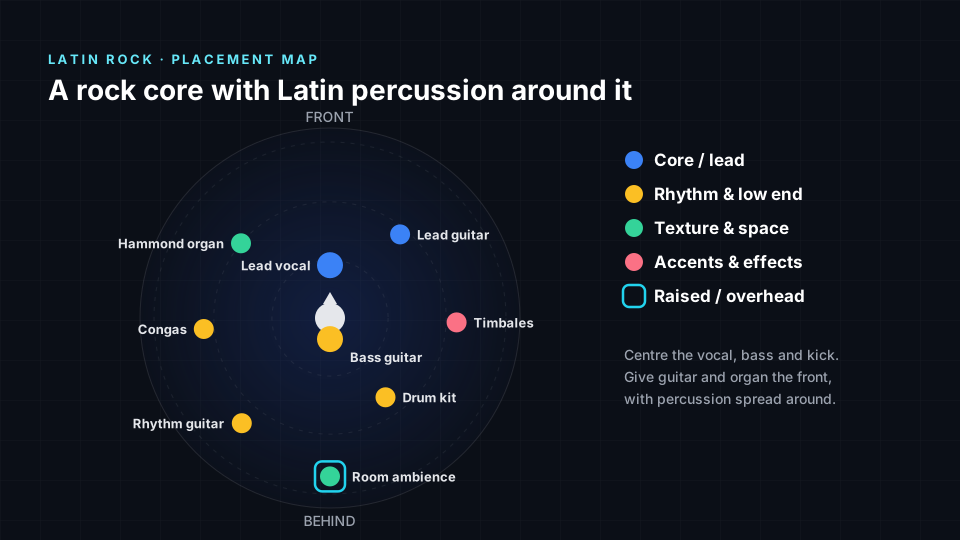
- In a spatial Latin rock mix the lead vocal, bass and kick stay centred, while the lead guitar and Hammond organ hold the front sides and the congas and timbales spread out to the left and right.
- Because the brain separates sounds into streams by direction, an effect known as auditory stream segregation, placing congas and timbales on opposite sides lets the ear follow both patterns against the rock kit.
- Latin rock runs two rhythm sections at once, a rock drum kit and a Latin percussion section, so it needs a wide layout and a lively, medium-sized room.
- The Latin rock immersion profile scores width 4, height 2, movement 3, low-end focus 4 and space 3 out of 5.
Latin rock is rock music played with Latin American rhythms, percussion and, often, Spanish lyrics. In the United States it took shape in the late 1950s and 1960s: Ritchie Valens turned the Mexican folk song "La Bamba" into a rock and roll hit in 1958, and East Los Angeles bands built a Chicano rock scene. In San Francisco, Santana fused blues rock guitar with congas, timbales and Hammond organ, played Woodstock in 1969 and reached a huge audience in 1970 with Abraxas and its version of Tito Puente's "Oye Como Va". Malo and El Chicano followed. In Latin America and Spain, rock en español became a mass movement in the 1980s. The core sound is drum kit, bass, electric guitar, keys and voice, with congas, timbales, bongos and cowbell playing rhythms drawn from son, cumbia and mambo. Latin rock suits spatial audio because it carries two rhythm sections at once, a rock kit and a Latin percussion section, and they need room to breathe. This guide covers how spatial audio for Latin rock works, where to place each element and how to make an immersive Latin rock mix. For the basics, see what spatial audio is.
Why Latin rock works in spatial audio
Latin rock is busy by design. A rock drummer plays a backbeat while the congas play a tumbao, the timbales add cascara and fills, and over the top the guitar solos and the organ sustains chords. In stereo these layers fight for the same space, and the hand drums disappear behind distorted guitar. In an immersive mix the rock core holds the centre, the guitar and organ face each other at the front, and the percussion opens out to the sides where every slap and rim shot can be heard.
The rule: a rock core in the middle, Latin percussion around it. Keep the vocal, bass and kick solid in the centre, give the lead guitar and organ the front sides, and let congas and timbales surround the listener in a lively room.
Immersive music for Latin rock: what listeners hear
- A voice and a groove in the middle. The singer sits front and centre, with bass and kick locked together underneath.
- Guitar that sings from the front. The lead guitar sits front right and comes slightly forward for its long, sustained solos.
- Percussion all around. Congas on one side and timbales on the other, so the clave-based patterns are heard as separate voices.
- A live band in a real room. A lively, medium reverb places you in a club rather than a dry studio.
Where to place each element in a Latin rock mix
| Element | Position | Height | Why it works |
|---|---|---|---|
| Lead vocal | Front centre | Ear level | The lyric, in Spanish, English or both |
| Bass guitar | Centre | Ear level | Tumbao-style lines that tie rock and Latin rhythm |
| Lead guitar | Front right, forward for solos | Ear level | Sustained melodic solos and riffs |
| Hammond organ | Front left | Ear level | Swelling chords and rotary speaker colour |
| Timbales | Right | Ear level | Cascara patterns, rim shots and fills |
| Congas | Left | Ear level | The tumbao and open slaps under the band |
| Drum kit | Behind right | Ear level | The rock backbeat beneath the percussion |
| Rhythm guitar | Behind left | Ear level | Chord riffs and off-beat strums |
| Room ambience | Behind | Raised | A lively club or festival room |
The psychoacoustics behind Latin rock placement
Every position in the table above follows how the ear and brain locate sound. Here is the reason behind the main choices for Latin rock.
- Bass and kick stay centred. The ear finds almost no direction in frequencies below roughly 80 to 100 Hz, so spreading the bass and kick only weakens the groove.
- Congas and timbales on opposite sides. The brain groups sounds into streams by pitch, timing and direction. This is auditory stream segregation (Bregman). Separating the interlocking conga and timbale patterns lets the ear follow both instead of one blur.
- A guitar solo that steps forward. A sound that gets louder and closer is heard as approaching more strongly than one that fades away. This is the perceptual bias for looming, rising sounds (Neuhoff). A small move forward makes a long sustained guitar line feel like it is reaching out to the listener.
- A lively room with side reflections. Early reflections arriving from the sides make a sound feel wider and more enveloping. This is spatial impression from early lateral reflections (Barron and Marshall). Side reflections give hand drums body without washing out the backbeat.
The immersion profile for Latin rock
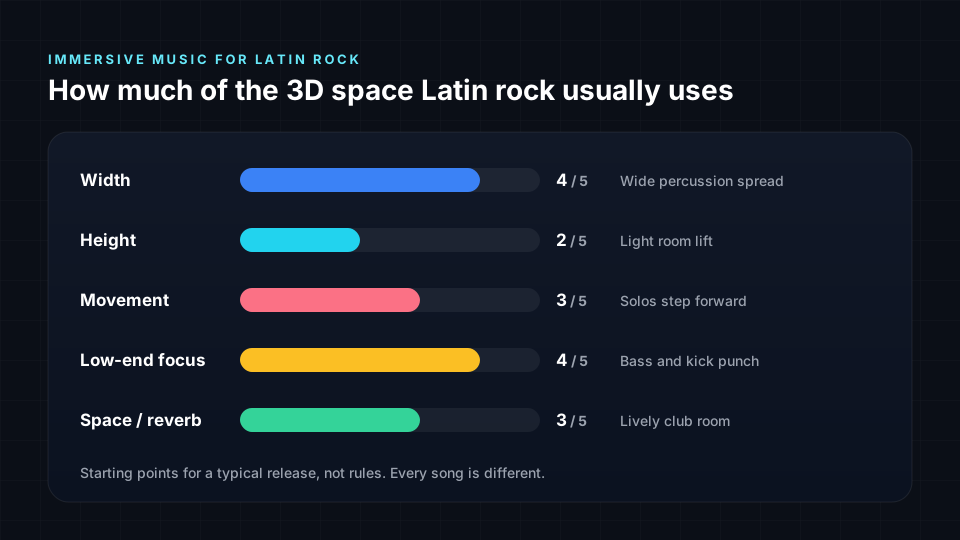
Width scores 4 because a full percussion section needs to spread beyond the front. Low-end focus is also 4: bass and kick carry the weight of a rock band and the congas add low, open tones. Movement scores 3, coming from guitar solos stepping forward and timbale fills crossing the side, not from constant panning. Space is 3, a lively live room that suits the percussion without blurring fast fills. Height stays at 2, with only a light raised room reflection.
Tips for an immersive Latin rock mix
- Lock bass and kick in the centre. The groove depends on them, so never spread or move them.
- Split the congas and timbales. Put them on opposite sides so each pattern stays readable against the rock kit.
- Bring the guitar forward for solos. Move the lead guitar a little closer and nearer the centre during a solo, then let it return.
- Give the organ its own side. Place the Hammond opposite the lead guitar so the two never mask each other.
- Use a lively room, not a long hall. A medium, bright reverb suits hand drums; long tails smear the fills.
Latin Rock styles: rock en español, Latin alternative and Chicano rock
The core placement holds for every style here: voice, bass and kick in the middle, percussion and guitars around them. What changes is how much Latin percussion is used and how wide the band needs to be.
Rock en Español
Rock en español is rock written and sung in Spanish across Latin America and Spain. It grew from local beat and garage bands in the 1960s and became a mass movement in the 1980s, when Argentine bands such as Soda Stereo and Mexican bands such as Caifanes and Maná filled stadiums. Much of it is guitar band music, closer to new wave or arena rock than to Santana. Keep the vocal centred and prominent, set two guitars on either front side and keep any percussion modest. A medium arena-style room suits the bigger anthems.
Latin Alternative
Latin alternative grew in the 1990s, when bands such as Café Tacvba in Mexico and Aterciopelados in Colombia mixed rock with cumbia, ranchera, electronic beats, hip hop and folk instruments. The Latin Alternative Music Conference has been held in the United States since 2000. This style can take more height and movement: place samples and electronic textures above and behind, folk instruments such as jarana or accordion at the sides and keep the vocal close and centred.
Chicano Rock
Chicano rock is the rock made by Mexican American musicians, above all in East Los Angeles. It runs from Ritchie Valens and the 1960s East Side bands through Santana-influenced groups such as El Chicano and Malo to Los Lobos, who mixed rock and roll with norteño and son jarocho, and later Ozomatli. Put horns behind and slightly raised, an accordion or bajo sexto on one side, and keep the band close and warm, like a backyard party or a neighbourhood dance hall.
Related styles such as Latin funk and Latin psychedelic rock follow the same idea: a centred rock core with percussion around it.
How to make immersive Latin rock from stereo
Spatial9 can create spatial audio from a stereo track in a few steps:
- Upload your stereo master or your stems.
- Spatial9's AI separates and places each part, pulling the vocal, guitar, organ, bass, kit, congas and timbales apart and setting the percussion section around a centred rock core.
- Preview it in binaural on headphones.
- Export Eclipsa Audio, ADM, binaural or Ambisonics.
- Publish a video. Create a YouTube-ready video with your immersive audio and publish it directly.
For related guides, read spatial audio for rock and spatial audio for Latin pop. Every guide is listed in spatial audio and immersive music by genre.
Frequently asked questions
Does this guide cover rock en español, Latin alternative and Chicano rock?
Yes. Rock en español centres the vocal with two guitars at the front sides. Latin alternative adds height and movement for samples and folk instruments. Chicano rock keeps a warm, close band with horns or accordion around it.
Can I make a Latin rock mix in Dolby Atmos or Eclipsa Audio?
Yes. The placements in this guide work for both. Spatial9 exports ADM, the standard file used by Dolby Atmos studios, as well as Eclipsa Audio for YouTube, so one immersive Latin rock mix covers both. If you plan to release the Atmos version on Apple Music, build it from your original stems or multitracks, because Apple does not accept Atmos made from a finished stereo master. See where to publish spatial audio. You may also hear this called a 3D Latin rock mix or Latin rock in spatial audio.
Is spatial audio good for Latin rock?
Yes. Latin rock stacks a rock band and a percussion section into one dense sound. Spatial audio gives each part its own direction, so the percussion is no longer buried under the guitars.
Where should the congas go in an immersive Latin rock mix?
Put them on one side at ear level, opposite the timbales, and slightly in front of the drum kit. That keeps the tumbao clear and stops it masking the snare backbeat.
How do I place a Santana-style guitar solo?
Start the lead guitar front right, then move it a little forward and toward the centre for the solo. Bring it back when the vocal returns.
How is Latin rock different from salsa in spatial audio?
Latin rock is built on a rock kit, electric guitar and organ, so it needs a solid centre and a punchy low end. Salsa is led by a horn section, piano montuno and a full percussion section, so it suits a wider band with horns spread across the front.
Can I convert an old Latin rock recording to spatial audio?
Yes. Spatial9 uses AI to separate the vocal, guitar, organ, bass, drums and percussion from a stereo master. Separation is never perfect with older recordings, so keep the layout simple and close.
Dolby and Dolby Atmos are trademarks of Dolby Laboratories. Spatial9 is not affiliated with or endorsed by Dolby Laboratories.
Sources
- Blauert, J. (1997). Spatial Hearing: The Psychophysics of Human Sound Localization, revised edition. MIT Press. Low-frequency, elevation, distance and motion cues.
- Mills, A. W. (1958). On the minimum audible angle. Journal of the Acoustical Society of America, 30(4), 237-246.
- Hebrank, J. and Wright, D. (1974). Spectral cues used in the localization of sound sources on the median plane. Journal of the Acoustical Society of America, 56(6), 1829-1834.
- Bronkhorst, A. W. (2000). The cocktail party phenomenon: a review of research on speech intelligibility in multiple-talker conditions. Acta Acustica united with Acustica, 86, 117-128.
- Litovsky, R. Y., Colburn, H. S., Yost, W. A. and Guzman, S. J. (1999). The precedence effect. Journal of the Acoustical Society of America, 106(4), 1633-1654.
- Barron, M. and Marshall, A. H. (1981). Spatial impression due to early lateral reflections in concert halls. Journal of Sound and Vibration, 77(2), 211-232.
- Neuhoff, J. G. (1998). Perceptual bias for rising tones. Nature, 395, 123-124.
- Bregman, A. S. (1990). Auditory Scene Analysis: The Perceptual Organization of Sound. MIT Press.
- Loza, S. (1993). Barrio Rhythm: Mexican American Music in Los Angeles. University of Illinois Press.
Bring the percussion around you
Upload a track to Spatial9 and hear the guitar, organ, congas and timbales open out around you in minutes. Then export it or publish it straight to YouTube.