Spatial Audio & Immersive Music for Mandopop: C-Pop Ballads, Taiwanese Pop & Zhongguo Feng
Spatial9 Team · · 12 min read
Part of the series Spatial audio and immersive music by genre.
Key takeaways
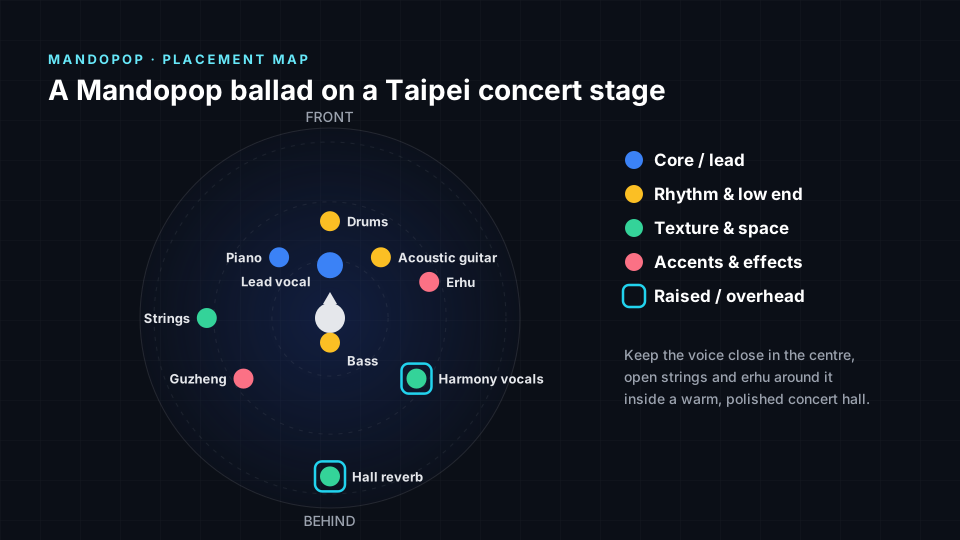
- Mandopop keeps the lead vocal close at the front centre with drums and bass on the centre line, piano and acoustic guitar on the front sides and strings, erhu and guzheng spread wide around the listener.
- Moving strings and harmonies away from the voice uses the cocktail party effect, so the brain can follow the tonal contours of a Mandarin lyric even in a lush chorus.
- In Mandopop the verse stays narrow and close, and the width opens only when the chorus, strings and harmonies arrive.
- The Mandopop immersion profile scores width 4, height 3, movement 2, low-end focus 3 and space 3 out of 5.
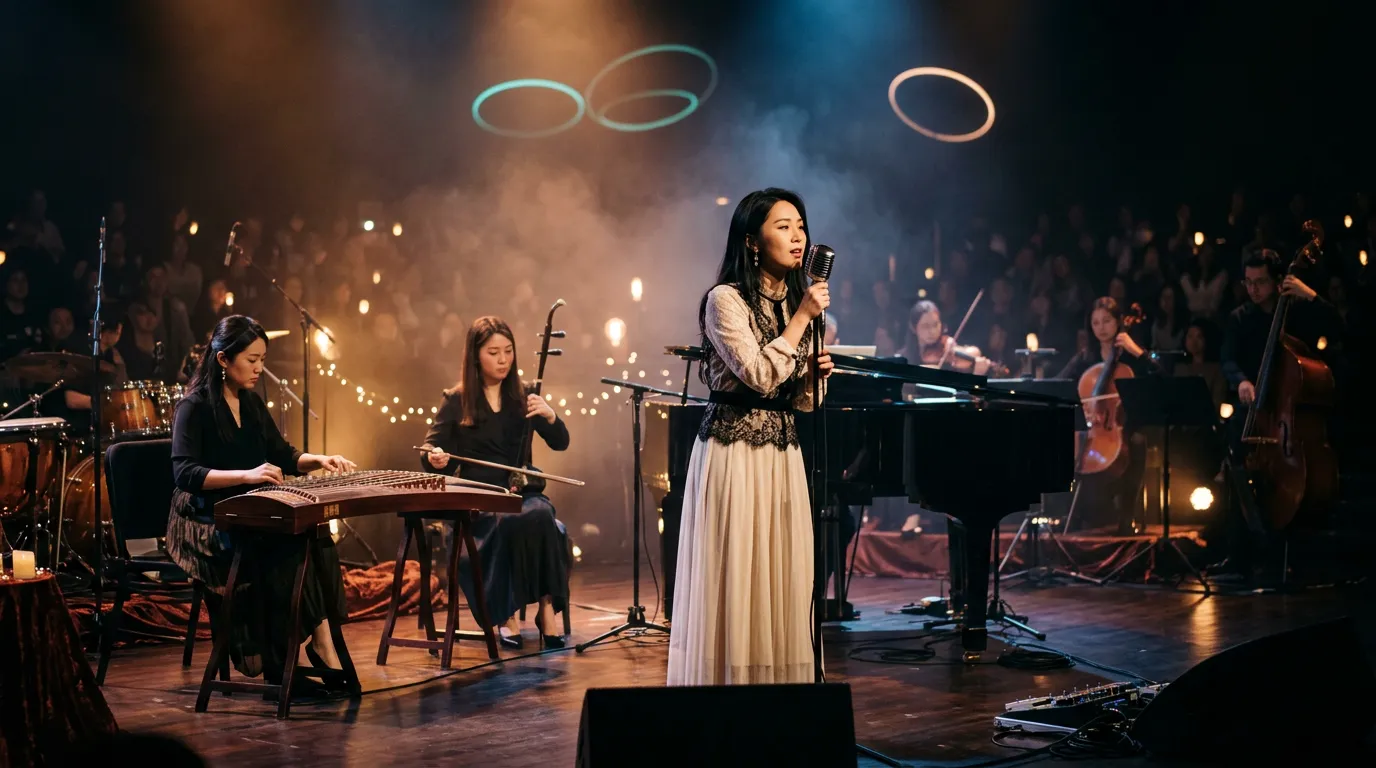
Mandopop is popular music sung in Mandarin Chinese. Its roots lie in 1920s and 1930s Shanghai, where the composer Li Jinhui blended Chinese folk melody with Western dance band music, and singers such as Zhou Xuan became film and radio stars. This early style is often called shidaiqu. After 1949 the industry moved to Hong Kong and Taiwan. In the 1970s and 1980s the Taiwanese singer Teresa Teng became the voice of the Chinese-speaking world, and her records spread into mainland China as it opened up. In Taiwan the campus song movement of the late 1970s, the label Rock Records, founded in 1980, and the songwriter Lo Ta-yu gave the music a new depth. From the 1990s Taipei became the centre of the industry, with stars such as Jacky Cheung, Faye Wong, A-mei and later Jay Chou, Jolin Tsai and the band Mayday. Today Mandopop is made in Taiwan, mainland China, Hong Kong, Singapore and Malaysia. Its sound runs from piano ballads to R&B, dance music and the Chinese-style fusion known as zhongguo feng, which brings in the erhu, guzheng, pipa and dizi. Mandopop suits spatial audio because the voice and the lyric are always the focus, while the arrangements are often lush and wide. This guide covers how spatial audio for Mandopop works, where to place each element and how to make an immersive Mandopop mix. For the basics, see what spatial audio is.
Why Mandopop works in spatial audio
Mandopop is built around the singer. Mandarin is a tonal language, and the meaning of each word depends on its pitch contour, so listeners follow the lyric closely. Around the voice, a typical song layers piano or acoustic guitar, a steady drum part, a warm bass line and, in the chorus, a string section and stacked harmonies. Zhongguo feng adds Chinese instruments that sit in the same range as the voice. In stereo all of this crowds into the middle, and the strings and erhu often mask the words. In an immersive mix the voice stays close and clear, the band sits just in front and the strings and Chinese instruments open up around the listener.
The rule: a close voice in the centre, the arrangement opening around it. Keep the lead vocal, drums and bass on the centre line, set piano and guitar to the front sides and let strings, erhu and guzheng widen the picture without crowding the lyric.
Immersive music for Mandopop: what listeners hear
- A voice that feels near. The lead vocal sits close and centred, so every word and breath is clear, as if the singer is in the room.
- A chorus that opens up. When the strings and harmonies enter, the sound widens around the listener, which gives the big chorus its lift.
- Chinese colours in their own places. The erhu sings from the right, the guzheng plucks from behind left, so they answer the voice without hiding it.
- A steady, polished floor. Drums and bass hold the centre, keeping the groove tight under even the widest arrangement.
Where to place each element in a Mandopop mix
| Element | Position | Height | Why it works |
|---|---|---|---|
| Lead vocal | Front centre | Ear level | The lyric is the heart of every song |
| Drums | Front centre, further back | Ear level | A steady beat behind the singer |
| Bass | Centre | Low | A warm, solid floor for the harmony |
| Piano | Front left | Ear level | The main chord part in ballads |
| Acoustic guitar | Front right | Ear level | Rhythm and sparkle that balance the piano |
| Strings | Wide left and around | Slightly raised | Lift and width for the chorus |
| Erhu | Right | Ear level | A singing line that answers the voice |
| Guzheng | Behind left | Ear level | Plucked texture in zhongguo feng |
| Harmony vocals | Behind right | Raised | Stacked voices that open the chorus |
| Hall reverb | Behind | Raised | A polished space around the whole song |
The psychoacoustics behind Mandopop placement
Every position in the table above follows how the ear and brain locate sound. Here is the reason behind the main choices for Mandopop.
- Bass and kick stay centred. The ear finds almost no direction in frequencies below roughly 80 to 100 Hz, so spreading the low end adds nothing and can make the floor feel loose. A centred bass keeps the ballad steady (Blauert).
- A clear lyric among many parts. The brain can pick out one voice among many, and it does this better when the competing sounds come from other directions. This is the cocktail party effect (Bronkhorst). Moving strings and harmonies away from the centre keeps the tonal contours of Mandarin easy to follow.
- Erhu and voice in different places. The brain sorts sounds into streams by pitch, timbre and direction. This is auditory stream segregation (Bregman). The erhu sits in the same range as a singing voice, so giving it its own position lets the ear hear two lines instead of one blur.
- Harmonies that feel above. The outer ear shapes high frequencies differently for sounds from above, and the brain reads these spectral cues as height. This is median plane localization by spectral cues (Hebrank and Wright). Lifting the harmony vocals and the hall a little makes the chorus feel taller without moving the lead.
The immersion profile for Mandopop
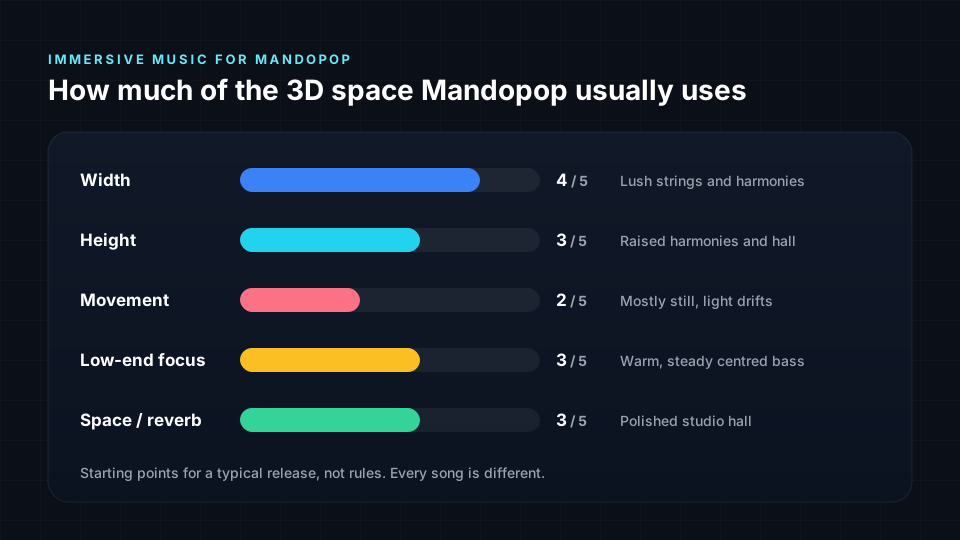
Width scores 4 because Mandopop arrangements are lush, with strings, harmonies, piano, guitar and Chinese instruments that can fill a wide circle around the voice. Height is 3: stacked harmonies, string pads and reverb can rise a little above the listener, but the core of the song stays at ear level. Movement is 2, since most parts hold still, with only small drifts from an erhu line or an effect in a bridge. Low-end focus is 3, because ballads need a warm, steady bass and the more modern R&B and dance songs push it further, yet the bass rarely dominates. Space is 3, a polished studio hall that flatters the voice without washing out the words.
Tips for an immersive Mandopop mix
- Keep the voice close. Place the lead vocal at the front centre with little reverb on its direct sound, so the lyric stays easy to follow.
- Spread the chorus, not the verse. Keep the verse narrow and let strings and harmonies open around the listener when the chorus arrives.
- Give Chinese instruments their own seat. Put the erhu, guzheng, pipa or dizi to the sides or behind, away from the voice, so their lines answer rather than mask.
- Hold the low end steady. Keep the bass and kick centred and tight, even in a wide arrangement.
- Use a clean, warm hall. A moderate reverb suits Mandopop, but keep it behind and slightly raised so the voice stays dry and present.
Mandopop styles: C-Pop ballads, Taiwanese pop and Zhongguo feng
The core placement holds for every style here: the voice close and centred, the low end steady, the arrangement around it. What changes is the size of the arrangement, the role of Chinese instruments and how much space the style needs.
C-Pop Ballads
The love ballad is the backbone of Mandopop. Teresa Teng's gentle recordings, such as The Moon Represents My Heart, set the model of a soft, close voice over strings. In the 1990s Jacky Cheung's Mandarin album Goodbye Kiss became one of the best-selling Chinese records of its time, and later singers such as Faye Wong, Stefanie Sun and JJ Lin, both from Singapore, carried the ballad into a new century. A ballad often starts with only piano and voice and builds to a full chorus with strings, drums and harmonies. Keep the voice close and dry at the front centre, the piano front left and the strings narrow in the verse. When the chorus arrives, let the strings spread wide and the harmonies rise behind, so the song grows around the listener while the voice stays in place.
Taiwanese Pop
From the 1980s Taipei became the creative centre of Mandopop. Rock Records and other labels developed songwriters such as Lo Ta-yu, whose 1982 debut album brought social comment into Mandarin songs. In the 1990s and 2000s Taiwanese pop produced A-mei, Jolin Tsai, the group S.H.E and the band Mayday, and mixed ballads with dance, R&B and rock. Alongside Mandarin, Taiwan has its own songs in Taiwanese Hokkien, sung by stars such as Jody Chiang, with melodies that show the influence of Japanese enka from the colonial period. For dance and R&B tracks, keep the beat and bass firm in the centre, place synths and guitars to the front sides and add small effects behind. For band songs, place two guitars left and right in front and keep the vocal close. For Hokkien songs, keep the voice warm and centred with the accompaniment arranged gently around it.
Zhongguo Feng
Zhongguo feng, meaning China wind, is a style that blends pop, R&B and hip hop with Chinese melody, instruments and poetic lyrics. It became popular in the 2000s, led by Jay Chou and the lyricist Vincent Fang, with songs such as East Wind Breaks and Blue and White Porcelain, which won Fang the best lyricist prize at the 19th Golden Melody Awards. Wang Leehom explored a related sound on his albums Shangri-La and Heroes of Earth. The style uses the erhu, guzheng, pipa and dizi alongside piano, strings and modern drums. Keep the voice and beat in the centre, the erhu to one side, the guzheng or pipa behind on the other and the dizi slightly raised. A light, wide hall gives the Chinese instruments air, and a gentle drift on the erhu adds a little motion.
Related traditions such as Cantopop in Hong Kong and the Chinese traditional instrumental repertoire follow a similar idea: keep the lead line close and centred and let the supporting instruments surround the listener in a clear room.
How to make immersive Mandopop from stereo
Spatial9 can create spatial audio from a stereo track in a few steps:
- Upload your stereo master or your stems.
- Spatial9's AI separates and places each part, pulling the lead vocal, harmonies, piano, strings, erhu and beat apart, keeping the voice close and centred and opening the arrangement around it.
- Preview it in binaural on headphones.
- Export Eclipsa Audio, ADM, binaural or Ambisonics.
- Publish a video. Create a YouTube-ready video with your immersive audio and publish it directly.
For related guides, read spatial audio for Cantopop and spatial audio for K-pop. Every guide is listed in spatial audio and immersive music by genre.
Frequently asked questions
Does this guide cover C-Pop Ballads, Taiwanese Pop and Zhongguo Feng?
Yes. C-Pop ballads keep a close voice with piano and strings that widen in the chorus. Taiwanese pop adds dance beats, guitars and synths around a firm centre, as well as Hokkien songs with a warm, centred voice. Zhongguo feng places the erhu, guzheng, pipa and dizi at the sides and behind a centred voice and beat.
Can I make a Mandopop mix in Dolby Atmos or Eclipsa Audio?
Yes. The placements in this guide work for both. Spatial9 exports ADM, the standard file used by Dolby Atmos studios, as well as Eclipsa Audio for YouTube, so one immersive Mandopop mix covers both. If you plan to release the Atmos version on Apple Music, build it from your original stems or multitracks, because Apple does not accept Atmos made from a finished stereo master. See where to publish spatial audio. You may also hear this called a 3D Mandopop mix or Mandopop in spatial audio.
Is spatial audio good for Mandopop?
Yes. Mandopop puts the voice and the lyric first, but its arrangements are often rich and wide. Spatial audio lets the voice stay close and clear while the strings, harmonies and Chinese instruments open around the listener.
Where should the erhu go in an immersive Mandopop mix?
Put the erhu to one side, a little further back than the voice. It sings in a similar range, so a separate position stops it from masking the lyric and lets the two lines talk to each other.
Should the lead vocal have a lot of reverb?
Keep the direct voice fairly dry and close, and send the reverb to the hall behind and above. This keeps every syllable clear, which matters in a tonal language, while the song still sounds polished.
How is Mandopop different from Cantopop in spatial audio?
Both centre on a close lead voice. Mandopop often uses wider modern arrangements and, in zhongguo feng, Chinese instruments around the listener. Cantopop leans on a classic Hong Kong band and concert sound with a slightly narrower front stage and a big arena room.
Can I convert an old Mandopop recording to spatial audio?
Yes. Spatial9 uses AI to separate the voice, strings and band from a stereo or mono recording, including older Shanghai and Taiwan recordings. Separation is never perfect with old masters, so keep the layout simple and the room moderate.
Dolby and Dolby Atmos are trademarks of Dolby Laboratories. Spatial9 is not affiliated with or endorsed by Dolby Laboratories.
Sources
- Blauert, J. (1997). Spatial Hearing: The Psychophysics of Human Sound Localization, revised edition. MIT Press. Low-frequency, elevation, distance and motion cues.
- Mills, A. W. (1958). On the minimum audible angle. Journal of the Acoustical Society of America, 30(4), 237-246.
- Hebrank, J. and Wright, D. (1974). Spectral cues used in the localization of sound sources on the median plane. Journal of the Acoustical Society of America, 56(6), 1829-1834.
- Bronkhorst, A. W. (2000). The cocktail party phenomenon: a review of research on speech intelligibility in multiple-talker conditions. Acta Acustica united with Acustica, 86, 117-128.
- Barron, M. and Marshall, A. H. (1981). Spatial impression due to early lateral reflections in concert halls. Journal of Sound and Vibration, 77(2), 211-232.
- Neuhoff, J. G. (1998). Perceptual bias for rising tones. Nature, 395, 123-124.
- Bregman, A. S. (1990). Auditory Scene Analysis: The Perceptual Organization of Sound. MIT Press.
- Moskowitz, M. L. (2010). Cries of Joy, Songs of Sorrow: Chinese Pop Music and Its Cultural Connotations. University of Hawai'i Press.
- Jones, A. F. (2001). Yellow Music: Media Culture and Colonial Modernity in the Chinese Jazz Age. Duke University Press.
Take the stage
Upload a track to Spatial9 and hear the voice up close with strings and erhu opening around you in minutes. Then export it or publish it straight to YouTube.