Spatial Audio & Immersive Music for Sertanejo: Sertanejo Universitário, Modão & Feminejo
Spatial9 Team · · 11 min read
Part of the series Spatial audio and immersive music by genre.
Key takeaways
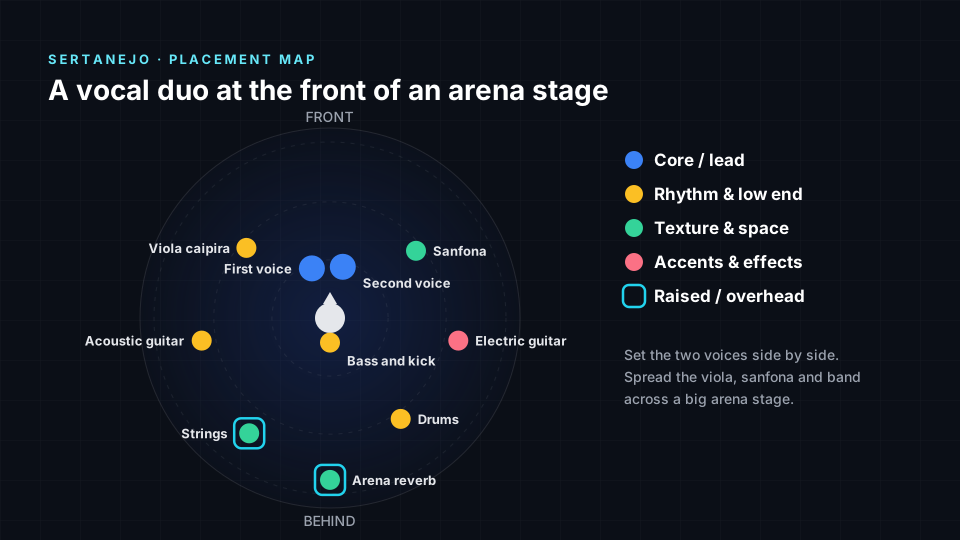
- In a spatial sertanejo mix the two voices of the dupla sit just either side of centre with the bass and kick in the middle, while the viola caipira, sanfona, guitars and drums spread around the listener.
- Because the ear resolves front positions to about one degree, an effect known as the minimum audible angle, a small gap between the two singers gives each a place without breaking the harmony.
- Sertanejo is a duet music often recorded live in front of huge crowds, so the room should be a large, warm arena with raised strings and the audience behind the listener.
- The sertanejo immersion profile scores width 4, height 3, movement 2, low-end focus 3 and space 4 out of 5.
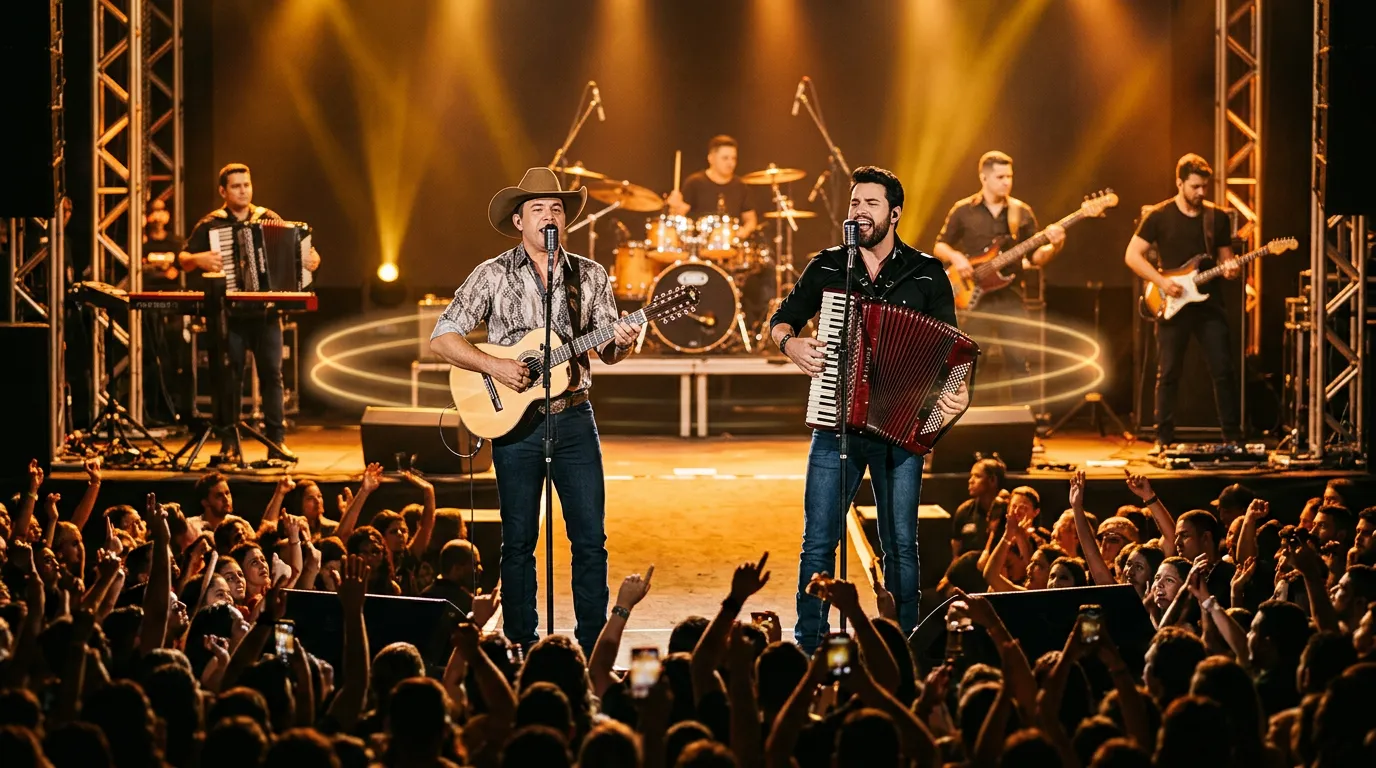
Sertanejo is the country music of Brazil, and today it is the most popular music in the country. Its roots lie in música caipira, the rural song of the interior of São Paulo, Minas Gerais, Goiás and Paraná, first recorded in 1929 when the writer Cornélio Pires produced a series of records of caipira singers. The heart of the style is the dupla, a duo singing in close parallel harmony, usually a third apart, over the viola caipira, a ten-string guitar tuned in open chords. Tonico & Tinoco became the classic duo from the 1940s, and Tião Carreiro & Pardinho made the pagode de viola famous. In the 1980s and 1990s duplas such as Chitãozinho & Xororó, Leandro & Leonardo and Zezé Di Camargo & Luciano added drums, electric guitar, keyboards and string sections, borrowing from American country and pop ballads. Songs are mostly about love, longing and heartbreak, a mood Brazilians call sofrência. Modern sertanejo is often released as live albums and concert videos, recorded in front of huge crowds. It suits spatial audio because it is already a stage music: two voices in front, a full band around them and an audience singing every word. This guide covers how spatial audio for sertanejo works, where to place each element and how to make an immersive sertanejo mix. For the basics, see what spatial audio is.
Why sertanejo works in spatial audio
Sertanejo is a duet first. The two singers trade verses, then join in thirds for the chorus, and that blended sound is the signature of every dupla. Around them the viola caipira rings out its open strings, the sanfona plays answering fills, the acoustic guitar strums and the electric guitar adds country licks, all over a solid pop rhythm section. In stereo the voices sit on top of each other and the band is squeezed into a wall behind them. In an immersive mix the two voices sit just apart at the front, close enough to blend, while the band spreads out around them and the arena opens up behind.
The rule: two voices side by side at the front, the band and the crowd spread wide around them. Keep the dupla close and centred, give the viola and sanfona their own sides, and set the whole show in a big, warm arena.
Immersive music for sertanejo: what listeners hear
- Two voices in front of you. The dupla stands just either side of centre, so each singer has a place yet the harmony still sounds like one voice.
- A band that surrounds the stage. Viola caipira, sanfona and guitars come from their own directions instead of one dense wall.
- Strings that lift the chorus. In the big ballads, the string section rises slightly above the band as the song builds.
- An arena around you. A wide, long reverb and the crowd singing along place you inside a sold-out live show.
Where to place each element in a sertanejo mix
| Element | Position | Height | Why it works |
|---|---|---|---|
| First voice | Front, just left of centre | Ear level | The lead melody of the dupla |
| Second voice | Front, just right of centre | Ear level | The harmony a third away, blending with the lead |
| Bass and kick | Centre | Ear level | The steady pop pulse under the band |
| Viola caipira | Front left | Ear level | The ringing open strings of the caipira tradition |
| Sanfona | Front right | Ear level | Answering fills and countermelodies |
| Acoustic guitar | Left | Ear level | Rhythm strums under the voices |
| Electric guitar | Right | Ear level | Country licks and ballad solos |
| Drums | Behind right | Ear level | Snare and cymbals of the live band |
| Strings | Behind left | Raised | Swelling pads that lift the chorus |
| Arena reverb | Behind | Raised | The size and roar of a live show |
The psychoacoustics behind sertanejo placement
Every position in the table above follows how the ear and brain locate sound. Here is the reason behind the main choices for sertanejo.
- Bass and kick stay centred. The ear finds almost no direction in frequencies below roughly 80 to 100 Hz, so the bass and kick gain nothing from being spread and stay strongest in the middle.
- The two voices only slightly apart. The ear can detect a change of only about one degree for sounds straight ahead. This is the minimum audible angle (Mills). A small gap either side of centre is enough to give each singer a place without breaking the blend of the harmony.
- Lead voices clear above the crowd. The brain can follow one voice among many by its direction and character. This is the cocktail party effect (Bronkhorst). Keeping the dupla at the front and the crowd singing behind lets the listener hear both the singers and the audience without confusion.
- A wide arena with side reflections. Early reflections arriving from the sides make a sound feel wider and more enveloping. This is spatial impression from early lateral reflections (Barron and Marshall). Strong side reflections give the ballads the scale of a live arena show.
The immersion profile for sertanejo
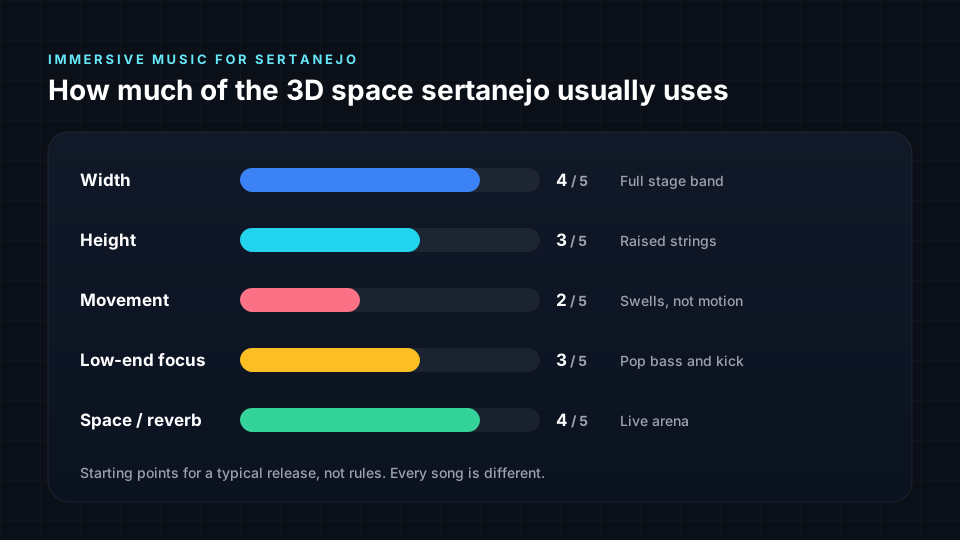
Width scores 4 because the modern band spreads across a full stage around the dupla. Space also scores 4: sertanejo is often recorded live in arenas, and the ballads need a large, warm reverb. Height is 3, with strings and the arena lifted above the band. Low-end focus is 3, since the bass and kick give a solid pop pulse without dominating. Movement scores 2, because the voices and band stay where they are and the drama comes from the songs and the swells, not from sounds flying around the head.
Tips for an immersive sertanejo mix
- Keep the dupla close together. Place the voices just either side of centre so the harmony stays one sound.
- Give the viola caipira its own side. Its open strings are the link to the caipira tradition, so let them ring clearly at the front.
- Set the sanfona opposite the viola. The two answer each other, and splitting them stops their fills from masking.
- Raise the strings for the chorus. A slight lift above the band makes the big ballad moments open up.
- Use a large, warm arena room. Put the crowd behind the listener on live recordings, but keep it lower than the voices.
Sertanejo styles: sertanejo universitário, modão and feminejo
The core placement holds for every style here: two voices at the front, bass in the middle, the band around them. What changes is the size of the band, the weight of the beat and how big the room should be.
Sertanejo Universitário
Sertanejo universitário took shape in the mid 2000s in the university towns of the Centre-West, in states such as Goiás and Mato Grosso do Sul, before taking over the national charts. Artists such as Jorge & Mateus, Luan Santana and Michel Teló, whose Ai Se Eu Te Pego became a worldwide hit in 2011, mixed the dupla tradition with pop, upbeat dance rhythms and a polished live sound. This is the widest style: spread the guitars, keys and sanfona around the sides, keep a firm bass and kick in the centre and use a big arena reverb with the crowd behind.
Modão
Modão is the name fans use for the old-school sertanejo songs and the caipira style behind them: slow, sorrowful songs about love and the countryside, built around the viola caipira and two voices in thirds. It is the music of bars and late-night singalongs as much as of records. Keep it simple and close: the dupla near the centre, the viola caipira prominent in front, an acoustic guitar opposite and only a light, warm room. Little or no drum kit is needed.
Feminejo
Feminejo is the name given to the wave of women artists who reshaped sertanejo in the 2010s, led by Marília Mendonça, Maiara & Maraisa and Simone & Simaria. They sang about heartbreak and independence from a woman's point of view, often with the raw emotion of sofrência ballads. Treat it like modern sertanejo, with a full band and an arena room, but keep the lead voice slightly closer and more central, since many songs are carried by one powerful singer rather than an equal duo.
Related styles such as música caipira, pagode de viola and arrocha follow the same idea: keep the voices close at the front and let the band and room support the emotion of the song.
How to make immersive sertanejo from stereo
Spatial9 can create spatial audio from a stereo track in a few steps:
- Upload your stereo master or your stems.
- Spatial9's AI separates and places each part, pulling the two voices, viola caipira, sanfona, guitars, bass and drums apart, even from live arena recordings, and setting the dupla at the front with the band and crowd around the listener.
- Preview it in binaural on headphones.
- Export Eclipsa Audio, ADM, binaural or Ambisonics.
- Publish a video. Create a YouTube-ready video with your immersive audio and publish it directly.
For related guides, read spatial audio for country and spatial audio for forró. Every guide is listed in spatial audio and immersive music by genre.
Frequently asked questions
Does this guide cover sertanejo universitário, modão and feminejo?
Yes. Sertanejo universitário takes the widest layout with a big arena and crowd. Modão keeps the dupla and viola caipira close in a small, warm room. Feminejo uses a full band and arena with the lead voice a little closer and more central.
Can I make a sertanejo mix in Dolby Atmos or Eclipsa Audio?
Yes. The placements in this guide work for both. Spatial9 exports ADM, the standard file used by Dolby Atmos studios, as well as Eclipsa Audio for YouTube, so one immersive sertanejo mix covers both. If you plan to release the Atmos version on Apple Music, build it from your original stems or multitracks, because Apple does not accept Atmos made from a finished stereo master. See where to publish spatial audio. You may also hear this called a 3D sertanejo mix or sertanejo in spatial audio.
Is spatial audio good for sertanejo?
Yes. Sertanejo layers two voices, viola, sanfona, guitars and a full band into one big, emotional sound. Spatial audio gives each part its own direction, so the harmony stays clear and the live show feels real.
How far apart should the two voices of a dupla be?
Only a little. Place them a short step either side of the centre, close enough that the harmony fuses into one sound. Spreading them wide breaks the blend that defines the style.
Where should the viola caipira go in an immersive sertanejo mix?
Put it on one front side at ear level, opposite the sanfona, so its ringing open strings stay clear. In modão and older recordings it can move closer to the centre, since it carries the whole arrangement.
How is sertanejo different from American country music in spatial audio?
The layouts are similar, with a band around a central voice. Sertanejo is usually built around a duo singing in thirds rather than one singer, uses the viola caipira and sanfona, and is often recorded live in arenas, so it suits a bigger room and a crowd behind the listener.
Can I convert a live sertanejo concert recording to spatial audio?
Yes. Spatial9 uses AI to separate the voices, band and crowd from a stereo master. Live recordings carry a lot of crowd noise, so keep the audience behind the listener and lower than the dupla.
Dolby and Dolby Atmos are trademarks of Dolby Laboratories. Spatial9 is not affiliated with or endorsed by Dolby Laboratories.
Sources
- Blauert, J. (1997). Spatial Hearing: The Psychophysics of Human Sound Localization, revised edition. MIT Press. Low-frequency, elevation, distance and motion cues.
- Mills, A. W. (1958). On the minimum audible angle. Journal of the Acoustical Society of America, 30(4), 237-246.
- Hebrank, J. and Wright, D. (1974). Spectral cues used in the localization of sound sources on the median plane. Journal of the Acoustical Society of America, 56(6), 1829-1834.
- Bronkhorst, A. W. (2000). The cocktail party phenomenon: a review of research on speech intelligibility in multiple-talker conditions. Acta Acustica united with Acustica, 86, 117-128.
- Litovsky, R. Y., Colburn, H. S., Yost, W. A. and Guzman, S. J. (1999). The precedence effect. Journal of the Acoustical Society of America, 106(4), 1633-1654.
- Barron, M. and Marshall, A. H. (1981). Spatial impression due to early lateral reflections in concert halls. Journal of Sound and Vibration, 77(2), 211-232.
- Neuhoff, J. G. (1998). Perceptual bias for rising tones. Nature, 395, 123-124.
- Bregman, A. S. (1990). Auditory Scene Analysis: The Perceptual Organization of Sound. MIT Press.
- Dent, A. S. (2009). River of Tears: Country Music, Memory, and Modernity in Brazil. Duke University Press.
Sing along with the dupla
Upload a track to Spatial9 and hear the two voices, the viola caipira and the arena crowd surround you in minutes. Then export it or publish it straight to YouTube.