Spatial Audio & Immersive Music for Gamelan: Javanese Gamelan, Balinese Gong Kebyar & Sundanese Degung
Spatial9 Team · · 12 min read
Part of the series Spatial audio and immersive music by genre.
Key takeaways
- In an immersive gamelan mix the gong ageng sits low in the centre, the singer and rebab lead from the front and the saron, bonang, gender and kenong form a wide arc around the listener.
- Because the brain separates sounds into streams by direction as well as pitch, a process called auditory stream segregation, giving each bronze layer its own place lets the slow melody and fast decoration stay clear.
- Keep the instruments still and let the interlocking patterns, gong cycles and tempo changes create the motion, inside a large open pavilion where the bronze can ring.
- The gamelan immersion profile scores width 5, height 3, movement 2, low-end focus 4 and space 4 out of 5.
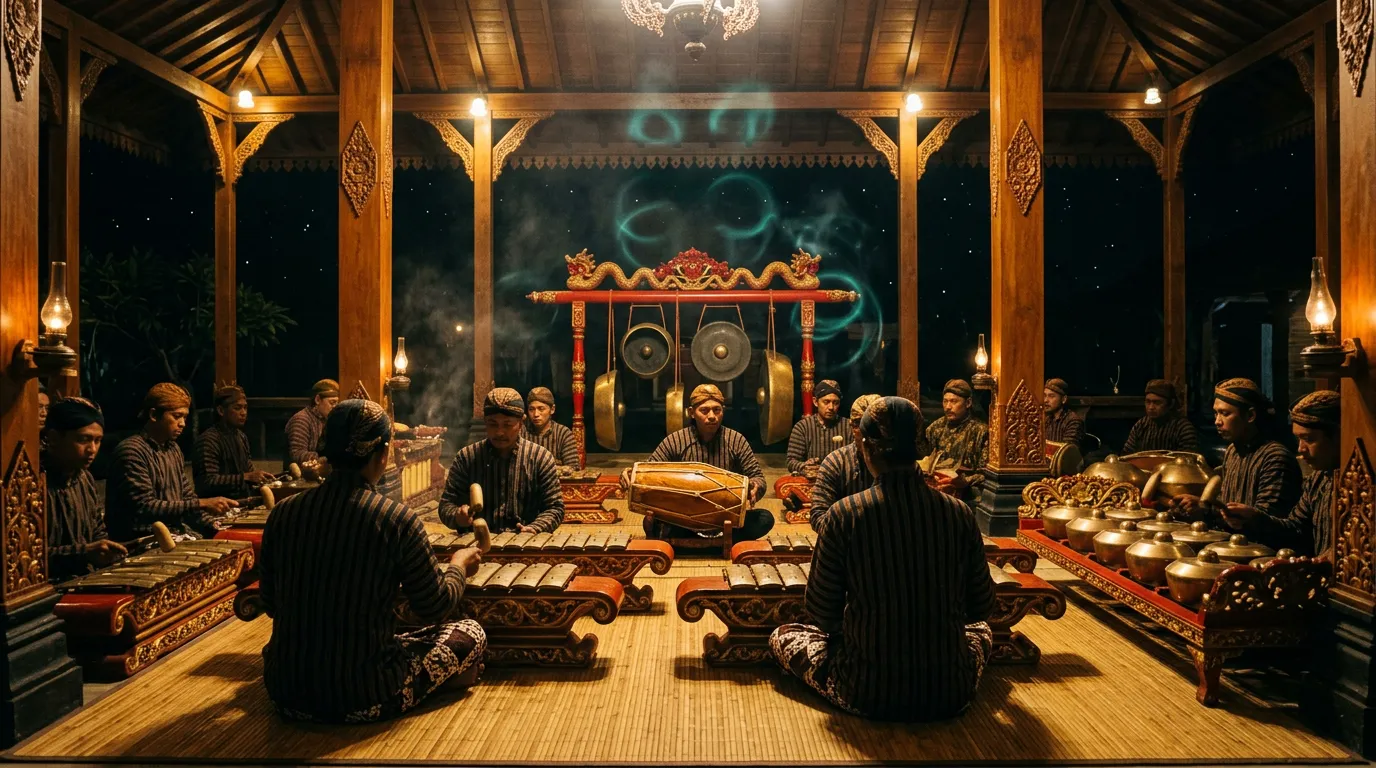
Gamelan is the orchestral music of Indonesia, played mostly on tuned bronze instruments: metallophones with keys over resonators, gong-chimes made of rows of kettle gongs, and hanging gongs, joined by drums, bowed and plucked strings, a bamboo flute and voices. The best-known traditions come from the islands of Java and Bali. In Central Java the courts of Yogyakarta and Surakarta, also called Solo, kept large gamelan sets for centuries, and the music still accompanies dance, ceremonies and wayang kulit, the night-long shadow puppet play led by a dalang. Each set is tuned as a unit, in slendro, a five-tone system, or pelog, a seven-tone system, so instruments are rarely swapped between ensembles. A single gong ageng, the largest gong, marks the end of each long cycle, while smaller gongs divide the cycle into regular points. In West Java the Sundanese developed their own ensembles, and in Bali the explosive gong kebyar style appeared in the north of the island around 1915. Western listeners took note early: Claude Debussy heard a Javanese gamelan at the Paris Exposition Universelle in 1889, and the music later shaped composers such as Colin McPhee, Lou Harrison and Steve Reich. In 2021 UNESCO added gamelan to its list of intangible cultural heritage. Gamelan suits spatial audio because the players sit on the floor in a wide group, many parts interlock across the ensemble and the bronze needs a big room to bloom. This guide covers how spatial audio for gamelan works, where to place each element and how to make an immersive gamelan mix. For the basics, see what spatial audio is.
Why gamelan works in spatial audio
Gamelan is built in layers that move at different speeds. A core melody, the balungan, is played on the saron and demung. Above it, the bonang, gender and gambang play faster patterns that fill in and decorate the melody. Below it, the kenong, kempul and gong ageng mark the structure in a slow, steady cycle. The kendhang drummer leads, signalling changes of tempo and density, while the rebab, suling and singers float freely over the top. In stereo all of this bronze piles up between two speakers. In an immersive mix each layer gets its own place, so the ear can follow the melody, the decoration and the gong cycle at the same time.
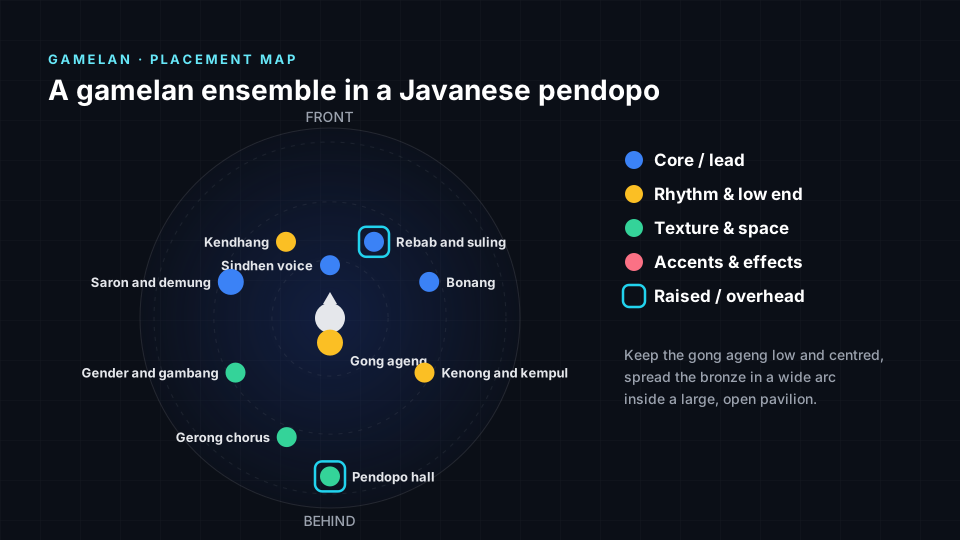
The rule: the gong at the heart, the bronze in a wide circle. Keep the gong ageng low and centred, spread the metallophones and gong-chimes in a broad arc on both sides and set the whole ensemble inside a large, open room.
Immersive music for gamelan: what listeners hear
- A gong you feel more than hear. The gong ageng sits low and centred, so its deep, slow stroke lands like a breath at the end of every cycle.
- Bronze on every side. The saron, bonang, gender and kenong ring from left, right and behind, so the listener sits inside the ensemble rather than in front of it.
- Interlocking parts that stay clear. Fast patterns shared between instruments come from different places, so the ear can hear how they fit together instead of a single blur.
- A slow shimmer in the room. The bronze tails hang in the air and gently beat against each other, which gives the music a living, glowing quality without any need to move sounds around.
Where to place each element in a gamelan mix
| Element | Position | Height | Why it works |
|---|---|---|---|
| Sindhen voice | Front centre | Ear level | The solo singer whose line floats over the ensemble |
| Gong ageng | Centre | Low | The deep gong that closes each cycle |
| Kendhang | Front left | Ear level | The drummer who leads tempo and changes |
| Rebab and suling | Front right | Raised | Bowed fiddle and flute that guide the melody |
| Saron and demung | Left | Ear level | The core melody on loud bronze keys |
| Bonang | Right | Ear level | Gong-chime patterns that anticipate the melody |
| Gender and gambang | Behind left | Ear level | Soft, fast decoration under the voice |
| Kenong and kempul | Behind right | Ear level | Gongs that divide the cycle into parts |
| Gerong chorus | Behind left | Ear level | Male unison voices that answer the singer |
| Pendopo hall | Behind | Raised | An open pavilion where the bronze can bloom |
The psychoacoustics behind gamelan placement
Every position in the table above follows how the ear and brain locate sound. Here is the reason behind the main choices for gamelan.
- Gong ageng stays centred. The ear finds almost no direction in frequencies below roughly 80 to 100 Hz, so the deep fundamental of the great gong gains nothing from being spread. Keeping it centred makes each gong stroke feel solid and calm (Blauert).
- Layers in different places. The brain groups sounds into streams by pitch, timing and direction. This is auditory stream segregation (Bregman). Setting the saron, bonang and gender apart lets the ear follow the slow melody and the fast decoration as separate lines, even though they share the same bronze tone.
- Wide enough to tell instruments apart. The ear can only separate two sources in front of the listener when they are a few degrees apart, and it needs more distance toward the sides. This is the minimum audible angle (Mills). Spreading the metallophones in a broad arc, rather than a narrow cluster, keeps similar bronze timbres from merging.
- A room with side reflections. Early reflections arriving from the sides make a sound feel wider and more enveloping. This is spatial impression from early lateral reflections (Barron and Marshall). A pendopo or hall with clear side reflections gives the ensemble its glow while keeping the attacks of the keys clean.
The immersion profile for gamelan
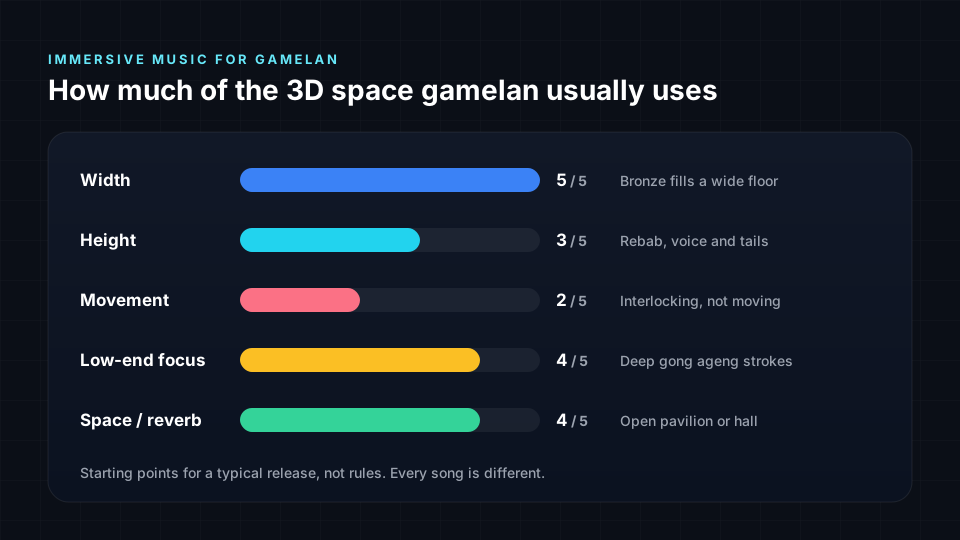
Width scores 5 because a full gamelan fills a wide floor, with metallophones, gong-chimes and hanging gongs set out on every side of the players. Low-end focus scores 4: the gong ageng and the large kempul carry deep, long tones that ground the whole cycle, though the music is not driven by a constant bass line. Space is 4, since gamelan is usually heard in a pendopo, a large open-sided pavilion, or in a hall, and the ringing bronze depends on that room. Height is 3, from the rebab, suling and voices floating above the bronze and the tails rising into the roof. Movement is 2, because the instruments stay in place and the motion comes from patterns passing between them and from changes of tempo, not from sounds travelling around the listener.
Tips for an immersive gamelan mix
- Anchor the gong ageng. Keep it centred, close and low, and give its long tail room to decay before the next cycle.
- Spread the bronze wide. Place the saron and bonang on opposite sides and the gender and kenong behind, so each layer of the texture has its own direction.
- Keep interlocking pairs apart. When two instruments share a fast pattern, set them a little apart so the listener can hear the hand-off between them.
- Let the drummer lead from the front. Keep the kendhang clear and slightly forward, because every change in tempo and density follows its signals.
- Use a large but gentle room. A moderate, open reverb suits gamelan, but keep the low end of the reverb short and avoid long, bright tails that smear the bronze.
Gamelan styles: Javanese gamelan, Balinese gong kebyar and Sundanese degung
The core placement holds for every style here: the deepest gong at the centre, the lead melody at the front and the bronze spread around the listener. What changes is the size of the ensemble, the speed and attack of the playing and how much room the style needs.
Javanese Gamelan
Central Javanese gamelan is known for its calm, layered sound. The music is organised in gong cycles: the gong ageng closes each cycle, while the kenong, kempul and ketuk mark regular points inside it. The saron and demung play the balungan, and the soft instruments, the gender, gambang, rebab, suling, celempung and voices, weave around it. The kendhang moves the music between levels of density called irama, so a piece can slow down and open out into long, quiet passages. Place the gong ageng low in the centre, the sindhen and rebab at the front, the loud saron to one side and the bonang to the other, with the gender and gambang closer and softer than the bronze keys. A large pendopo room suits the style.
Balinese Gong Kebyar
Gong kebyar emerged in north Bali, in the Buleleng region, around 1915. The word kebyar suggests a sudden burst or flare, and the music lives up to it, with explosive unison strikes, sudden stops and fast changes of tempo and dynamics. The gangsa metallophones play kotekan, fast interlocking patterns in which two parts, polos and sangsih, combine into a single line. The reyong, a row of kettle gongs shared by four players, adds bright, rhythmic accents, and the ceng-ceng cymbals add crash. Instruments are tuned in pairs, one a little higher than the other, so the bronze shimmers with a fast beating known as ombak, or waves. In 1925 the dancer I Ketut Marya, known as I Mario, first performed the kebyar duduk dance to this music. Place the paired gangsa wide on both sides so the kotekan can be heard as two interlocking halves, the reyong to one side, the kendang pair at the front and the gong in the centre. Gong kebyar is louder and brighter than Javanese gamelan, so it can take a slightly drier room and a little more movement in its fast passages.
Sundanese Degung
Gamelan degung comes from the Sundanese people of West Java. It developed in the nineteenth century at the courts of the regents who ruled local districts under Dutch colonial rule, with Cianjur and Bandung both important centres. After the 1920s the Bandung tradition spread widely. The ensemble is smaller and gentler than a Javanese set: bonang, saron and peking, the low hanging jenglong, a gong, kendang drums and the suling degung, a bamboo flute with four finger holes that carries much of the melody. It is tuned in its own five-tone scale, laras degung. The older instrumental style is often called degung klasik, and later forms added singers. Put the suling at the front and slightly raised, the bonang and saron on opposite sides, the jenglong and gong low near the centre and the kendang close to the front. Degung is intimate, so a warm, mid-sized room works better than a vast hall.
Related Balinese ensembles, such as gamelan angklung and gamelan semar pegulingan, follow the same idea: the deepest gong in the centre and the bronze around the listener.
How to make immersive gamelan from stereo
Spatial9 can create spatial audio from a stereo track in a few steps:
- Upload your stereo master or your stems.
- Spatial9's AI separates and places each part, pulling the gongs, metallophones, drums, rebab, flute and voices apart even from field recordings, and setting the bronze in a wide arc around a centred gong ageng.
- Preview it in binaural on headphones.
- Export Eclipsa Audio, ADM, binaural or Ambisonics.
- Publish a video. Create a YouTube-ready video with your immersive audio and publish it directly.
For related guides, read spatial audio for taiko and spatial audio for minimalism. Every guide is listed in spatial audio and immersive music by genre.
Frequently asked questions
Does this guide cover Javanese Gamelan, Balinese Gong Kebyar and Sundanese Degung?
Yes. Javanese gamelan seats the gong ageng in the centre with the saron and bonang on opposite sides inside a large pendopo. Balinese gong kebyar spreads the paired gangsa wide so the kotekan is clear. Sundanese degung puts the suling at the front in a warmer, smaller room.
Can I make a gamelan mix in Dolby Atmos or Eclipsa Audio?
Yes. The placements in this guide work for both. Spatial9 exports ADM, the standard file used by Dolby Atmos studios, as well as Eclipsa Audio for YouTube, so one immersive gamelan mix covers both. If you plan to release the Atmos version on Apple Music, build it from your original stems or multitracks, because Apple does not accept Atmos made from a finished stereo master. See where to publish spatial audio. You may also hear this called a 3D gamelan mix or gamelan in spatial audio.
Is spatial audio good for gamelan?
Yes. Gamelan is played by a large group seated around the listener's space, with many layers of bronze that move at different speeds. Spatial audio gives each layer its own place and lets the ringing tails bloom in a real room instead of piling up between two speakers.
Where should the gong ageng go in an immersive gamelan mix?
Put the gong ageng in the centre, close and low. Its deepest tone carries little direction, and the whole cycle depends on its stroke feeling calm and solid.
How is gamelan different from taiko in spatial audio?
Gamelan is a tuned bronze ensemble with layered melodies, a slow gong cycle and soft instruments that need space to ring, so it suits a wide, calm circle around a centred gong. Taiko is built on large drums and physical movement on stage, so it suits a heavier low end and more motion.
Can I convert an old gamelan field recording to spatial audio?
Yes. Spatial9 uses AI to separate the gongs, metallophones, drums and voices from a stereo or mono recording. Separation is never perfect with many bronze instruments sharing similar tones, so keep the layout simple and the room moderate.
Dolby and Dolby Atmos are trademarks of Dolby Laboratories. Spatial9 is not affiliated with or endorsed by Dolby Laboratories.
Sources
- Blauert, J. (1997). Spatial Hearing: The Psychophysics of Human Sound Localization, revised edition. MIT Press. Low-frequency, elevation, distance and motion cues.
- Mills, A. W. (1958). On the minimum audible angle. Journal of the Acoustical Society of America, 30(4), 237-246.
- Hebrank, J. and Wright, D. (1974). Spectral cues used in the localization of sound sources on the median plane. Journal of the Acoustical Society of America, 56(6), 1829-1834.
- Bronkhorst, A. W. (2000). The cocktail party phenomenon: a review of research on speech intelligibility in multiple-talker conditions. Acta Acustica united with Acustica, 86, 117-128.
- Barron, M. and Marshall, A. H. (1981). Spatial impression due to early lateral reflections in concert halls. Journal of Sound and Vibration, 77(2), 211-232.
- Neuhoff, J. G. (1998). Perceptual bias for rising tones. Nature, 395, 123-124.
- Bregman, A. S. (1990). Auditory Scene Analysis: The Perceptual Organization of Sound. MIT Press.
- Sumarsam (1995). Gamelan: Cultural Interaction and Musical Development in Central Java. University of Chicago Press.
- Tenzer, M. (2000). Gamelan Gong Kebyar: The Art of Twentieth-Century Balinese Music. University of Chicago Press.
Sit among the bronze
Upload a track to Spatial9 and hear the gong ageng at the centre with the bronze ringing around you in minutes. Then export it or publish it straight to YouTube.