Spatial Audio & Immersive Music for Vallenato: Paseo, Puya & Vallenato Romántico
Spatial9 Team · · 10 min read
Part of the series Spatial audio and immersive music by genre.
Key takeaways
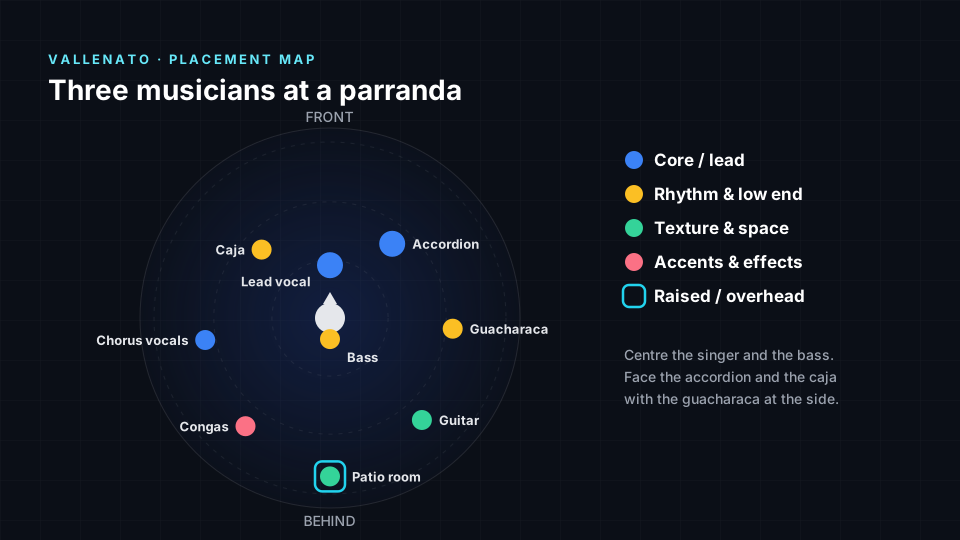
- In a spatial vallenato mix the lead vocal and the bass stay centred, the accordion and the caja face each other at the front and the guacharaca scrapes from the side.
- Because the brain sorts sounds into streams by pitch, timing and direction, an effect known as auditory stream segregation, giving the caja and the guacharaca their own sides lets the ear follow both rhythms under the accordion.
- Vallenato is the music of the parranda, a gathering of friends around three musicians, so the space should be close and warm, like a patio rather than a concert hall.
- The vallenato immersion profile scores width 3, height 2, movement 2, low-end focus 3 and space 2 out of 5.
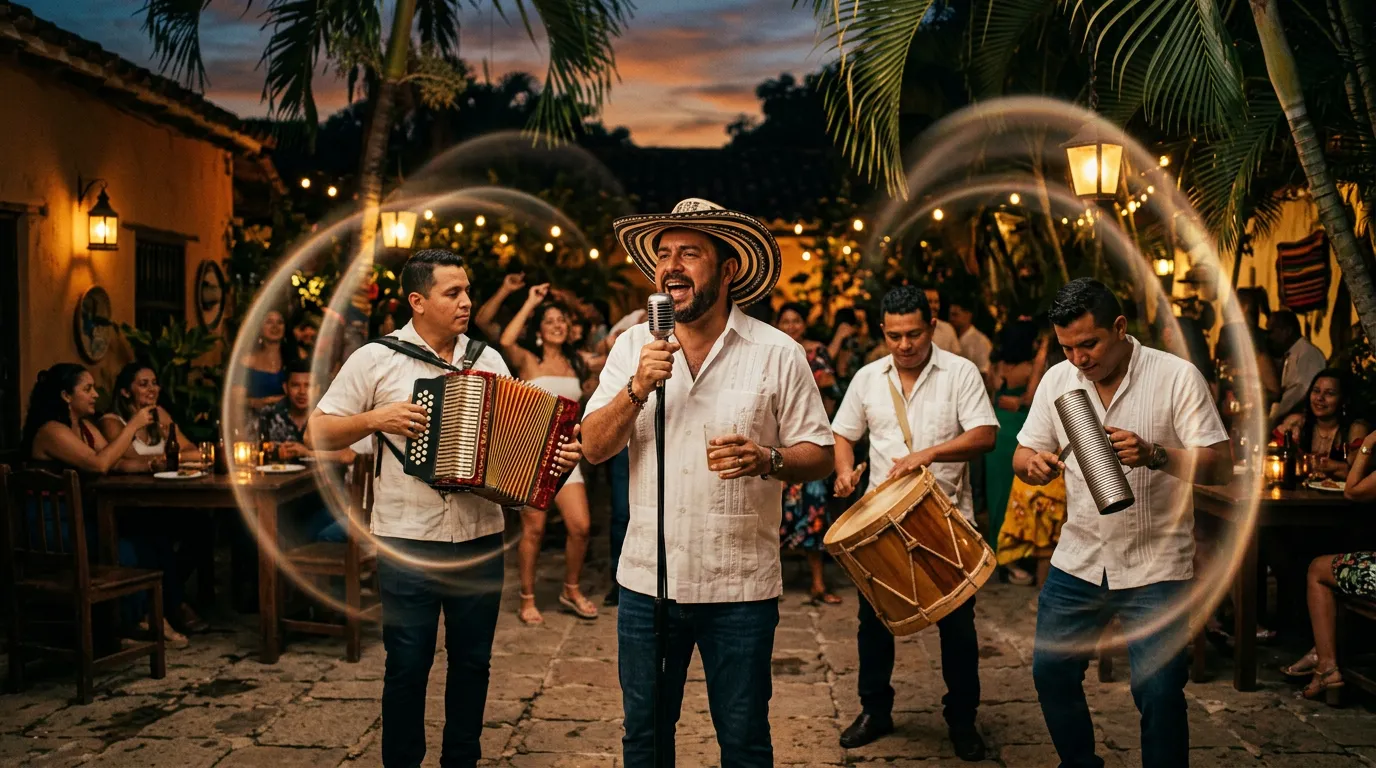
Vallenato is the accordion music of the Caribbean region of Colombia, centred on Valledupar in the Cesar department and the neighbouring areas of La Guajira and Magdalena. It grew up among rural workers and travelling singers, the juglares, who carried news and stories from town to town. The button accordion reached the coast in the late nineteenth century and joined two local instruments: the caja vallenata, a small drum played with the hands, and the guacharaca, a ridged cane or wooden stick scraped with a wire fork. The three are often described as a meeting of European, African and Indigenous roots. Songs are grouped into four aires: the paseo, the merengue, the son and the puya. Composers such as Rafael Escalona, Emiliano Zuleta and Leandro Díaz wrote its classic songs, and the Festival de la Leyenda Vallenata has crowned accordion kings in Valledupar since 1968, beginning with Alejo Durán. Later the electric bass joined, and singers such as Diomedes Díaz and Carlos Vives took the music to stadiums. In 2015 UNESCO added traditional vallenato to its list of heritage in need of urgent safeguarding. Vallenato suits spatial audio because its sound rests on three clear voices: one melody and two rhythms. This guide covers how spatial audio for vallenato works, where to place each element and how to make an immersive vallenato mix. For the basics, see what spatial audio is.
Why vallenato works in spatial audio
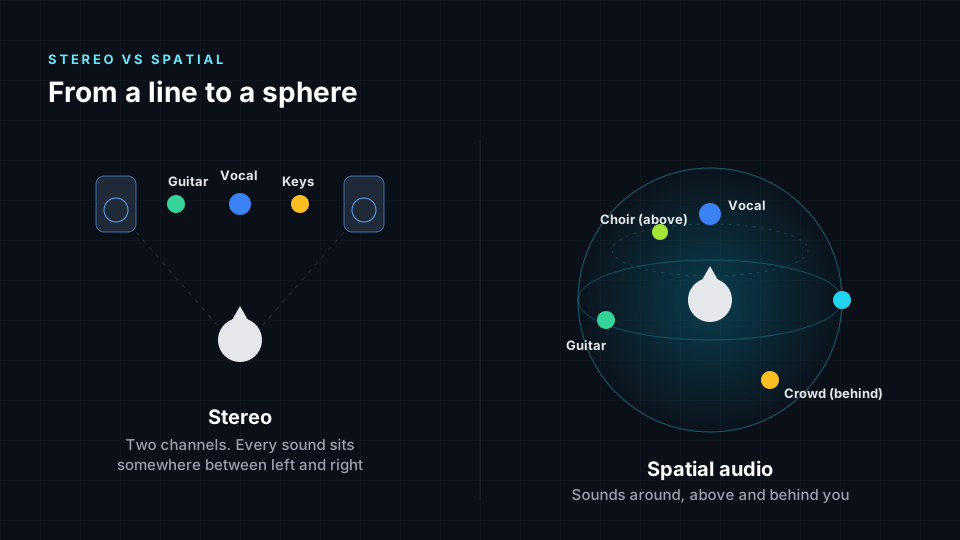
Vallenato is a three-way conversation under a singer. The accordion plays the melody, the introductions and the fast runs between verses. The caja drives the rhythm with slaps and rolls, and the guacharaca scrapes a constant, shuffling pattern that gives each aire its feel. The singer tells the story, often adding spoken greetings to friends in the middle of the song. In stereo the caja and guacharaca blend into one rattle under the accordion. In an immersive mix the singer and bass hold the centre, the accordion and caja face each other at the front and the guacharaca takes its own side.
The rule: a centred voice, accordion and caja facing each other, the guacharaca at the side. Keep the three instruments in a close arc in front of the listener, let the accordion step forward a little for its runs, and keep the space warm and near.
Immersive music for vallenato: what listeners hear
- A singer telling you the story. The lead vocal sits in the centre, close and clear, greetings and all.
- An accordion that steps out. The introductions and runs between verses move slightly forward, then sit back under the next line.
- Two rhythms you can tell apart. The caja slaps from the front left and the guacharaca scrapes from the right, so the groove has depth instead of one rattle.
- A parranda around you. A close, warm space places you in a patio among friends, not in a distant hall.
Where to place each element in a vallenato mix
| Element | Position | Height | Why it works |
|---|---|---|---|
| Lead vocal | Front centre | Ear level | The story and the greetings of every song |
| Bass | Centre | Ear level | The walking pulse under the trio |
| Accordion | Front right, stepping in for runs | Ear level | Melody, introductions and fast runs |
| Caja | Front left | Ear level | Hand drum slaps and rolls that drive the aire |
| Guacharaca | Right | Ear level | The scraped pattern that shapes the groove |
| Chorus vocals | Left | Ear level | Answers and refrains behind the lead |
| Guitar | Behind right | Ear level | Chords and fills in modern vallenato |
| Congas | Behind left | Ear level | Extra percussion in larger groups |
| Patio room | Behind | Raised | A close, warm parranda space |
The psychoacoustics behind vallenato placement
Every position in the table above follows how the ear and brain locate sound. Here is the reason behind the main choices for vallenato.
- Bass stays centred. The ear finds almost no direction in frequencies below roughly 80 to 100 Hz, so the bass gains nothing from being spread and keeps the walking pulse solid in the middle.
- Caja and guacharaca on different sides. The brain groups sounds into streams by pitch, timing and direction. This is auditory stream segregation (Bregman). The slap of the caja and the scrape of the guacharaca both live in the upper mids, and separating them lets the ear follow two rhythms instead of one.
- Small steps forward for the accordion. The ear can detect a change of only about one degree for sounds straight ahead. This is the minimum audible angle (Mills). A modest move toward the centre is enough to bring the accordion out for its runs.
- A voice that stays clear over the trio. Listeners can pick out one voice among competing sounds when it comes from a different direction. This is the cocktail party effect (Bronkhorst). Keeping the chorus to the side lets every word of the lead stay easy to follow.
The immersion profile for vallenato
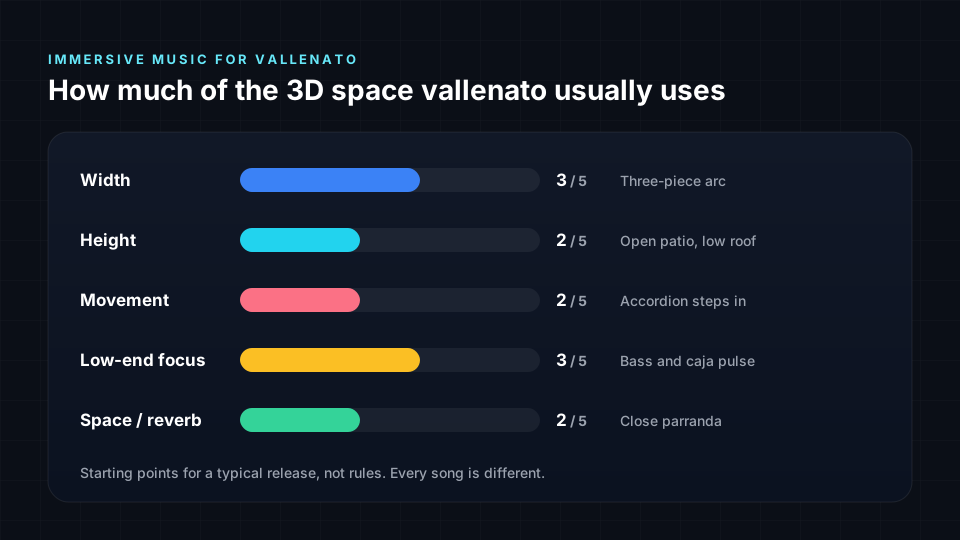
Width scores 3 because the three core instruments sit in a close arc, with extra players a little wider. Low-end focus is 3: the electric bass walks under every song and the caja adds weight, but there is no heavy sub bass. Space is low at 2, since vallenato belongs to the patio and the parranda. Height is 2, with only a light reflection above. Movement scores 2, from the accordion stepping forward for its runs rather than sounds moving around the head.
Tips for an immersive vallenato mix
- Keep the lead vocal front and centre. The story comes first, so the singer never moves.
- Face the accordion and caja across the front. Set them on opposite sides so melody and drum stay clear.
- Give the guacharaca its own side. Place it to the right, apart from the caja, so its scrape shapes the groove.
- Keep the chorus beside the lead, not on top of it. Set the backing voices to one side so the lyrics stay clear.
- Keep the room close and warm. A short, natural space suits the parranda; long reverbs blur the caja and guacharaca.
Vallenato styles: paseo, puya and vallenato romántico
The core placement holds for every style here: voice and bass in the middle, accordion, caja and guacharaca in a close arc. What changes is the tempo, the balance between voice and instruments and how much room the style needs.
Paseo
The paseo is the most common vallenato aire, a moderate 2/4 used for storytelling and love songs, and many of the best-known vallenatos are paseos. The accordion introduces the song and answers each line, while the caja and guacharaca keep a relaxed, rolling pulse. Keep the voice close in the centre, the accordion front right, the caja front left and the guacharaca to the right. A warm, close space suits the style.
Puya
The puya is the fastest and most demanding aire, a showcase for the musicians. The accordion plays rapid runs and each of the three instruments takes a turn in the spotlight, which makes it a test piece at the Festival de la Leyenda Vallenata. Keep the trio close and bright, and let each soloist step slightly forward for its turn: accordion from the front right, caja from the front left, guacharaca from the right. Keep the room short so the fast patterns stay sharp.
Vallenato Romántico
Vallenato romántico grew in the 1980s and 1990s, with groups such as Binomio de Oro and singers such as Diomedes Díaz putting love songs and a smoother voice at the centre. Larger bands added bass, congas, guitar, keyboards and backing singers, and Carlos Vives later blended vallenato with pop and rock. This style can take a slightly wider layout: keep the voice close in the centre, the accordion at the front, the chorus to one side and congas and guitar behind. A touch more reverb suits the ballads.
Related styles such as the merengue and son aires of vallenato and the new wave vallenato of the 2000s follow the same idea: centre the voice and bass, then keep the accordion, caja and guacharaca close in front.
How to make immersive vallenato from stereo
Spatial9 can create spatial audio from a stereo track in a few steps:
- Upload your stereo master or your stems.
- Spatial9's AI separates and places each part, pulling the voice, accordion, caja, guacharaca and bass apart even from older recordings, and setting the three core instruments in a close arc around a centred singer.
- Preview it in binaural on headphones.
- Export Eclipsa Audio, ADM, binaural or Ambisonics.
- Publish a video. Create a YouTube-ready video with your immersive audio and publish it directly.
For related guides, read spatial audio for cumbia and spatial audio for merengue. Every guide is listed in spatial audio and immersive music by genre.
Frequently asked questions
Does this guide cover paseo, puya and vallenato romántico?
Yes. The paseo keeps a close trio around a storytelling voice. The puya lets each instrument step forward for fast solos in a short room. Vallenato romántico takes a slightly wider layout with chorus, congas and guitar around a smooth lead vocal.
Can I make a vallenato mix in Dolby Atmos or Eclipsa Audio?
Yes. The placements in this guide work for both. Spatial9 exports ADM, the standard file used by Dolby Atmos studios, as well as Eclipsa Audio for YouTube, so one immersive vallenato mix covers both. If you plan to release the Atmos version on Apple Music, build it from your original stems or multitracks, because Apple does not accept Atmos made from a finished stereo master. See where to publish spatial audio. You may also hear this called a 3D vallenato mix or vallenato in spatial audio.
Is spatial audio good for vallenato?
Yes. Vallenato layers an accordion, two rhythm instruments and a voice in the same busy mid range. Spatial audio gives each one its own direction, so the accordion runs, the caja, the guacharaca and the lyrics all come through more clearly.
Where should the accordion go in an immersive vallenato mix?
Put it at the front right at ear level, opposite the caja, and a little closer than the other instruments. Bring it slightly forward for introductions and runs between verses.
Where should the guacharaca go?
Put it to the right at ear level, further out than the accordion and away from the caja. Its scrape carries well, so it does not need to be loud, only clearly separate.
How is vallenato different from cumbia in spatial audio?
Both come from Caribbean Colombia, but vallenato is built on the accordion, caja and guacharaca trio around a storytelling singer, so it suits a close arc. Cumbia grew around drums, flutes or a brass band for dancing, so it can take a wider, more rhythmic layout.
Can I convert an old vallenato recording to spatial audio?
Yes. Spatial9 uses AI to separate the voice, accordion, caja, guacharaca and bass from a stereo or mono master. Separation is never perfect with older recordings, so keep the layout simple and close.
Dolby and Dolby Atmos are trademarks of Dolby Laboratories. Spatial9 is not affiliated with or endorsed by Dolby Laboratories.
Sources
- Blauert, J. (1997). Spatial Hearing: The Psychophysics of Human Sound Localization, revised edition. MIT Press. Low-frequency, elevation, distance and motion cues.
- Mills, A. W. (1958). On the minimum audible angle. Journal of the Acoustical Society of America, 30(4), 237-246.
- Hebrank, J. and Wright, D. (1974). Spectral cues used in the localization of sound sources on the median plane. Journal of the Acoustical Society of America, 56(6), 1829-1834.
- Bronkhorst, A. W. (2000). The cocktail party phenomenon: a review of research on speech intelligibility in multiple-talker conditions. Acta Acustica united with Acustica, 86, 117-128.
- Litovsky, R. Y., Colburn, H. S., Yost, W. A. and Guzman, S. J. (1999). The precedence effect. Journal of the Acoustical Society of America, 106(4), 1633-1654.
- Barron, M. and Marshall, A. H. (1981). Spatial impression due to early lateral reflections in concert halls. Journal of Sound and Vibration, 77(2), 211-232.
- Neuhoff, J. G. (1998). Perceptual bias for rising tones. Nature, 395, 123-124.
- Bregman, A. S. (1990). Auditory Scene Analysis: The Perceptual Organization of Sound. MIT Press.
- Wade, P. (2000). Music, Race, and Nation: Música Tropical in Colombia. University of Chicago Press.
Join the parranda
Upload a track to Spatial9 and hear the accordion, caja and guacharaca gather around you in minutes. Then export it or publish it straight to YouTube.