Spatial Audio & Immersive Music for Tango: Argentine Tango, Nuevo Tango & Electrotango
Spatial9 Team · · 10 min read
Part of the series Spatial audio and immersive music by genre.
Key takeaways
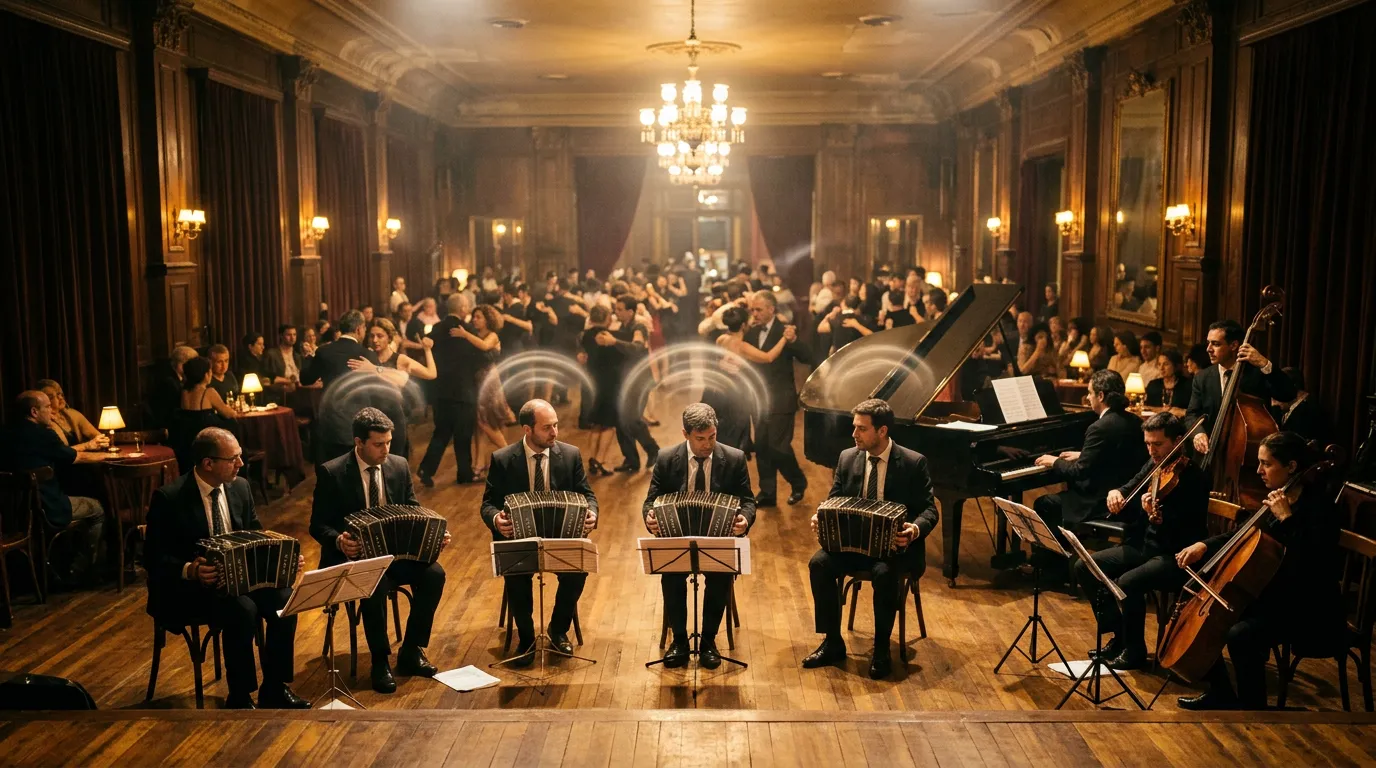
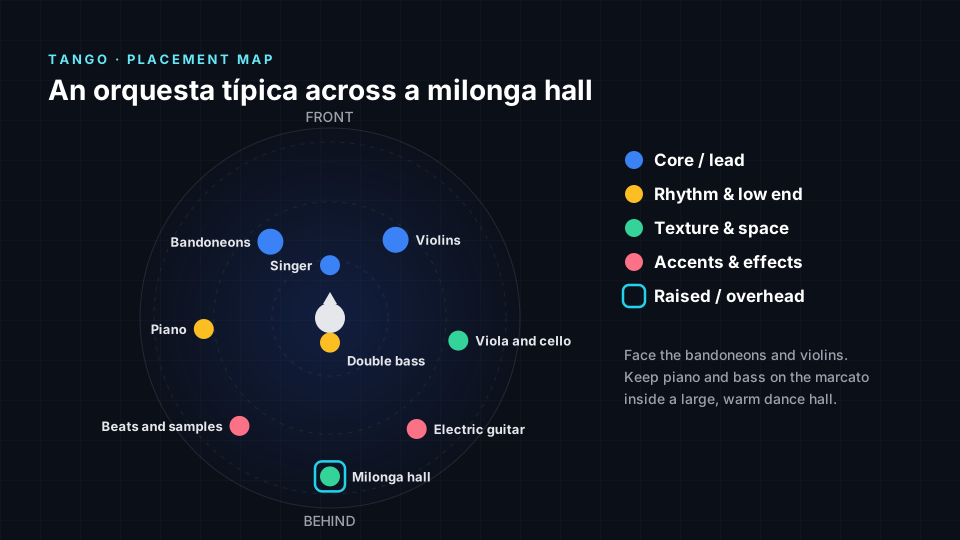
- In a spatial tango mix the bandoneons sit front left and the violins front right, with the singer centred, the piano and double bass holding the marcato underneath and the room of a milonga hall around them.
- Because a sound that grows louder is heard as coming closer, an effect known as looming, the dragging arrastre and the sudden swells of a tango orchestra can feel like they move toward the listener without any panning.
- Tango is dramatic dance and concert music, so the space should be a large, warm hall with clear side reflections and room for sharp accents to ring.
- The tango immersion profile scores width 4, height 2, movement 3, low-end focus 3 and space 4 out of 5.
Tango is the music of the Río de la Plata, born in the port neighbourhoods of Buenos Aires and Montevideo in the 1880s and 1890s. It grew from the habanera, the milonga and the candombe of Afro-Uruguayan and Afro-Argentine communities, played first by small groups with flute, violin and guitar. The bandoneón, a square button concertina from Germany, arrived around the turn of the century and became the voice of tango. Carlos Gardel's Mi noche triste in 1917 made the sung tango a national form, and in the 1920s Julio De Caro's sextet refined the sound. The golden age of the orquesta típica, roughly 1935 to 1955, belonged to bandleaders such as Juan D'Arienzo, Aníbal Troilo, Carlos Di Sarli and Osvaldo Pugliese, with a row of bandoneons, a section of violins, piano and double bass. The rhythm is a firm marcato in four, broken by syncopation and by the arrastre, a dragging swell into the beat. In 2009 UNESCO added tango to its list of intangible cultural heritage. Tango suits spatial audio because the orchestra is a dialogue between two sections and the hall is part of the music. This guide covers how spatial audio for tango works, where to place each element and how to make an immersive tango mix. For the basics, see what spatial audio is.
Why tango works in spatial audio
Tango is built on contrast. The bandoneons punch out staccato chords and dragging arrastres, then the violins answer with long, singing lines. The piano and double bass hammer the marcato, then drop out for a sudden silence before the next phrase. A singer, the cantor, steps in for a refrain in the middle of the dance. In mono these sections stack into one dense, rich block. In an immersive mix the bandoneons and violins face each other across the front, the rhythm section holds the centre and the hall gives every accent room to ring.
The rule: bandoneons and violins facing off, the marcato in the middle. Spread the two sections across a wide front stage, keep the piano and bass anchored and set it all in a large, warm hall where the dancers move.
Immersive music for tango: what listeners hear
- Two sections in conversation. The bandoneons call from the left and the violins answer from the right, so every phrase becomes a dialogue.
- A beat you can stand on. The piano and double bass hold a firm marcato close to the centre, with the bass slaps and scrapes sharp and clear.
- Swells that come toward you. The arrastre and the sudden crescendos feel like the orchestra leaning in, then pulling back.
- A hall full of dancers. A large, warm reverb places you in a milonga hall or a theatre, with room for the silences between phrases.
Where to place each element in a tango mix
| Element | Position | Height | Why it works |
|---|---|---|---|
| Singer | Front centre | Ear level | The cantor stepping in for the refrain |
| Double bass | Centre | Ear level | The marcato and the percussive scrapes |
| Bandoneons | Front left | Ear level | Staccato chords, arrastres and melody |
| Violins | Front right | Ear level | Long singing lines and sharp accents |
| Piano | Left | Ear level | Marcato chords and rhythmic fills |
| Viola and cello | Right | Ear level | Counter melodies under the violins |
| Electric guitar | Behind right | Ear level | Colour in Piazzolla's quintet sound |
| Beats and samples | Behind left | Ear level | Electronic loops in electrotango |
| Milonga hall | Behind | Raised | A large, warm room around the orchestra |
The psychoacoustics behind tango placement
Every position in the table above follows how the ear and brain locate sound. Here is the reason behind the main choices for tango.
- Double bass stays centred. The ear finds almost no direction in frequencies below roughly 80 to 100 Hz, so the bass gains nothing from being spread and keeps the marcato solid for dancers.
- Bandoneons and violins on opposite sides. The brain groups sounds into streams by pitch, timing and direction. This is auditory stream segregation (Bregman). Setting the two sections apart lets the ear hear call and answer instead of one thick texture.
- Swells that seem to approach. Listeners hear sounds that grow louder as moving closer, and they overestimate how near a rising sound has come. This is the looming effect for rising intensity (Neuhoff). The arrastre already carries this sense of motion, so it needs no panning.
- A large hall with side reflections. Early reflections arriving from the sides make a sound feel wider and more enveloping. This is spatial impression from early lateral reflections (Barron and Marshall). Strong side reflections give the orchestra the scale of a dance hall while keeping the staccato sharp.
The immersion profile for tango
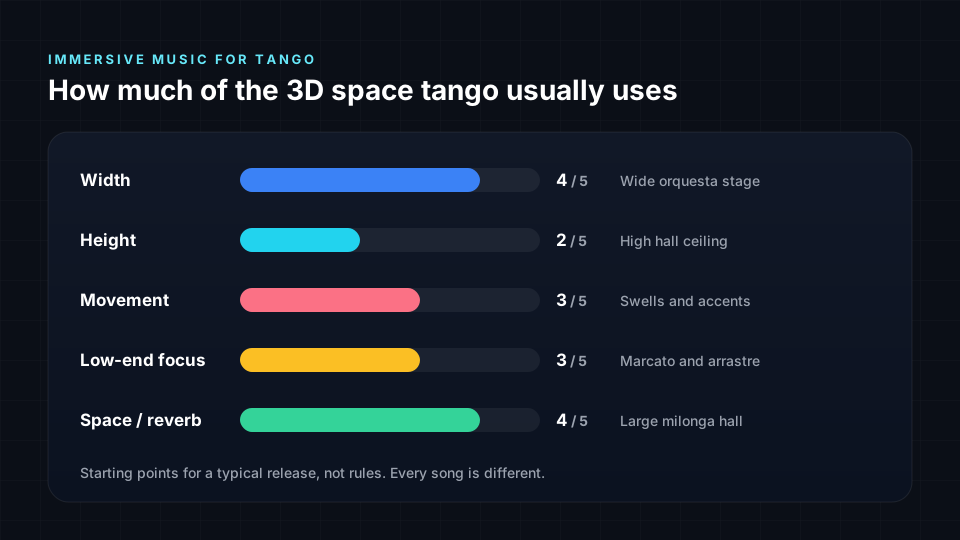
Width scores 4 because an orquesta típica spreads across a stage, with bandoneons and violins on opposite sides. Space also scores 4: tango was made for dance halls and theatres, and its silences need room to ring. Movement is 3, coming from dramatic swells, arrastres and sudden stops rather than sounds flying around. Low-end focus is 3, since the piano and double bass carry a strong marcato without heavy sub bass. Height is 2, from the reflection of a high ceiling.
Tips for an immersive tango mix
- Face the bandoneons and violins. Put them on opposite front sides so every call has an answer.
- Keep the marcato centred. Hold the double bass in the middle and the piano close to it, so dancers always find the beat.
- Let the dynamics move the music. Keep the sections in place and let the arrastre and crescendos create motion.
- Bring the singer in close. The cantor should sit just in front, clearer than the orchestra but not detached from it.
- Use a large, warm hall. Generous reverb suits tango, but keep the early reflections clean so the staccato stays sharp.
Tango styles: Argentine tango, nuevo tango and electrotango
The core placement holds for every style here: lead voices at the front, the rhythm anchored in the middle. What changes is the size of the ensemble, the amount of electric and electronic sound and how much room the style needs.
Argentine Tango
Argentine tango here means the classic dance music of the orquesta típica, along with its relatives the milonga and the tango vals. Bandleaders shaped distinct sounds: D'Arienzo's driving staccato, Di Sarli's smooth elegance, Pugliese's heavy, dramatic yumba. Seat the bandoneons front left in a row, the violins front right, the piano left and the double bass in the centre, with the singer just in front. A large, warm hall suits the style.
Nuevo Tango
Nuevo tango is the concert tango of Astor Piazzolla, who studied in Paris in the 1950s and returned to blend tango with classical counterpoint and jazz harmony. His Quinteto Nuevo Tango, formed in 1960, joined bandoneón, violin, piano, electric guitar and double bass, and pieces such as Libertango made the style known worldwide. The smaller group can sit in a chamber layout: bandoneón front left, violin front right, piano left, electric guitar right and double bass centred. A concert hall with clear reflections suits the music.
Electrotango
Electrotango blends tango samples and live bandoneón with electronic beats, bass and atmosphere. Gotan Project, formed in Paris, released La Revancha del Tango in 2001, and Bajofondo and Tanghetto followed. This style can take a wider, moving layout: keep the bandoneón and any violin at the front, the kick and bass in the centre, and let loops, samples and pads spread around the sides and back. Short delays and a deep reverb add atmosphere.
Related styles such as milonga, tango vals and Uruguayan candombe follow the same idea: keep the lead instruments at the front, the rhythm anchored in the middle and the dance hall around the listener.
How to make immersive tango from stereo
Spatial9 can create spatial audio from a stereo track in a few steps:
- Upload your stereo master or your stems.
- Spatial9's AI separates and places each part, pulling the bandoneons, violins, piano, double bass and singer apart even from old mono recordings, and setting the two sections across a wide stage with the marcato in the centre.
- Preview it in binaural on headphones.
- Export Eclipsa Audio, ADM, binaural or Ambisonics.
- Publish a video. Create a YouTube-ready video with your immersive audio and publish it directly.
For related guides, read spatial audio for bolero and spatial audio for chamber music. Every guide is listed in spatial audio and immersive music by genre.
Frequently asked questions
Does this guide cover Argentine tango, nuevo tango and electrotango?
Yes. Argentine tango seats a full orquesta típica across a wide stage in a dance hall. Nuevo tango uses a chamber layout for Piazzolla's quintet. Electrotango keeps the bandoneón in front and spreads loops and pads around the sides and back.
Can I make a tango mix in Dolby Atmos or Eclipsa Audio?
Yes. The placements in this guide work for both. Spatial9 exports ADM, the standard file used by Dolby Atmos studios, as well as Eclipsa Audio for YouTube, so one immersive tango mix covers both. If you plan to release the Atmos version on Apple Music, build it from your original stems or multitracks, because Apple does not accept Atmos made from a finished stereo master. See where to publish spatial audio. You may also hear this called a 3D tango mix or tango in spatial audio.
Is spatial audio good for tango?
Yes. Tango is built on two sections answering each other over a firm beat, and on dramatic dynamics. Spatial audio lets the bandoneons and violins face each other and gives the hall room to carry every silence and accent.
Where should the bandoneón go in an immersive tango mix?
Put the bandoneón section front left at ear level, opposite the violins. In a quintet or solo setting, a single bandoneón can move closer to the centre, since it carries most of the melody.
Should the dancers' hall be part of the mix?
Yes. Tango was played for dancers in large halls, and a warm, roomy reverb with clean side reflections is part of its character. Keep it behind and slightly raised so it surrounds the orchestra without blurring the beat.
How is tango different from flamenco in spatial audio?
Tango is an ensemble music built around a bandoneón and string orchestra in a dance hall, so it needs a wide two-sided stage. Flamenco centres on a voice, a guitar and palmas in a smaller space, so it suits a closer, tighter layout.
Can I convert a 1940s tango recording to spatial audio?
Yes. Spatial9 uses AI to separate the bandoneons, violins, piano, bass and singer from a mono master. Separation is never perfect with older recordings, so keep the layout simple and the hall moderate.
Dolby and Dolby Atmos are trademarks of Dolby Laboratories. Spatial9 is not affiliated with or endorsed by Dolby Laboratories.
Sources
- Blauert, J. (1997). Spatial Hearing: The Psychophysics of Human Sound Localization, revised edition. MIT Press. Low-frequency, elevation, distance and motion cues.
- Mills, A. W. (1958). On the minimum audible angle. Journal of the Acoustical Society of America, 30(4), 237-246.
- Hebrank, J. and Wright, D. (1974). Spectral cues used in the localization of sound sources on the median plane. Journal of the Acoustical Society of America, 56(6), 1829-1834.
- Bronkhorst, A. W. (2000). The cocktail party phenomenon: a review of research on speech intelligibility in multiple-talker conditions. Acta Acustica united with Acustica, 86, 117-128.
- Litovsky, R. Y., Colburn, H. S., Yost, W. A. and Guzman, S. J. (1999). The precedence effect. Journal of the Acoustical Society of America, 106(4), 1633-1654.
- Barron, M. and Marshall, A. H. (1981). Spatial impression due to early lateral reflections in concert halls. Journal of Sound and Vibration, 77(2), 211-232.
- Neuhoff, J. G. (1998). Perceptual bias for rising tones. Nature, 395, 123-124.
- Bregman, A. S. (1990). Auditory Scene Analysis: The Perceptual Organization of Sound. MIT Press.
- Collier, S., Cooper, A., Azzi, M. S. and Martin, R. (1995). ¡Tango! The Dance, the Song, the Story. Thames and Hudson.
Take the dance floor
Upload a track to Spatial9 and hear the bandoneons and violins face each other across the hall in minutes. Then export it or publish it straight to YouTube.