Spatial Audio & Immersive Music for Samba: Pagode, Samba-Enredo & Samba de Roda
Spatial9 Team · · 10 min read
Part of the series Spatial audio and immersive music by genre.
Key takeaways
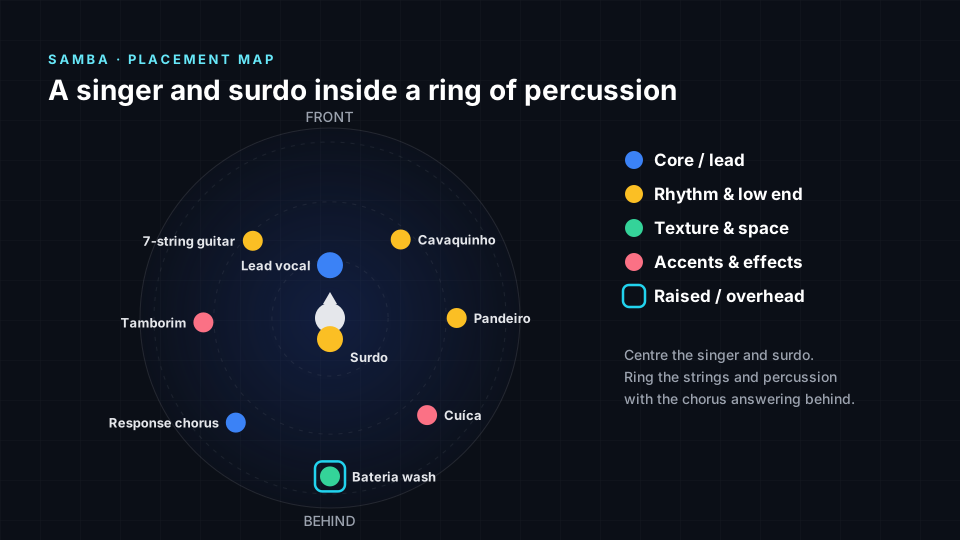
- In a spatial samba mix the lead vocal and the surdo stay centred, while the cavaquinho, seven-string guitar, pandeiro, tamborim and cuíca form a ring around the listener.
- Because the brain separates voices that come from different directions, an effect known as the cocktail party effect, placing the response chorus behind keeps the lead singer's lyric clear.
- Samba is circle music, from a pagode table to a samba school bateria, so it suits a wide, surrounding layout in a lively but short room.
- The samba immersion profile scores width 5, height 2, movement 3, low-end focus 4 and space 3 out of 5.
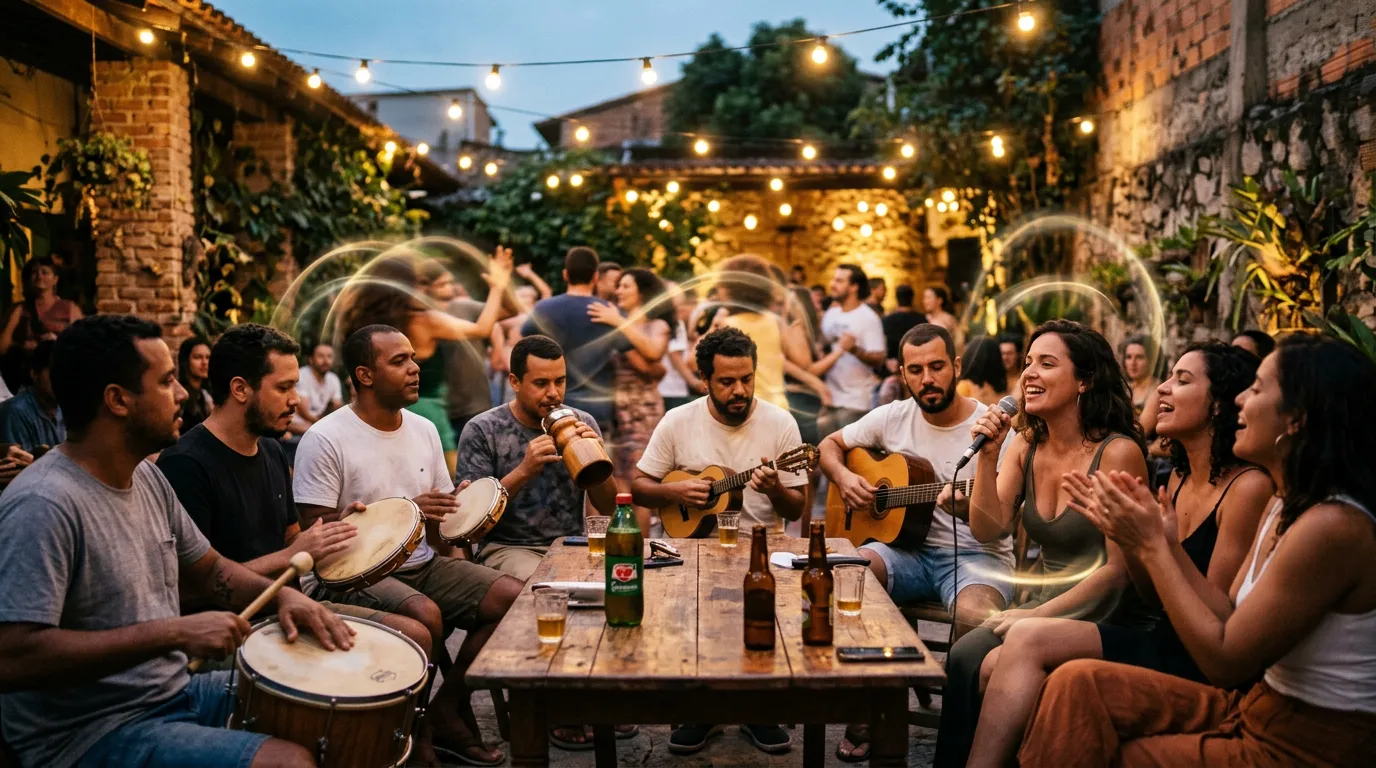
Samba is the Afro-Brazilian song and dance music of Rio de Janeiro. It grew in the early twentieth century among Black communities who had moved from Bahia to Rio, in gatherings at houses such as that of Tia Ciata, and drew on samba de roda, lundu and maxixe. "Pelo Telefone", registered by Donga in 1916 and recorded in 1917, is usually called the first recorded samba. From the late 1920s the first samba schools formed in neighbourhoods such as Estácio, led by composers including Ismael Silva, and the music became central to Rio's carnival. Cartola, Noel Rosa, Pixinguinha, Clara Nunes, Paulinho da Viola, Beth Carvalho and Zeca Pagodinho are among its key names. The music is in 2/4, with the deep surdo accenting the second beat, the pandeiro, tamborim, agogô and cuíca weaving syncopated patterns above it, and the cavaquinho and seven-string guitar supplying chords and bass runs. Samba suits spatial audio because it is played in a circle: in a roda the musicians sit around a table and the crowd sings back. This guide covers how spatial audio for samba works, where to place each element and how to make an immersive samba mix. For the basics, see what spatial audio is.
Why samba works in spatial audio
Samba is a web of interlocking parts. The surdo marks the pulse, the pandeiro fills every subdivision, the tamborim plays sharp syncopated figures, the cuíca squeaks and moans, and the cavaquinho strums in rhythm while the seven-string guitar answers with low runs. On top, the lead singer calls and the chorus responds. In stereo all of this collapses into a single shimmering block. In an immersive mix each instrument takes its own place in a circle, the way the musicians actually sit.
The rule: a singer in front, a surdo at the heart and a ring of percussion around you. Keep the voice and surdo centred, spread the strings and hand percussion around the listener, and set the chorus behind so the crowd seems to answer.
Immersive music for samba: what listeners hear
- A singer leading the circle. The lead vocal sits front and centre, clear above the percussion.
- A pulse you can feel. The surdo sits in the middle, its accent on the second beat driving the whole groove.
- Percussion on every side. Pandeiro, tamborim and cuíca each come from their own direction, so the syncopations can be heard one by one.
- A crowd that answers back. The chorus responds from behind and around, as in a roda or a samba school rehearsal.
Where to place each element in a samba mix
| Element | Position | Height | Why it works |
|---|---|---|---|
| Lead vocal | Front centre | Ear level | The melody and the call that leads the song |
| Surdo | Centre | Ear level | The deep pulse with its accent on beat two |
| Cavaquinho | Front right | Ear level | Bright rhythmic strumming and short melodic lines |
| 7-string guitar | Front left | Ear level | Low counter-melodies and bass runs |
| Pandeiro | Right | Ear level | Constant sixteenth-note patterns and slaps |
| Tamborim | Left, moving | Ear level | Sharp syncopated figures that turn the groove |
| Cuíca | Behind right | Ear level | Squeaking, moaning friction drum colour |
| Response chorus | Behind left | Ear level | The crowd singing back each refrain |
| Bateria wash | Behind | Raised | The wide sound of a full percussion section |
The psychoacoustics behind samba placement
Every position in the table above follows how the ear and brain locate sound. Here is the reason behind the main choices for samba.
- Surdo stays centred. The ear finds almost no direction in frequencies below roughly 80 to 100 Hz, so the surdo's low tone gains nothing from being spread and works best as the anchor.
- Pandeiro and tamborim on opposite sides. The brain groups sounds into streams by pitch, timing and direction. This is auditory stream segregation (Bregman). Both are bright frame drums playing dense patterns, and setting them apart lets the ear hear two interlocking rhythms.
- Singer in front, chorus behind. Listeners can pick out one voice among many when the voices come from different directions. This is the cocktail party effect (Bronkhorst). Separating lead and chorus keeps the lyric clear when the whole roda sings.
- A raised bateria wash. Sounds with more high-frequency energy tend to be heard as higher. This is spectral elevation cues (Hebrank and Wright). The shakers, caixa and tamborins of a full bateria are bright, so lifting their wash slightly feels natural.
The immersion profile for samba
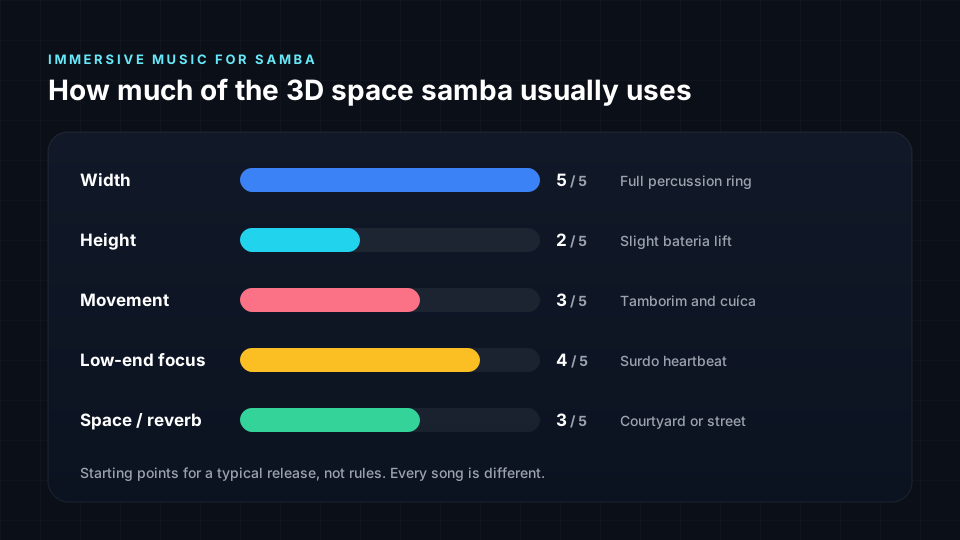
Width scores 5 because samba is played in a circle and a bateria can involve hundreds of drummers, so the percussion can surround the listener completely. Low-end focus is 4: the surdo is the heartbeat of the music. Movement scores 3, coming from tamborim turns, cuíca slides and call and response rather than sweeping effects. Space is 3, a lively room or open street that stays clear for dense patterns. Height stays at 2, with only a slight lift for the bateria wash.
Tips for an immersive samba mix
- Anchor the surdo in the centre. The groove depends on its second-beat accent, so never spread or move it.
- Split pandeiro and tamborim. Put them on opposite sides so their dense patterns stay separate.
- Pair the cavaquinho and seven-string guitar. Set them on opposite front sides so the strumming and the bass runs answer each other.
- Put the chorus behind the listener. The response should feel like the crowd around you, not a second lead.
- Keep the room lively but short. Fast percussion smears in long reverb; a bright, short room keeps every stroke clear.
Samba styles: pagode, samba-enredo and samba de roda
The core placement holds for every style here: voice and surdo in the middle, strings and percussion around them. What changes is the size of the group and the space it plays in.
Pagode
Pagode grew from informal samba gatherings in Rio in the late 1970s and 1980s, above all the meetings at the Cacique de Ramos club that produced the group Fundo de Quintal. They added the tantã, a deep hand-played drum, the repique de mão and a banjo tuned like a cavaquinho, and sang around a table. Keep the circle small: lead vocal in front, cavaquinho and banjo on the front sides, tantã centred low and pandeiro and repique around the sides, in a warm, close room.
Samba-Enredo
Samba-enredo is the theme samba that each Rio samba school writes for its carnival parade, telling a story chosen for that year. A lead singer, the puxador, sings over a cavaquinho and a bateria of hundreds of percussionists, and the whole school sings along as it moves down the Sambadrome, opened in 1984. This style takes the widest layout: put the puxador front and centre, spread surdos, caixas, repiniques, tamborins and chocalhos all around and let the bateria wash rise above and behind, in a big open space.
Samba de Roda
Samba de roda is the older circle samba of the Recôncavo region of Bahia, recognised by UNESCO in 2005 as a Masterpiece of the Oral and Intangible Heritage of Humanity. Participants clap and sing in a circle while dancers take turns in the middle, accompanied by pandeiro, viola, atabaque and sometimes a plate scraped with a knife. Place the singers in front and the clapping around the listener, set the pandeiro and viola on either side and keep the room natural and intimate.
Related styles such as samba-canção and partido-alto follow the same idea: a singer in front, a surdo or bass at the centre and a ring of strings and percussion around the listener.
How to make immersive samba from stereo
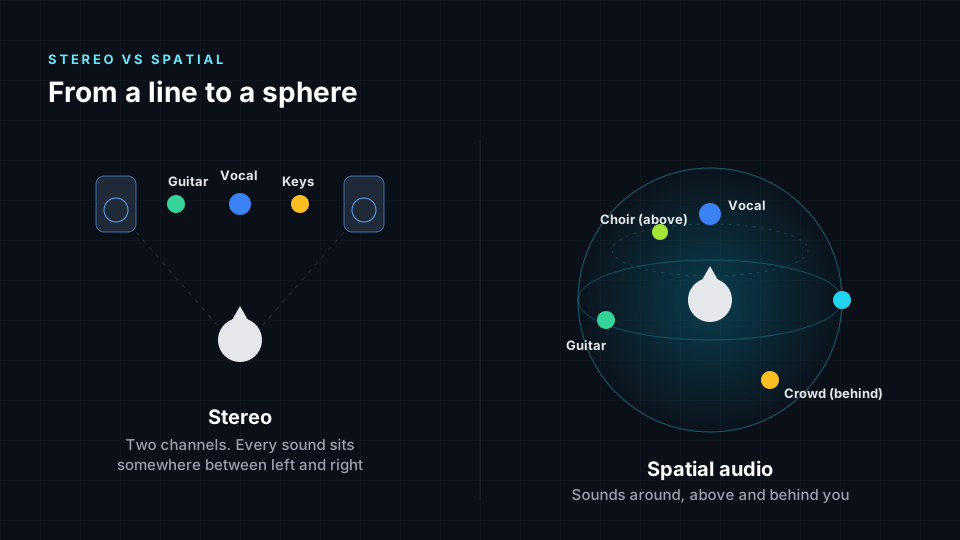
Spatial9 can create spatial audio from a stereo track in a few steps:
- Upload your stereo master or your stems.
- Spatial9's AI separates and places each part, pulling the vocal, chorus, cavaquinho, guitar, surdo, pandeiro, tamborim and cuíca apart and setting them in a ring around a centred surdo.
- Preview it in binaural on headphones.
- Export Eclipsa Audio, ADM, binaural or Ambisonics.
- Publish a video. Create a YouTube-ready video with your immersive audio and publish it directly.
For related guides, read spatial audio for bossa nova and MPB and spatial audio for axé and frevo. Every guide is listed in spatial audio and immersive music by genre.
Frequently asked questions
Does this guide cover pagode, samba-enredo and samba de roda?
Yes. Pagode keeps a small circle around a table with cavaquinho, banjo and tantã. Samba-enredo takes the widest layout, with a puxador in front and a huge bateria all around. Samba de roda places singers and clapping in an intimate Bahian circle.
Can I make a samba mix in Dolby Atmos or Eclipsa Audio?
Yes. The placements in this guide work for both. Spatial9 exports ADM, the standard file used by Dolby Atmos studios, as well as Eclipsa Audio for YouTube, so one immersive samba mix covers both. If you plan to release the Atmos version on Apple Music, build it from your original stems or multitracks, because Apple does not accept Atmos made from a finished stereo master. See where to publish spatial audio. You may also hear this called a 3D samba mix or samba in spatial audio.
Is spatial audio good for samba?
Yes. Samba layers many bright percussion parts over a deep surdo pulse. Spatial audio gives each instrument its own direction, so the interlocking rhythms become clear instead of blending into one wash.
Where should the surdo go in an immersive samba mix?
Keep it in the centre at ear level. Its low tone carries little direction, and as the anchor of the groove it should stay steady while lighter percussion surrounds it.
How do I make a samba school bateria sound huge?
Spread the sections around the listener, surdos centred and low, caixas and repiniques to the sides and tamborins and chocalhos behind, then add a slightly raised, open wash. Keep the puxador clearly in front.
How is samba different from bossa nova in spatial audio?
Samba is percussion-led and communal, so it suits a wide ring of drums and a chorus around the listener. Bossa nova is quiet and intimate, built on voice and nylon-string guitar, so it suits a narrow, close layout.
Can I convert an old samba recording to spatial audio?
Yes. Spatial9 uses AI to separate the vocal, chorus, strings and percussion from a stereo or mono master. Separation is never perfect with older recordings, so keep the ring of percussion modest and close.
Dolby and Dolby Atmos are trademarks of Dolby Laboratories. Spatial9 is not affiliated with or endorsed by Dolby Laboratories.
Sources
- Blauert, J. (1997). Spatial Hearing: The Psychophysics of Human Sound Localization, revised edition. MIT Press. Low-frequency, elevation, distance and motion cues.
- Mills, A. W. (1958). On the minimum audible angle. Journal of the Acoustical Society of America, 30(4), 237-246.
- Hebrank, J. and Wright, D. (1974). Spectral cues used in the localization of sound sources on the median plane. Journal of the Acoustical Society of America, 56(6), 1829-1834.
- Bronkhorst, A. W. (2000). The cocktail party phenomenon: a review of research on speech intelligibility in multiple-talker conditions. Acta Acustica united with Acustica, 86, 117-128.
- Litovsky, R. Y., Colburn, H. S., Yost, W. A. and Guzman, S. J. (1999). The precedence effect. Journal of the Acoustical Society of America, 106(4), 1633-1654.
- Barron, M. and Marshall, A. H. (1981). Spatial impression due to early lateral reflections in concert halls. Journal of Sound and Vibration, 77(2), 211-232.
- Neuhoff, J. G. (1998). Perceptual bias for rising tones. Nature, 395, 123-124.
- Bregman, A. S. (1990). Auditory Scene Analysis: The Perceptual Organization of Sound. MIT Press.
- Vianna, H. (1999). The Mystery of Samba: Popular Music and National Identity in Brazil. University of North Carolina Press.
Join the roda
Upload a track to Spatial9 and hear the surdo, pandeiro and tamborim form a circle around you in minutes. Then export it or publish it straight to YouTube.