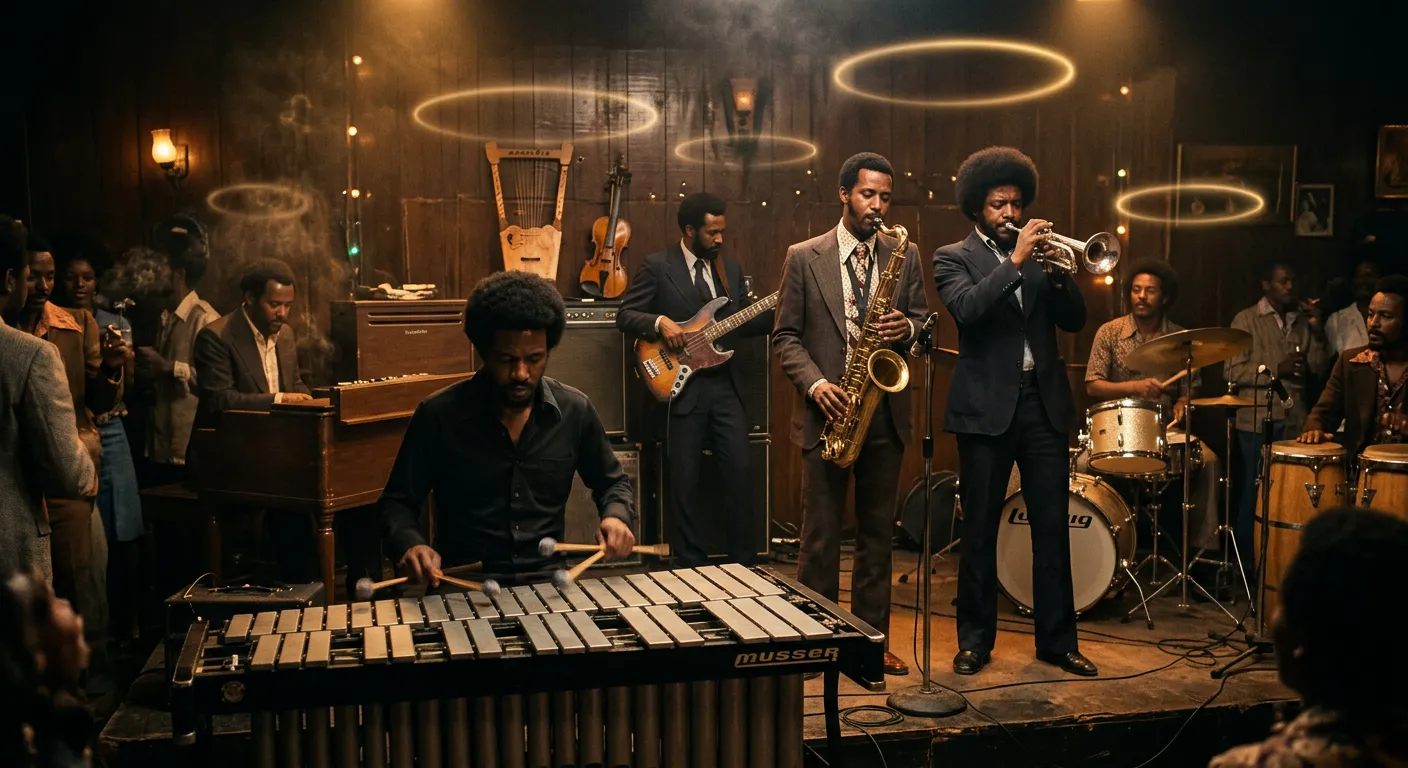
Spatial Audio & Immersive Music for Ethio-Jazz: Tizita, Ethiopian Pop & Eskista
Spatial9 Team · · 11 min read
Part of the series Spatial audio and immersive music by genre.
Key takeaways
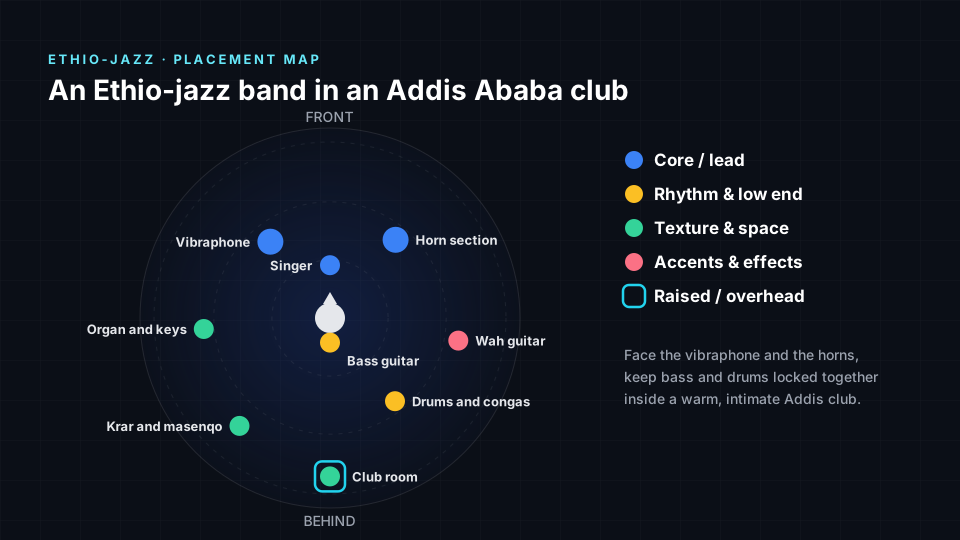
- In a spatial Ethio-jazz mix the vibraphone sits front left and the horn section front right, with the singer centred, the bass and drums anchored in the middle and organ, guitar and traditional instruments set around the sides.
- Because the brain sorts sounds into separate streams by pitch, timing and direction, setting the vibraphone and horns apart lets the ear follow their modal lines as a conversation rather than one thick unison.
- Ethio-jazz grew in the nightclubs of Addis Ababa, so the space should feel like a warm, intimate club with a soft room sound rather than a vast concert hall.
- The Ethio-jazz immersion profile scores width 4, height 2, movement 2, low-end focus 3 and space 3 out of 5.
Ethio-jazz is the meeting of Ethiopian music with jazz, Latin and funk, born in Addis Ababa in the late 1960s and early 1970s. Its roots lie in the brass bands of the imperial era, when the Imperial Bodyguard Band, the Police Orchestra and other state ensembles trained musicians to read and arrange for horns. The vibraphonist and composer Mulatu Astatke studied in London and then in the United States, where he recorded with Latin musicians in New York in the 1960s. Back in Addis Ababa he set Ethiopian melodies, built on the pentatonic qenet modes such as tizita, bati, ambassel and anchihoye, over jazz harmony, Latin percussion and funk basslines, and he called the result Ethio-jazz. Those years are often called the golden age of Swinging Addis: independent labels such as Amha Records, founded in 1969, recorded singers including Mahmoud Ahmed, Alèmayèhu Eshèté and Tlahoun Gèssèssè with horn driven bands. The scene was cut short after the 1974 revolution, when the military government imposed a night time curfew. From the late 1990s Francis Falceto's Éthiopiques series on the Buda Musique label reissued these records, and Jim Jarmusch's 2005 film Broken Flowers brought Mulatu's music to a new audience. Ethio-jazz suits spatial audio because the music is a conversation between lead voices over a hypnotic groove, and the club room is part of its sound. This guide covers how spatial audio for Ethio-jazz works, where to place each element and how to make an immersive Ethio-jazz mix. For the basics, see what spatial audio is.
Why Ethio-jazz works in spatial audio
Ethio-jazz is built on repetition and conversation. The bass and drums lay down a slow, rolling groove that barely changes. Over it the vibraphone and the horns trade phrases in the minor sounding qenet modes, sometimes in unison, sometimes in call and response. The organ holds long chords, a wah guitar picks out short accents and, in many recordings, a krar or masenqo adds a traditional colour. In stereo these parts tend to sit on top of each other in one dark, dense block. In an immersive mix the vibraphone and horns face each other across the front, the rhythm section holds the middle and the club gives each phrase space to linger.
The rule: vibraphone and horns in conversation, the groove locked in the centre. Spread the two lead voices across a wide front stage, keep the bass and drums anchored and set the band inside a warm, intimate room.
Immersive music for Ethio-jazz: what listeners hear
- Two lead voices in conversation. The vibraphone rings from the left and the horns answer from the right, so each modal phrase has a reply.
- A groove that pulls you in. The bass and drums hold a slow, repeating figure close to the centre, steady enough to sink into.
- Colour all around. Organ, wah guitar and the buzz of the krar and masenqo sit around the sides, each in its own space.
- A late night club. A warm, close reverb places you in a small room in Addis Ababa, with the band near enough to touch.
Where to place each element in an Ethio-jazz mix
| Element | Position | Height | Why it works |
|---|---|---|---|
| Singer | Front centre | Ear level | Amharic vocals with melisma and ornament |
| Bass guitar | Centre | Ear level | The deep, repeating figure under the groove |
| Vibraphone | Front left | Ear level | Ringing modal melodies and soft sustain |
| Horn section | Front right | Ear level | Saxophone and trumpet answering the vibes |
| Organ and keys | Left | Ear level | Long chords and electric piano colour |
| Wah guitar | Right | Ear level | Short funky accents between phrases |
| Drums and congas | Behind right | Ear level | Jazz kit and Latin hand drums in the groove |
| Krar and masenqo | Behind left | Ear level | Traditional lyre and fiddle colour |
| Club room | Behind | Raised | A warm, intimate room around the band |
The psychoacoustics behind Ethio-jazz placement
Every position in the table above follows how the ear and brain locate sound. Here is the reason behind the main choices for Ethio-jazz.
- Bass guitar stays centred. The ear finds almost no direction in frequencies below roughly 80 to 100 Hz, so the bass gains nothing from being spread and keeps the groove solid (Blauert).
- Vibraphone and horns on opposite sides. The brain groups sounds into streams by pitch, timing and direction. This is auditory stream segregation (Bregman). Setting the two lead voices apart lets the ear hear a conversation instead of one thick unison.
- Instruments spaced around the room. Listeners are most precise at telling directions apart in front of them, and less precise toward the sides. This is the minimum audible angle (Mills). Keeping the lead voices in front and the colour instruments wider uses that sharp frontal hearing for the parts that matter most.
- A small club with side reflections. Early reflections arriving from the sides make a sound feel wider and more enveloping. This is spatial impression from early lateral reflections (Barron and Marshall). Gentle side reflections give the band the warmth of a club without blurring the vibraphone's attack.
The immersion profile for Ethio-jazz
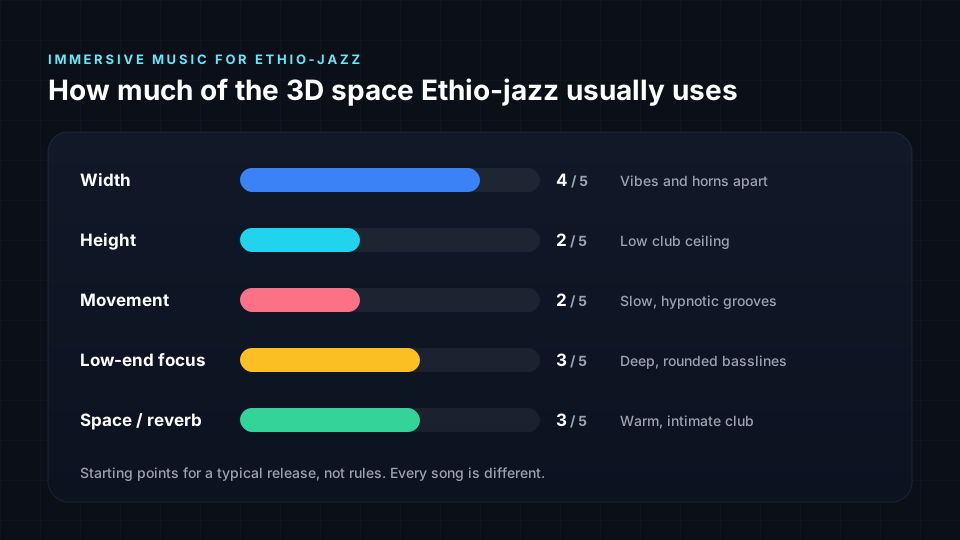
Width scores 4 because the band spreads across a stage, with vibraphone and horns on opposite sides and organ, guitar and traditional instruments around them. Space scores 3: the music was made in nightclubs and small studios, so it suits a warm, close room more than a large hall. Low-end focus is 3, since the bass carries deep, repeating figures without heavy sub bass. Movement is 2, because the grooves are slow and hypnotic and the parts stay in place. Height is 2, from the reflections of a low club ceiling.
Tips for an immersive Ethio-jazz mix
- Face the vibraphone and the horns. Put them on opposite front sides so every phrase has an answer.
- Lock the bass and drums together. Keep the bass in the centre and the kick close to it, so the hypnotic groove never wanders.
- Let the modes do the work. The qenet melodies already carry a strong mood, so keep the instruments still and avoid busy panning.
- Give the traditional instruments room. Set the krar, masenqo or washint to the side or behind, where their buzzing tone can be heard without crowding the leads.
- Use a warm, intimate room. A short, dark reverb suits Ethio-jazz, but keep the early reflections clean so the vibraphone keeps its ring.
Ethio-jazz styles: tizita, Ethiopian pop and eskista
The core placement holds for every style here: lead voices at the front, the groove anchored in the middle. What changes is the balance between jazz band and traditional instruments, how much the singer leads and how much room the style needs.
Tizita
Tizita is both a song form and one of the qenet modes of Ethiopian music, and the word means something like longing or nostalgic memory. Many singers of the golden age recorded their own tizita, and Mulatu Astatke and later jazz musicians have used the mode as a base for slow, brooding instrumentals. Keep the layout close and still: the singer or lead instrument front centre, the vibraphone or piano front left, a soft horn line front right and the bass centred. A warm, slightly longer reverb suits the mood.
Ethiopian Pop
Ethiopian pop grew from the same horn bands of the 1960s and 1970s, with singers such as Mahmoud Ahmed, Alèmayèhu Eshèté and Tlahoun Gèssèssè fronting groups of saxophones, trumpets, organ, guitar, bass and drums. In the 1980s and 1990s much of the music was made in the diaspora as well as in Addis Ababa, and synthesisers and drum machines became common. Put the singer front centre and slightly forward, the horns front right, keys front left and the bass and drums in the middle, with backing vocals around the sides.
Eskista
Eskista is the famous shoulder dance of the Amhara people, and the music that drives it is bright and fast, often with a bouncing triple feel. In its traditional form it is played on the kebero drum, the krar and the masenqo with hand claps and singing, and pop bands play it with a full rhythm section. Place the kebero or drums close to the centre, the krar front left, the masenqo front right and claps and voices around the listener, as if dancers were circling the band. A lively room fits the style.
Related styles such as Ethiopian funk, azmari music and the work of newer Ethio-jazz revival bands around the world follow the same idea: keep the lead voices at the front, the groove anchored in the middle and the room around the listener.
How to make immersive Ethio-jazz from stereo
Spatial9 can create spatial audio from a stereo track in a few steps:
- Upload your stereo master or your stems.
- Spatial9's AI separates and places each part, pulling the vibraphone, horns, organ, bass, drums and singer apart even from older recordings, and setting the vibraphone and horns across a wide front stage with the groove in the centre.
- Preview it in binaural on headphones.
- Export Eclipsa Audio, ADM, binaural or Ambisonics.
- Publish a video. Create a YouTube-ready video with your immersive audio and publish it directly.
For related guides, read spatial audio for Afrobeat and spatial audio for soul jazz. Every guide is listed in spatial audio and immersive music by genre.
Frequently asked questions
Does this guide cover tizita, Ethiopian pop and eskista?
Yes. Tizita uses a close, still layout around a singer or lead instrument. Ethiopian pop puts a singer in front of a horn band. Eskista sets the drums in the centre with krar, masenqo and claps around the listener.
Can I make an Ethio-jazz mix in Dolby Atmos or Eclipsa Audio?
Yes. The placements in this guide work for both. Spatial9 exports ADM, the standard file used by Dolby Atmos studios, as well as Eclipsa Audio for YouTube, so one immersive Ethio-jazz mix covers both. If you plan to release the Atmos version on Apple Music, build it from your original stems or multitracks, because Apple does not accept Atmos made from a finished stereo master. See where to publish spatial audio. You may also hear this called a 3D Ethio-jazz mix or Ethiopian jazz in spatial audio.
Is spatial audio good for Ethio-jazz?
Yes. Ethio-jazz is built on lead voices trading modal phrases over a steady groove. Spatial audio lets the vibraphone and horns face each other and gives the club room to carry the mood.
Where should the vibraphone go in an immersive Ethio-jazz mix?
Put the vibraphone front left at ear level, opposite the horns. In a small group where it carries most of the melody, it can move closer to the centre.
What are the qenet modes and do they change the mix?
The qenet are the main pentatonic modes of Ethiopian music, usually named tizita, bati, ambassel and anchihoye. They do not change where instruments go, but their dark, haunting sound benefits from a still layout and a warm room rather than busy movement.
How is Ethio-jazz different from Afrobeat in spatial audio?
Afrobeat is a dense, driving Nigerian dance music with interlocking guitars, a big horn section and long jams, so it suits a wide, busy stage. Ethio-jazz is slower and more hypnotic, built on modal melodies and the vibraphone, so it suits a closer, calmer layout.
Can I convert a 1970s Ethiopian recording to spatial audio?
Yes. Spatial9 uses AI to separate the voice, horns, keys, bass and drums from a stereo or mono master. Separation is never perfect with older recordings, so keep the layout simple and the room moderate.
Dolby and Dolby Atmos are trademarks of Dolby Laboratories. Spatial9 is not affiliated with or endorsed by Dolby Laboratories.
Sources
- Blauert, J. (1997). Spatial Hearing: The Psychophysics of Human Sound Localization, revised edition. MIT Press. Low-frequency, elevation, distance and motion cues.
- Bregman, A. S. (1990). Auditory Scene Analysis: The Perceptual Organization of Sound. MIT Press.
- Mills, A. W. (1958). On the minimum audible angle. Journal of the Acoustical Society of America, 30(4), 237-246.
- Barron, M. and Marshall, A. H. (1981). Spatial impression due to early lateral reflections in concert halls. Journal of Sound and Vibration, 77(2), 211-232.
- Bronkhorst, A. W. (2000). The cocktail party phenomenon: a review of research on speech intelligibility in multiple-talker conditions. Acta Acustica united with Acustica, 86, 117-128.
- Litovsky, R. Y., Colburn, H. S., Yost, W. A. and Guzman, S. J. (1999). The precedence effect. Journal of the Acoustical Society of America, 106(4), 1633-1654.
- Falceto, F. (2001). Abyssinie Swing: A Pictorial History of Modern Ethiopian Music. Shama Books.
Step into the club
Upload a track to Spatial9 and hear the vibraphone and horns trade lines across the room in minutes. Then export it or publish it straight to YouTube.