Spatial Audio & Immersive Music for Bollywood: Complete Guide
Spatial9 Team · · Updated
Part of the series Spatial audio and immersive music by genre.
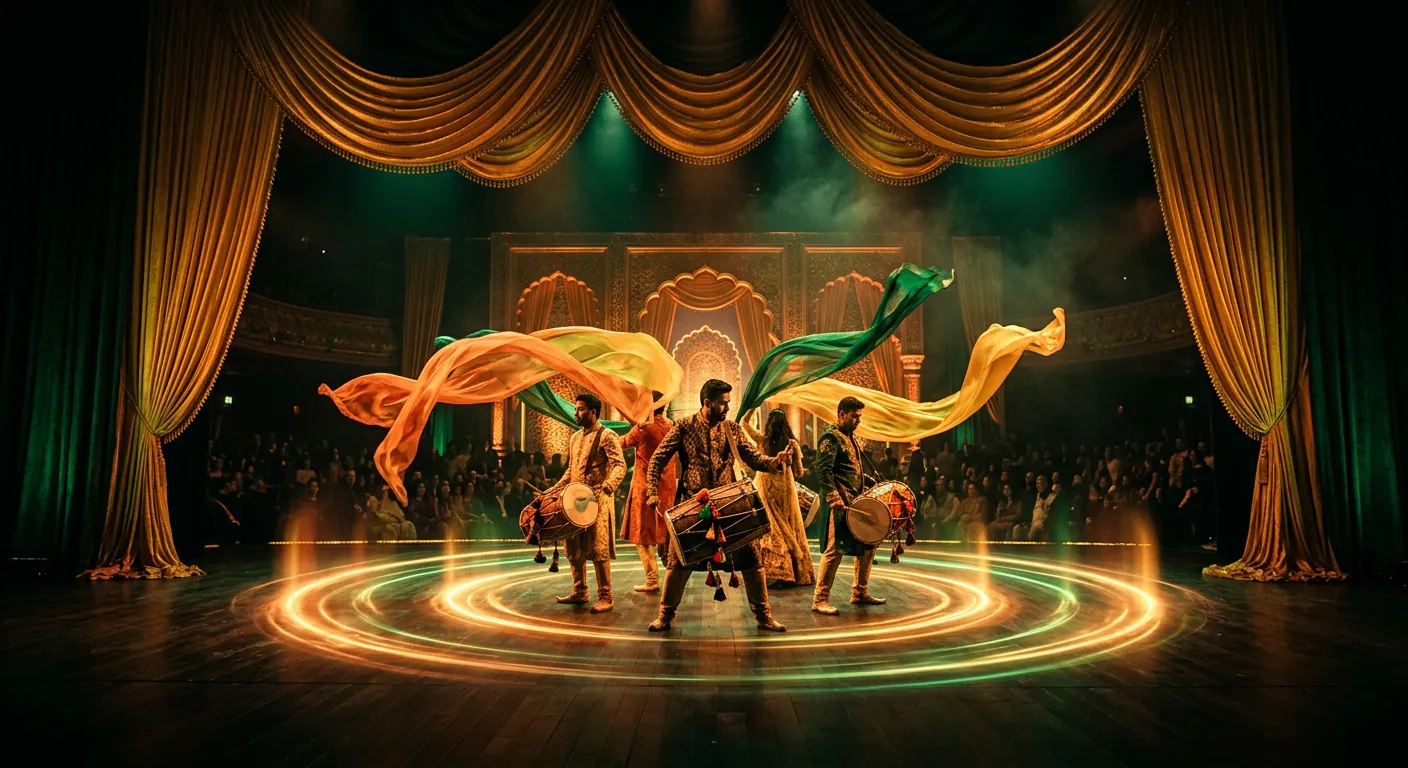
Bollywood songs are written for the big screen. They combine Indian classical and folk instruments with full orchestras, choirs, electronic beats and duet vocals, often in a single song. That scale has always been cinematic, and spatial audio is the natural next step. This guide covers how spatial audio for Bollywood works, where to place each element and how to make an immersive Bollywood mix. For the basics, see what spatial audio is.
Why Bollywood is made for immersive sound
Bollywood music is already mixed for cinemas, where surround and immersive sound are common. Its arrangements have clear layers: singers, rhythm, melody instruments, orchestra and choir. Each layer maps naturally to a different part of the 3D space.
The rule: singers are always clear. However big the orchestra gets, the vocals stay in front and easy to understand.
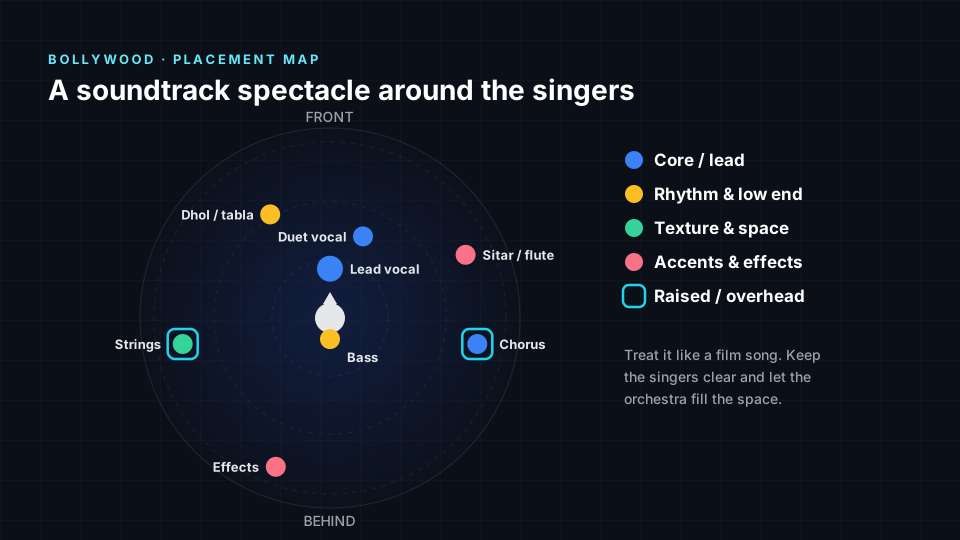
Immersive music for Bollywood: what listeners hear
- Singers you can understand. Lead and duet vocals stay clear and close.
- Rhythm with energy. Dhol and tabla drive the song from the front.
- An orchestra around you. Strings and chorus rise on both sides.
- Film-like moments. Effects and sweeps move behind the listener.
Where to place each element in a Bollywood mix
| Element | Position | Height | Why it works |
|---|---|---|---|
| Lead vocal | Front centre | Ear level | The playback singer leads |
| Duet vocal | Front right, close | Ear level | Clear dialogue between singers |
| Dhol and tabla | Front left | Ear level | Energetic rhythm |
| Bass | Centre | Ear level | Modern low end |
| Sitar and flute | Right | Ear level | Classical colour |
| Strings | Left | Raised | Cinematic sweep |
| Chorus | Right | Raised | Big film moments |
| Effects | Behind, moving | Ear level | Soundtrack drama |
The psychoacoustics behind Bollywood placement
Every position in the table above follows how the ear and brain locate sound. Here is the reason behind the main choices for Bollywood.
- Lead and duet vocals both in front. Hearing is sharpest straight ahead: listeners can tell apart sources about 1 degree apart in front of them, but need far larger gaps at the sides (Mills, 1958). Keeping both voices in the precise frontal zone lets a duet read as a conversation.
- Dhol and tabla left, sitar and flute right. Sounds that overlap in pitch mask each other less when they arrive from different directions, so spreading them keeps every part clear without extra EQ. Splitting rhythm and melody instruments keeps a dense arrangement clear.
- Strings and chorus raised. Sound arriving from the sides, slightly different at each ear, creates the feeling of being inside the music. Acousticians call this envelopment. Lush strings and choirs spread around and above give the cinematic scale the genre is known for.
- Effects moving behind. Moving sounds grab attention because the brain is wired to track change, so motion works best when it is slow, deliberate and kept away from the anchor parts. Movement behind the singers adds excitement without pulling focus from the song.
The immersion profile for Bollywood
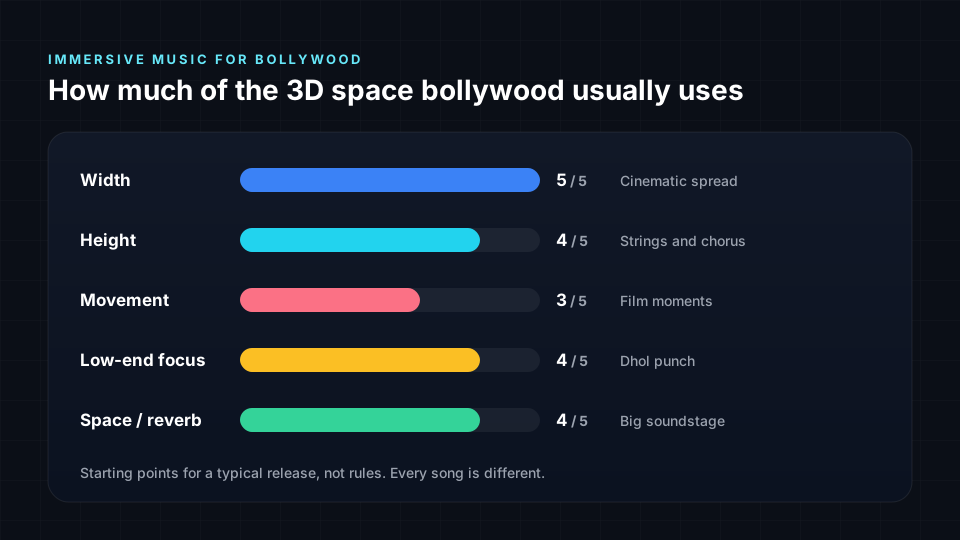
Bollywood scores high on almost every dimension, much like a film score. The difference is that the vocals always stay at the front of the mix.
Tips for an immersive Bollywood mix
- Treat it like a film. Think in scenes: intimate verses, huge choruses.
- Keep duets close together. Both singers in front, slightly apart.
- Raise the orchestra. Strings and chorus gain scale with height.
- Give classical instruments their own place. Sitar, flute and tabla deserve clear positions.
- Save movement for transitions. Sweeps and effects work best between sections.
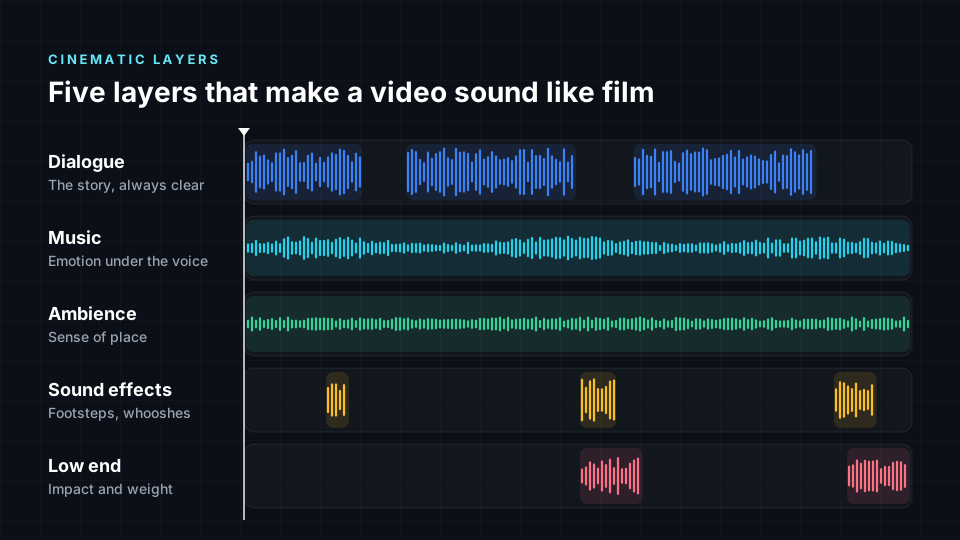
How to make immersive Bollywood music from stereo
Spatial9 can create spatial audio from a stereo track in a few steps:
- Upload your stereo master or your stems.
- Spatial9's AI separates and places each part, keeping the singers clear in front.
- Preview it in binaural on headphones.
- Export Eclipsa Audio, ADM, binaural or Ambisonics.
- Publish a video. Create a YouTube-ready video with your immersive audio and publish it directly.
For related guides, read spatial audio for film and game scores and spatial audio for pop. Every guide is listed in spatial audio and immersive music by genre.
Frequently asked questions
Can I make a Bollywood mix in Dolby Atmos or Eclipsa Audio?
Yes. The placements in this guide work for both. Spatial9 exports ADM, the standard file used by Dolby Atmos studios, as well as Eclipsa Audio for YouTube, so one immersive Bollywood mix covers both. You may also hear this called a 3D Bollywood mix or Hindi songs in spatial audio.
Is spatial audio good for Bollywood music?
Yes. Bollywood songs are cinematic, with orchestras, choirs and duets that gain a lot from a 3D space.
Where should the duet vocals go?
Both in front, slightly apart, so listeners can follow the conversation between the singers.
Can old Bollywood songs be remixed in spatial audio?
Yes. Spatial9 can separate a stereo recording into its parts and place them in 3D, even when the original multitracks are not available.
Can I convert a finished Bollywood track to spatial audio?
Yes. Spatial9 uses AI to generate an immersive mix from a stereo master and exports it as Eclipsa Audio, ADM, binaural or Ambisonics.
Does immersive Bollywood music work on normal headphones?
Yes. The mix is rendered binaurally, so the cinematic feel works on any regular headphones.
Dolby and Dolby Atmos are trademarks of Dolby Laboratories. Spatial9 is not affiliated with or endorsed by Dolby Laboratories.
Sources
- Blauert, J. (1997). Spatial Hearing: The Psychophysics of Human Sound Localization, revised edition. MIT Press. Low-frequency, elevation, distance and motion cues.
- Mills, A. W. (1958). On the minimum audible angle. Journal of the Acoustical Society of America, 30(4), 237-246.
- Hebrank, J. and Wright, D. (1974). Spectral cues used in the localization of sound sources on the median plane. Journal of the Acoustical Society of America, 56(6), 1829-1834.
- Bronkhorst, A. W. (2000). The cocktail party phenomenon: a review of research on speech intelligibility in multiple-talker conditions. Acta Acustica united with Acustica, 86, 117-128.
- Litovsky, R. Y., Colburn, H. S., Yost, W. A. and Guzman, S. J. (1999). The precedence effect. Journal of the Acoustical Society of America, 106(4), 1633-1654.
- Barron, M. and Marshall, A. H. (1981). Spatial impression due to early lateral reflections in concert halls. Journal of Sound and Vibration, 77(2), 211-232.
- Neuhoff, J. G. (1998). Perceptual bias for rising tones. Nature, 395, 123-124.
- Bregman, A. S. (1990). Auditory Scene Analysis: The Perceptual Organization of Sound. MIT Press.
Turn your song into a spectacle
Upload a track to Spatial9 and hear your Bollywood song fill the space around you in minutes. Then export it or publish it straight to YouTube.