Spatial Audio & Immersive Music for Rumba & Afro-Cuban: Guaguancó, Son Cubano & Changüí
Spatial9 Team · · 10 min read
Part of the series Spatial audio and immersive music by genre.
Key takeaways
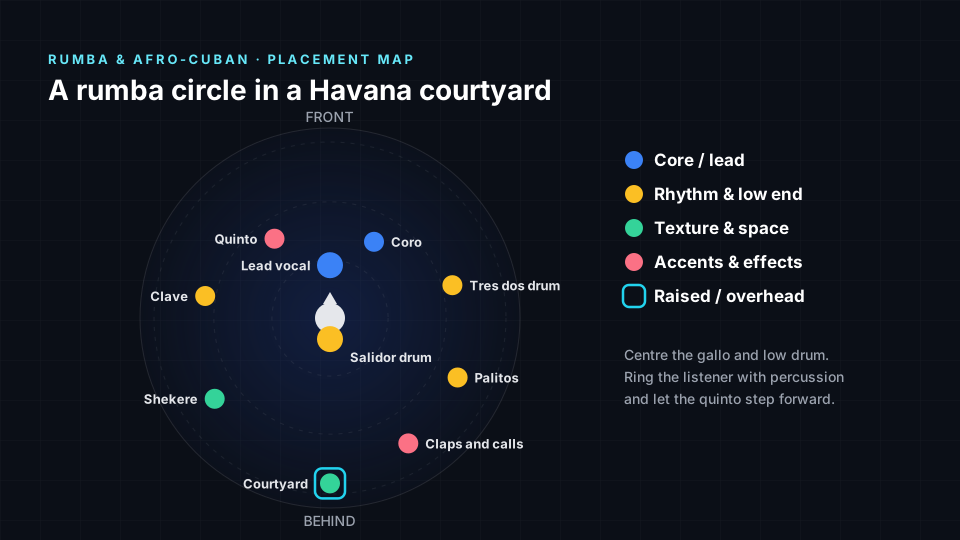
- In a spatial rumba mix the lead singer and the low salidor drum stay centred, while the coro, quinto, tres dos, clave, palitos and shekere form a circle around the listener.
- Because the brain sorts sounds into separate streams by pitch, timing and direction, an effect known as auditory stream segregation, placing the low and middle congas apart lets the ear follow their interlocking conversation.
- Rumba is Afro-Cuban music of voices, drums and dance played in a circle, so the room should be a warm, open courtyard with only light reflections overhead.
- The rumba and Afro-Cuban music immersion profile scores width 4, height 2, movement 2, low-end focus 2 and space 3 out of 5.
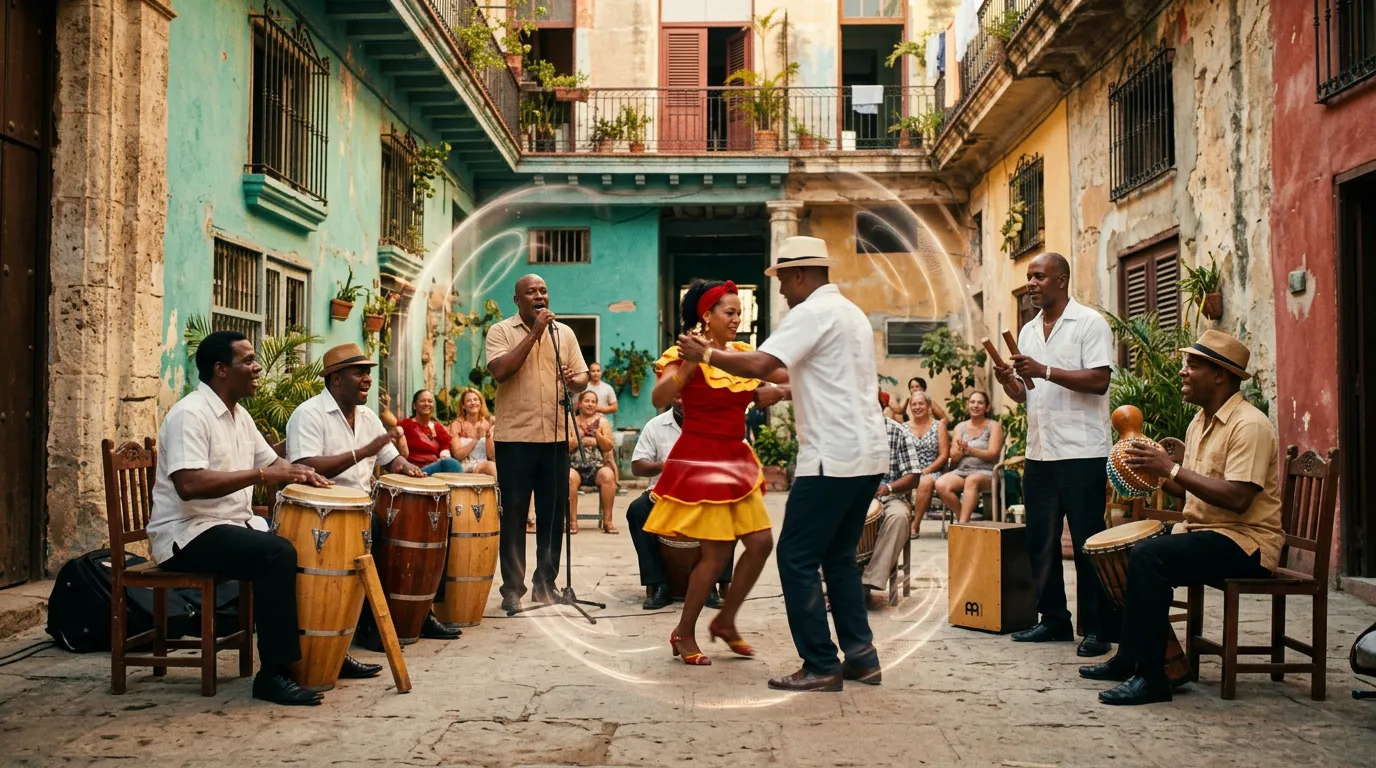
Rumba is the Afro-Cuban music of drums, voices and dance that took shape in the late nineteenth century in the docks and tenement courtyards, the solares, of Havana and Matanzas, around the time slavery was abolished in Cuba in 1886. A rumba is built on three drums of different pitch: the low salidor, the middle tres dos and the high quinto, which improvises in dialogue with the dancers. The clave and the palitos, two sticks beaten on wood, hold the timeline, while a lead singer, the gallo, trades lines with a chorus, the coro. Groups such as Los Muñequitos de Matanzas, founded in 1952, and Los Papines carried the style onto records and stages. Rumba suits spatial audio because it is played in a circle: the players and the dancers literally surround the listener. This guide covers how spatial audio for rumba and Afro-Cuban music works, where to place each element and how to make an immersive rumba mix. For the basics, see what spatial audio is.
Why rumba and Afro-Cuban music works in spatial audio
Rumba is a conversation in rhythm. The low and middle drums interlock, the clave keeps the timeline, the quinto answers the dancers and the gallo calls while the coro replies. In stereo these parts flatten into a dense wall of drums. In an immersive mix the singer and the low drum hold the centre, each other part takes its own place in the ring and the quinto steps forward when it talks to the dancers.
The rule: a centred singer and low drum inside a ring of percussion. Keep the voice and the salidor in the middle, spread the other drums and the small percussion in a circle around the listener, and set them in a warm open courtyard.
Immersive music for rumba and Afro-Cuban music: what listeners hear
- A singer calling to you. The gallo sits front and centre, with the coro answering just beside them.
- Three drums, three voices. The low, middle and high congas each come from their own direction, so the interlocking pattern is easy to follow.
- A quinto that talks back. The high drum moves slightly forward for each burst of improvisation, as if answering a dancer in front of you.
- A courtyard around the circle. A warm, open reverb places you in a solar, a street corner or a small patio full of people.
Where to place each element in a rumba and Afro-Cuban music mix
| Element | Position | Height | Why it works |
|---|---|---|---|
| Lead vocal | Front centre | Ear level | The gallo who leads the song and the story |
| Salidor drum | Centre | Ear level | The low conga that anchors the pattern |
| Coro | Front right of centre | Ear level | The chorus that answers the gallo |
| Quinto | Front left of centre, stepping forward | Ear level | The high drum that improvises with the dancers |
| Tres dos drum | Right | Ear level | The middle conga that interlocks with the salidor |
| Clave | Left | Ear level | The two-bar timeline that every part follows |
| Palitos | Behind right | Ear level | Sticks on wood that double the timeline |
| Claps and calls | Behind right | Ear level | Hand claps and shouts from the people in the circle |
| Shekere | Behind left | Ear level | Beaded gourd that fills the gaps |
| Courtyard | Behind | Raised | Reflections from the walls of an open patio |
The psychoacoustics behind rumba and Afro-Cuban music placement
Every position in the table above follows how the ear and brain locate sound. Here is the reason behind the main choices for rumba and Afro-Cuban music.
- Low and middle drums on different sides. The brain groups sounds into streams by pitch, timing and direction. This is auditory stream segregation (Bregman). The salidor and tres dos share the same skin tone, and setting them apart lets the ear hear two drums in conversation.
- Small steps forward for the quinto. The ear can detect a change of only about one degree for sounds straight ahead. This is the minimum audible angle (Mills). A short move toward the centre is enough to show when the quinto starts to improvise.
- Gallo and coro apart. The brain can follow one voice among many when they come from different directions. This is the cocktail party effect (Bronkhorst). Keeping the coro just to one side of the gallo makes every call and response clear.
- A courtyard with side reflections. Early reflections arriving from the sides make a sound feel wider and more enveloping. This is spatial impression from early lateral reflections (Barron and Marshall). Reflections from patio walls give the drums body without blurring their sharp slaps.
The immersion profile for rumba and Afro-Cuban music
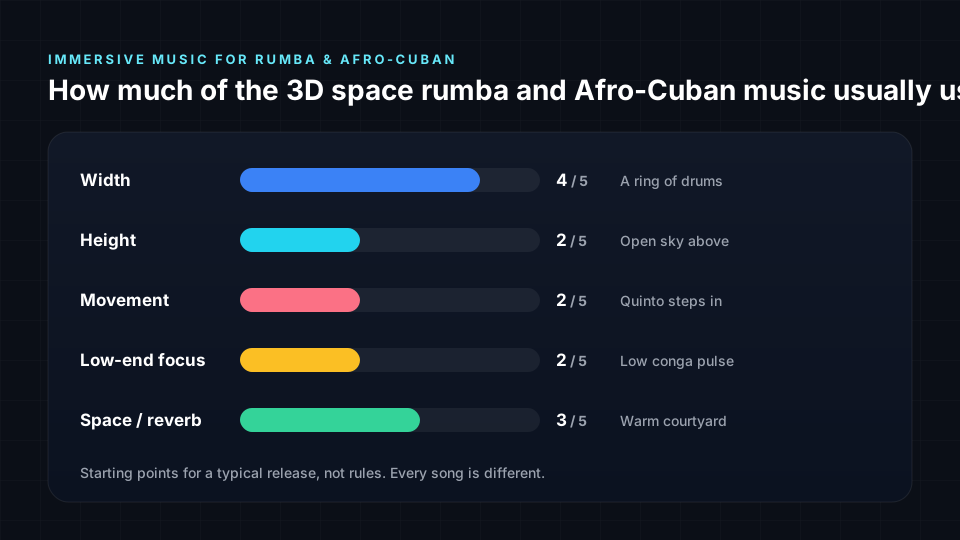
Width scores 4 because rumba is played in a ring, so the percussion can wrap around the listener. Space scores 3: a courtyard needs a natural, open sound, but long reverb would blur the fast slaps of the quinto. Low-end focus is 2, since the salidor and, in son, the bass give a warm pulse rather than a heavy bottom. Height is low, with only light reflections from the walls. Movement scores 2, coming from the quinto stepping forward to improvise, not from sounds flying around the head.
Tips for an immersive rumba and Afro-Cuban music mix
- Keep the gallo front and centre. The lead voice never moves.
- Separate the three drums. Put the salidor in the centre and the tres dos and quinto on opposite sides so the conversation stays clear.
- Keep the clave easy to find. The clave is the timeline for everyone, so give it a clear, fixed position and do not bury it.
- Move the quinto forward, not around. Bring the high drum a little closer for its phrases, then let it settle back.
- Use a warm, open room. A courtyard or small hall suits the music; avoid long, dark reverbs and artificial effects.
Rumba & Afro-Cuban styles: guaguancó, son cubano and changüí
The core placement holds for every style here: the voice and the lowest part in the middle, the percussion and strings around the listener. What changes is the line-up and how much the drums lead.
Guaguancó
Guaguancó is the best-known form of rumba, a medium-tempo couple dance in which the man tries to catch the woman with a sudden pelvic gesture, the vacunao, and she blocks him. Use the full circle layout: gallo and salidor in the centre, coro beside the singer, tres dos and quinto on opposite sides, and clave, palitos and shekere spread behind. Let the quinto step forward with each vacunao.
Son Cubano
Son cubano grew up in eastern Cuba and reached Havana in the early twentieth century, where groups such as the Sexteto Habanero and Ignacio Piñeiro's Septeto Nacional made it the island's popular music. Its sound joins the tres, a guitar with three doubled strings, with guitar, bongó, maracas, claves and bass, later adding trumpet. In the 1940s Arsenio Rodríguez expanded it into the conjunto with piano, conga and more trumpets. Keep the vocal and bass centred, the tres front left, the trumpet front right, bongó and conga apart, and maracas and claves behind.
Changüí
Changüí is a rural son style from the Guantánamo region in the far east of Cuba. A typical group uses tres, bongó, maracas, a metal scraper called the guayo and the marímbula, a large box with plucked metal tongues that plays the bass. Elio Revé later brought changüí into his Havana dance orchestra. Put the marímbula in the centre with the voice, the tres and bongó on opposite front sides, and the guayo and maracas behind. A small, dry room fits its rural roots.
Related styles such as yambú, columbia and the sacred batá drumming of Santería follow the same idea: keep the voice and the lowest drum centred, then set the rest of the ensemble in a circle around the listener.
How to make immersive rumba and Afro-Cuban music from stereo
Spatial9 can create spatial audio from a stereo track in a few steps:
- Upload your stereo master or your stems.
- Spatial9's AI separates and places each part, pulling the gallo, coro, congas, clave, small percussion, tres and bass apart even from old recordings and setting them in a circle as if around a rumba in a courtyard.
- Preview it in binaural on headphones.
- Export Eclipsa Audio, ADM, binaural or Ambisonics.
- Publish a video. Create a YouTube-ready video with your immersive audio and publish it directly.
For related guides, read spatial audio for salsa and spatial audio for Latin jazz. Every guide is listed in spatial audio and immersive music by genre.
Frequently asked questions
Does this guide cover guaguancó, son cubano and changüí?
Yes. Guaguancó uses the full circle of drums and voices with the quinto stepping forward. Son cubano centres the voice and bass with the tres, trumpet and small percussion around them. Changüí puts the marímbula in the centre with tres and bongó on opposite sides in a small, dry room.
Can I make a rumba and Afro-Cuban music mix in Dolby Atmos or Eclipsa Audio?
Yes. The placements in this guide work for both. Spatial9 exports ADM, the standard file used by Dolby Atmos studios, as well as Eclipsa Audio for YouTube, so one immersive rumba mix covers both. If you plan to release the Atmos version on Apple Music, build it from your original stems or multitracks, because Apple does not accept Atmos made from a finished stereo master. See where to publish spatial audio. You may also hear this called a 3D rumba and Afro-Cuban music mix or rumba and Afro-Cuban music in spatial audio.
Is spatial audio good for rumba?
Yes. Rumba is played in a circle by drums and voices that interlock closely. Spatial audio gives each part its own direction, so the whole conversation comes through clearly.
Where should the clave go in an immersive rumba mix?
Put it on one side at ear level, in a fixed place, opposite the tres dos. Every other part is played against it.
How is rumba different from salsa in spatial audio?
Rumba is played by voices and percussion in a circle, so it suits a ring of drums and a natural courtyard. Salsa adds piano, bass, a horn section and timbales, so it needs a wider stage, a stronger low end and more space for the brass.
Where should the tres go in a son cubano mix?
Place it front left at ear level, close to the singer, with the trumpet on the opposite side. The tres carries the repeating riff that drives the son.
Can I convert an old Cuban recording to spatial audio?
Yes. Spatial9 uses AI to separate the voices, drums, tres and bass from a mono or stereo master. Separation is never perfect with older recordings, so keep the layout simple and the circle close.
Dolby and Dolby Atmos are trademarks of Dolby Laboratories. Spatial9 is not affiliated with or endorsed by Dolby Laboratories.
Sources
- Blauert, J. (1997). Spatial Hearing: The Psychophysics of Human Sound Localization, revised edition. MIT Press. Low-frequency, elevation, distance and motion cues.
- Mills, A. W. (1958). On the minimum audible angle. Journal of the Acoustical Society of America, 30(4), 237-246.
- Hebrank, J. and Wright, D. (1974). Spectral cues used in the localization of sound sources on the median plane. Journal of the Acoustical Society of America, 56(6), 1829-1834.
- Bronkhorst, A. W. (2000). The cocktail party phenomenon: a review of research on speech intelligibility in multiple-talker conditions. Acta Acustica united with Acustica, 86, 117-128.
- Litovsky, R. Y., Colburn, H. S., Yost, W. A. and Guzman, S. J. (1999). The precedence effect. Journal of the Acoustical Society of America, 106(4), 1633-1654.
- Barron, M. and Marshall, A. H. (1981). Spatial impression due to early lateral reflections in concert halls. Journal of Sound and Vibration, 77(2), 211-232.
- Neuhoff, J. G. (1998). Perceptual bias for rising tones. Nature, 395, 123-124.
- Bregman, A. S. (1990). Auditory Scene Analysis: The Perceptual Organization of Sound. MIT Press.
- Sublette, N. (2004). Cuba and Its Music: From the First Drums to the Mambo. Chicago Review Press.
Step into the circle
Upload a track to Spatial9 and hear the congas, clave and coro gather around you in minutes. Then export it or publish it straight to YouTube.