
Spatial Audio & Immersive Music for Kompa & Zouk: Konpa Direk, Zouk Love & Cadence-Lypso
Spatial9 Team · · 11 min read
Part of the series Spatial audio and immersive music by genre.
Key takeaways
- In a spatial kompa and zouk mix the lead vocal and the rolling bass stay close at the centre, while the rhythm and lead guitars trade from opposite sides and keyboards, horns and percussion form a warm arc around the listener.
- Because the brain sorts sounds into separate streams by pitch, timing and direction, an effect known as auditory stream segregation, splitting the two bright kompa guitars keeps both patterns clear.
- Kompa and zouk are couple dance musics, so the room should be a warm dance hall and any movement should be gentle rather than sweeping.
- The kompa and zouk immersion profile scores width 3, height 2, movement 2, low-end focus 4 and space 3 out of 5.
Kompa and zouk are the great couple dance musics of the French and Creole-speaking Caribbean. Kompa, written konpa in Haitian Creole, was created in Port-au-Prince in 1955 by the saxophonist and band leader Nemours Jean-Baptiste, who called his steady, mid-tempo groove compas direct. It is built on a drum kit with a constant cymbal and cowbell pattern, congas, an electric bass, interlocking guitars and a horn section, later joined by keyboards. In the 1960s and 1970s smaller "mini-jazz" groups and bands such as Tabou Combo and Skah Shah spread kompa through Haiti, New York and the French Antilles. Zouk was born in Guadeloupe and Martinique at the start of the 1980s, when Kassav', formed by Pierre-Édouard Décimus and Jacob Desvarieux, blended Antillean carnival rhythms, kompa and cadence with synthesisers and studio production. Kassav' made zouk an international sound across Africa, the Caribbean and France. Both styles are smooth, warm and built on a rolling bass and layers of guitar and keyboard, which an immersive mix can open out around the listener. This guide covers how spatial audio for kompa and zouk works, where to place each element and how to make an immersive kompa and zouk mix. For the basics, see what spatial audio is.
Why kompa and zouk works in spatial audio
Kompa and zouk are music for dancing close. The groove is steady rather than fast, and the energy comes from layers that interlock: a bass that rolls under every bar, a cymbal and cowbell ticking without a break, two guitars playing short, bright patterns against each other, and keyboards and horns answering the singer. In stereo these layers pile into a dense, polished middle. In an immersive mix the bass and voice stay together at the centre, the guitars trade from either side and the keyboards and pads wrap around the listener like the warmth of a dance hall.
The rule: a close voice and a rolling bass, with the guitars trading and the band wrapped softly around. Keep the singer and bass central, split the guitars, put the keys and horns in a smooth arc and avoid big moves that would disturb the sway of the dance.
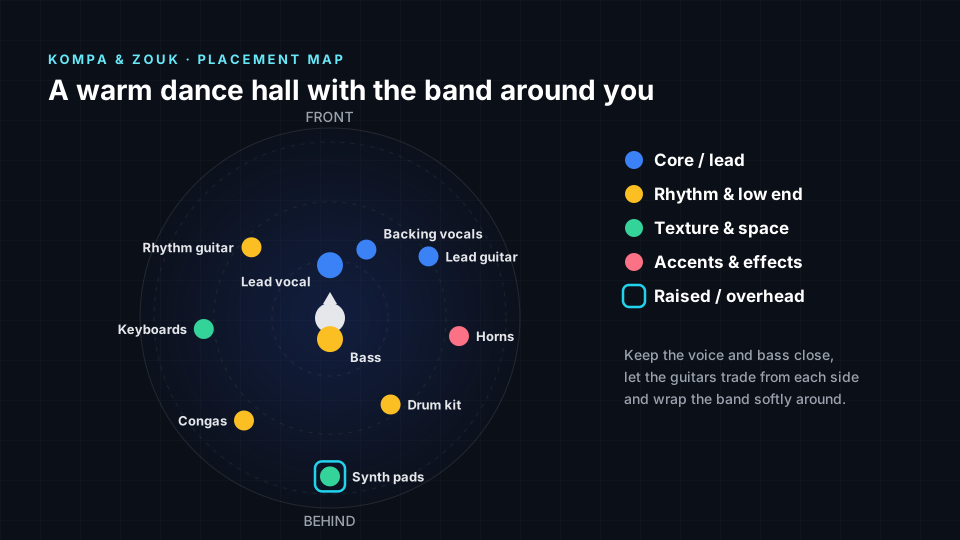
Immersive music for kompa and zouk: what listeners hear
- A voice close to you. The lead vocal sits in the centre, warm and intimate, with harmony singers just beside it.
- A bass that rolls. The bassline holds the middle, smooth and full, carrying the sway of the dance.
- Guitars that talk. The rhythm and lead guitars play their bright patterns from opposite sides, so you hear the conversation.
- A warm wrap of sound. Keyboards, horns and soft pads surround the listener without crowding the singer.
Where to place each element in a kompa and zouk mix
| Element | Position | Height | Why it works |
|---|---|---|---|
| Lead vocal | Front centre | Ear level | The love song or story at the heart of every track |
| Bass | Centre | Ear level | The rolling line that carries the couple dance |
| Backing vocals | Front right of centre | Ear level | Harmonies and chorus answers close to the lead |
| Rhythm guitar | Front left | Ear level | Short, chopped chords locked to the groove |
| Lead guitar | Front right, moving slightly | Ear level | Bright, arpeggiated kompa melodies and fills |
| Keyboards | Left | Ear level | Chords, riffs and synth hooks |
| Horns | Right | Ear level | Saxophone and brass answers in kompa |
| Congas | Behind left | Ear level | Hand drums that keep the groove rolling |
| Drum kit | Behind right | Ear level | The steady kick and the constant cymbal and cowbell |
| Synth pads | Behind | Raised | A soft, warm layer that lifts the chorus |
The psychoacoustics behind kompa and zouk placement
Every position in the table above follows how the ear and brain locate sound. Here is the reason behind the main choices for kompa and zouk.
- Bass stays centred. The ear finds almost no direction in frequencies below roughly 80 to 100 Hz, so the bass gains nothing from being spread. A centred bass keeps the rolling groove full and steady.
- Rhythm and lead guitar on opposite sides. The brain groups sounds into streams by pitch, timing and direction. This is auditory stream segregation (Bregman). Kompa guitars share a clean, bright tone, and setting them apart lets the ear follow both patterns instead of one blur.
- Harmony singers just beside the lead. The ear can detect a change of only about one degree for sounds straight ahead. This is the minimum audible angle (Mills). A small offset is enough to separate the backing vocals from the lead while keeping the blend.
- A warm room with side reflections. Early reflections arriving from the sides make a sound feel wider and more enveloping. This is spatial impression from early lateral reflections (Barron and Marshall). Gentle side reflections give the band the warmth of a dance hall without blurring the groove.
The immersion profile for kompa and zouk
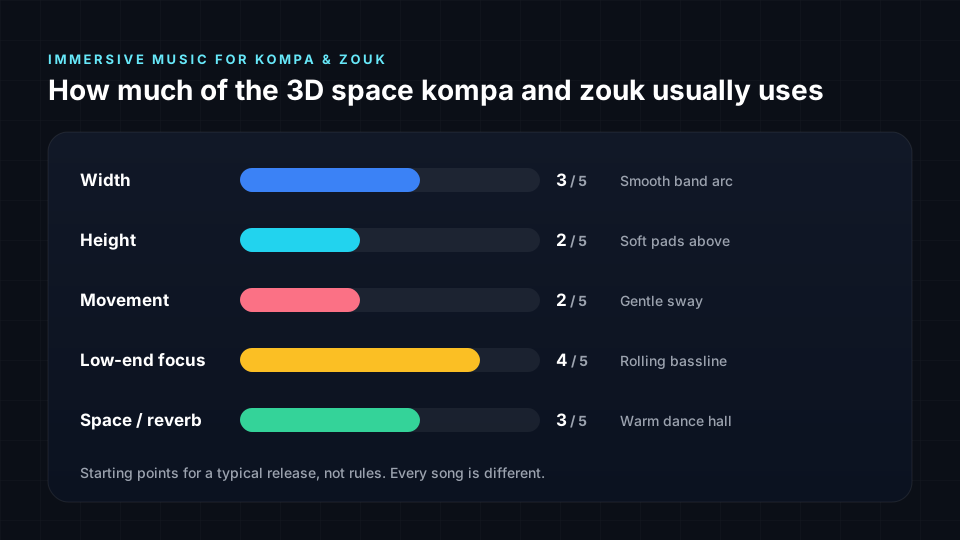
Low-end focus scores 4 because the bass is the soul of both styles, full and always present. Width is 3: the band forms a smooth arc in front and to the sides rather than a full circle. Space also scores 3, a warm dance hall rather than an open street or a long echo. Height is low, with only a soft layer of pads above. Movement scores 2, limited to small guitar fills and solos, because the music should sway, not swirl.
Tips for an immersive kompa and zouk mix
- Keep the voice close. Kompa and zouk love songs are intimate, so place the singer at the centre and near the listener.
- Give the bass room. Hold it at the centre and let it roll; do not crowd it with too much low keyboard.
- Split the guitars. Put the rhythm and lead guitars on opposite front sides so their patterns stay clear.
- Wrap the band softly. Spread keys, horns and congas in a smooth arc, and lift only the pads a little.
- Keep movement gentle. Small moves for guitar fills are enough; big sweeps distract from the dance.
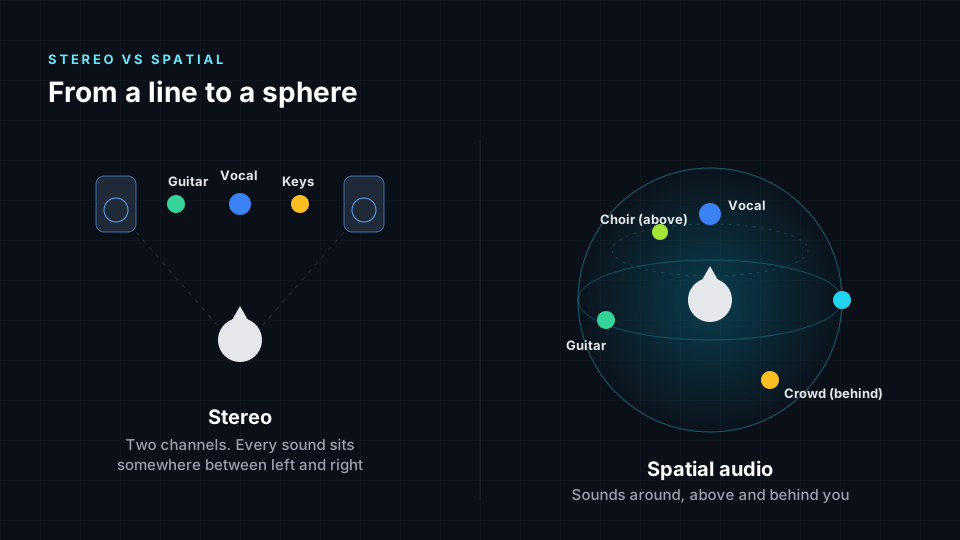
Kompa & Zouk styles: konpa direk, zouk love and cadence-lypso
The core placement holds for every style here: the voice and bass in the middle, the guitars split and the band in a warm arc. What changes is the tempo, the size of the band and how much synthesiser sits in the mix.
Konpa Direk
Konpa direk, or compas direct, is the original Haitian style created by Nemours Jean-Baptiste in 1955 and developed by the big bands and mini-jazz groups that followed. It uses a full live band: drums with the constant cymbal and cowbell, congas, bass, two guitars, horns and later keyboards. Modern konpa bands such as T-Vice and Carimi kept the live groove with more synthesisers. Place the horns on one side and keyboards on the other, split the guitars in front and keep the cowbell and cymbal clear but behind, so the groove ticks steadily under the band.
Zouk Love
Zouk love is the slow, romantic side of zouk, which grew from the mid-1980s and into the 1990s with singers such as Edith Lefel and Jean-Philippe Marthély of Kassav'. It slows the tempo, softens the drums and puts the emphasis on the voice, warm synthesisers and a smooth bass. It later spread widely through Lusophone Africa, where it influenced kizomba. Keep the singer very close and centred, let the pads wrap gently around and above the listener and keep percussion light and further back.
Cadence-Lypso
Cadence-lypso is a style from Dominica that took shape in the 1970s, led by the band Exile One and its founder Gordon Henderson. It mixes the cadence rhythm of Haitian bands with calypso and Dominica's own traditions, often with horns and a strong rhythm section, and it was one of the influences on zouk. Treat it as a lively band: horns wide on one side, guitars split in front, drums and percussion behind and the vocal and bass centred. A slightly brighter, livelier room suits its energy.
Related styles such as Antillean cadence, kizomba and the Haitian mizik rasin of the 1990s follow the same idea: centre the voice and bass, then wrap the band around the listener.
How to make immersive kompa and zouk from stereo
Spatial9 can create spatial audio from a stereo track in a few steps:
- Upload your stereo master or your stems.
- Spatial9's AI separates and places each part, pulling the vocal, bass, guitars, keyboards, horns and percussion apart and setting them in a warm arc around the listener.
- Preview it in binaural on headphones.
- Export Eclipsa Audio, ADM, binaural or Ambisonics.
- Publish a video. Create a YouTube-ready video with your immersive audio and publish it directly.
For related guides, read spatial audio for soca and calypso and spatial audio for bachata. Every guide is listed in spatial audio and immersive music by genre.
Frequently asked questions
Does this guide cover konpa direk, zouk love and cadence-lypso?
Yes. Konpa direk uses a live band with split guitars and horns opposite the keyboards. Zouk love keeps the voice very close with pads wrapping gently around. Cadence-lypso brings a lively band with horns wide and a brighter room.
Can I make a kompa and zouk mix in Dolby Atmos or Eclipsa Audio?
Yes. The placements in this guide work for both. Spatial9 exports ADM, the standard file used by Dolby Atmos studios, as well as Eclipsa Audio for YouTube, so one immersive kompa and zouk mix covers both. If you plan to release the Atmos version on Apple Music, build it from your original stems or multitracks, because Apple does not accept Atmos made from a finished stereo master. See where to publish spatial audio. You may also hear this called a 3D kompa and zouk mix or kompa and zouk in spatial audio.
Is spatial audio good for kompa and zouk?
Yes. Kompa and zouk layer guitars, keyboards, horns and percussion over a rolling bass and a close voice. Spatial audio gives each layer its own direction, so the band sounds warm and open without covering the singer.
Where should the guitars go in an immersive kompa mix?
Put the rhythm and lead guitars on opposite front sides at ear level. Their bright patterns interlock, and separating them lets the listener hear the conversation between them.
How do I keep the bass right in an immersive zouk mix?
Keep it at the centre and in mono, with enough space around it. Avoid low synth pads and keyboard parts that crowd the same range, and let the bass carry the sway of the dance.
How is kompa different from bachata in spatial audio?
Kompa is a band music with a rolling bass, horns, keyboards and a steady cymbal and cowbell, so it suits a warm arc of instruments. Bachata is led by requinto guitar lines and bongos over a lighter bass, so it needs a narrower, more guitar-focused layout.
Can I convert an old kompa recording to spatial audio?
Yes. Spatial9 uses AI to separate the vocal, bass, guitars, keyboards, horns and percussion from a stereo master. Separation is never perfect with older recordings, so keep the layout simple and the voice and bass close.
Dolby and Dolby Atmos are trademarks of Dolby Laboratories. Spatial9 is not affiliated with or endorsed by Dolby Laboratories.
Sources
- Blauert, J. (1997). Spatial Hearing: The Psychophysics of Human Sound Localization, revised edition. MIT Press. Low-frequency, elevation, distance and motion cues.
- Mills, A. W. (1958). On the minimum audible angle. Journal of the Acoustical Society of America, 30(4), 237-246.
- Hebrank, J. and Wright, D. (1974). Spectral cues used in the localization of sound sources on the median plane. Journal of the Acoustical Society of America, 56(6), 1829-1834.
- Bronkhorst, A. W. (2000). The cocktail party phenomenon: a review of research on speech intelligibility in multiple-talker conditions. Acta Acustica united with Acustica, 86, 117-128.
- Litovsky, R. Y., Colburn, H. S., Yost, W. A. and Guzman, S. J. (1999). The precedence effect. Journal of the Acoustical Society of America, 106(4), 1633-1654.
- Barron, M. and Marshall, A. H. (1981). Spatial impression due to early lateral reflections in concert halls. Journal of Sound and Vibration, 77(2), 211-232.
- Neuhoff, J. G. (1998). Perceptual bias for rising tones. Nature, 395, 123-124.
- Bregman, A. S. (1990). Auditory Scene Analysis: The Perceptual Organization of Sound. MIT Press.
- Guilbault, J. (1993). Zouk: World Music in the West Indies. University of Chicago Press.
Dance a little closer
Upload a track to Spatial9 and hear the voice, guitars and bass wrap around you in minutes. Then export it or publish it straight to YouTube.