Spatial Audio & Immersive Music for Soca & Calypso: Power Soca, Groovy Soca & Chutney Soca
Spatial9 Team · · 11 min read
Part of the series Spatial audio and immersive music by genre.
Key takeaways
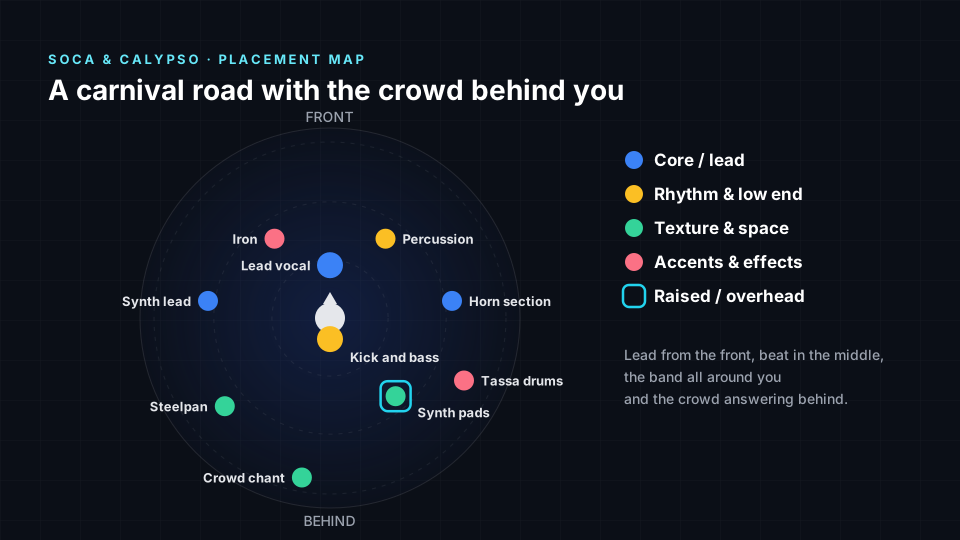
- In a spatial soca and calypso mix the lead vocal stays in front with the kick and bass centred, while the iron, percussion, horns and synths ring the listener and the crowd answers from behind.
- Because the brain picks out one voice best when competing sounds come from other directions, an effect known as the cocktail party effect, putting the crowd behind and the band to the sides keeps every lyric clear.
- Soca and calypso are carnival musics played on the road and at outdoor fetes, so the space should feel open and lively rather than reverberant.
- The soca and calypso immersion profile scores width 4, height 3, movement 3, low-end focus 4 and space 2 out of 5.
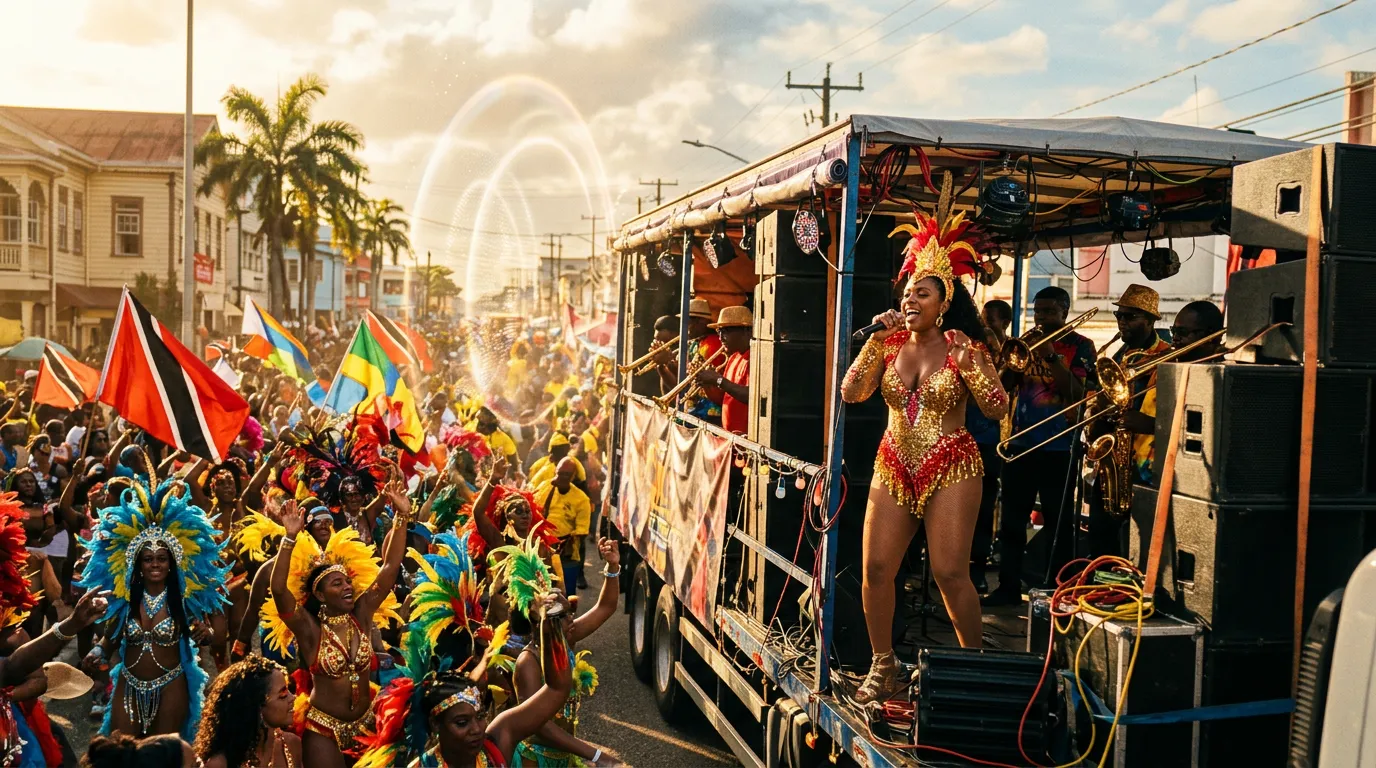
Calypso is the song tradition of Trinidad and Tobago. It grew in the nineteenth century from West African song traditions, the French Creole songs of carnival and the call-and-response of the chantwell singers, and by the early twentieth century calypsonians were singing witty, topical and often biting lyrics in the carnival tents. The first recordings were made in 1914, and singers such as Attila the Hun, Roaring Lion, Lord Kitchener and the Mighty Sparrow made calypso a voice of the island, with brass, guitar, bass and percussion behind them. Harry Belafonte's album Calypso of 1956 took the style around the world. In the 1970s Lord Shorty set out to give calypso new life by mixing it with rhythms from Indo-Trinidadian music and soul, and called the result soca, the "soul of calypso". Soca became the music of carnival, played from huge music trucks on the road, with stars such as Machel Montano and Destra Garcia. Both are built on call-and-response between singer and crowd, which makes them a strong fit for spatial audio. This guide covers how spatial audio for soca and calypso works, where to place each element and how to make an immersive soca and calypso mix. For the basics, see what spatial audio is.
Why soca and calypso works in spatial audio
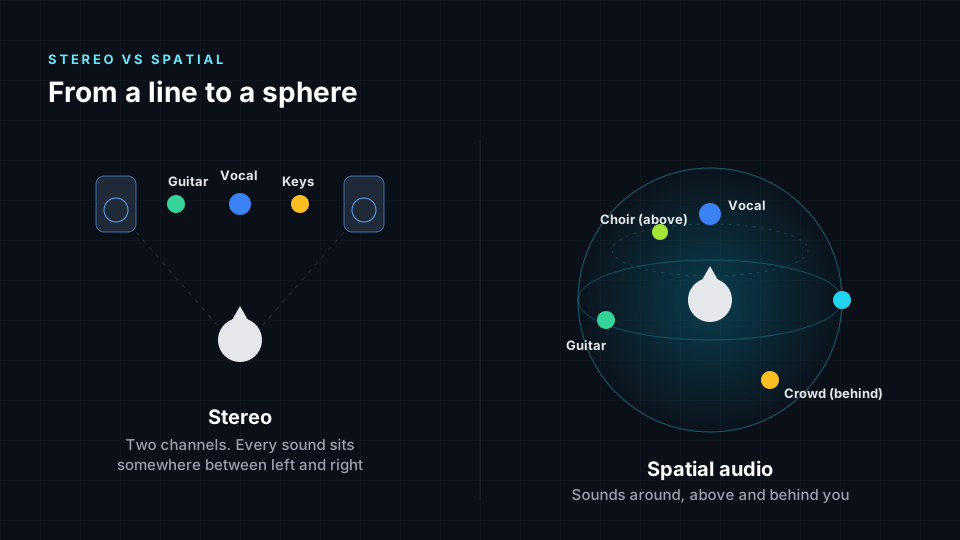
Soca is a party in which the audience has a part to play. The singer calls "wave", "jump" or "wine" and thousands of people answer. Under the voice, a pounding kick and bass, a bright iron struck on every beat, busy percussion and short horn or synth riffs keep the energy high. Calypso is lighter and wordier, with the lyric at the front and the band answering it. In stereo the crowd, the band and the voice sit in one flat line. In an immersive mix the singer leads from the front, the band surrounds the listener and the crowd answers from behind, so the listener is part of the fete.
The rule: a clear voice in front, a heavy beat at the centre and the crowd behind. Keep the vocal and the low end central, ring the listener with iron, percussion, horns and synths, and put the call-and-response around them.
Immersive music for soca and calypso: what listeners hear
- A singer leading the road. The lead vocal sits in front and in the centre, so every lyric and every command comes through.
- A beat you move to. The kick and bass pound at the centre, the anchor of the jump.
- A band all around. Iron, percussion, horns, synths and sometimes steelpan or tassa come from their own directions instead of one bright block.
- A crowd at your back. Shouts, chants and answers from behind put the listener in the middle of the fete.
Where to place each element in a soca and calypso mix
| Element | Position | Height | Why it works |
|---|---|---|---|
| Lead vocal | Front centre | Ear level | The lyric, the story and the commands to the crowd |
| Kick and bass | Centre | Below ear level | The pounding pulse that drives soca |
| Iron | Front left | Ear level | A car brake drum struck with a metal beater, driving the rhythm |
| Percussion | Front right | Ear level | Congas, cowbell and shakers filling the groove |
| Synth lead | Left | Ear level | The riff or hook that answers the singer |
| Horn section | Right, moving slightly | Ear level | Classic calypso and soca brass riffs |
| Synth pads | Behind right | Raised | Chords and builds that lift the chorus |
| Tassa drums | Behind right | Ear level | Indo-Trinidadian drums in chutney soca |
| Steelpan | Behind left | Ear level | Pan melodies from the carnival tradition |
| Crowd chant | Behind | Ear level | The fete answering every call |
The psychoacoustics behind soca and calypso placement
Every position in the table above follows how the ear and brain locate sound. Here is the reason behind the main choices for soca and calypso.
- Kick and bass stay centred. The ear finds almost no direction in frequencies below roughly 80 to 100 Hz, so the kick and bass gain nothing from being spread. A centred low end keeps soca hitting hard on headphones and big systems.
- Iron and percussion on opposite sides. The brain groups sounds into streams by pitch, timing and direction. This is auditory stream segregation (Bregman). The iron and the hand percussion are both bright and busy, and setting them apart keeps each pattern clear.
- A voice clear above the party. The brain can pick out one voice among many competing sounds, and it does this best when they come from different directions. This is the cocktail party effect (Bronkhorst). Putting the crowd behind and the band to the sides keeps the singer's words clear in front.
- Build-ups that rush in. Listeners hear a sound that grows louder as changing more than one that fades by the same amount. This is the perceptual bias for rising, or looming, tones (Neuhoff). A soca build that grows and closes in before the drop feels more intense.
The immersion profile for soca and calypso
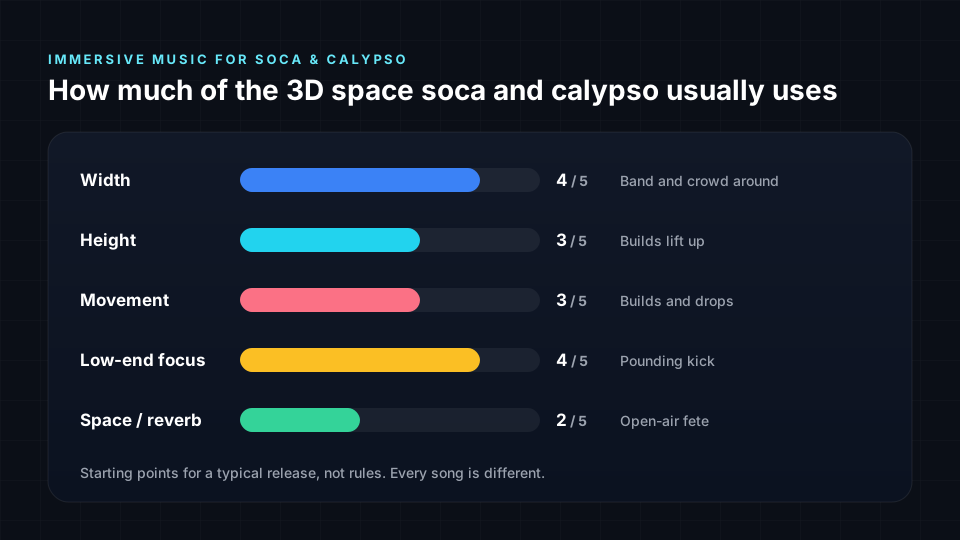
Low-end focus scores 4 because modern soca is built on a pounding kick and bass, while older calypso is lighter. Width is 4: the band and the crowd should surround the listener. Height scores 3, from synth pads and builds rising above the band. Movement is 3, coming from builds, drops and horn riffs rather than constant motion. Space scores only 2, because a fete or a road march is outdoors, with energy and crowd sound but few reflections.
Tips for an immersive soca and calypso mix
- Keep the singer clear and central. Calypso lyrics and soca commands both need to be heard, so the voice never moves.
- Hold the kick and bass in the middle. The beat drives the jump, so keep the low end solid and mono.
- Split the iron and the percussion. Put them on opposite sides so the bright patterns stay separate.
- Put the crowd behind the listener. Answers, chants and whistles from behind make the listener part of the road march.
- Lift the build-ups. Raise pads and risers above the band before a drop, then bring everything back to ear level.
Soca & Calypso styles: power soca, groovy soca and chutney soca
The core placement holds for every style here: the singer in front, the kick and bass at the centre and the band and crowd around. What changes is the tempo, the energy of the build and the instruments that colour the band.
Power Soca
Power soca is the fast, high-energy side of the music, the sound of jump-up anthems and road marches. Songs are full of commands to the crowd, with a pounding kick, sharp synth riffs and big builds and drops. Machel Montano, Bunji Garlin and Superblue are among its best-known voices. Keep the vocal close and strong in the centre, the kick and bass heavy and the synths and horns wide. Use raised builds and a big crowd behind to bring out the energy of the road.
Groovy Soca
Groovy soca is slower and smoother, made for dancing close and winding rather than jumping, with more melody, softer synths and a rolling bassline. It was given its own category in Trinidad's Soca Monarch competition, separate from power soca. Keep the vocal warm and central with backing vocals just beside it, give the bass a rounder weight and move the percussion slightly further out. Use a little more space and less movement than power soca.
Chutney Soca
Chutney soca blends soca with chutney, the up-tempo folk music of Trinidad's Indian community, mixing English and Hindi lyrics with dholak, tassa drums, harmonium and dhantal over a soca beat. Drupatee Ramgoonai's "Mr. Bissessar (Roll Up de Tassa)" in the late 1980s was an early landmark, and the style grew through the 1990s. Keep the vocal centred, put the tassa and dholak on opposite sides around the listener, with the dhantal's bright metal strike near the front, and keep the soca kick and bass at the centre.
Related styles such as classic calypso, extempo, rapso and bouyon follow the same idea: centre the voice and the beat, then spread the band and the crowd around the listener.
How to make immersive soca and calypso from stereo
Spatial9 can create spatial audio from a stereo track in a few steps:
- Upload your stereo master or your stems.
- Spatial9's AI separates and places each part, pulling the vocal, kick, bass, iron, percussion, horns and synths apart and setting them around the listener with the crowd behind.
- Preview it in binaural on headphones.
- Export Eclipsa Audio, ADM, binaural or Ambisonics.
- Publish a video. Create a YouTube-ready video with your immersive audio and publish it directly.
For related guides, read spatial audio for steelpan music and spatial audio for dancehall. Every guide is listed in spatial audio and immersive music by genre.
Frequently asked questions
Does this guide cover power soca, groovy soca and chutney soca?
Yes. Power soca uses a heavy beat, wide synths and raised builds. Groovy soca is slower, with a warmer vocal and more space. Chutney soca puts tassa, dholak and dhantal around the listener over the soca beat.
Can I make a soca and calypso mix in Dolby Atmos or Eclipsa Audio?
Yes. The placements in this guide work for both. Spatial9 exports ADM, the standard file used by Dolby Atmos studios, as well as Eclipsa Audio for YouTube, so one immersive soca and calypso mix covers both. If you plan to release the Atmos version on Apple Music, build it from your original stems or multitracks, because Apple does not accept Atmos made from a finished stereo master. See where to publish spatial audio. You may also hear this called a 3D soca and calypso mix or soca and calypso in spatial audio.
Is spatial audio good for soca and calypso?
Yes. Soca and calypso are built on call-and-response between singer and crowd, with a busy band in between. Spatial audio puts the singer in front, the band around and the crowd behind, so the listener feels part of the fete.
Where should the iron go in an immersive soca mix?
Put it on one front side at ear level, opposite the hand percussion. The iron has a bright, cutting sound that never stops, so it needs its own direction to stay clear without stinging the ear.
How do I mix a soca crowd in spatial audio?
Place crowd chants and answers behind the listener and a little to the sides. Keep them below the lead vocal, and bring them up for the call-and-response moments.
How is soca different from dancehall in spatial audio?
Soca is a carnival music with a fast beat, a full band sound and crowd call-and-response, so it suits a wide ring of instruments and a crowd behind. Dancehall is built on sparse digital riddims and a deejay's voice, so it needs a heavier, emptier centre and more space around fewer elements.
Can I convert an old calypso recording to spatial audio?
Yes. Spatial9 uses AI to separate the voice, horns, guitar, bass and percussion from a mono or stereo master. Separation is never perfect with early recordings, so keep the layout simple and keep the lyric clear.
Dolby and Dolby Atmos are trademarks of Dolby Laboratories. Spatial9 is not affiliated with or endorsed by Dolby Laboratories.
Sources
- Blauert, J. (1997). Spatial Hearing: The Psychophysics of Human Sound Localization, revised edition. MIT Press. Low-frequency, elevation, distance and motion cues.
- Mills, A. W. (1958). On the minimum audible angle. Journal of the Acoustical Society of America, 30(4), 237-246.
- Hebrank, J. and Wright, D. (1974). Spectral cues used in the localization of sound sources on the median plane. Journal of the Acoustical Society of America, 56(6), 1829-1834.
- Bronkhorst, A. W. (2000). The cocktail party phenomenon: a review of research on speech intelligibility in multiple-talker conditions. Acta Acustica united with Acustica, 86, 117-128.
- Litovsky, R. Y., Colburn, H. S., Yost, W. A. and Guzman, S. J. (1999). The precedence effect. Journal of the Acoustical Society of America, 106(4), 1633-1654.
- Barron, M. and Marshall, A. H. (1981). Spatial impression due to early lateral reflections in concert halls. Journal of Sound and Vibration, 77(2), 211-232.
- Neuhoff, J. G. (1998). Perceptual bias for rising tones. Nature, 395, 123-124.
- Bregman, A. S. (1990). Auditory Scene Analysis: The Perceptual Organization of Sound. MIT Press.
- Guilbault, J. (2007). Governing Sound: The Cultural Politics of Trinidad's Carnival Musics. University of Chicago Press.
Get on the road
Upload a track to Spatial9 and hear the singer, the band and the crowd surround you in minutes. Then export it or publish it straight to YouTube.