
Spatial Audio & Immersive Music for Dub: Roots Dub, Steppers Dub & Dub Poetry
Spatial9 Team · · 11 min read
Part of the series Spatial audio and immersive music by genre.
Key takeaways
- In a spatial dub mix the drums and bass stay fixed and heavy at the centre, while tape echo, spring reverb, vocal fragments and the dub siren move around and above the listener.
- Because dub delays arrive far later than the few milliseconds the ear fuses into one sound, an effect known as the precedence effect, each repeat is heard as a separate event and can travel to a new position.
- Dub is a music made on the mixing desk for huge sound systems, so the space should feel larger than any room, with drop-outs leaving the bass alone in open air.
- The dub immersion profile scores width 5, height 4, movement 5, low-end focus 5 and space 5 out of 5.
Dub is the remix music of Jamaica. It grew in Kingston at the end of the 1960s and the early 1970s, when producers began pressing instrumental "version" sides on the B-side of reggae singles for sound system DJs to talk over. Engineers soon went further. King Tubby, working from a small studio in Waterhouse, stripped songs down to drums and bass, dropped the vocal in for a line and out again, and soaked guitar chops and snare hits in tape echo and spring reverb, using filters on his mixing desk to sweep the sound. Lee "Scratch" Perry at his Black Ark studio, Errol Thompson, Scientist and Prince Jammy built their own styles, and Augustus Pablo's melodica became one of the sounds of the music, as on "King Tubbys Meets Rockers Uptown". Dub was designed for huge sound systems, where the bass is felt in the chest and the echoes fill the night air. It is already music about space and movement, which makes it a natural fit for spatial audio. This guide covers how spatial audio for dub works, where to place each element and how to make an immersive dub mix. For the basics, see what spatial audio is.
Why dub works in spatial audio
In dub the mix is the performance. The engineer rides the faders live, muting the guitar, sending a single snare hit into a long delay, letting a word of the vocal echo away into the distance. Two speakers can only move these effects from left to right. In an immersive mix an echo can travel around the listener, a reverb tail can rise overhead and a drop-out can leave the bass alone in an empty room. Dub engineers have always tried to create a space bigger than the speakers; spatial audio finally gives them one.
The rule: a heavy, fixed centre of drums and bass, with everything else free to move. Keep the riddim solid at the centre, let effects and fragments travel around and above the listener and use silence and drop-outs as much as sound.
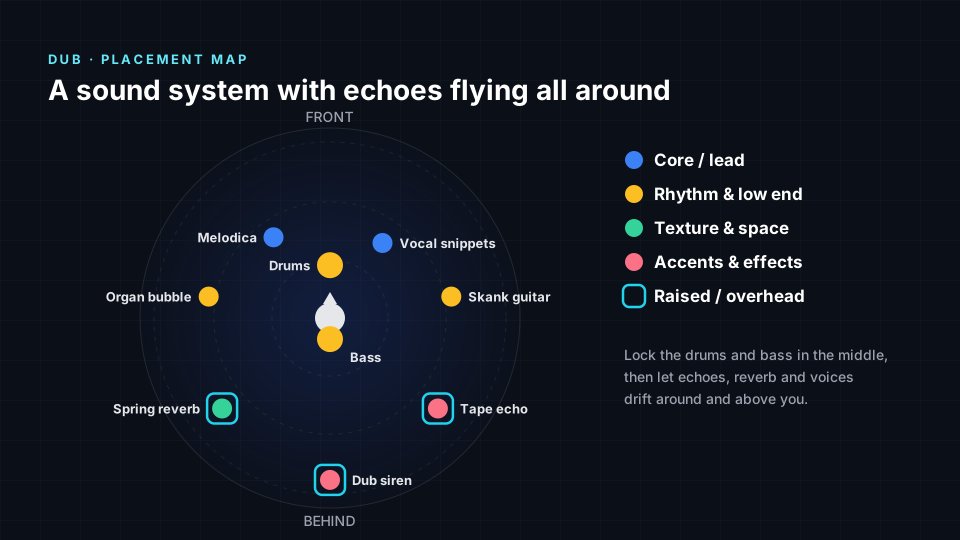
Immersive music for dub: what listeners hear
- Bass you can feel. The bassline sits at the centre, deep and steady, the anchor for everything else.
- Echoes that travel. A snare hit or a word of the vocal repeats and moves across and around the room as it fades.
- Reverb above your head. Spring reverb splashes rise and bloom overhead instead of sitting flat behind the band.
- Space and silence. When the engineer drops parts out, the gap feels like an open room around the bass and drums.
Where to place each element in a dub mix
| Element | Position | Height | Why it works |
|---|---|---|---|
| Drums | Front centre | Ear level | The one-drop or steppers beat that holds the riddim |
| Bass | Centre | Below ear level | The deep, heavy line at the heart of every dub |
| Melodica | Front left | Ear level | A lead melody, as in the Augustus Pablo sound |
| Vocal snippets | Front right, moving | Ear level | Fragments of the original song that drop in and out |
| Organ bubble | Left | Ear level | The shuffling reggae organ pattern |
| Skank guitar | Right | Ear level | Off-beat chops, often sent into echo |
| Spring reverb | Behind left | Raised | The splash and crash of the reverb tank |
| Tape echo | Behind right, moving | Raised | Repeats that trail away around the room |
| Dub siren | Behind, moving | Overhead | Sound system siren and effects sweeping above |
The psychoacoustics behind dub placement
Every position in the table above follows how the ear and brain locate sound. Here is the reason behind the main choices for dub.
- Bass stays centred and low. The ear finds almost no direction in frequencies below roughly 80 to 100 Hz, so the bass gains nothing from being spread. In dub the bass is the music, and a centred, mono low end keeps it powerful on any system.
- Echoes that sound like separate events. When a copy of a sound arrives within a few milliseconds, the brain fuses it with the original and hears it from the first direction. This is the precedence effect (Litovsky). Dub delays are hundreds of milliseconds long, well past that limit, so each repeat is heard as its own sound, and placing repeats in new directions makes them travel.
- Reverb and sirens overhead. The outer ear shapes the high frequencies of a sound differently depending on its height, and the brain reads these changes as elevation. These are spectral elevation cues (Hebrank and Wright). Bright reverb splashes and sirens rich in high frequencies are easy to lift above the listener.
- Rising sweeps that feel close. Listeners hear a sound that grows louder as changing more than one that fades by the same amount. This is the perceptual bias for rising, or looming, tones (Neuhoff). An echo that builds or a filter that opens seems to rush toward you, so use it for big moments.
The immersion profile for dub
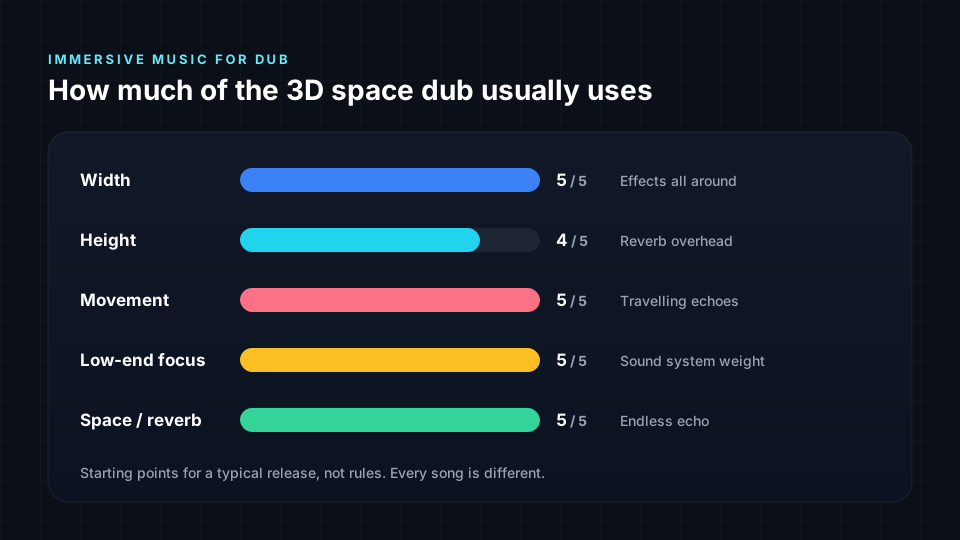
Movement scores 5, the top of the scale, because dub mixes are performed live on the desk and the echoes are meant to travel. Low-end focus is also 5: the bass is the centre of the music and of the sound system. Space scores 5, since long delays and spring reverb build a room far bigger than the studio. Width is 5, with effects reaching all the way around the listener. Height scores 4, from reverb splashes and sirens rising overhead while the riddim stays at ear level.
Tips for an immersive dub mix
- Lock the drums and bass in the centre. Everything else can move, but the riddim must stay still and heavy.
- Send echoes on a journey. Pan each repeat of a delay to a new position so it travels around the listener as it fades.
- Lift the reverb. Put spring reverb and sirens above and behind the listener so they bloom over the band.
- Use drop-outs. Mute parts as the classic engineers did; in spatial audio the empty space around the bass becomes part of the music.
- Keep the low end mono. Spread the effects, never the bass, so it hits hard on headphones and on a sound system.
Dub styles: roots dub, steppers dub and dub poetry
The core placement holds for every style here: drums and bass fixed at the centre, effects and fragments moving around them. What changes is the beat, the weight of the voice and how much the space is filled.
Roots Dub
Roots dub is the classic Jamaican sound of the 1970s, the version sides and dub albums made by King Tubby, Lee Perry, Errol Thompson and Scientist from roots reggae songs. It uses the one-drop beat, where the kick and rimshot land together on the third beat, live bass, organ, guitar and horns, with plenty of tape echo and spring reverb. Keep the drums and bass central, place the band instruments at ear level around them and let the echoes and reverb move freely above. Use drop-outs generously: in roots dub the silence matters.
Steppers Dub
Steppers dub uses a four-on-the-floor kick drum, a pattern that became popular in Jamaica in the late 1970s and was taken up by British sound systems. Jah Shaka, Mad Professor, Zion Train and Iration Steppas carried it into the 1980s and 1990s with synthesisers, drum machines and long, heavy basslines. It is more driving and electronic than roots dub. Keep the kick and bass solid and centred, spread synth stabs and percussion wider and let longer, darker delays circle the listener like a sound system in a large hall.
Dub Poetry
Dub poetry sets spoken verse over reggae and dub rhythms. It grew in Jamaica and Britain in the 1970s, with poets such as Linton Kwesi Johnson, whose album Dread Beat an' Blood came out in 1978, along with Mutabaruka, Oku Onuora and Jean "Binta" Breeze. The words carry the meaning, so the voice must stay clear. Keep the poet centred and close, the bass and drums under them and the effects lighter and further back, opening them up only between lines.
Related styles such as dub techno, digital dub and the dub mixes of UK sound system culture follow the same idea: centre the bass and the beat, then let echoes and space move around the listener.
How to make immersive dub from stereo
Spatial9 can create spatial audio from a stereo track in a few steps:
- Upload your stereo master or your stems.
- Spatial9's AI separates and places each part, pulling the drums, bass, vocal, organ, guitar, melodica and the echo and reverb returns apart and setting the effects to travel around and above the listener.
- Preview it in binaural on headphones.
- Export Eclipsa Audio, ADM, binaural or Ambisonics.
- Publish a video. Create a YouTube-ready video with your immersive audio and publish it directly.
For related guides, read spatial audio for reggae and spatial audio for dub techno. Every guide is listed in spatial audio and immersive music by genre.
Frequently asked questions
Does this guide cover roots dub, steppers dub and dub poetry?
Yes. Roots dub keeps a one-drop riddim at the centre with echoes and reverb moving freely above. Steppers dub drives a four-on-the-floor kick and long, dark delays around the listener. Dub poetry keeps the spoken voice close and clear with lighter effects.
Can I make a dub mix in Dolby Atmos or Eclipsa Audio?
Yes. The placements in this guide work for both. Spatial9 exports ADM, the standard file used by Dolby Atmos studios, as well as Eclipsa Audio for YouTube, so one immersive dub mix covers both. If you plan to release the Atmos version on Apple Music, build it from your original stems or multitracks, because Apple does not accept Atmos made from a finished stereo master. See where to publish spatial audio. You may also hear this called a 3D dub mix or dub in spatial audio.
Is spatial audio good for dub?
Yes. Dub was always about space, echo and movement. Spatial audio gives the effects real directions and height, so the delays and reverb can travel around the listener rather than between two speakers.
Where should the bass go in an immersive dub mix?
At the centre, low and mono. The ear cannot locate deep bass anyway, and keeping it centred keeps it heavy on headphones and on a big system. Move the effects, never the bass.
How do I make dub echoes move in spatial audio?
Pan each repeat of a delay to a different position, for example starting in front and moving round to the side and behind as it fades. Raise the tail a little so it seems to drift upward.
How is dub different from reggae in spatial audio?
Reggae is a song with a band, so the vocal stays central and the effects stay modest. Dub is a remix built around drums and bass, so it can strip out the vocal and send echoes and reverb all around and above the listener.
Can I convert an old dub record to spatial audio?
Yes. Spatial9 uses AI to separate the drums, bass, voice, instruments and effects from a stereo master. Echoes and reverb are blended into the original mix, so separation is never perfect; keep the bass central and move the clearest echoes.
Dolby and Dolby Atmos are trademarks of Dolby Laboratories. Spatial9 is not affiliated with or endorsed by Dolby Laboratories.
Sources
- Blauert, J. (1997). Spatial Hearing: The Psychophysics of Human Sound Localization, revised edition. MIT Press. Low-frequency, elevation, distance and motion cues.
- Mills, A. W. (1958). On the minimum audible angle. Journal of the Acoustical Society of America, 30(4), 237-246.
- Hebrank, J. and Wright, D. (1974). Spectral cues used in the localization of sound sources on the median plane. Journal of the Acoustical Society of America, 56(6), 1829-1834.
- Bronkhorst, A. W. (2000). The cocktail party phenomenon: a review of research on speech intelligibility in multiple-talker conditions. Acta Acustica united with Acustica, 86, 117-128.
- Litovsky, R. Y., Colburn, H. S., Yost, W. A. and Guzman, S. J. (1999). The precedence effect. Journal of the Acoustical Society of America, 106(4), 1633-1654.
- Barron, M. and Marshall, A. H. (1981). Spatial impression due to early lateral reflections in concert halls. Journal of Sound and Vibration, 77(2), 211-232.
- Neuhoff, J. G. (1998). Perceptual bias for rising tones. Nature, 395, 123-124.
- Bregman, A. S. (1990). Auditory Scene Analysis: The Perceptual Organization of Sound. MIT Press.
- Veal, M. E. (2007). Dub: Soundscapes and Shattered Songs in Jamaican Reggae. Wesleyan University Press.
Turn up the echo
Upload a track to Spatial9 and hear the bass hold the centre while the echoes fly around you in minutes. Then export it or publish it straight to YouTube.