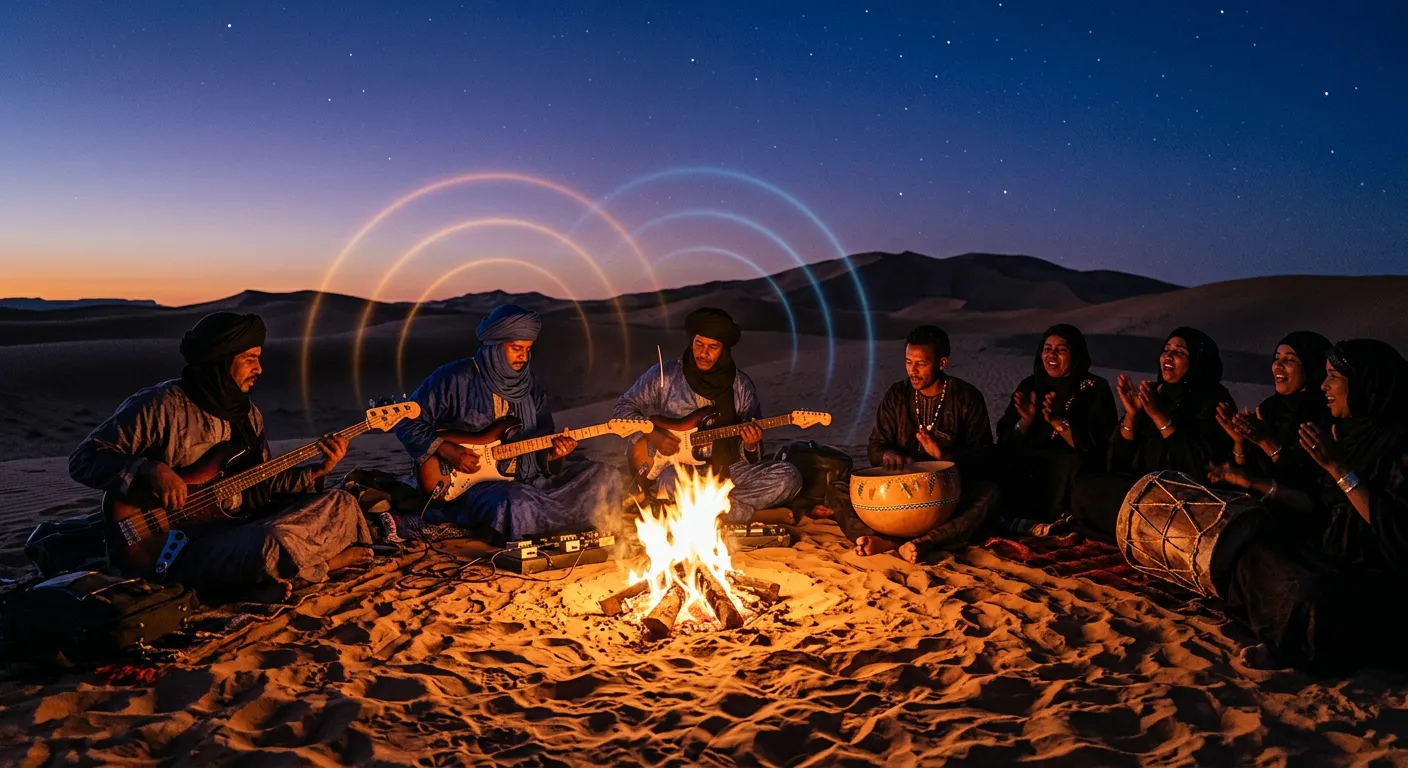
Spatial Audio & Immersive Music for Desert Blues: Tishoumaren, Wassoulou & Malian Blues
Spatial9 Team · · 11 min read
Part of the series Spatial audio and immersive music by genre.
Key takeaways
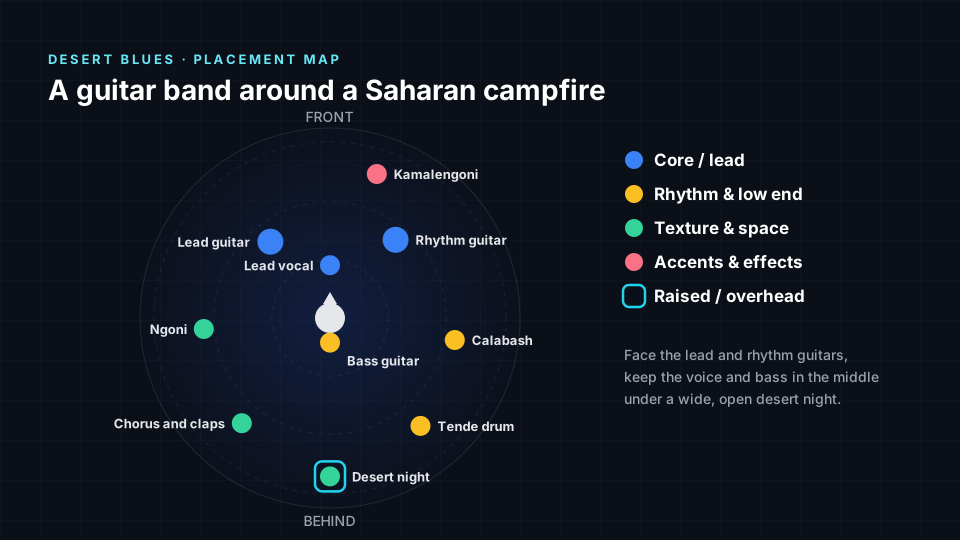
- In a spatial desert blues mix the lead guitar sits front left and the rhythm guitar front right, with the singer centred, the bass guitar anchored underneath and the chorus, handclaps, ngoni and calabash spread around the sides.
- Because the brain separates sounds that come from different directions, an effect known as auditory stream segregation, the hypnotic interlocking guitar riffs stay clear instead of blurring into one drone.
- Desert blues is unhurried, trance-like music often heard outdoors at night, so the space should be large and open, with soft, wide reflections that leave room around every note.
- The desert blues immersion profile scores width 4, height 2, movement 2, low-end focus 3 and space 4 out of 5.
Desert blues is a name used outside Africa for the guitar music of Mali and the wider Sahara and Sahel, and it covers several distinct traditions. One is the electric guitar music of the Tuareg, the Kel Tamasheq people of northern Mali, Niger, Algeria and Libya. After droughts and rebellions in the 1970s and 1980s, many young Tuareg men lived in exile in Algeria and Libya, and there they took up the electric guitar and sang of exile, the desert and resistance. Their music became known as tishoumaren, or simply al guitara. Tinariwen, a group formed by Ibrahim Ag Alhabib around 1979, spread the sound through cassettes and, from 2001, through international albums and the Festival au Désert near Timbuktu. Further south, the singers of the Wassoulou region built a new popular music on the hunters' harp, and in the 1990s Oumou Sangaré became its best known voice. Along the Niger River, Ali Farka Touré from Niafunké played guitar lines drawn from Songhai and Fulani music that many Western listeners heard as close to American blues, and his 1994 album with Ry Cooder, Talking Timbuktu, won a Grammy. The sound is built on repeating, circling guitar riffs, call and response singing, handclaps and hand drums, with a steady bass and a slow, trance-like pulse. Desert blues suits spatial audio because the music is open and patient, and the space around it is part of its feeling. This guide covers how spatial audio for desert blues works, where to place each element and how to make an immersive desert blues mix. For the basics, see what spatial audio is.
Why desert blues works in spatial audio
Desert blues is built on repetition. A lead guitar plays a short, circling phrase, and a second guitar answers with its own riff, the two locking together over and over. The singer calls a line and a chorus, often of women, answers with handclaps and ululation. A calabash or tende drum keeps a rolling pulse. In stereo these parts lie on top of each other and the guitars smear into one drone. In an immersive mix each guitar has its own place, the chorus surrounds the listener and the open space lets the riffs breathe.
The rule: two guitars facing each other, the voice and the bass in the middle. Spread the guitars across a wide front stage, keep the singer and bass anchored, put the chorus and claps around you and set it all under a wide, open sky.
Immersive music for desert blues: what listeners hear
- Two guitars in a loop. The lead guitar circles on the left and the rhythm guitar answers on the right, so the riffs feel like they turn around you.
- A voice in the middle of the circle. The singer sits just in front, with the chorus and handclaps answering from around and behind.
- A slow, steady pulse. The bass, calabash and tende hold a rolling beat that never hurries, drawing you into the trance.
- A wide night around you. A large, open space puts you outside under the stars, with soft echoes and room between every phrase.
Where to place each element in a desert blues mix
| Element | Position | Height | Why it works |
|---|---|---|---|
| Lead vocal | Front centre | Ear level | The sung story at the heart of the song |
| Bass guitar | Centre | Ear level | A steady, warm pulse under the riffs |
| Lead guitar | Front left | Ear level | Circling riffs and bent melodic lines |
| Rhythm guitar | Front right | Ear level | The answering riff that locks with the lead |
| Kamalengoni | Front right, further out | Ear level | Bright, plucked patterns in Wassoulou |
| Ngoni | Left | Ear level | Lute lines that echo the guitar |
| Calabash | Right | Ear level | A deep, rolling hand drum pulse |
| Chorus and claps | Behind left | Ear level | Call and response around the singer |
| Tende drum | Behind right | Ear level | The mortar drum of Tuareg gatherings |
| Desert night | Behind | Raised | A wide, open space around the band |
The psychoacoustics behind desert blues placement
Every position in the table above follows how the ear and brain locate sound. Here is the reason behind the main choices for desert blues.
- Bass guitar stays centred. The ear finds almost no direction in frequencies below roughly 80 to 100 Hz (Blauert), so the bass gains nothing from being spread and keeps the pulse steady.
- Guitars on opposite sides. The brain groups sounds into streams by pitch, timing and direction. This is auditory stream segregation (Bregman). Setting the two guitars apart lets the ear follow each riff instead of hearing one tangled drone.
- The singer clear above the chorus. Listeners pick out one voice from many more easily when the voices come from different directions. This is the cocktail party effect (Bronkhorst). Keeping the lead vocal in front and the chorus behind keeps the words clear.
- A wide, open space. Early reflections arriving from the sides make a sound feel wider and more enveloping. This is spatial impression from early lateral reflections (Barron and Marshall). Soft side reflections give the band the scale of an open landscape while keeping the guitar picking clear.
The immersion profile for desert blues
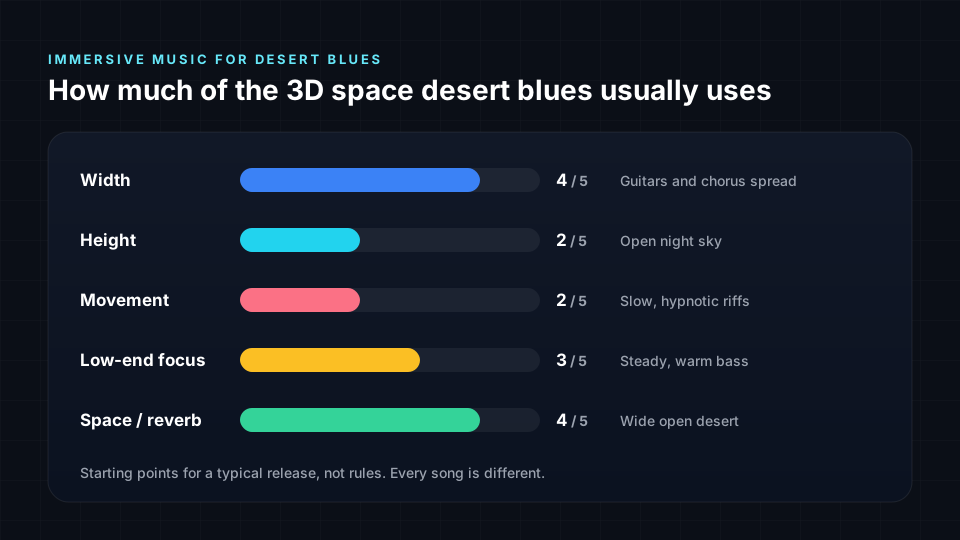
Width scores 4 because a desert blues band spreads two or more guitars, a chorus and percussion around a circle of players. Space also scores 4: the music is often played outdoors or recorded with generous reverb and delay, and its long, repeating phrases need room. Movement is only 2, since the power of the music lies in steady repetition, not in sounds flying around. Low-end focus is 3, with a warm, steady bass and deep calabash but no heavy sub bass. Height is 2, a gentle lift that suggests the open sky.
Tips for an immersive desert blues mix
- Face the two guitars. Put the lead and rhythm guitars on opposite front sides so each riff has its own place.
- Keep the bass centred. Hold the bass guitar in the middle so the slow pulse stays steady.
- Surround the listener with the chorus. Place the chorus and handclaps behind and to the sides, so the call and response comes from around you.
- Let repetition do the work. Keep every part still and let the circling riffs build the trance.
- Use a large, open space. A wide, soft reverb and gentle delay suit desert blues, but keep the early reflections clean so the guitar picking stays clear.
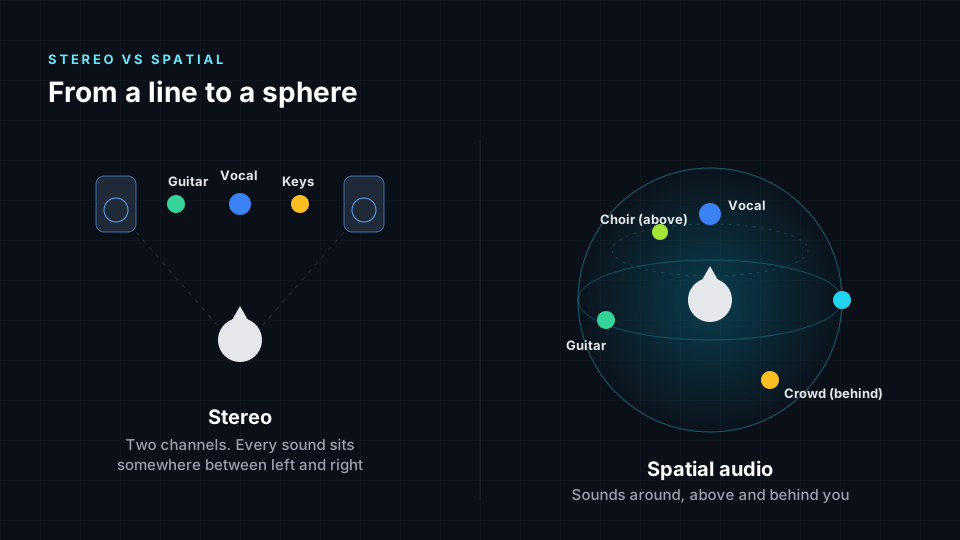
Desert blues styles: Tishoumaren, Wassoulou and Malian blues
The core placement holds for every style here: guitars or plucked strings spread across the front, the voice and bass anchored in the middle. What changes is the lead instrument, the role of the chorus and how much open space the style needs.
Tishoumaren
Tishoumaren is the guitar music of the Tuareg, named after the ishumar, the young exiles who first played it in the 1970s and 1980s. It grew from older Tuareg music, such as the women's tende songs with their mortar drum and handclaps, and took on electric guitar from rock and Arabic pop. After Tinariwen, groups and guitarists from northern Mali and Niger, such as Bombino and Mdou Moctar, brought it to stages worldwide. Seat the lead guitar front left, the rhythm guitar front right and the bass in the centre, with the singer just in front, the chorus and claps behind left and the tende behind right. A large, open space suits the style.
Wassoulou
Wassoulou music comes from the Wassoulou region of southern Mali, near the borders with Guinea and Côte d'Ivoire. It draws on the music of the donso, the hunters, and on the kamalengoni, a harp-lute adapted from the hunters' harp in the second half of the twentieth century. The singers, many of them women, sing about love, marriage and the lives of women, over the kamalengoni, djembe, bass and the karignan, a metal scraper. Place the kamalengoni front right, the guitar front left, the djembe and percussion around the sides and the singer just in front, with the chorus behind. A warm, medium to large room suits it.
Malian Blues
Malian blues here means the acoustic and electric guitar music of the Niger River towns, made famous by Ali Farka Touré and continued by players such as Afel Bocoum and Vieux Farka Touré, and by Boubacar Traoré in the south. The guitar plays repeating, modal lines drawn from Songhai and Fulani music, often joined by the ngoni lute, the one-string njarka fiddle and the calabash. This style can take a more intimate layout: keep the guitar at front left or front centre, the ngoni left, the calabash right and the singer close. Use a natural, airy room rather than a heavy reverb.
Related styles such as Saharan guitar music from Niger and Algeria, Moorish music from Mauritania and the kora music of the Mandinka griots follow the same idea: keep the strings spread at the front, the voice and bass anchored in the middle and the open space around the listener.
How to make immersive desert blues from stereo
Spatial9 can create spatial audio from a stereo track in a few steps:
- Upload your stereo master or your stems.
- Spatial9's AI separates and places each part, pulling the guitars, bass, voices, claps and percussion apart even from old cassette recordings, and setting the two guitars across a wide stage with the singer and bass in the centre.
- Preview it in binaural on headphones.
- Export Eclipsa Audio, ADM, binaural or Ambisonics.
- Publish a video. Create a YouTube-ready video with your immersive audio and publish it directly.
For related guides, read spatial audio for Delta blues and spatial audio for mbalax. Every guide is listed in spatial audio and immersive music by genre.
Frequently asked questions
Does this guide cover Tishoumaren, Wassoulou and Malian Blues?
Yes. Tishoumaren seats two electric guitars across the front with the chorus, claps and tende around the listener in a large, open space. Wassoulou puts the kamalengoni and the singer at the front with percussion around the sides. Malian blues uses a closer, more intimate layout for guitar, ngoni and calabash.
Can I make a desert blues mix in Dolby Atmos or Eclipsa Audio?
Yes. The placements in this guide work for both. Spatial9 exports ADM, the standard file used by Dolby Atmos studios, as well as Eclipsa Audio for YouTube, so one immersive desert blues mix covers both. If you plan to release the Atmos version on Apple Music, build it from your original stems or multitracks, because Apple does not accept Atmos made from a finished stereo master. See where to publish spatial audio. You may also hear this called a 3D desert blues mix, Tuareg guitar in spatial audio or assouf in spatial audio.
Is spatial audio good for desert blues?
Yes. Desert blues is built on interlocking guitars, call and response singing and a slow, hypnotic pulse. Spatial audio lets each guitar keep its own place and lets the chorus and the open space surround you, which deepens the trance.
How is desert blues different from Delta blues in spatial audio?
The two are often compared, and many listeners hear a family likeness in the bent notes and repeating riffs. Delta blues is usually one voice and one guitar, so it suits a close, intimate layout in a small room. Desert blues is more often a group, with two or more guitars, a chorus, claps and drums, so it needs a wider layout and a larger, more open space.
Where should the chorus and handclaps go?
Place the chorus and handclaps behind and to the sides, at ear level, so the call and response comes from around the listener. Keep them a little further away than the lead singer so the words of the song stay clear.
Should desert blues use a lot of reverb?
A fair amount, but it should feel open rather than cavernous. Use a wide, soft reverb with gentle delay on the guitars, and keep the early reflections clean so the fast picking and handclaps stay sharp.
Can I convert an old Tuareg cassette recording to spatial audio?
Yes. Spatial9 uses AI to separate the guitars, bass, voices and percussion from a stereo or mono master, even a worn cassette transfer. Separation is never perfect with older recordings, so keep the layout simple and the space moderate.
Dolby and Dolby Atmos are trademarks of Dolby Laboratories. Spatial9 is not affiliated with or endorsed by Dolby Laboratories.
Sources
- Blauert, J. (1997). Spatial Hearing: The Psychophysics of Human Sound Localization, revised edition. MIT Press. Low-frequency, elevation, distance and motion cues.
- Bronkhorst, A. W. (2000). The cocktail party phenomenon: a review of research on speech intelligibility in multiple-talker conditions. Acta Acustica united with Acustica, 86, 117-128.
- Litovsky, R. Y., Colburn, H. S., Yost, W. A. and Guzman, S. J. (1999). The precedence effect. Journal of the Acoustical Society of America, 106(4), 1633-1654.
- Barron, M. and Marshall, A. H. (1981). Spatial impression due to early lateral reflections in concert halls. Journal of Sound and Vibration, 77(2), 211-232.
- Bregman, A. S. (1990). Auditory Scene Analysis: The Perceptual Organization of Sound. MIT Press.
- Eyre, B. (2000). In Griot Time: An American Guitarist in Mali. Temple University Press.
- Durán, L. (1995). Birds of Wasulu: freedom of expression and expressions of freedom in the popular music of southern Mali. British Journal of Ethnomusicology, 4, 101-134.
Sit by the fire
Upload a track to Spatial9 and hear the guitars circle around you under a wide desert sky in minutes. Then export it or publish it straight to YouTube.