Spatial Audio & Immersive Music for Indian Classical: Complete Guide
Spatial9 Team · · Updated
Part of the series Spatial audio and immersive music by genre.
Indian classical music has two great traditions: Hindustani music from the north, with instruments like sitar, sarod, bansuri and sarangi, and Carnatic music from the south, with veena, violin, mridangam and ghatam. Both are built on raga, a melodic framework, and tala, a rhythmic cycle, over the constant drone of the tanpura. A performance often opens with a slow, free alap before the rhythm enters and builds towards fast, virtuosic passages. This guide covers how spatial audio for Indian classical music works, where to place each element and how to make an immersive mix. For the basics, see what spatial audio is.
Why Indian classical music works so well in spatial audio
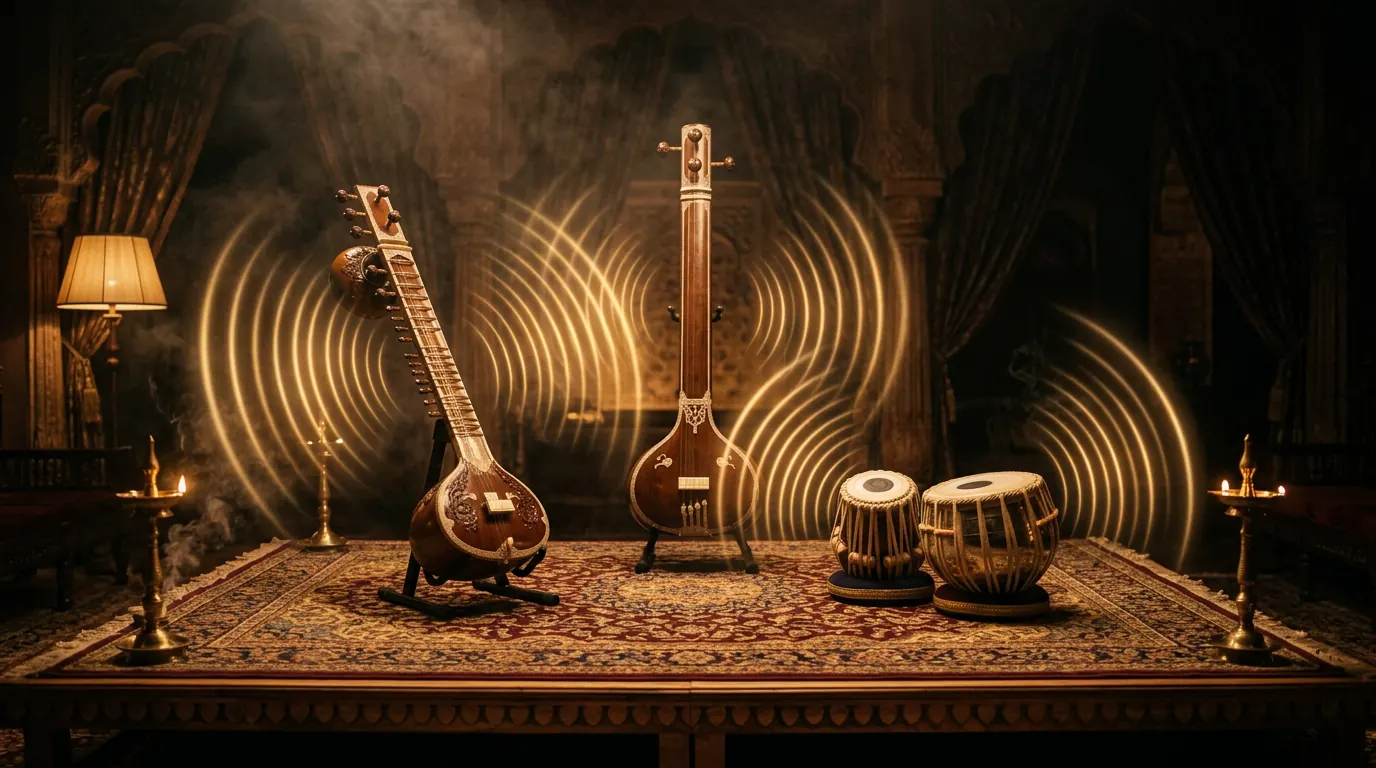
Indian classical concerts are intimate. Musicians sit close together on a raised platform, facing the audience, and the drone of the tanpura creates a shimmering field of overtones that seems to fill the whole room. In stereo, that drone often sits flat behind the soloist. In spatial audio, it can surround the listener while the soloist and drummer stay sharp and focused in front.
The rule: focus the performers, surround with the drone. Keep every melodic and rhythmic detail clear in front, and let the tanpura and hall carry the space.
Immersive music for Indian classical: what listeners hear
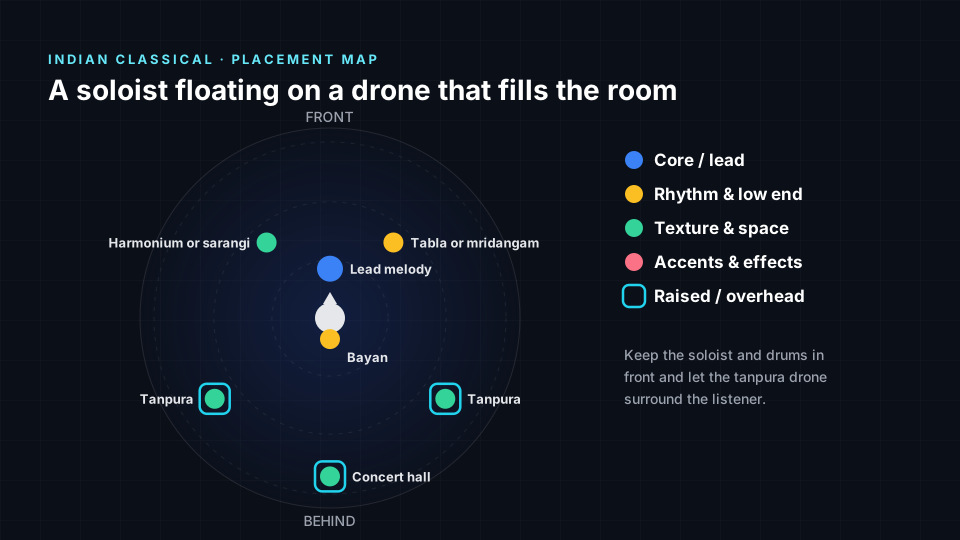
- A soloist in sharp focus. Every ornament, slide and gamaka of the sitar, voice or bansuri is clear in front.
- Rhythm close beside it. The tabla or mridangam sits just to the right, with the deep bayan strokes grounded in the centre.
- A drone that surrounds. The tanpura's overtones shimmer around and slightly above the listener.
- A calm, open hall. Natural reverb lifts the music without blurring fast passages.
Where to place each element in an Indian classical mix
| Element | Position | Height | Why it works |
|---|---|---|---|
| Lead melody (sitar, voice, bansuri, veena) | Front centre | Ear level | The raga unfolds here |
| Harmonium, sarangi or violin | Front left | Ear level | Follows and echoes the soloist |
| Tabla or mridangam | Front right | Ear level | Close, crisp rhythm |
| Bayan (bass drum of the tabla) | Centre | Ear level | Deep, resonant low end |
| Tanpura | Behind left and right | Slightly raised | A drone that fills the room |
| Concert hall | Behind and above | Raised | Calm, natural space |
The psychoacoustics behind Indian classical placement
Every position in the table above follows how the ear and brain locate sound. Here is the reason behind the main choices for Indian classical music.
- Soloist front and centre. Our sense of direction is sharpest straight ahead, where the ear can separate sources only a degree or two apart. Ornaments and microtonal slides stay precise and stable there.
- Tanpura spread behind and to the sides. Sound arriving from the sides, slightly different at each ear, creates the feeling of being inside the music. Acousticians call this envelopment. A drone spread around the listener becomes a space to sit in rather than a sound in front.
- Tanpura separated from the soloist. The drone shares many frequencies with the melody. When two sounds overlap in pitch, separating them in direction makes each easier to hear. Researchers call this spatial release from masking.
- Bayan centred. Low frequencies give the brain very little usable direction, so the deep strokes of the bayan sit naturally in the middle and anchor the tala.
The immersion profile for Indian classical
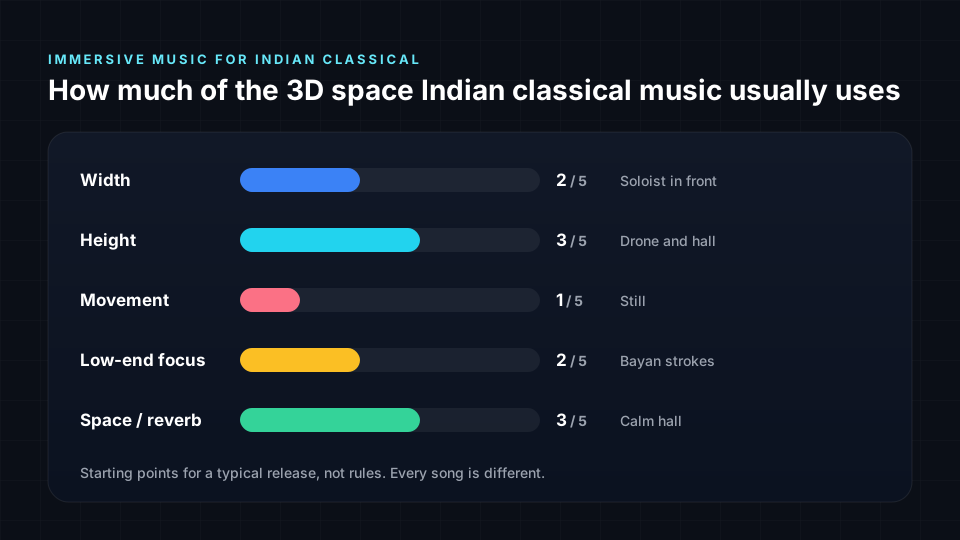
The performers stay close together, so width is low. Height rises because the tanpura and hall lift the sound. Movement stays at the minimum. The music already moves through the raga.
Tips for an immersive Indian classical mix
- Never lose the drone. The tanpura is the reference for every note. Keep it steady and present from start to finish.
- Keep the soloist still. Melodic detail is the heart of the music. Movement would distract from it.
- Stay close to the tabla. The dayan's sharp strokes should be crisp, and the bayan's slides deep and centred.
- Use a natural hall. Gentle reverb suits the alap. Keep it short enough that fast jhala passages stay clear.
- Follow the shape of the performance. Let the space feel wide and calm in the alap, then more focused when the rhythm enters.
How to make immersive Indian classical music from stereo
Spatial9 can create spatial audio from a stereo track in a few steps:
- Upload your stereo master or your stems.
- Spatial9's AI separates and places each part, from the soloist and tabla to the tanpura.
- Preview it in binaural on headphones.
- Export Eclipsa Audio, ADM, binaural or Ambisonics.
- Publish a video. Create a YouTube-ready video with your immersive audio and publish it directly.
For related guides, read spatial audio for Bollywood, spatial audio for classical music and spatial audio for meditation and sleep. Every guide is listed in spatial audio and immersive music by genre.
Frequently asked questions
Can I make an Indian classical mix in Dolby Atmos or Eclipsa Audio?
Yes. The placements in this guide work for both. Spatial9 exports ADM, the standard file used by Dolby Atmos studios, as well as Eclipsa Audio for YouTube, so one immersive mix covers both. You may also hear this called a 3D raga recording or Indian classical music in spatial audio.
Does this work for both Hindustani and Carnatic music?
Yes. Swap the instruments, for example sitar and tabla for veena and mridangam, and keep the same layout: soloist in front, drums beside, drone around.
Where should the tanpura go?
Spread gently behind and to the sides, slightly raised. It should feel like it fills the room rather than coming from one point.
Is spatial audio good for vocal ragas?
Yes. The singer stays front and centre, with the harmonium or sarangi just beside them and the drone around the listener.
Can I convert an archival concert recording to spatial audio?
Yes. Spatial9 uses AI to separate a stereo master into its parts and export an immersive mix as Eclipsa Audio, ADM, binaural or Ambisonics.
Does immersive Indian classical music work on normal headphones?
Yes. The mix is rendered binaurally, so the drone surrounds you on any regular headphones.
Dolby and Dolby Atmos are trademarks of Dolby Laboratories. Spatial9 is not affiliated with or endorsed by Dolby Laboratories.
Sources
- Blauert, J. (1997). Spatial Hearing: The Psychophysics of Human Sound Localization, revised edition. MIT Press. Low-frequency, elevation, distance and motion cues.
- Mills, A. W. (1958). On the minimum audible angle. Journal of the Acoustical Society of America, 30(4), 237-246.
- Bronkhorst, A. W. (2000). The cocktail party phenomenon: a review of research on speech intelligibility in multiple-talker conditions. Acta Acustica united with Acustica, 86, 117-128.
- Barron, M. and Marshall, A. H. (1981). Spatial impression due to early lateral reflections in concert halls. Journal of Sound and Vibration, 77(2), 211-232.
- Hebrank, J. and Wright, D. (1974). Spectral cues used in the localization of sound sources on the median plane. Journal of the Acoustical Society of America, 56(6), 1829-1834.
- Bregman, A. S. (1990). Auditory Scene Analysis: The Perceptual Organization of Sound. MIT Press.
Seat your listeners in front of the musicians
Upload an Indian classical recording to Spatial9 and hear the tanpura surround you in minutes. Then export it or publish it straight to YouTube.