Spatial Audio & Immersive Music for Hawaiian Music: Slack-Key Guitar, Hawaiian Steel Guitar & Hapa Haole
Spatial9 Team · · 12 min read
Part of the series Spatial audio and immersive music by genre.
Key takeaways
- Spatial audio for Hawaiian music places the voice at front centre with a soft, centred upright bass, the slack-key guitar front left, the steel guitar front right, ukulele and rhythm guitar at the sides and an open-air room behind.
- Auditory stream segregation means the brain separates sounds that come from different directions, so splitting the slack-key and steel guitars lets the ear follow both melodies instead of one blur of ringing strings.
- Hawaiian music is calm and still, so keep every player in place, let the steel guitar's glide supply the motion and use a short, natural room that does not smear the open strings.
- The Hawaiian music immersion profile scores width 3, height 2, movement 1, low-end focus 2 and space 3 out of 5.
Hawaiian music joins the ancient chant and dance of the islands with instruments and harmonies that arrived in the nineteenth century. Before contact, mele (chant) and hula were performed with the pahu drum, the ipu gourd and other percussion. Christian missionaries arrived in 1820 and brought hymn singing, which Hawaiians shaped into their own himeni and later into a rich style of vocal harmony and falsetto. In the 1830s Spanish and Mexican vaqueros came to the islands to work with cattle and brought guitars, and Hawaiians developed their own open tunings, played with the thumb on the bass and the fingers on the melody: kī hōʻalu, or slack-key guitar. Portuguese immigrants from Madeira arrived from 1879 with a small guitar, the machete or braguinha, which became the ukulele. King Kalākaua championed hula and Hawaiian music at court, and Queen Liliʻuokalani wrote Aloha ʻOe. In the late nineteenth century Joseph Kekuku developed the technique of sliding a steel bar along the strings, and the Hawaiian steel guitar spread to the mainland, helped by the Panama-Pacific International Exposition in San Francisco in 1915. The hapa haole songs of Tin Pan Alley and Hollywood, and the radio show Hawaii Calls from 1935, made the sound famous worldwide. From the 1970s the Hawaiian Renaissance brought renewed pride in the language, with artists such as Gabby Pahinui, the Sons of Hawaii and later Israel Kamakawiwoʻole. Hawaiian music suits spatial audio because it is gentle, acoustic and built from a few clear voices that each deserve their own place. This guide covers how spatial audio for Hawaiian music works, where to place each element and how to make an immersive Hawaiian music mix. For the basics, see what spatial audio is.
Why Hawaiian music works in spatial audio
Hawaiian music is made of a few warm layers. A slack-key guitar plays a steady bass with the thumb and a melody with the fingers, often letting open strings ring. A steel guitar glides between notes and sustains long, singing lines. The ukulele adds a bright, light strum, and an upright bass keeps a soft pulse. Over this the singer may move between a chest voice and a high falsetto, with harmony voices joining in the chorus. In stereo the two guitars and the ukulele crowd the middle with the voice, and the ringing open strings blur together. In an immersive mix the voice stays at the centre, the slack-key and steel guitars take opposite front sides and the rhythm instruments sit just beyond them, so each ringing string can be heard.
The rule: the voice in the middle, the guitars like two shores on either side. Keep the singer and bass centred, split the slack-key and steel guitars across the front and set the group in a relaxed, open-air room.
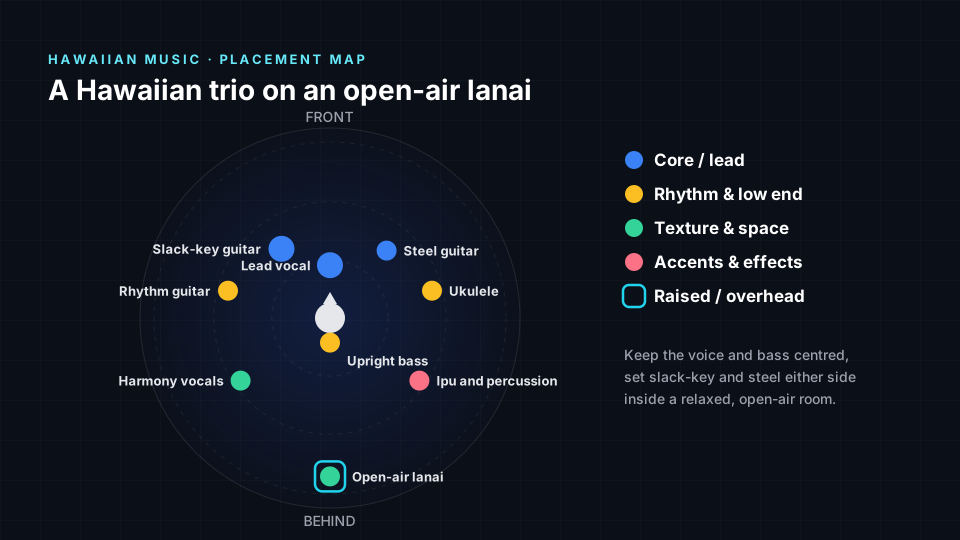
Immersive music for Hawaiian music: what listeners hear
- A voice in the centre of the group. The singer sits close and centred, so the Hawaiian words and the leaps into falsetto stay clear and personal.
- Two guitars like a conversation. The slack-key guitar on one side and the steel guitar on the other trade phrases, and each keeps its own ringing tone.
- A light, bright rhythm. The ukulele and rhythm guitar strum just beyond the leads, giving a gentle lift without covering the melody.
- An easy, open room. A soft, natural reverb puts the band on a porch or in a small garden, with no need for sounds to move around the listener.
Where to place each element in a Hawaiian music mix
| Element | Position | Height | Why it works |
|---|---|---|---|
| Lead vocal | Front centre | Ear level | The song, the words and the falsetto lead |
| Upright bass | Centre | Low | A soft, steady floor under the band |
| Slack-key guitar | Front left | Ear level | Thumb bass and melody on open tunings |
| Steel guitar | Front right | Ear level | Gliding, sustained lines that answer the voice |
| Rhythm guitar | Left | Ear level | Chords that support the slack-key part |
| Ukulele | Right | Ear level | A bright, light strum beside the steel |
| Harmony vocals | Behind left | Ear level | Chorus voices and falsetto harmonies |
| Ipu and percussion | Behind right | Ear level | Gourd beats and light hula rhythm |
| Open-air lanai | Behind | Raised | A relaxed, natural room around the band |
The psychoacoustics behind Hawaiian music placement
Every position in the table above follows how the ear and brain locate sound. Here is the reason behind the main choices for Hawaiian music.
- Slack-key and steel guitar apart. The brain groups sounds into streams by pitch, timbre and direction. This is auditory stream segregation (Bregman). Placing the plucked slack-key and the gliding steel on opposite sides lets the ear follow both melodies instead of hearing one tangle of ringing strings.
- Voice apart from the guitars. Listeners follow a voice far more easily when it comes from a different direction from other sounds. This is the cocktail party effect (Bronkhorst). A centred singer with the guitars to the sides keeps the Hawaiian lyrics clear.
- Upright bass stays centred. The ear finds almost no direction in frequencies below roughly 80 to 100 Hz, so the low notes of the bass and the thumb line of the slack-key gain nothing from being spread. Keeping the deepest notes centred keeps the band grounded (Blauert).
- A room with soft side reflections. Early reflections arriving from the sides make a sound feel wider and more enveloping. This is spatial impression from early lateral reflections (Barron and Marshall). A gentle, open room with light side reflections gives the ringing guitars a natural bloom without washing them out.
The immersion profile for Hawaiian music
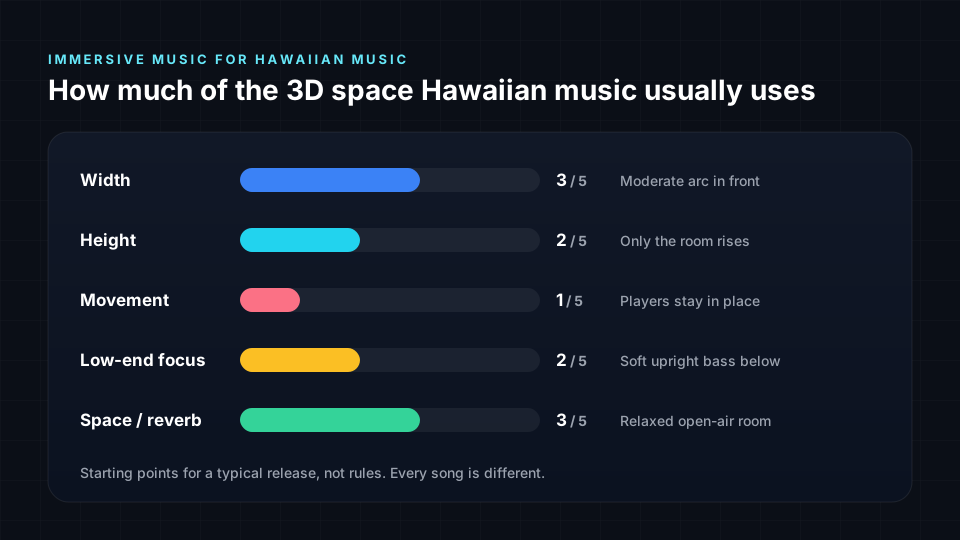
Width scores 3 because the small group forms a moderate arc in front of the listener rather than a full circle. Height is 2, since only the open room and a little of the falsetto rise above ear level. Movement is 1: the steel guitar glides in pitch, but the players stay in place, so the mix should not pan sounds around the listener. Low-end focus is 2, because the upright bass and the slack-key thumb line are soft and supportive rather than heavy. Space scores 3, as the music often belongs on a porch, in a garden or in a small hall, so the room should feel natural and open but not large.
Tips for an immersive Hawaiian music mix
- Keep the voice close and centred. Let the Hawaiian words and the falsetto breaks sit clearly in front of the band.
- Split the two lead guitars. Place the slack-key guitar front left and the steel guitar front right, so they answer each other rather than blur together.
- Let the steel glide, not travel. The steel guitar already slides in pitch. Keep it in one place and let the bar create the sense of motion.
- Keep the rhythm light. Set the ukulele and rhythm guitar just beyond the leads and a little lower in level, so the strum lifts the song without covering it.
- Use a soft, open room. A short, natural reverb suits Hawaiian music. Avoid long tails that smear the ringing open strings, and keep the low end of the reverb light.
Hawaiian music styles: Slack-key guitar, Hawaiian steel guitar and Hapa haole
The core placement holds for every style here: the voice at the centre, the guitars on either side and a soft bass underneath. What changes is which instrument leads, the size of the group and how polished the room should sound.
Slack-Key Guitar
Slack-key guitar, kī hōʻalu in Hawaiian, means loosening the keys: the strings are tuned down to open chords, often called taropatch tunings, and each family once kept its own tunings close. The thumb plays a steady alternating bass while the fingers pick the melody, with hammer-ons, pull-offs and ringing harmonics. Gabby Pahinui recorded Hiʻilawe in 1946, often named as one of the first commercial slack-key recordings, and later played with the Sons of Hawaii. Sonny Chillingworth, Ray Kane, Leonard Kwan, Ledward Kaʻapana and Keola Beamer carried the style forward, and George Winston's Dancing Cat Records released a long series of slack-key albums from the 1990s. A solo slack-key recording needs care: place the guitar close and slightly left of centre or even centred, keep the thumb bass low and steady and let a soft room catch the ringing strings. With two or more guitars, spread them across the front.
Hawaiian Steel Guitar
The Hawaiian steel guitar, kīkā kila, is played flat on the lap with a steel bar sliding along the strings. Joseph Kekuku is credited with developing the technique in the late nineteenth century, and he later toured the mainland and Europe. After the 1915 Panama-Pacific International Exposition in San Francisco, Hawaiian steel became one of the most popular sounds in the United States, and players such as Sol Hoʻopiʻi made it famous on record. The instrument went on to shape country and western swing through the lap steel and the pedal steel. Place the steel guitar front right, close enough to sing, with a touch of its own reverb so its long, sliding notes bloom. Keep a rhythm guitar or ukulele opposite it, and the voice and bass centred.
Hapa Haole
Hapa haole means half foreign, and hapa haole songs are Hawaiian-themed songs sung mainly in English, often with a few Hawaiian words. They grew from the early twentieth century and peaked between the 1920s and the 1950s, through Tin Pan Alley, Hollywood films and radio. Harry Owens wrote Sweet Leilani, which Bing Crosby sang in the 1937 film Waikiki Wedding, and the song won an Academy Award. The radio show Hawaii Calls, hosted by Webley Edwards, broadcast from Waikīkī from 1935 to millions of listeners. Hapa haole recordings often add strings, vibraphone or a small dance band to the steel guitar and ukulele. Keep the voice centred, the steel guitar front right and the ukulele and guitar on the sides, with any strings in a moderate arc behind. A slightly larger, polished studio room suits the style.
Related traditions such as Tahitian string bands, Hawaiian falsetto singing and modern island music follow the same idea: keep the voice centred, the guitars and ukulele in a gentle arc and a relaxed room around the listener.
How to make immersive Hawaiian music from stereo
Spatial9 can create spatial audio from a stereo track in a few steps:
- Upload your stereo master or your stems.
- Spatial9's AI separates and places each part, pulling the voice, slack-key guitar, steel guitar, ukulele and bass apart even from older recordings, and setting the guitars on either side of a centred singer.
- Preview it in binaural on headphones.
- Export Eclipsa Audio, ADM, binaural or Ambisonics.
- Publish a video. Create a YouTube-ready video with your immersive audio and publish it directly.
For related guides, read spatial audio for country and spatial audio for western swing. Every guide is listed in spatial audio and immersive music by genre.
Frequently asked questions
Does this guide cover Slack-Key Guitar, Hawaiian Steel Guitar and Hapa Haole?
Yes. Slack-key guitar puts one or more open-tuned guitars close at the front with a soft room. Hawaiian steel guitar sets the steel on one front side, answering the voice. Hapa haole adds strings or a small dance band behind a centred singer, steel guitar and ukulele.
Can I make a Hawaiian music mix in Dolby Atmos or Eclipsa Audio?
Yes. The placements in this guide work for both. Spatial9 exports ADM, the standard file used by Dolby Atmos studios, as well as Eclipsa Audio for YouTube, so one immersive Hawaiian mix covers both. If you plan to release the Atmos version on Apple Music, build it from your original stems or multitracks, because Apple does not accept Atmos made from a finished stereo master. See where to publish spatial audio. You may also hear this called a 3D Hawaiian mix or Hawaiian music in spatial audio.
Is spatial audio good for Hawaiian music?
Yes. Hawaiian music is gentle and acoustic, with a few voices and guitars that each have their own colour. Spatial audio lets each ringing string and each harmony keep its own place, so the listener feels close to the band.
Where should the steel guitar go in an immersive Hawaiian mix?
Put the steel guitar on one front side, opposite the slack-key or rhythm guitar, and a little behind the voice. Keep it in place and let its sliding notes carry the motion.
How should I handle a solo slack-key guitar recording?
Keep it simple. Place the guitar close and near the centre, keep the thumb bass steady and low and use a soft, natural room. Do not split a single guitar across the sides, because the bass and melody come from one instrument.
How is Hawaiian music different from country in spatial audio?
Hawaiian music centres on a soft voice, slack-key and steel guitars and ukulele in a relaxed, open room. Country often adds drums, electric bass, fiddle and pedal steel on a band stage, so it suits a wider layout with a firmer low end.
Can I convert an old hapa haole recording to spatial audio?
Yes. Spatial9 uses AI to separate the voice, steel guitar, ukulele and orchestra from a stereo or mono recording. Separation is never perfect with early recordings, so keep the layout simple and the room moderate.
Dolby and Dolby Atmos are trademarks of Dolby Laboratories. Spatial9 is not affiliated with or endorsed by Dolby Laboratories.
Sources
- Blauert, J. (1997). Spatial Hearing: The Psychophysics of Human Sound Localization, revised edition. MIT Press. Low-frequency, elevation, distance and motion cues.
- Mills, A. W. (1958). On the minimum audible angle. Journal of the Acoustical Society of America, 30(4), 237-246.
- Hebrank, J. and Wright, D. (1974). Spectral cues used in the localization of sound sources on the median plane. Journal of the Acoustical Society of America, 56(6), 1829-1834.
- Bronkhorst, A. W. (2000). The cocktail party phenomenon: a review of research on speech intelligibility in multiple-talker conditions. Acta Acustica united with Acustica, 86, 117-128.
- Barron, M. and Marshall, A. H. (1981). Spatial impression due to early lateral reflections in concert halls. Journal of Sound and Vibration, 77(2), 211-232.
- Neuhoff, J. G. (1998). Perceptual bias for rising tones. Nature, 395, 123-124.
- Bregman, A. S. (1990). Auditory Scene Analysis: The Perceptual Organization of Sound. MIT Press.
- Kanahele, G. S. (ed.) (1979). Hawaiian Music and Musicians: An Illustrated History. University Press of Hawaii.
- Troutman, J. W. (2016). Kika Kila: How the Hawaiian Steel Guitar Changed the Sound of Modern Music. University of North Carolina Press.
Pull up a chair on the lanai
Upload a track to Spatial9 and hear the singer at the centre with the slack-key and steel guitars on either side in minutes. Then export it or publish it straight to YouTube.