Spatial Audio & Immersive Music for Chinese Traditional Music: Guqin, Jiangnan Sizhu & Chinese Orchestra
Spatial9 Team · · 12 min read
Part of the series Spatial audio and immersive music by genre.
Key takeaways
- Spatial audio for Chinese traditional music places the guqin or lead instrument close at the front centre, the erhu and dizi front left and front right, the pipa and yangqin to the sides and the sheng slightly raised behind, with the percussion at the back.
- The brain separates instruments into streams by pitch, timbre and direction, so auditory stream segregation lets the listener follow each instrument's version of the same melody in heterophonic textures.
- Keep every player in a fixed position and the low end light, and let a calm hall, teahouse or pavilion room carry the long decays and silences the music is built around.
- The Chinese traditional music immersion profile scores width 4, height 3, movement 1, low-end focus 2 and space 4 out of 5.
Chinese traditional music is one of the oldest living music cultures in the world. Ancient writers sorted instruments into eight sounds, or bayin, by the material they were made from: silk, bamboo, metal, stone, wood, skin, gourd and earth. A set of 65 bronze bells buried with the Marquis Yi of Zeng around 433 BCE and found in Hubei in 1978 shows how large and refined court music already was. The guqin, a seven-stringed zither without frets, became the instrument of scholars and is linked with Confucius, and in 1977 a recording of Guan Pinghu playing the guqin piece Flowing Water was sent into space on the Voyager Golden Record. Over many centuries each region grew its own ensembles, such as Jiangnan sizhu around Shanghai, Cantonese music in Guangdong and nanguan in Fujian. In the 20th century musicians such as Liu Tianhua raised the erhu to a concert instrument, the blind street musician Abing left pieces such as The Moon Reflected on Erquan, and groups such as the Datong Music Society in Shanghai began to build larger ensembles from the early 1920s. In 1953 the Central Broadcasting Chinese Orchestra was founded in Beijing, and the modern Chinese orchestra spread across mainland China, Hong Kong, Taiwan, Singapore and Malaysia. In 2003 UNESCO proclaimed guqin music a masterpiece of intangible heritage. Chinese traditional music suits spatial audio because so much of it is about resonance, silence and the room around a few clear lines. This guide covers how spatial audio for Chinese traditional music works, where to place each element and how to make an immersive Chinese traditional music mix. For the basics, see what spatial audio is.
Why Chinese traditional music works in spatial audio
Chinese traditional music is built on melody. A single line is shared, varied and decorated by several instruments at once, a texture often called heterophony. The erhu bends and slides, the dizi adds bright ornaments with the buzz of its membrane, the pipa and yangqin add plucked and struck notes, and the sheng holds soft chords above. In a solo guqin piece the most important sounds are tiny: the slide of a finger along a silk string, a harmonic that rings and fades, the silence after a phrase. In stereo these layers crowd together and the quiet details get lost. In an immersive mix each instrument keeps a clear place, the gentle low end stays light, and the room carries the long decays that the music is written around.
The rule: one clear line in front, the ensemble in a calm arc around it. Keep the lead instrument at the front centre, spread the sections wide in a fixed arc and let the hall or garden room breathe above and behind.
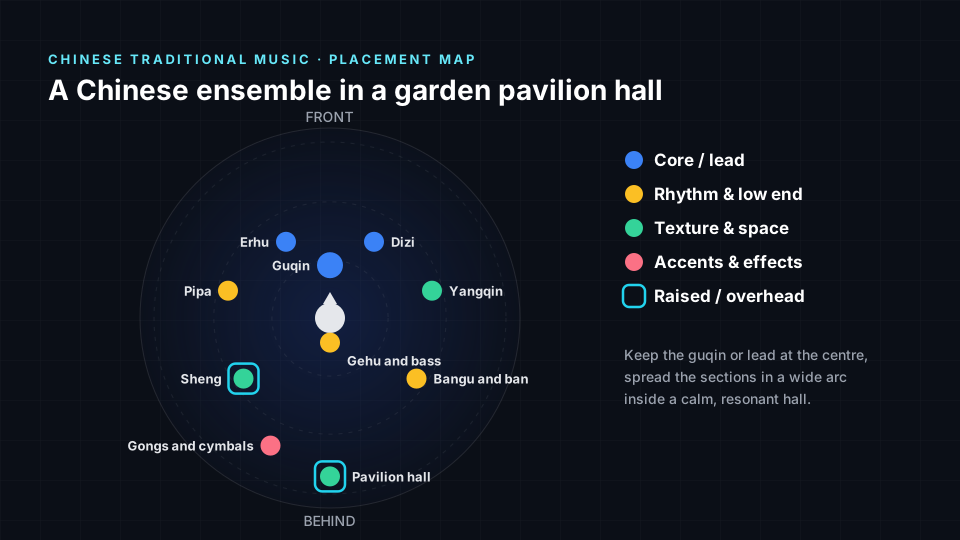
Immersive music for Chinese traditional music: what listeners hear
- A close, intimate lead. The guqin, erhu or dizi sits just in front of you, so every slide, breath and harmonic is easy to hear.
- A wide, steady arc of colour. Plucked strings on one side and struck strings on the other form a broad, calm picture that does not move.
- Air above the ensemble. The sheng and the reflections of the room rise slightly overhead, like light coming through a high roof.
- Silence that has shape. Long decays fade into a real space, so the pauses between phrases feel as important as the notes.
Where to place each element in a Chinese traditional music mix
| Element | Position | Height | Why it works |
|---|---|---|---|
| Guqin | Front centre | Ear level | The solo voice of the scholar's tradition |
| Erhu | Front left | Ear level | The singing bowed line of the melody |
| Dizi | Front right | Ear level | Bright bamboo flute with buzzing ornaments |
| Pipa | Left | Ear level | Plucked lute rhythm and tremolo |
| Yangqin | Right | Ear level | Struck dulcimer chords and runs |
| Sheng | Behind left | Raised | Soft mouth organ chords floating above |
| Bangu and ban | Behind right | Ear level | Drum and clapper that set the tempo |
| Gongs and cymbals | Far behind left | Ear level | Accents and climaxes from the back |
| Gehu and bass | Centre | Low | A light low floor for the orchestra |
| Pavilion hall | Behind | Raised | A calm, resonant room around the music |
The psychoacoustics behind Chinese traditional music placement
Every position in the table above follows how the ear and brain locate sound. Here is the reason behind the main choices for Chinese traditional music.
- Low strings stay centred. The ear finds almost no direction in frequencies below roughly 80 to 100 Hz, so the deepest notes of the gehu, double bass and large drums gain nothing from being spread. Keeping them centred and light gives the orchestra a steady floor (Blauert).
- Erhu and dizi in different places. The brain groups sounds into streams by pitch, timbre and direction. This is auditory stream segregation (Bregman). In heterophony several instruments play nearly the same melody, so giving each one its own direction lets the ear follow the small differences between them.
- The sheng just above. The outer ear shapes high frequencies differently for sounds above and below, and the brain reads these spectral cues as height. This is spectral cues for elevation (Hebrank and Wright). The bright, sustained partials of the sheng carry these cues well, so a slight lift makes it float without pulling focus from the melody.
- A room with side reflections. Early reflections arriving from the sides make a sound feel wider and more enveloping. This is spatial impression from early lateral reflections (Barron and Marshall). Clear side reflections give the guqin's long decays and the orchestra's soft passages a real place to live.
The immersion profile for Chinese traditional music
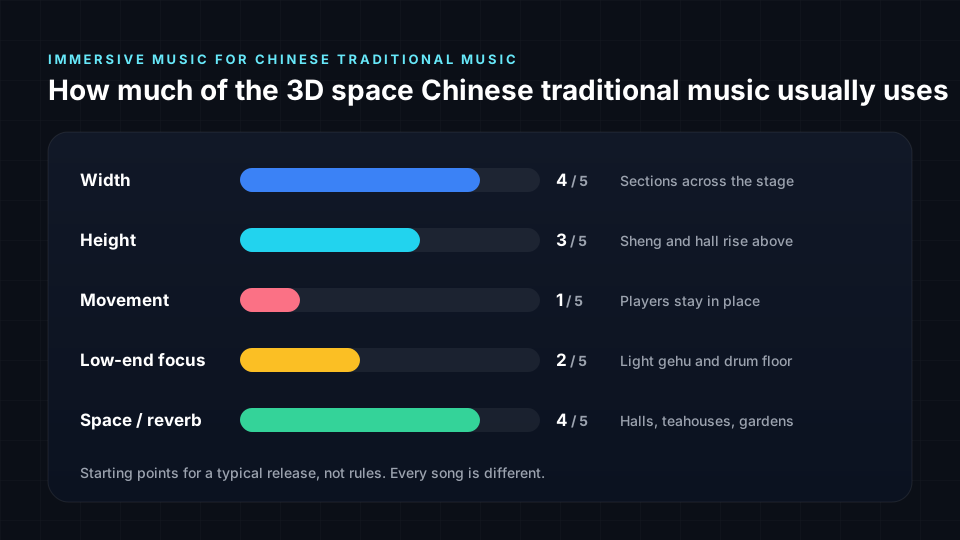
Width scores 4 because a full Chinese orchestra spreads its bowed, plucked, wind and percussion sections across a wide stage, and even a small sizhu group sits in a broad circle. Space also scores 4: much of this music was made for halls, teahouses, temples and garden pavilions, and long natural decays are part of its sound. Height is 3, from the sheng's sustained chords and the reflections of a high ceiling rising above the players. Low-end focus is 2, since the gehu, double bass and large drums give a light floor but the music lives mostly in the middle and upper range. Movement is 1, because the players sit still and the music moves through melody and ornament rather than through sounds travelling around the listener.
Tips for an immersive Chinese traditional music mix
- Keep the lead close and clear. Place the guqin, erhu or dizi at the front centre and keep its small sounds, such as finger slides and breath, audible.
- Spread the sections in a fixed arc. Put bowed strings and winds at the front, plucked strings to the sides and percussion behind, and leave them where they are.
- Separate the heterophony. Give each melodic instrument its own direction so the slight differences between their versions of the tune stay clear.
- Keep the low end light. Centre the gehu, bass and big drums and do not let them swell, so the melody always sits on top.
- Use a calm, resonant room. A natural hall or wooden pavilion reverb suits the music, but keep it clean so the guqin's quiet harmonics are not washed away.
Chinese traditional music styles: Guqin, Jiangnan sizhu and Chinese orchestra
The core placement holds for every style here: the lead line in front, the ensemble in a calm arc around it and the room above. What changes is the size of the group, the amount of percussion and how close the listener sits.
Guqin
The guqin is a seven-stringed zither with no frets and no movable bridges, played on a table with the strings stopped against the wood. Thirteen small inlaid dots, the hui, mark the positions for harmonics. Its music was written down in a special tablet notation called jianzipu, and famous pieces include Flowing Water, Guangling San and Three Variations on Plum Blossom. The guqin was played by scholars for themselves and a few friends, so it is a quiet, private sound. Place the guqin close and centred, with the open strings slightly fuller in the low range and the harmonics clear on top. If a xiao, the end-blown bamboo flute, joins it, set the xiao just to one side. Use a small wooden room or study rather than a large hall, and let each note fade into silence.
Jiangnan Sizhu
Jiangnan sizhu means silk and bamboo music from the region south of the Yangtze River, around Shanghai, Suzhou and Hangzhou. It is played by small groups of friends in teahouses and music clubs, with instruments such as the erhu, dizi or xiao, pipa, yangqin, sanxian, qinqin and a small drum and clapper. The core repertoire is often called the eight great pieces, including Huanle Ge and Zhonghua Liuban, and the players weave their own decorated versions of the same tune. The music was studied in depth by Lawrence Witzleben in his book on the Shanghai tradition. Seat the erhu and dizi at the front, with the pipa and yangqin on the two sides and the small percussion behind. Keep the group close and friendly, inside a warm room with a little natural chatter of reflections.
Chinese Orchestra
The modern Chinese orchestra grew out of sizhu groups in the 1920s and took on the layout of a Western symphony orchestra, with sections of bowed strings, plucked strings, winds and percussion. The bowed section runs from the high gaohu through the erhu and zhonghu to the gehu or cello and double bass. The plucked section includes the pipa, liuqin, ruan, yangqin and guzheng, and the winds include the dizi, sheng and suona. Leading groups include the Central Broadcasting Chinese Orchestra, founded in 1953, and the Hong Kong Chinese Orchestra, founded in 1977. Spread the bowed strings across the front, the plucked strings in the middle on both sides, the winds behind, with the sheng slightly raised, and the percussion at the back. Keep the low strings centred and light, and use a large concert hall with clear side reflections.
Related traditions such as Cantonese music, Chaozhou string music, Xi'an drum music and nanguan follow the same idea: keep the lead line in front, the ensemble in a still arc around it and the room around the listener.
How to make immersive Chinese traditional music from stereo
Spatial9 can create spatial audio from a stereo track in a few steps:
- Upload your stereo master or your stems.
- Spatial9's AI separates and places each part, pulling the erhu, dizi, pipa, yangqin and percussion apart even from older recordings, and setting the sections in a wide arc around a centred lead.
- Preview it in binaural on headphones.
- Export Eclipsa Audio, ADM, binaural or Ambisonics.
- Publish a video. Create a YouTube-ready video with your immersive audio and publish it directly.
For related guides, read spatial audio for Japanese traditional music and spatial audio for gamelan. Every guide is listed in spatial audio and immersive music by genre.
Frequently asked questions
Does this guide cover Guqin, Jiangnan Sizhu and Chinese Orchestra?
Yes. Guqin music places one quiet zither close and centred inside a small wooden room. Jiangnan sizhu seats a small group of bowed, plucked and wind instruments in a friendly circle. The Chinese orchestra spreads full sections across a wide stage inside a concert hall.
Can I make a Chinese traditional music mix in Dolby Atmos or Eclipsa Audio?
Yes. The placements in this guide work for both. Spatial9 exports ADM, the standard file used by Dolby Atmos studios, as well as Eclipsa Audio for YouTube, so one immersive Chinese traditional music mix covers both. If you plan to release the Atmos version on Apple Music, build it from your original stems or multitracks, because Apple does not accept Atmos made from a finished stereo master. See where to publish spatial audio. You may also hear this called a 3D Chinese traditional music mix or Chinese instrumental music in spatial audio.
Is spatial audio good for Chinese traditional music?
Yes. Chinese traditional music is built on clear melodic lines, fine ornaments and long, quiet decays. Spatial audio gives each instrument its own place and puts the listener inside a calm, resonant room rather than in front of a flat picture.
Where should the guqin go in an immersive mix?
Put the guqin at the front centre, close to the listener. Its sound is soft and full of tiny details, so it needs to be near and steady, with a small room around it rather than a large hall.
Should the instruments move around the listener?
No. The players in Chinese traditional music sit still, and the music moves through melody, ornament and changes of tempo. Fixed positions keep the picture calm and let the ear follow the small differences between instruments.
How is Chinese traditional music different from Japanese traditional music in spatial audio?
Chinese traditional music often uses full sections of bowed and plucked strings, so it suits a wider arc and a little more low end. Japanese traditional music, from gagaku to shakuhachi, uses fewer players and more silence, so it suits a narrower picture with even more focus on the room.
Can I convert an old Chinese traditional music recording to spatial audio?
Yes. Spatial9 uses AI to separate the erhu, dizi, plucked strings and percussion from a stereo or mono recording. Separation is never perfect with older or crowded recordings, so keep the layout simple and the room moderate.
Dolby and Dolby Atmos are trademarks of Dolby Laboratories. Spatial9 is not affiliated with or endorsed by Dolby Laboratories.
Sources
- Blauert, J. (1997). Spatial Hearing: The Psychophysics of Human Sound Localization, revised edition. MIT Press. Low-frequency, elevation, distance and motion cues.
- Mills, A. W. (1958). On the minimum audible angle. Journal of the Acoustical Society of America, 30(4), 237-246.
- Hebrank, J. and Wright, D. (1974). Spectral cues used in the localization of sound sources on the median plane. Journal of the Acoustical Society of America, 56(6), 1829-1834.
- Bronkhorst, A. W. (2000). The cocktail party phenomenon: a review of research on speech intelligibility in multiple-talker conditions. Acta Acustica united with Acustica, 86, 117-128.
- Barron, M. and Marshall, A. H. (1981). Spatial impression due to early lateral reflections in concert halls. Journal of Sound and Vibration, 77(2), 211-232.
- Neuhoff, J. G. (1998). Perceptual bias for rising tones. Nature, 395, 123-124.
- Bregman, A. S. (1990). Auditory Scene Analysis: The Perceptual Organization of Sound. MIT Press.
- Witzleben, J. L. (1995). "Silk and Bamboo" Music in Shanghai: The Jiangnan Sizhu Instrumental Ensemble Tradition. Kent State University Press.
- van Gulik, R. H. (1940). The Lore of the Chinese Lute: An Essay in Ch'in Ideology. Sophia University, Tokyo.
Sit in the pavilion
Upload a track to Spatial9 and hear the lead line in front of you with the ensemble spread in a calm arc around you in minutes. Then export it or publish it straight to YouTube.