Spatial Audio & Immersive Music for Bhangra: Punjabi Folk Bhangra, UK Bhangra & Punjabi Pop
Spatial9 Team · · 12 min read
Part of the series Spatial audio and immersive music by genre.
Key takeaways
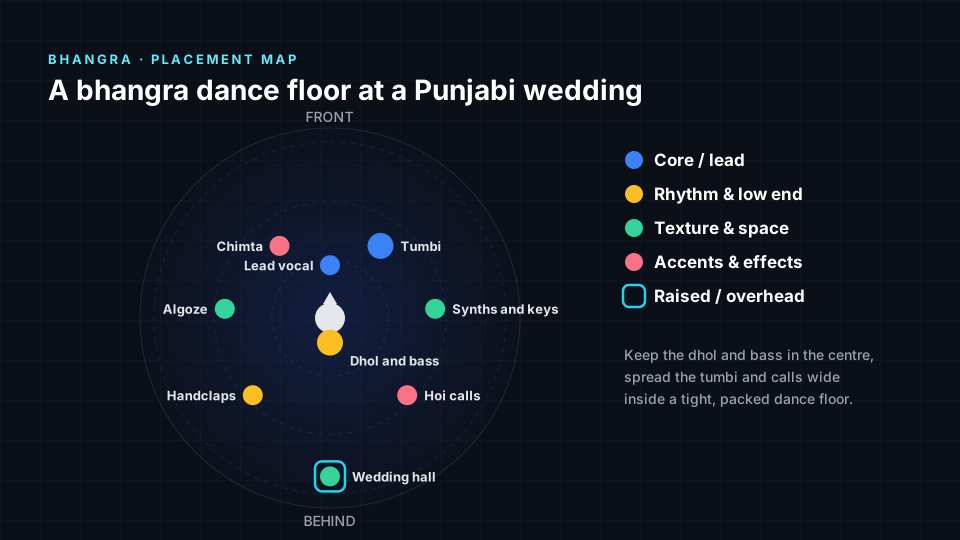
- Spatial audio for bhangra places the dhol and bass close and centred, the lead vocal at front centre, the tumbi and chimta on the front sides and the algoze, synths, claps and hoi calls in a wide ring around the listener.
- The ear finds almost no direction below about 80 to 100 Hz, so the dagga stroke and the bass belong in the centre, while auditory stream segregation lets the listener follow the bright tumbi apart from the heavy drum.
- Never move the dhol or the singer, and let only the calls, claps and riffs drift a little like dancers turning, inside a short, dry room that keeps the groove punchy.
- The bhangra immersion profile scores width 4, height 2, movement 3, low-end focus 5 and space 2 out of 5.
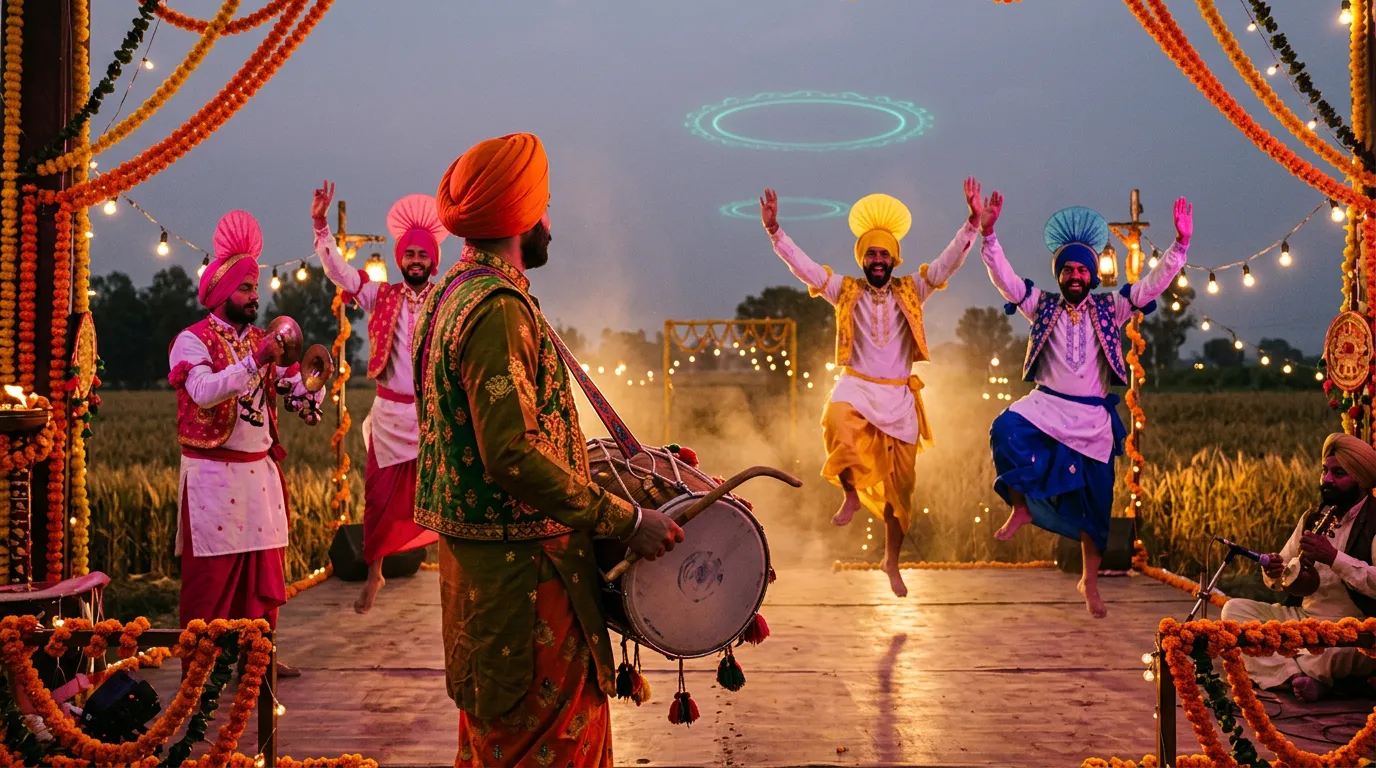
Bhangra began as a folk dance of the farming villages of Punjab, a region now divided between Pakistan and India. Men danced it at harvest time, above all around Vaisakhi in April, to the beat of the dhol, a large double-headed barrel drum played with a heavy curved stick, the dagga, on the bass side and a thin cane, the tihli, on the treble side. The dancers shouted calls such as hoi and balle balle and sang short folk couplets called boliyan, while the tumbi, a high one-string lute, the chimta, a pair of long iron tongs with jingles, and the algoze, a pair of wooden flutes played together, carried the tune. After the partition of 1947, stage troupes and college teams in Indian Punjab shaped bhangra into a choreographed performance with bright costumes. Punjabi migrants then took the music to Britain, and from the late 1970s bands in Southall and Birmingham, such as Alaap, Bhujhangy Group and Apna Sangeet, added drum machines, synths and bass guitar to create UK bhangra. From the 1990s Daler Mehndi in India and Panjabi MC in Britain took bhangra beats to a global audience, and Punjabi pop now fills charts and festival stages across the world. Bhangra suits spatial audio because it is dance music built around one huge drum and a crowd that shouts back. This guide covers how spatial audio for bhangra works, where to place each element and how to make an immersive bhangra mix. For the basics, see what spatial audio is.
Why bhangra works in spatial audio
Bhangra is built on a strong, bouncing groove. The dhol plays the chaal, a lilting rhythm with a deep thud on the dagga side and a sharp crack on the tihli side. The tumbi repeats a short, catchy riff high above it. The chimta and handclaps mark the off beats, and the singer delivers fast, proud lines, broken up by shouted calls from the band and the crowd. In modern tracks a bass guitar, synth bass or 808 doubles the low end of the dhol. In stereo the dhol, bass, tumbi, voice and synths all fight for the middle, and the bright parts can pile into a harsh wall. In an immersive mix the dhol and bass hold a solid centre, the lead voice sits in front, and the tumbi, chimta, calls and claps form a ring that keeps the dance floor moving.
The rule: the dhol in the middle, the party all around it. Anchor the dhol and bass close and centred, keep the singer in front and spread the bright instruments and shouts wide, inside a tight, dry room that keeps the groove punchy.
Immersive music for bhangra: what listeners hear
- A drum you feel in your chest. The dhol and bass sit close and centred, so every thud of the dagga lands with full weight under the dancers.
- Bright riffs on both sides. The tumbi rings from the front right and the chimta jangles from the front left, so the hooks stay clear without cutting into the voice.
- Shouts from the crowd. The hoi and balle balle calls burst in from behind and the sides, as if the dancers around you are shouting along.
- A floor that keeps moving. The calls and the tumbi shift a little as the song goes on, giving a sense of dancers turning, while the drum and the singer stay put.
Where to place each element in a bhangra mix
| Element | Position | Height | Why it works |
|---|---|---|---|
| Lead vocal | Front centre | Ear level | The singer who leads every line and boli |
| Dhol and bass | Centre | Low | The heavy groove that drives the dance floor |
| Tumbi | Front right | Ear level | The high, catchy riff that hooks the song |
| Chimta | Front left | Ear level | Jingling iron accents on the off beats |
| Algoze | Left | Ear level | Twin folk flutes that carry the village sound |
| Synths and keys | Right | Ear level | Pads and riffs in UK bhangra and Punjabi pop |
| Handclaps | Behind left | Ear level | The clapped pulse of the crowd |
| Hoi calls | Behind right | Ear level | Shouts from the dancers that lift each section |
| Wedding hall | Behind | Raised | A tight, lively room around the dance floor |
The psychoacoustics behind bhangra placement
Every position in the table above follows how the ear and brain locate sound. Here is the reason behind the main choices for bhangra.
- Dhol and bass stay centred. The ear finds almost no direction in frequencies below roughly 80 to 100 Hz, so the dagga stroke and the bass line gain nothing from being spread. Keeping them centred and mono gives the groove its full weight on every system (Blauert).
- Tumbi and dhol in different places. The brain groups sounds into streams by pitch, timing and direction. This is auditory stream segregation (Bregman). Setting the bright tumbi away from the heavy drum lets the ear follow the riff and the beat as two clear lines.
- Tight spacing at the front. The ear is most precise straight ahead, where it can tell apart sources only a degree or two apart. This is the minimum audible angle (Mills). The tumbi, chimta and voice can sit close together in front and still sound distinct, so the hooks stay focused.
- Calls that seem to rush in. Listeners hear sounds that grow louder as moving closer, and they overestimate how near a rising sound has come. This is the looming effect for rising intensity (Neuhoff). A hoi call that swells from behind feels like a dancer stepping toward you, which adds energy without moving the drum.
The immersion profile for bhangra
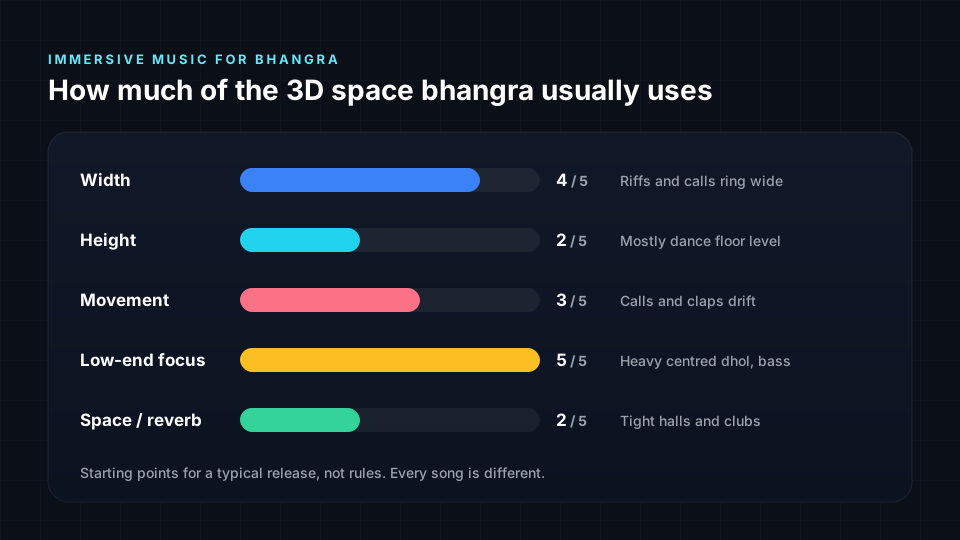
Low-end focus scores 5, the highest value, because the dhol and the bass are the engine of bhangra and should sit heavy and centred. Width scores 4 because the tumbi, chimta, algoze, synths, claps and calls spread in a wide ring around the drum. Movement is 3: the drum and singer stay put, but the calls, claps and riffs can drift a little, just as dancers turn and a dhol player walks through a crowd. Height is 2, since the music lives at dance floor level, with only the room itself raised. Space is 2, because bhangra is heard in packed wedding halls, clubs and outdoor stages where a short, dry room keeps the groove tight.
Tips for an immersive bhangra mix
- Lock the dhol and bass together. Keep both centred and close, and let the dagga thud and the bass line share the low end rather than clash, so the floor never feels empty.
- Keep the tihli crisp. The thin stick of the dhol gives the crack that drives the dance. Leave it sharp and centred so the rhythm cuts through the synths.
- Spread the hooks. Place the tumbi front right and the chimta front left, close to the voice but not on top of it, so every riff stays easy to sing along with.
- Let the crowd move a little. Give the hoi calls and claps a gentle drift behind and to the sides, but never move the dhol or the lead voice.
- Use a short, punchy room. A small, dry hall suits bhangra. Long reverb blurs the dhol and the bass, so keep any tails short and bright.
Bhangra styles: Punjabi folk bhangra, UK bhangra and Punjabi pop
The core placement holds for every style here: the dhol and bass at the centre, the singer in front and the bright instruments around them. What changes is how much electronic sound is used, how deep the bass goes and how large the stage or room is.
Punjabi Folk Bhangra
Punjabi folk bhangra is the village dance and its music, played on the dhol with the tumbi, chimta, algoze and voice, often with dancers holding a wooden clapper called the saap. The dhol player leads the dancers through changing rhythms, and singers trade boliyan between the steps. After 1947 the dance moved onto stages and into college competitions in Indian Punjab, where teams shaped it into a set routine. Singers such as Gurdas Maan and Kuldeep Manak kept the folk sound alive on record, and the singer Amar Singh Chamkila built a huge following in the 1980s with his duets. Place the dhol close and centred with the singer just in front, the tumbi front right, the chimta front left and the algoze to the left. Keep the shouts of the dancers behind and to the sides, and use a small, open room or an outdoor stage with very little reverb.
UK Bhangra
UK bhangra grew in the Punjabi communities of Southall in west London and of Birmingham and the Midlands. Alaap, formed in Southall in 1977 by the singer Channi Singh, and Birmingham groups such as Bhujhangy Group and Apna Sangeet played weddings and community halls and added drum kits, synths and bass guitar to the folk sound. Producers such as Kuljit Bhamra and Deepak Khazanchi helped shape the studio sound of the 1980s, and Malkit Singh and his band Golden Star had a worldwide hit with Gur Nalon Ishq Mitha in the mid 1980s. Daytime discos drew young British Asians in the late 1980s, and in the 1990s Bally Sagoo remixed Punjabi songs for the club while Apache Indian blended bhangra with reggae. Panjabi MC's Mundian To Bach Ke, first released in 1998, became a global hit in 2003. Keep the dhol and bass guitar centred and low, the drum machine under them, the singer in front and the synths and keys wide to the right. A tight club room suits the style.
Punjabi Pop
Punjabi pop takes the energy of bhangra into modern pop and hip hop production. In India Daler Mehndi broke through with Bolo Ta Ra Ra in 1995 and Tunak Tunak Tun in 1998, and later singers such as Jazzy B, Diljit Dosanjh and Sidhu Moose Wala brought Punjabi songs to huge audiences around the world. In 2023 Diljit Dosanjh became the first Punjabi artist to perform at Coachella, and a new wave of artists such as AP Dhillon mixed Punjabi singing with trap and R&B beats. The low end often moves from the dhol to an 808 sub bass, which must stay firmly centred. Keep the vocal at front centre and very clear, set the 808 and any sampled dhol in the middle, and spread the synths, tumbi samples and backing vocals wide. A short, modern room suits the style, with a little extra space only on the pads.
Related traditions such as the giddha dance songs of Punjabi women, the bhangra-influenced songs of Bollywood and the Punjabi music scenes of Canada and the United States follow the same idea: keep the drum and the voice at the centre and the party around the listener.
How to make immersive bhangra from stereo
Spatial9 can create spatial audio from a stereo track in a few steps:
- Upload your stereo master or your stems.
- Spatial9's AI separates and places each part, pulling the dhol, bass, tumbi, chimta and lead vocal apart even from older cassette-era UK bhangra releases, and setting the riffs and calls around a heavy, centred dhol.
- Preview it in binaural on headphones.
- Export Eclipsa Audio, ADM, binaural or Ambisonics.
- Publish a video. Create a YouTube-ready video with your immersive audio and publish it directly.
For related guides, read spatial audio for Bollywood and spatial audio for qawwali. Every guide is listed in spatial audio and immersive music by genre.
Frequently asked questions
Does this guide cover Punjabi Folk Bhangra, UK Bhangra and Punjabi Pop?
Yes. Punjabi folk bhangra places the dhol in the centre with the tumbi, chimta and algoze around it in a small open room. UK bhangra adds drum machines, bass guitar and synths in a tight club. Punjabi pop sets the vocal and a centred 808 at the heart of a modern, wide mix.
Can I make a bhangra mix in Dolby Atmos or Eclipsa Audio?
Yes. The placements in this guide work for both. Spatial9 exports ADM, the standard file used by Dolby Atmos studios, as well as Eclipsa Audio for YouTube, so one immersive bhangra mix covers both. If you plan to release the Atmos version on Apple Music, build it from your original stems or multitracks, because Apple does not accept Atmos made from a finished stereo master. See where to publish spatial audio. You may also hear this called a 3D bhangra mix or bhangra in spatial audio.
Is spatial audio good for bhangra?
Yes. Bhangra is dance music built around one heavy drum, bright riffs and a crowd that shouts back. Spatial audio gives the dhol a solid centre and puts the listener in the middle of the dance floor instead of in front of it.
Where should the dhol go in an immersive bhangra mix?
Put the dhol in the centre, close to the listener and low. Its deep dagga stroke carries little direction, and the whole dance depends on it feeling solid and steady.
Should the bass be louder than the dhol?
Not in folk bhangra, where the dhol is the bass. In UK bhangra and Punjabi pop, let the bass or 808 fill the lowest notes and the dhol carry the punch just above, both centred, so they support each other instead of masking.
How is bhangra different from qawwali in spatial audio?
Both come from Punjab, but they serve different purposes. Bhangra is dance music with a heavy, centred dhol and a tight, dry room. Qawwali is devotional music for a seated party, with a lead voice, harmonium and chorus in a moderate shrine courtyard and much less low end.
Can I convert an old bhangra cassette recording to spatial audio?
Yes. Spatial9 uses AI to separate the dhol, tumbi, bass and voices from a stereo or mono recording. Separation is never perfect with dense or worn recordings, so keep the layout simple and the room dry.
Dolby and Dolby Atmos are trademarks of Dolby Laboratories. Spatial9 is not affiliated with or endorsed by Dolby Laboratories.
Sources
- Blauert, J. (1997). Spatial Hearing: The Psychophysics of Human Sound Localization, revised edition. MIT Press. Low-frequency, elevation, distance and motion cues.
- Mills, A. W. (1958). On the minimum audible angle. Journal of the Acoustical Society of America, 30(4), 237-246.
- Hebrank, J. and Wright, D. (1974). Spectral cues used in the localization of sound sources on the median plane. Journal of the Acoustical Society of America, 56(6), 1829-1834.
- Bronkhorst, A. W. (2000). The cocktail party phenomenon: a review of research on speech intelligibility in multiple-talker conditions. Acta Acustica united with Acustica, 86, 117-128.
- Barron, M. and Marshall, A. H. (1981). Spatial impression due to early lateral reflections in concert halls. Journal of Sound and Vibration, 77(2), 211-232.
- Neuhoff, J. G. (1998). Perceptual bias for rising tones. Nature, 395, 123-124.
- Bregman, A. S. (1990). Auditory Scene Analysis: The Perceptual Organization of Sound. MIT Press.
- Sharma, S., Hutnyk, J. and Sharma, A., eds. (1996). Dis-Orienting Rhythms: The Politics of the New Asian Dance Music. Zed Books.
Hit the dance floor
Upload a track to Spatial9 and hear the dhol pounding at the centre with the tumbi and the hoi calls all around you in minutes. Then export it or publish it straight to YouTube.