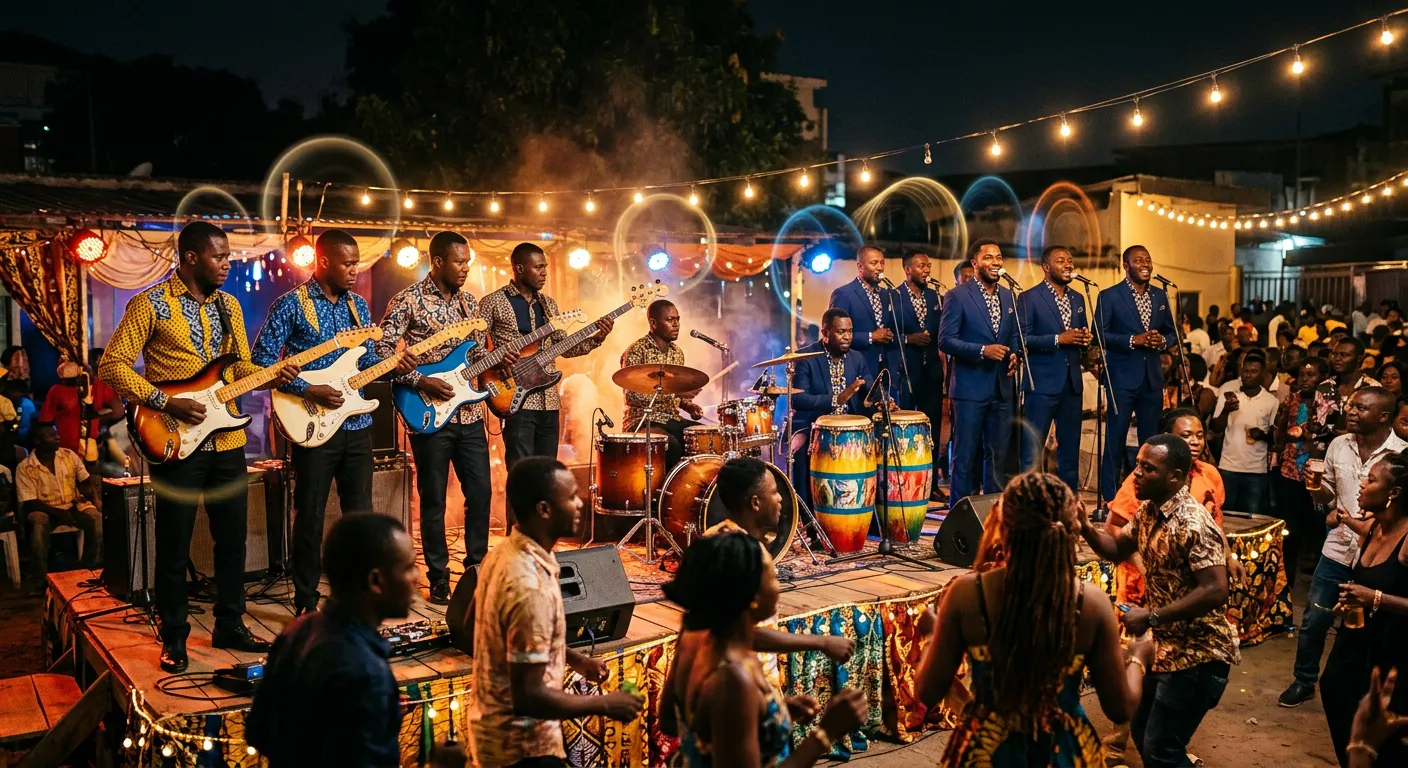
Spatial Audio & Immersive Music for Soukous & Congolese Rumba: Rumba Congolaise, Soukous & Ndombolo
Spatial9 Team · · 12 min read
Part of the series Spatial audio and immersive music by genre.
Key takeaways
- In a spatial soukous and Congolese rumba mix the lead guitar sits front left and the mi-solo guitar front right, with the lead singer centred, the bass guitar anchored underneath and the rhythm guitar, drums and vocal chorus spread around the sides.
- Because the brain separates sounds that come from different directions, an effect known as auditory stream segregation, the three interlocking guitars of the sebene stay clear instead of blurring into one bright wash.
- Congolese rumba borrowed its name and its clave feel from Cuban son records of the 1930s and 1940s, but it is guitar music sung in Lingala, so the mix should centre on the guitars and voices rather than on a wall of hand drums.
- The soukous and Congolese rumba immersion profile scores width 4, height 2, movement 3, low-end focus 3 and space 3 out of 5.
Congolese rumba grew up on both banks of the Congo River, in Léopoldville (now Kinshasa) and Brazzaville. From the 1930s, records of Cuban son, many issued by HMV in its GV series, were sold in the port towns and played on the radio. Record companies often labelled this Cuban music rumba, and the name stuck. Local musicians took its clave feel and its form, a sung verse followed by a looser dance section, and made it their own with acoustic guitars, likembé thumb pianos, bottles and voices singing in Lingala. Greek-owned labels such as Ngoma, Opika and Loningisa recorded the new sound in the late 1940s, and Wendo Kolosoy's Marie-Louise of 1948 became one of its first big hits. In the 1950s electric guitars, saxophones and horns arrived. Joseph Kabasele, Le Grand Kallé, led African Jazz and recorded Indépendance Cha Cha for the independence of the Congo in 1960. His band was also home to the guitarist Docteur Nico. Franco founded OK Jazz in 1956, and Tabu Ley Rochereau later led his own bands. Over the following decades the dance section, the sebene, grew faster and longer, giving birth to soukous and then ndombolo. In 2021 UNESCO added Congolese rumba, nominated jointly by both Congos, to its list of intangible cultural heritage. Soukous and Congolese rumba suit spatial audio because the music is a conversation between guitars and voices, and the dance floor is part of the song. This guide covers how spatial audio for soukous and Congolese rumba works, where to place each element and how to make an immersive Congolese rumba mix. For the basics, see what spatial audio is.
Why soukous and Congolese rumba works in spatial audio
A Congolese rumba song usually comes in two halves. First the singers carry a slow, sweet melody in close harmony over a gentle groove. Then the band breaks into the sebene, where the lead guitar plays high, ringing cycles, the mi-solo guitar weaves a middle line and the rhythm guitar keeps a steady pattern underneath. The bass rolls between them and the drums lift the energy. In mono or narrow stereo the three guitars sit on top of each other and turn into one glittering blur. In an immersive mix each guitar gets its own place, so you can follow every line as it locks into the others.
The rule: three guitars spread apart, the voice and the bass in the middle. Put the lead and mi-solo guitars on opposite front sides, the rhythm guitar further out, keep the singer and the bass anchored and set the band in a lively dance bar.
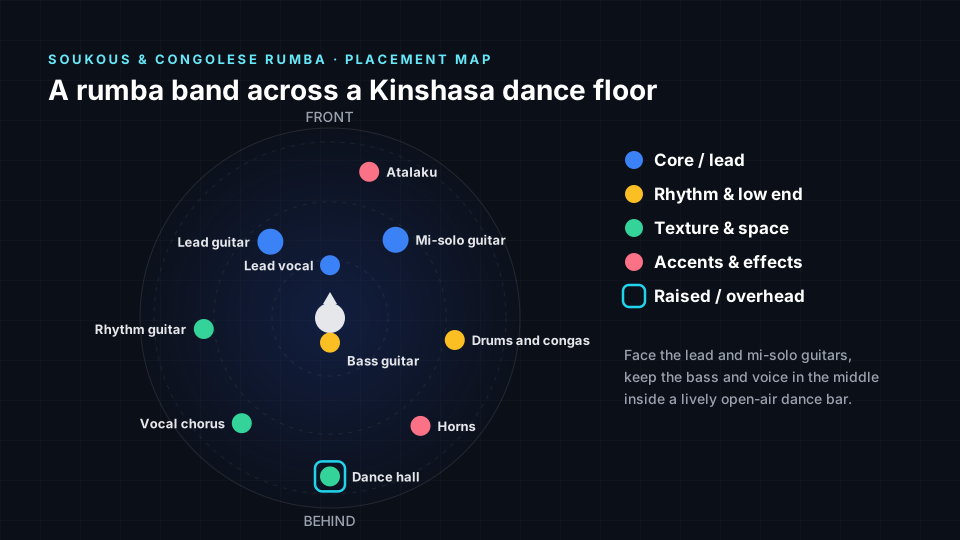
Immersive music for soukous and Congolese rumba: what listeners hear
- Guitars you can follow. The lead guitar rings from the left, the mi-solo answers from the right and the rhythm guitar ticks along the side, so the whole sebene becomes clear.
- A voice that stays close. The lead singer sits just in front, with the harmony chorus around and behind, as if the band leans in for the love song.
- A dance section that lifts. When the sebene arrives, the guitars climb, the drums open up and the atalaku shouts, and the energy seems to rise around you.
- A bar full of dancers. A medium, lively room puts you on the floor of an open-air bar, close enough to feel the bass but with the night around you.
Where to place each element in a soukous and Congolese rumba mix
| Element | Position | Height | Why it works |
|---|---|---|---|
| Lead vocal | Front centre | Ear level | The sweet sung melody of the rumba |
| Bass guitar | Centre | Ear level | The rolling line that drives the dance |
| Lead guitar | Front left | Ear level | High, ringing cycles in the sebene |
| Mi-solo guitar | Front right | Ear level | The middle line that weaves with the lead |
| Atalaku | Front right, further out | Ear level | Shouted calls that fire up the dancers |
| Rhythm guitar | Left | Ear level | A steady chord pattern under the solos |
| Drums and congas | Right | Ear level | Snare, hi-hat and hand drums for the groove |
| Vocal chorus | Behind left | Ear level | Close harmony around the lead singer |
| Horns | Behind right | Ear level | Saxophone and trumpet riffs in classic rumba |
| Dance hall | Behind | Raised | A lively open-air bar around the band |
The psychoacoustics behind soukous and Congolese rumba placement
Every position in the table above follows how the ear and brain locate sound. Here is the reason behind the main choices for Congolese rumba.
- Bass guitar stays centred. The ear finds almost no direction in frequencies below roughly 80 to 100 Hz (Blauert), so the bass gains nothing from being spread and keeps the groove solid for dancers.
- Guitars on opposite sides. The brain groups sounds into streams by pitch, timing and direction. This is auditory stream segregation (Bregman). Setting the lead and mi-solo guitars apart lets the ear follow two bright lines in the same register instead of one tangle.
- The singer clear among many voices. Listeners pick out one voice from many more easily when the voices come from different directions. This is the cocktail party effect (Bronkhorst). Keeping the lead vocal in front and the chorus behind keeps the words of the song clear.
- A lively room that stays crisp. The ear takes the direction of a sound from the first arrival and folds the early echoes into it. This is the precedence effect (Litovsky and colleagues). A medium room with clear early reflections adds life without smearing the fast guitar picking.
The immersion profile for soukous and Congolese rumba
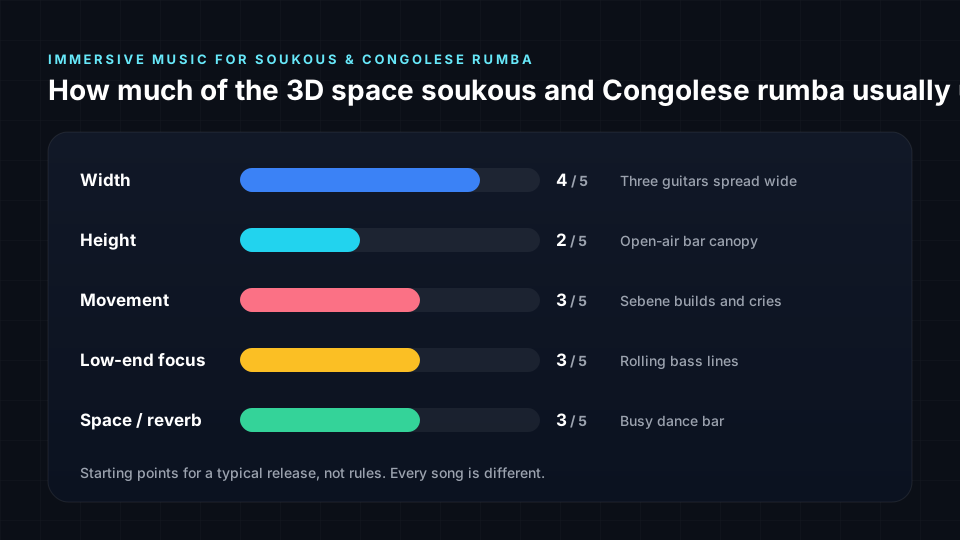
Width scores 4 because a rumba band spreads three guitars, singers, drums and often horns across a stage. Movement is 3, coming from the shift between the sung part and the sebene, and from the guitar lines climbing and answering each other, rather than sounds flying around. Low-end focus is 3, since the bass guitar carries a rolling, melodic line and the kick is light, without heavy sub bass. Space is 3: the music lives in busy dance bars and halls, lively but not cavernous. Height is 2, from the canopy or ceiling of the bar above the band.
Tips for an immersive soukous and Congolese rumba mix
- Give each guitar its own place. Put the lead guitar front left, the mi-solo front right and the rhythm guitar further out on the left, so the sebene stays clear.
- Keep the bass centred. The bass guitar drives the dance, so hold it in the middle and let it roll.
- Bring the singer in close. The lead vocal should sit just in front, with the harmony chorus slightly behind and wider.
- Let the sebene lift the music. Keep the band in place and let the guitars, drums and atalaku raise the energy when the dance section begins.
- Use a lively, medium room. A bar or hall reverb suits the music, but keep it short enough that the fast guitar picking stays crisp.
Soukous and Congolese rumba styles: Rumba congolaise, soukous and ndombolo
The core placement holds for every style here: guitars spread across the front, the voice and bass anchored in the middle. What changes is the tempo, the share of the song given to the sebene and how much electronic sound the band uses.
Rumba Congolaise
Rumba congolaise is the classic sound of the 1950s to the 1970s, the music of African Jazz, OK Jazz and the bands around them. Songs often open with a slow, sung section in close harmony, then move into a sebene where the guitars take over. Many bands used saxophones, trumpets and clarinet alongside the guitars. Seat the lead guitar front left, the mi-solo front right, the rhythm guitar left and the bass in the centre, with the singer just in front, the chorus behind and the horns behind right. A warm, medium hall suits the style.
Soukous
Soukous is the faster, dance-focused offshoot that took off in the 1970s and 1980s. Youth bands in Kinshasa such as Zaïko Langa Langa, formed in 1969, cut the horns and pushed the guitars and drums forward. In the 1980s many musicians moved to Paris and recorded a quick, polished soukous with short songs that jumped almost at once into the sebene. This style can take a brighter, tighter layout: keep the lead guitar high and clear at front left, the mi-solo front right, the snare and hi-hat crisp on the right and the bass firm in the centre. Use a shorter room so the fast picking stays sharp.
Ndombolo
Ndombolo is the Kinshasa dance style that rose in the late 1990s, linked with bands such as Wenge Musica and its offshoots. It pairs heavy, driving drums and often drum machines and keyboards with long guitar sebenes and the shouted calls of the atalaku, the animator who names dances and fires up the crowd. Give it a wider layout: keep the guitars in front, the kick and bass solid in the centre and place the atalaku a little further out than the lead singer, so his calls cut through. Keyboards and effects can sit around the sides and back.
Related styles such as kwassa kwassa, Kenyan benga and the rumba of Tanzania and Zambia follow the same idea: keep the guitars spread at the front, the bass anchored in the middle and the dance floor around the listener.
How to make immersive soukous and Congolese rumba from stereo
Spatial9 can create spatial audio from a stereo track in a few steps:
- Upload your stereo master or your stems.
- Spatial9's AI separates and places each part, pulling the lead and mi-solo guitars, rhythm guitar, bass, drums and voices apart even from old recordings, and setting the guitars across a wide stage with the singer and bass in the centre.
- Preview it in binaural on headphones.
- Export Eclipsa Audio, ADM, binaural or Ambisonics.
- Publish a video. Create a YouTube-ready video with your immersive audio and publish it directly.
For related guides, read spatial audio for rumba and Afro-Cuban music and spatial audio for highlife. Every guide is listed in spatial audio and immersive music by genre.
Frequently asked questions
Does this guide cover Rumba Congolaise, Soukous and Ndombolo?
Yes. Rumba congolaise seats a classic guitar and horn band in a warm hall, with the singer in front. Soukous uses a brighter, tighter layout for fast guitars and crisp drums. Ndombolo keeps the guitars in front, adds a strong kick and bass and gives the atalaku his own spot.
Can I make a soukous and Congolese rumba mix in Dolby Atmos or Eclipsa Audio?
Yes. The placements in this guide work for both. Spatial9 exports ADM, the standard file used by Dolby Atmos studios, as well as Eclipsa Audio for YouTube, so one immersive Congolese rumba mix covers both. If you plan to release the Atmos version on Apple Music, build it from your original stems or multitracks, because Apple does not accept Atmos made from a finished stereo master. See where to publish spatial audio. You may also hear this called a 3D soukous mix, a 3D rumba congolaise mix or Congolese rumba in spatial audio.
How is Congolese rumba different from Cuban rumba?
They share a name but they are different music. Cuban rumba proper, with styles such as guaguancó, yambú and columbia, is a street and backyard form of voices, clave and hand drums from Havana and Matanzas. Congolese rumba grew instead from Cuban son records, which the record trade often sold under the rumba label. Congolese musicians kept the clave feel and the verse then dance section shape of son, but rebuilt the music around guitars and Lingala singing. There is also a deeper link: much Cuban music has roots in Central African, Kongo traditions, so the records that reached Kinshasa were in part a sound coming home. In spatial audio, Cuban rumba centres on a circle of drums and voices, while Congolese rumba centres on interlocking guitars, so read our guide to rumba and Afro-Cuban music for the drum circle layout.
What is the sebene and how should I mix it?
The sebene is the instrumental dance section, usually in the second half of the song, where the guitars play repeating, interlocking cycles and the dancers take over. Keep each guitar in its own place, let the lead guitar sit slightly higher in level and let the drums and atalaku lift the energy without moving the band around.
Where should the atalaku go in an immersive mix?
Place the atalaku front right, a little further out than the lead singer and at ear level. His calls are short and loud, so they cut through from there without crowding the lead vocal in the centre.
Is spatial audio good for soukous?
Yes. Soukous is built on several bright guitars playing in the same high register, which tend to blur in stereo. Spatial audio lets each guitar stand in its own place, so the interlocking lines become clear and the groove feels wider.
Can I convert a 1950s Congolese rumba recording to spatial audio?
Yes. Spatial9 uses AI to separate the guitars, bass, voices and percussion from a mono master. Separation is never perfect with older recordings, so keep the layout simple and the room moderate.
Dolby and Dolby Atmos are trademarks of Dolby Laboratories. Spatial9 is not affiliated with or endorsed by Dolby Laboratories.
Sources
- Blauert, J. (1997). Spatial Hearing: The Psychophysics of Human Sound Localization, revised edition. MIT Press. Low-frequency, elevation, distance and motion cues.
- Mills, A. W. (1958). On the minimum audible angle. Journal of the Acoustical Society of America, 30(4), 237-246.
- Bronkhorst, A. W. (2000). The cocktail party phenomenon: a review of research on speech intelligibility in multiple-talker conditions. Acta Acustica united with Acustica, 86, 117-128.
- Litovsky, R. Y., Colburn, H. S., Yost, W. A. and Guzman, S. J. (1999). The precedence effect. Journal of the Acoustical Society of America, 106(4), 1633-1654.
- Barron, M. and Marshall, A. H. (1981). Spatial impression due to early lateral reflections in concert halls. Journal of Sound and Vibration, 77(2), 211-232.
- Bregman, A. S. (1990). Auditory Scene Analysis: The Perceptual Organization of Sound. MIT Press.
- Stewart, G. (2000). Rumba on the River: A History of the Popular Music of the Two Congos. Verso.
Join the dance floor
Upload a track to Spatial9 and hear the guitars of the sebene interlock around you in minutes. Then export it or publish it straight to YouTube.