
Spatial Audio & Immersive Music for Cumbia: Complete Guide
Spatial9 Team · · Updated
Part of the series Spatial audio and immersive music by genre.
Cumbia was born on the Caribbean coast of Colombia, from a meeting of African drumming, Indigenous gaita flutes and Spanish song. Over the twentieth century it spread across Latin America and took on new forms: the big-band cumbia of Colombia, cumbia sonidera in Mexico, chicha in Peru, cumbia villera in Argentina and many more. Across all of them, the same steady, swaying two-beat rhythm drives the dance. This guide covers how spatial audio for cumbia works, where to place each element and how to make an immersive cumbia mix. For the basics, see what spatial audio is.
Why cumbia works so well in spatial audio
Cumbia is played by a band in a circle of dancers. Its groove comes from a few simple parts locking together: the scraper keeping a constant pattern, the drums answering it, the bass on the beat and the accordion or flute carrying the melody. Each part is easy to hear on its own, which makes cumbia ideal for placing around the listener.
The rule: ground the dance, circle the rhythm. Keep the voice and bass steady in the centre and spread the percussion around the floor.
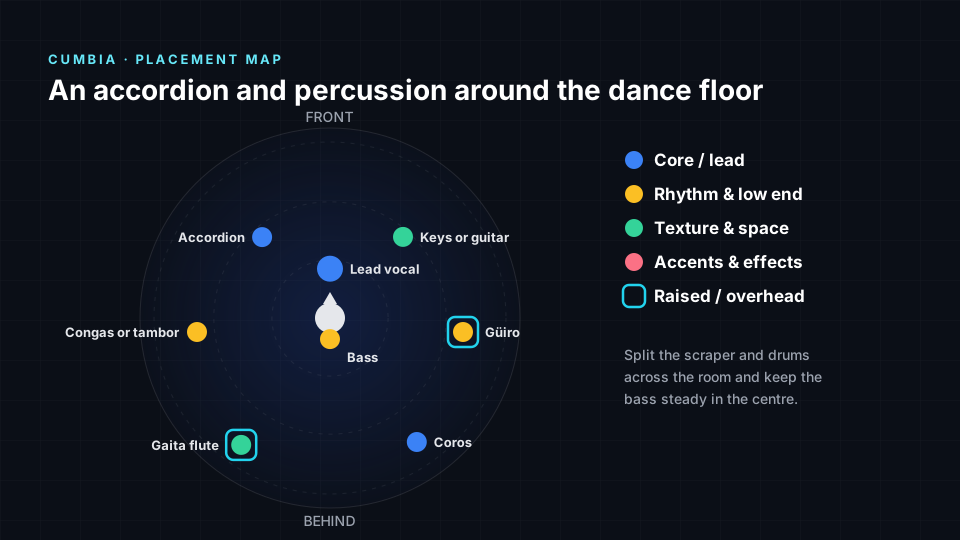
Immersive music for cumbia: what listeners hear
- A voice leading the dance. The singer stays front and centre.
- The accordion calling out. Melody lines answer the singer from the front left.
- A scraper you can feel. The güiro or guacharaca keeps the pulse from one side, crisp and bright.
- Drums from the other side. Congas or the tambor alegre trade patterns across the room.
- Flutes and coros behind. The gaita and backing voices lift the chorus from behind.
Where to place each element in a cumbia mix
| Element | Position | Height | Why it works |
|---|---|---|---|
| Lead vocal | Front centre | Ear level | Leads the band and the dancers |
| Accordion | Front left | Ear level | The melodic voice of the band |
| Keys or guitar | Front right | Ear level | Rhythm and harmony |
| Bass | Centre | Ear level | The steady two-beat foundation |
| Congas or tambor alegre | Left | Ear level | Drum patterns from one side |
| Güiro or guacharaca | Right | Slightly raised | The constant scrape of the groove |
| Gaita flute | Behind left | Raised | Traditional melody floating above |
| Coros | Behind right | Ear level | Backing voices answer the lead |
The psychoacoustics behind cumbia placement
Every position in the table above follows how the ear and brain locate sound. Here is the reason behind the main choices for cumbia.
- Drums left, scraper right. When sounds overlap in time, separating them in direction makes each easier to follow. Researchers call this spatial release from masking. The interlocking percussion parts stay clear and danceable.
- Güiro slightly raised. The outer ear shapes high frequencies differently depending on the height of a sound, and the brain reads those changes as elevation. Bright, scratchy sounds like a güiro carry those cues well, so a small lift sounds convincing.
- Bass centred. Low frequencies give the brain very little usable direction, which is why a single subwoofer can serve a whole speaker system. A centred bass keeps the two-beat pulse solid for dancers.
- Coros behind. Sound coming from the sides and behind, slightly different at each ear, creates the feeling of being surrounded. Acousticians call this envelopment. Backing voices from behind make the chorus feel like a crowd singing along.
The immersion profile for cumbia
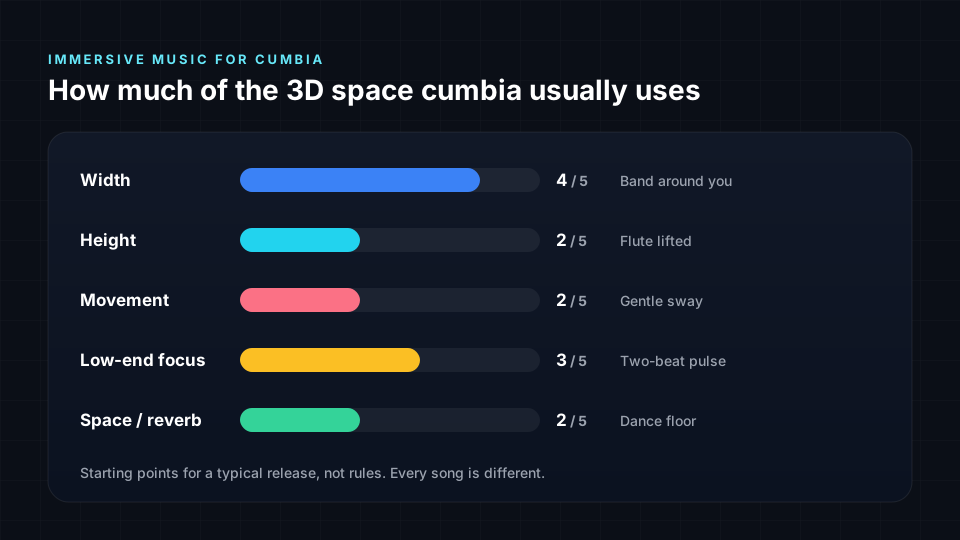
Cumbia scores high on width because the band surrounds the dance floor. Space stays fairly low. Cumbia records are usually dry and punchy, and too much reverb makes the groove feel slow.
Tips for an immersive cumbia mix
- Protect the scraper. The güiro or guacharaca is the heartbeat of cumbia. Keep it crisp and steady.
- Split the percussion. Put drums and scraper on opposite sides so each pattern stays clear.
- Keep the bass in the middle. Dancers lock onto it.
- Do not over-wet the mix. A dry, close sound feels more like a live dance.
- Let modern styles move a little. Cumbia sonidera and electronic cumbia can use gentle sweeps, but keep traditional cumbia still.
How to make immersive cumbia from stereo
Spatial9 can create spatial audio from a stereo track in a few steps:
- Upload your stereo master or your stems.
- Spatial9's AI separates and places each part, from the accordion to the güiro.
- Preview it in binaural on headphones.
- Export Eclipsa Audio, ADM, binaural or Ambisonics.
- Publish a video. Create a YouTube-ready video with your immersive audio and publish it directly.
For related guides, read spatial audio for Latin music, spatial audio for salsa and spatial audio for regional Mexican music. Every guide is listed in spatial audio and immersive music by genre.
Frequently asked questions
Can I make a cumbia mix in Dolby Atmos or Eclipsa Audio?
Yes. The placements in this guide work for both. Spatial9 exports ADM, the standard file used by Dolby Atmos studios, as well as Eclipsa Audio for YouTube, so one immersive cumbia mix covers both. You may also hear this called a 3D cumbia mix or cumbia in spatial audio.
Is spatial audio good for cumbia?
Yes. Cumbia is made of a few clear, interlocking parts, and spreading them around the listener makes the groove even easier to feel.
Where should the accordion go?
Front left, at ear level, so it answers the singer without competing with them.
Does this work for cumbia sonidera, chicha and cumbia villera?
Yes. The core layout stays the same. Swap the accordion for electric guitar in chicha or synths in sonidera, and keep the scraper and bass where they are.
Can I convert an old cumbia record to spatial audio?
Yes. Spatial9 uses AI to separate a stereo master into its parts and export an immersive mix as Eclipsa Audio, ADM, binaural or Ambisonics.
Does immersive cumbia work on normal headphones?
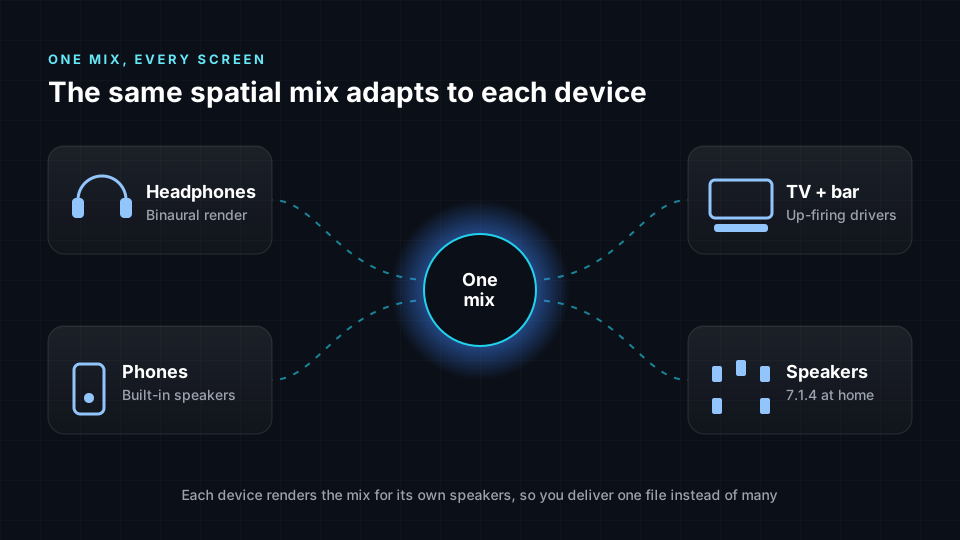
Yes. The mix is rendered binaurally, so the band surrounds you on any regular headphones.
Dolby and Dolby Atmos are trademarks of Dolby Laboratories. Spatial9 is not affiliated with or endorsed by Dolby Laboratories.
Sources
- Blauert, J. (1997). Spatial Hearing: The Psychophysics of Human Sound Localization, revised edition. MIT Press. Low-frequency, elevation, distance and motion cues.
- Hebrank, J. and Wright, D. (1974). Spectral cues used in the localization of sound sources on the median plane. Journal of the Acoustical Society of America, 56(6), 1829-1834.
- Bronkhorst, A. W. (2000). The cocktail party phenomenon: a review of research on speech intelligibility in multiple-talker conditions. Acta Acustica united with Acustica, 86, 117-128.
- Barron, M. and Marshall, A. H. (1981). Spatial impression due to early lateral reflections in concert halls. Journal of Sound and Vibration, 77(2), 211-232.
- Mills, A. W. (1958). On the minimum audible angle. Journal of the Acoustical Society of America, 30(4), 237-246.
- Bregman, A. S. (1990). Auditory Scene Analysis: The Perceptual Organization of Sound. MIT Press.
Put your listeners in the middle of the dance
Upload a cumbia track to Spatial9 and hear the band circle you in minutes. Then export it or publish it straight to YouTube.