Spatial Audio & Immersive Music for Latin Pop: Complete Guide
Spatial9 Team · · Updated
Part of the series Spatial audio and immersive music by genre.
Latin pop is Spanish- and Portuguese-language pop built for the charts, from ballads and dance-pop to the guitar-driven hits of the late 1990s and the reggaeton-influenced crossovers of today. It takes the song structure and polish of pop and adds Latin rhythm, acoustic and flamenco-style guitar, live percussion and often brass. That makes it different from straight reggaeton, where the dembow beat dominates, and from salsa, where the full orquesta leads. In Latin pop, the singer and the song come first. This guide covers how spatial audio for Latin pop works, where to place each element and how to make an immersive Latin pop mix. For the basics, see what spatial audio is.
Why Latin pop works so well in spatial audio
Latin pop arrangements are layered like modern pop, with stacked vocals, synths and ear candy, but they also carry live instruments that sound best with space around them. A nylon-string guitar, a pair of congas or a horn section loses its warmth when it is squeezed into a dense stereo mix. In spatial audio, those parts can sit around the listener while the vocal stays front and centre.
The rule: the star in front, the band dancing around them. Keep verses fairly focused and let the chorus open up into the full space.
Immersive music for Latin pop: what listeners hear
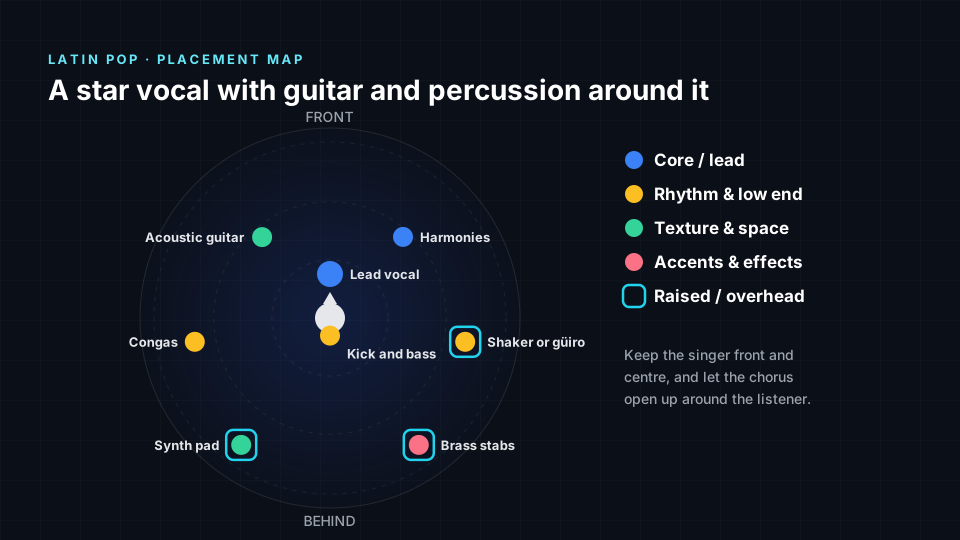
- A voice that owns the song. The lead vocal stays front and centre in every section.
- Guitar with warmth. The acoustic or flamenco-style guitar plays from the front left, close and detailed.
- Rhythm on both sides. Congas and shakers trade patterns across the room.
- A chorus that opens up. Pads, harmonies and brass spread above and behind when the hook lands.
Where to place each element in a Latin pop mix
| Element | Position | Height | Why it works |
|---|---|---|---|
| Lead vocal | Front centre | Ear level | The star of the record |
| Acoustic guitar | Front left | Ear level | Warm rhythm and hooks |
| Harmonies | Front right | Ear level | Support the lead in the chorus |
| Kick and bass | Centre | Ear level | A solid pop foundation |
| Congas | Left | Ear level | Live Latin rhythm |
| Shaker or güiro | Right | Slightly raised | Bright, constant groove |
| Synth pad | Behind left | Raised | Lifts the chorus |
| Brass stabs | Behind right | Raised | Energy and punch in the hook |
The psychoacoustics behind Latin pop placement
Every position in the table above follows how the ear and brain locate sound. Here is the reason behind the main choices for Latin pop.
- Lead vocal in front. Our sense of direction is sharpest straight ahead, where the ear can separate sources only a degree or two apart. That keeps the voice clear and stable on every device.
- Congas left, shaker right. When sounds overlap in time, separating them in direction makes each one easier to hear. Researchers call this spatial release from masking. The percussion stays lively without crowding the vocal.
- Pads and brass raised behind. Sound arriving from the sides and behind, slightly different at each ear, creates the feeling of being inside the music. Acousticians call this envelopment. It makes the chorus feel bigger without pushing the vocal back.
- Kick and bass centred. Low frequencies give the brain very little usable direction, so a centred low end translates cleanly from earbuds to club systems.
The immersion profile for Latin pop
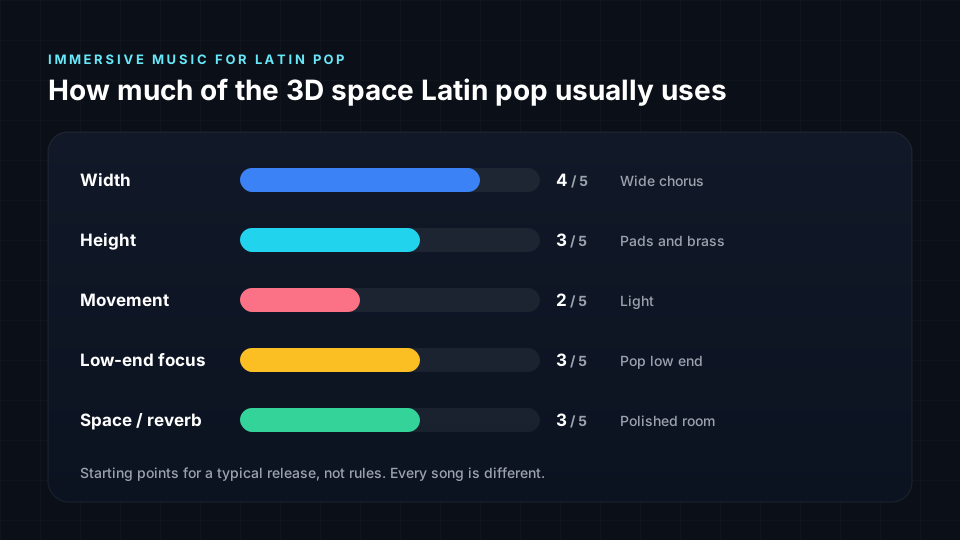
Latin pop scores high on width because its chorus is built to feel big. Movement stays light: a few pieces of ear candy can travel, but the band and singer stay put.
Tips for an immersive Latin pop mix
- Keep the vocal front and centre. It should never move or drift.
- Let the verse breathe, then open the chorus. Save the full 3D space for the hook.
- Keep the guitar close. A nylon or flamenco-style guitar sounds best detailed and near.
- Split the percussion. Put congas and shakers on opposite sides.
- Use height for the hook. Raise pads and brass in the chorus to make it lift.
How to make immersive Latin pop from stereo
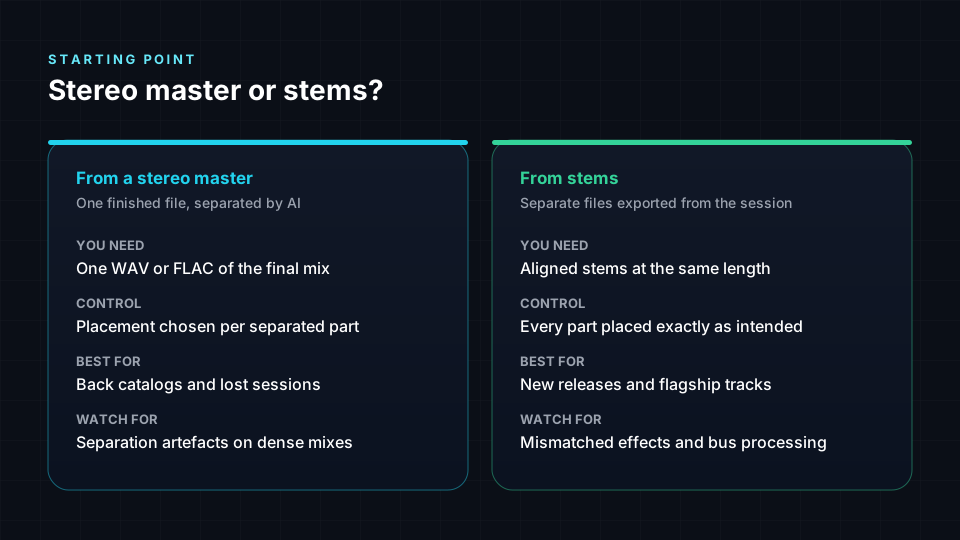
Spatial9 can create spatial audio from a stereo track in a few steps:
- Upload your stereo master or your stems.
- Spatial9's AI separates and places each part, from the vocal and guitar to the percussion.
- Preview it in binaural on headphones.
- Export Eclipsa Audio, ADM, binaural or Ambisonics.
- Publish a video. Create a YouTube-ready video with your immersive audio and publish it directly.
For related guides, read spatial audio for Latin music and reggaeton, spatial audio for pop and spatial audio for flamenco. Every guide is listed in spatial audio and immersive music by genre.
Frequently asked questions
Can I make a Latin pop mix in Dolby Atmos or Eclipsa Audio?
Yes. The placements in this guide work for both. Spatial9 exports ADM, the standard file used by Dolby Atmos studios, as well as Eclipsa Audio for YouTube, so one immersive Latin pop mix covers both. You may also hear this called a 3D Latin pop mix or Latin pop in spatial audio.
How is Latin pop different from reggaeton in spatial audio?
In reggaeton the dembow beat drives everything and stays locked in the centre. In Latin pop the vocal and song lead, and live guitar and percussion get more room around the listener.
Where should the acoustic guitar go?
Front left, close and at ear level, so it supports the singer without masking them.
Can a Latin pop ballad work in spatial audio?
Yes. Keep the voice and piano or guitar close in front, and let strings and pads rise gently behind and above.
Can I convert a released Latin pop song to spatial audio?
Yes. Spatial9 uses AI to separate a stereo master into its parts and export an immersive mix as Eclipsa Audio, ADM, binaural or Ambisonics.
Does immersive Latin pop work on normal headphones?
Yes. The mix is rendered binaurally, so the band surrounds you on any regular headphones.
Dolby and Dolby Atmos are trademarks of Dolby Laboratories. Spatial9 is not affiliated with or endorsed by Dolby Laboratories.
Sources
- Blauert, J. (1997). Spatial Hearing: The Psychophysics of Human Sound Localization, revised edition. MIT Press. Low-frequency, elevation, distance and motion cues.
- Mills, A. W. (1958). On the minimum audible angle. Journal of the Acoustical Society of America, 30(4), 237-246.
- Bronkhorst, A. W. (2000). The cocktail party phenomenon: a review of research on speech intelligibility in multiple-talker conditions. Acta Acustica united with Acustica, 86, 117-128.
- Barron, M. and Marshall, A. H. (1981). Spatial impression due to early lateral reflections in concert halls. Journal of Sound and Vibration, 77(2), 211-232.
- Hebrank, J. and Wright, D. (1974). Spectral cues used in the localization of sound sources on the median plane. Journal of the Acoustical Society of America, 56(6), 1829-1834.
- Bregman, A. S. (1990). Auditory Scene Analysis: The Perceptual Organization of Sound. MIT Press.
Turn your next Latin hit into an experience
Upload a Latin pop track to Spatial9 and hear the band dance around you in minutes. Then export it or publish it straight to YouTube.