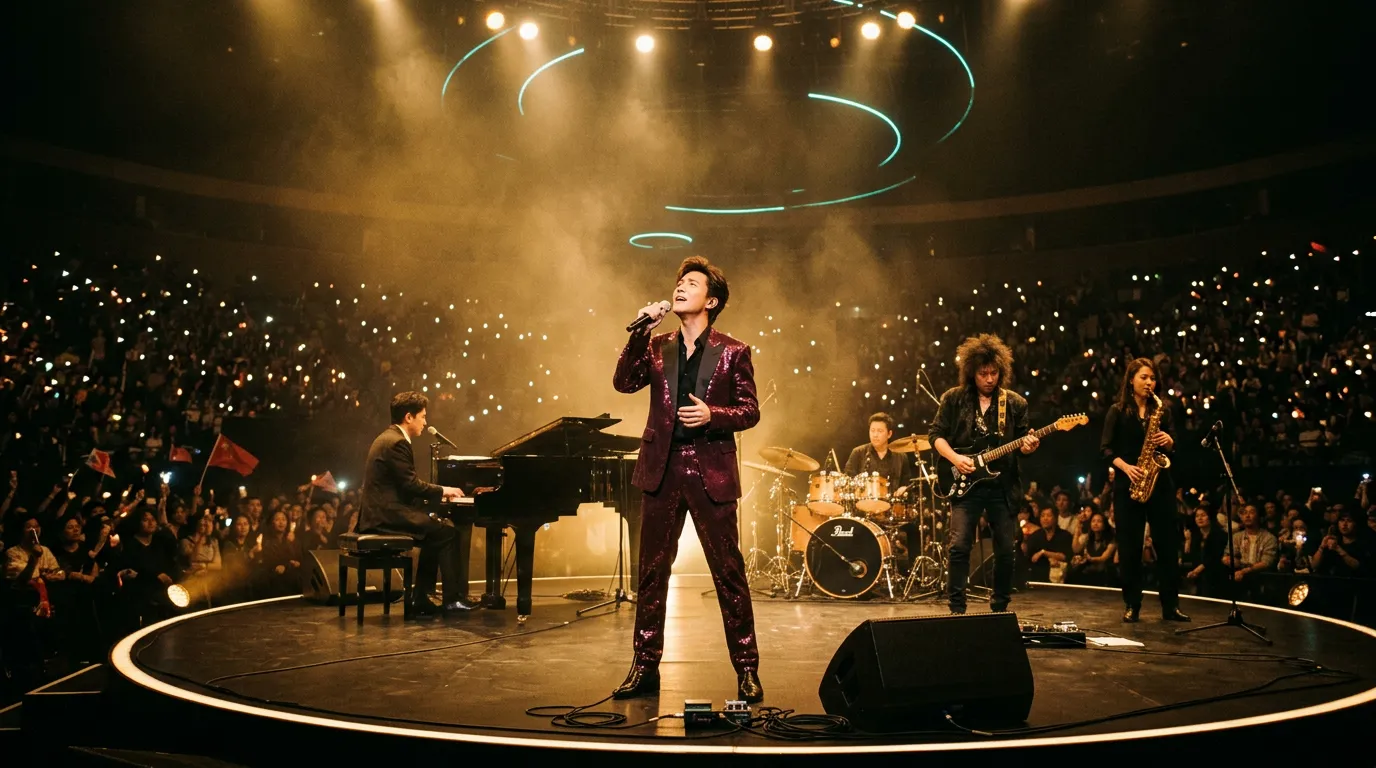
Spatial Audio & Immersive Music for Cantopop: Hong Kong Ballads, 1980s Cantopop & Canto-Rock
Spatial9 Team · · 12 min read
Part of the series Spatial audio and immersive music by genre.
Key takeaways
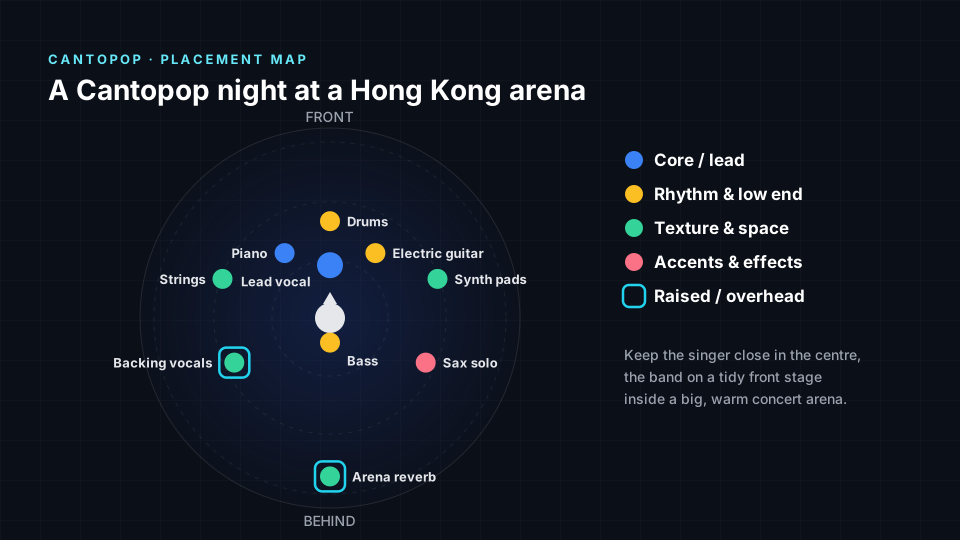
- Cantopop keeps the lead vocal close at the front centre with drums and bass on the centre line, piano and electric guitar on the front sides and strings, synths and backing vocals just beyond them.
- Moving strings, synths and harmonies away from the voice uses the cocktail party effect, so the brain can follow the tones of each Cantonese word even in a full chorus.
- In Cantopop the band stays on a tidy front stage, and the big arena reverb goes behind and above while the voice stays dry.
- The Cantopop immersion profile scores width 3, height 3, movement 2, low-end focus 3 and space 3 out of 5.
Cantopop is popular music sung in Cantonese, made mainly in Hong Kong. Before the 1970s the city's music was dominated by Cantonese opera, Mandarin songs and English-language pop. That changed in the mid-1970s, when theme songs for TVB television dramas, many written by the composer Joseph Koo, began to top the charts in Cantonese. The singer Sandra Lang, Sam Hui with his 1974 song Games Gamblers Play and Roman Tam, whose 1979 theme Below the Lion Rock became an anthem of Hong Kong identity, led the way. The 1980s were the golden age. Leslie Cheung, Anita Mui, Alan Tam and Danny Chan filled the Hong Kong Coliseum, opened in 1983, and their records spread across Asia and to Chinese communities around the world. Bands such as Beyond and Tat Ming Pair brought rock and new wave into the language. In the 1990s the Four Heavenly Kings, Jacky Cheung, Andy Lau, Aaron Kwok and Leon Lai, ruled the charts, and later stars such as Eason Chan and Joey Yung carried the music on. Cantonese is a tonal language, so lyricists such as James Wong, Lin Xi and Albert Leung must fit the tones of the words to the shape of the melody. Cantopop suits spatial audio because the voice and its carefully fitted lyric are always the focus, framed by a full band and a big concert sound. This guide covers how spatial audio for Cantopop works, where to place each element and how to make an immersive Cantopop mix. For the basics, see what spatial audio is.
Why Cantopop works in spatial audio
Cantopop is a singer's music. Because each Cantonese word has a fixed tone, the melody and lyric are bound together, and listeners follow the words closely. Around the voice, a typical song uses a band of drums, bass, piano and guitar, with strings or synthesizers for the chorus and backing vocals in the hooks. Many 1980s records add a saxophone or guitar solo in the bridge. In stereo the strings, synths and backing vocals often press on the voice, and the big reverb of the era can blur the words. In an immersive mix the voice stays close, the band forms a tidy front stage and the arena opens behind and above.
The rule: the singer in front, the band on a clear stage, the arena all around. Anchor the lead vocal, drums and bass on the centre line, keep piano and guitar on the front sides and let strings, synths and reverb fill the room without crowding the lyric.
Immersive music for Cantopop: what listeners hear
- A singer right in front of you. The lead vocal sits close and centred, so every tone and syllable of the Cantonese lyric is clear.
- A tidy band stage. Piano, guitar, drums and bass form a front stage that feels like a live show, not a wall of sound.
- A chorus that lifts into the room. Strings, synths and backing vocals rise a little and spread when the hook arrives.
- A concert hall around you. A large, warm arena reverb sits behind and above, giving the song the feel of a night at the Coliseum.
Where to place each element in a Cantopop mix
| Element | Position | Height | Why it works |
|---|---|---|---|
| Lead vocal | Front centre | Ear level | The tonal lyric carries the song |
| Drums | Front centre, further back | Ear level | A steady beat on the band stage |
| Bass | Centre | Low | A warm, solid floor under the band |
| Piano | Front left | Ear level | The main chord part in ballads |
| Electric guitar | Front right | Ear level | Rhythm and lead lines in band songs |
| Strings | Left | Slightly raised | Lift and drama in the chorus |
| Synth pads | Right | Slightly raised | The 1980s sheen that balances the strings |
| Backing vocals | Behind left | Raised | Harmonies that open the hook |
| Sax solo | Behind right | Ear level | The classic bridge solo, with a slight drift |
| Arena reverb | Behind | Raised | A big concert room around the song |
The psychoacoustics behind Cantopop placement
Every position in the table above follows how the ear and brain locate sound. Here is the reason behind the main choices for Cantopop.
- Bass and kick stay centred. The ear finds almost no direction in frequencies below roughly 80 to 100 Hz, so the low end gains nothing from being spread. A centred bass keeps the band tight and the ballad steady (Blauert).
- A clear lyric among many parts. The brain picks out one voice among competing sounds more easily when those sounds come from other directions. This is the cocktail party effect (Bronkhorst). Moving strings, synths and backing vocals away from the centre keeps the tones of each Cantonese word easy to hear.
- Separate seats on the stage. The ear can tell apart two sources only a few degrees apart in front, but it is far less precise at the sides. This is the minimum audible angle (Mills). Placing piano and guitar a moderate distance either side of the voice keeps them distinct without pushing the stage too wide.
- An arena with side reflections. Early reflections arriving from the sides make a sound feel wider and more enveloping. This is spatial impression from early lateral reflections (Barron and Marshall). Clear side reflections give the feel of a big Hong Kong concert while keeping the voice dry and near.
The immersion profile for Cantopop
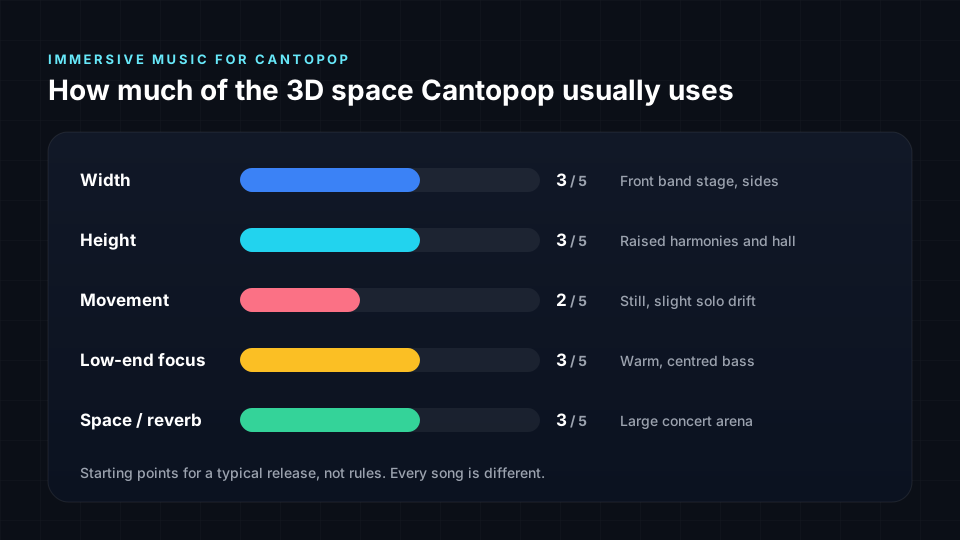
Width scores 3 because Cantopop is built on a front band stage, with strings and synths reaching the sides but not wrapping fully around. Height is 3: backing vocals, string pads and the arena reverb rise a little above the listener, while the voice and band stay at ear level. Movement is 2, since the players hold their places and only a sax or guitar solo or a short effect drifts gently. Low-end focus is 3, a warm, centred bass that supports ballads and band songs without dominating them. Space is 3, a large concert room that gives the music its live glow while the voice stays dry and present.
Tips for an immersive Cantopop mix
- Protect the lyric. Keep the lead vocal at the front centre and fairly dry, so every tone of the Cantonese words stays clear.
- Build a tidy front stage. Set piano and guitar a moderate distance either side of the voice, with drums and bass on the centre line.
- Lift the hook, not the verse. Keep the verse close and let strings, synths and backing vocals rise and spread when the chorus arrives.
- Let solos drift a little. A sax or guitar solo can sit behind to one side with a small, slow movement, then settle back.
- Use a big but controlled room. An arena reverb suits Cantopop, but keep it behind and slightly raised, with a short low end so the bass stays tight.
Cantopop styles: Hong Kong ballads, 1980s Cantopop and Canto-rock
The core placement holds for every style here: the singer close and centred, the low end steady, the band in front and the room around. What changes is the size of the arrangement, the amount of guitar and synth and how big the room should feel.
Hong Kong Ballads
The slow love song has been central to Cantopop since its start. Many classic ballads began as television or film themes, and singers such as Danny Chan, Leslie Cheung, Jacky Cheung and later Eason Chan made the form their own. The lyricists Lin Xi and Albert Leung wrote some of the best-known ballad lyrics, fitting poetic Cantonese to each melody note by note. A ballad often opens with piano and voice, adds a soft band in the second verse and builds to a full chorus with strings and backing vocals. Keep the voice close and dry at the front centre, the piano front left and the strings narrow at first. Let the strings spread and the harmonies rise behind in the final chorus, so the song grows around the listener while the singer stays in place.
1980s Cantopop
The 1980s are remembered as the golden age of Cantopop. Leslie Cheung, Anita Mui and Alan Tam were the biggest stars, and their concert seasons at the Hong Kong Coliseum became major events. Many hits were Cantonese versions of Japanese songs, such as Leslie Cheung's Monica, adapted from a song by Koji Kikkawa. The sound used synthesizers, drum machines, slap bass, bright electric guitars and saxophone solos, often with large, bright reverb. Keep the voice and drum machine in the centre, place the synth pads to one side and the strings or brass to the other, and set the sax solo behind right with a small drift. A big, bright room fits the era, but trim the reverb on the voice so the lyric stays clear.
Canto-Rock
Canto-rock grew from the Hong Kong band boom of the mid-1980s. Beyond, formed in 1983 and led by the singer and songwriter Wong Ka Kui, wrote songs such as Glorious Years, a 1990 tribute to Nelson Mandela, and Boundless Oceans, Vast Skies, released in 1993, the year Wong died after an accident in Tokyo. Tat Ming Pair mixed new wave synths with Cantonese lyrics, and Tai Chi brought a harder rock edge. Place two guitars left and right on the front stage, with the bass and kick firm in the centre and the voice just in front of them. Keep the drum kit fairly narrow, put any keyboard or synth slightly behind to one side and use a live room or arena reverb that gives the band energy without washing out the words.
Related traditions such as Mandopop and Japanese city pop share much of this layout: a close lead voice, a tidy band and a polished room, with the lyric always at the front.
How to make immersive Cantopop from stereo
Spatial9 can create spatial audio from a stereo track in a few steps:
- Upload your stereo master or your stems.
- Spatial9's AI separates and places each part, pulling the lead vocal, backing vocals, piano, guitars, strings, synths and drums apart even from older 1980s masters, keeping the singer close and centred and the band on a clear front stage.
- Preview it in binaural on headphones.
- Export Eclipsa Audio, ADM, binaural or Ambisonics.
- Publish a video. Create a YouTube-ready video with your immersive audio and publish it directly.
For related guides, read spatial audio for Mandopop and spatial audio for J-pop. Every guide is listed in spatial audio and immersive music by genre.
Frequently asked questions
Does this guide cover Hong Kong Ballads, 1980s Cantopop and Canto-Rock?
Yes. Hong Kong ballads keep a close voice with piano and strings that widen in the final chorus. 1980s Cantopop adds synths, drum machines and sax solos inside a bright, big room. Canto-rock places two guitars on a front stage around a firm centre of bass, kick and voice.
Can I make a Cantopop mix in Dolby Atmos or Eclipsa Audio?
Yes. The placements in this guide work for both. Spatial9 exports ADM, the standard file used by Dolby Atmos studios, as well as Eclipsa Audio for YouTube, so one immersive Cantopop mix covers both. If you plan to release the Atmos version on Apple Music, build it from your original stems or multitracks, because Apple does not accept Atmos made from a finished stereo master. See where to publish spatial audio. You may also hear this called a 3D Cantopop mix or Cantopop in spatial audio.
Is spatial audio good for Cantopop?
Yes. Cantopop puts the voice and its tonal lyric first, framed by a full band and a big concert sound. Spatial audio keeps the singer close and clear while the band and the arena open around the listener.
Why does the vocal need to stay so dry?
In Cantonese the tone of each word carries its meaning, and heavy reverb on the direct voice smears those pitch contours. Keep the voice close and send the reverb behind and above, so the song sounds big while the lyric stays sharp.
How wide should the band be?
Keep it moderate. A front stage with piano and guitar either side of the voice, and strings and synths a little further out, gives a live feel without pulling attention away from the singer.
How is Cantopop different from Mandopop in spatial audio?
Both centre on a close lead voice. Cantopop leans on a classic Hong Kong band stage and a big arena room, with a slightly narrower front. Mandopop often uses wider, lusher arrangements and, in zhongguo feng, Chinese instruments placed around the listener.
Can I convert an old Cantopop recording to spatial audio?
Yes. Spatial9 uses AI to separate the voice, band, strings and synths from a stereo recording, including 1970s and 1980s masters. Separation is never perfect with older tapes, so keep the layout simple and the room moderate.
Dolby and Dolby Atmos are trademarks of Dolby Laboratories. Spatial9 is not affiliated with or endorsed by Dolby Laboratories.
Sources
- Blauert, J. (1997). Spatial Hearing: The Psychophysics of Human Sound Localization, revised edition. MIT Press. Low-frequency, elevation, distance and motion cues.
- Mills, A. W. (1958). On the minimum audible angle. Journal of the Acoustical Society of America, 30(4), 237-246.
- Hebrank, J. and Wright, D. (1974). Spectral cues used in the localization of sound sources on the median plane. Journal of the Acoustical Society of America, 56(6), 1829-1834.
- Bronkhorst, A. W. (2000). The cocktail party phenomenon: a review of research on speech intelligibility in multiple-talker conditions. Acta Acustica united with Acustica, 86, 117-128.
- Barron, M. and Marshall, A. H. (1981). Spatial impression due to early lateral reflections in concert halls. Journal of Sound and Vibration, 77(2), 211-232.
- Neuhoff, J. G. (1998). Perceptual bias for rising tones. Nature, 395, 123-124.
- Bregman, A. S. (1990). Auditory Scene Analysis: The Perceptual Organization of Sound. MIT Press.
- Chu, Y. W. (2017). Hong Kong Cantopop: A Concise History. Hong Kong University Press.
Light up the Coliseum
Upload a track to Spatial9 and hear the singer up close with the band and the arena opening around you in minutes. Then export it or publish it straight to YouTube.