Spatial Audio & Immersive Music for Gnawa: Lila Ceremony, Gnawa Fusion & Gnawa Jazz
Spatial9 Team · · 11 min read
Part of the series Spatial audio and immersive music by genre.
Key takeaways
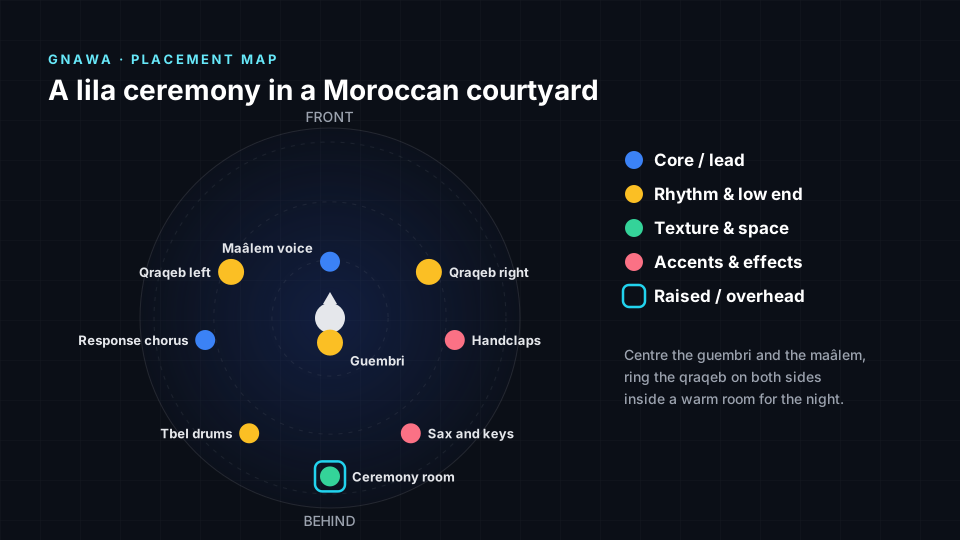
- In a spatial Gnawa mix the guembri and the maâlem's voice sit at the centre, with the iron qraqeb ringing on both sides, the answering chorus around the listener and the warm room of a night ceremony behind.
- Because the brain sorts sounds into separate streams by pitch and direction, the deep guembri, the metallic qraqeb and the chorus stay clear when they come from different places, even when they play without pause for hours.
- Gnawa is trance music that builds slowly, so the motion should come from tempo and intensity rising together rather than from sounds flying around the room.
- The Gnawa music immersion profile scores width 4, height 3, movement 2, low-end focus 4 and space 4 out of 5.
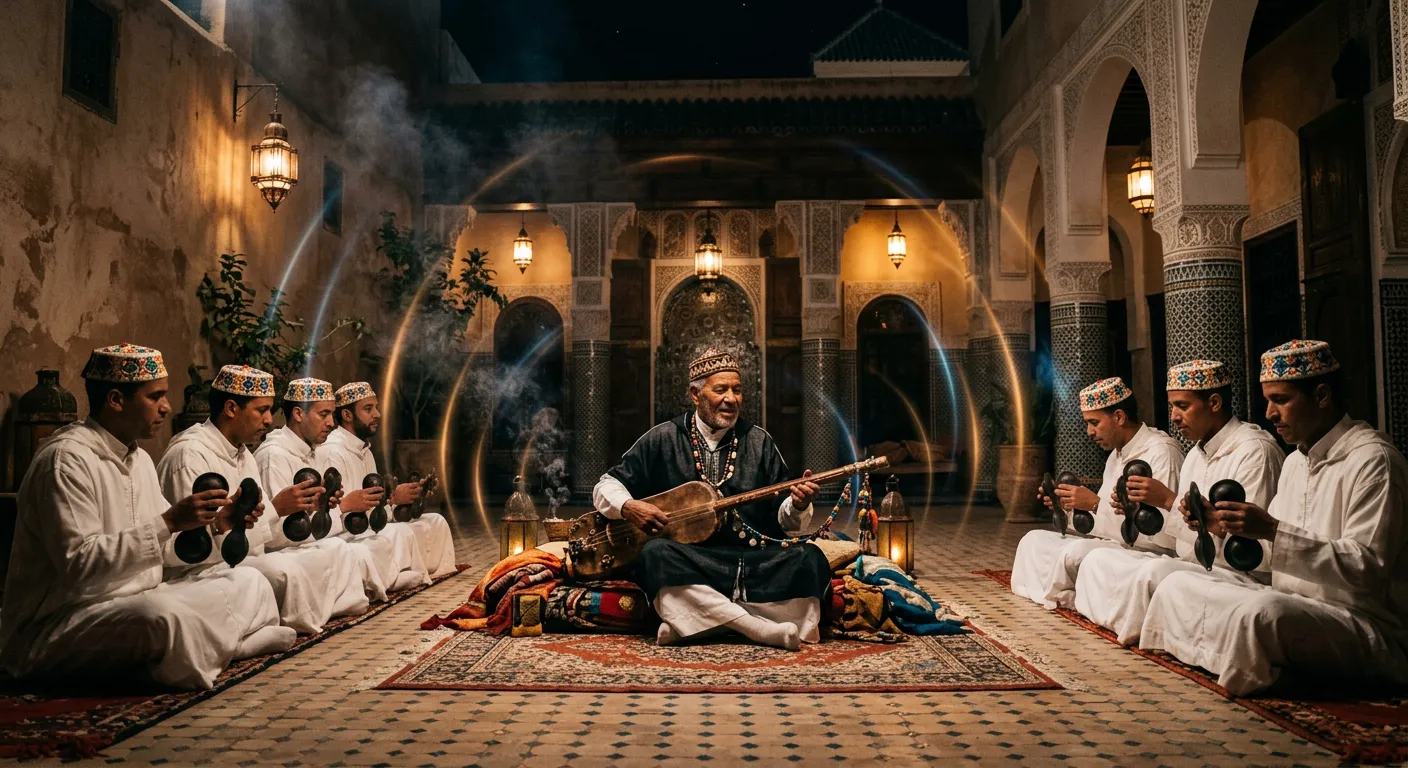
Gnawa is the spiritual music of the Gnawa brotherhoods of Morocco, with close relatives in the diwan of Algeria. Its roots lie with people from sub-Saharan West Africa who were brought north across the Sahara over many centuries, many of them enslaved, and who blended their own traditions with Sufi Islam. The music grew up in cities such as Marrakech, Essaouira, Fez and Tangier. Its heart is the guembri, also called the sintir or hajhouj, a three-stringed lute with a long neck and a body covered in camel skin, played by a master musician known as the maâlem. Around him, musicians clash the qraqeb, pairs of heavy iron castanets, and sing a chorus that answers his calls. Large tbel drums lead the opening procession. The central ritual is the lila, a night-long ceremony of healing and trance in which each family of spirits, the mlouk, is called with its own songs, colours and incense. From the late 1960s visiting jazz musicians began to seek it out, and in the 1970s groups such as Nass El Ghiwane brought Gnawa sounds into popular music. The Gnaoua and World Music Festival in Essaouira began in 1998, and in 2019 UNESCO added Gnawa to its list of intangible cultural heritage. Gnawa suits spatial audio because the music is played in a circle and the room is part of the ritual. This guide covers how spatial audio for Gnawa music works, where to place each element and how to make an immersive Gnawa mix. For the basics, see what spatial audio is.
Why Gnawa music works in spatial audio
Gnawa is built on a few strong layers that repeat for a long time. The guembri plays deep, looping bass phrases with a buzzing, percussive attack. The qraqeb lock into a fast, clattering triplet pulse. The maâlem sings a line and the chorus answers. Over many minutes the tempo rises, the qraqeb get louder and the dancers move toward trance. In stereo the guembri and the iron castanets fight for the same space, and the metal can bury the bass. In an immersive mix the guembri holds the centre, the qraqeb surround it from both sides and the room gives the long build somewhere to grow.
The rule: the guembri in the middle, the iron all around it. Anchor the bass lute and the voice at the centre, spread the qraqeb players in a wide arc and set the circle inside a warm room where the night can unfold.
Immersive music for Gnawa music: what listeners hear
- A bass voice in the middle of the circle. The guembri sits close and centred, so its deep, buzzing phrases feel like they come from the floor beneath you.
- Iron on both sides. The qraqeb clatter from left and right, wrapping the listener in a bright, steady pulse without masking the guembri.
- Call and answer around you. The maâlem sings from the front and the chorus answers from the sides, so every phrase becomes a conversation in the room.
- A slow climb toward trance. As the tempo and volume rise, the whole circle seems to lean in, with no need for sounds to move around the space.
Where to place each element in a Gnawa music mix
| Element | Position | Height | Why it works |
|---|---|---|---|
| Maâlem voice | Front centre | Ear level | The master's call that leads each song |
| Guembri | Centre | Low | Deep bass phrases that anchor the trance |
| Qraqeb left | Front left | Ear level | One side of the iron castanet pulse |
| Qraqeb right | Front right | Ear level | The other side of the castanet pulse |
| Response chorus | Left | Ear level | Voices answering the maâlem's call |
| Handclaps | Right | Ear level | Accents that lift the groove |
| Tbel drums | Behind left | Ear level | The opening procession and big accents |
| Sax and keys | Behind right | Ear level | Colour in Gnawa jazz and fusion |
| Ceremony room | Behind | Raised | A warm courtyard around the circle |
The psychoacoustics behind Gnawa music placement
Every position in the table above follows how the ear and brain locate sound. Here is the reason behind the main choices for Gnawa.
- Guembri stays centred. The ear finds almost no direction in frequencies below roughly 80 to 100 Hz, so the deepest part of the guembri gains nothing from being spread. Keeping it centred holds the trance steady (Blauert).
- Qraqeb and guembri in different places. The brain groups sounds into streams by pitch, timing and direction. This is auditory stream segregation (Bregman). Setting the bright iron apart from the low lute lets the ear follow both for hours without fatigue.
- A build that seems to approach. Listeners hear sounds that grow louder as moving closer, and they overestimate how near a rising sound has come. This is the looming effect for rising intensity (Neuhoff). The long crescendo of a Gnawa song already carries this sense of motion, so it needs no panning.
- A room with side reflections. Early reflections arriving from the sides make a sound feel wider and more enveloping. This is spatial impression from early lateral reflections (Barron and Marshall). Clear side reflections make the circle feel like a real courtyard while keeping the qraqeb crisp.
The immersion profile for Gnawa music
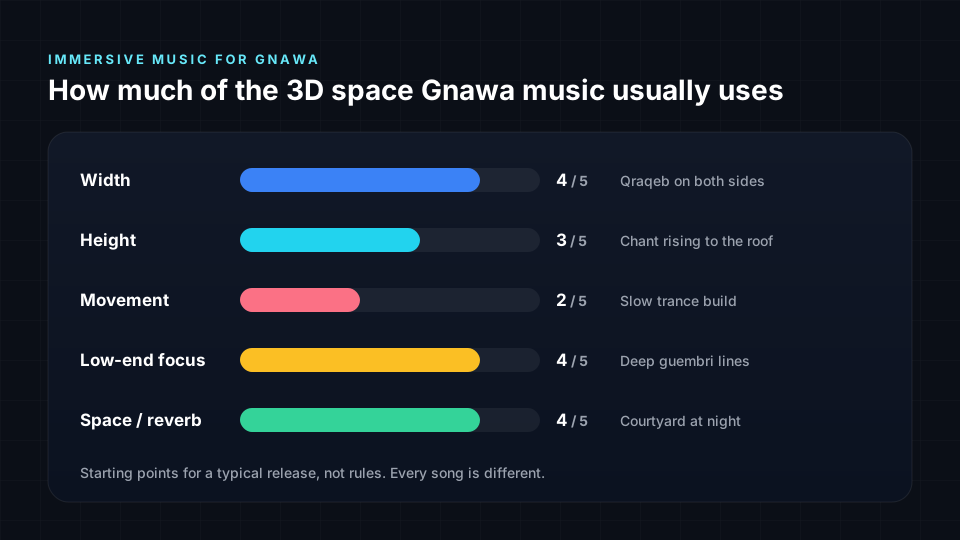
Width scores 4 because the qraqeb players and chorus form a wide circle around the maâlem. Low-end focus also scores 4: the guembri is a true bass instrument, and its deep plucked lines carry the whole ceremony. Space is 4, since the lila takes place in a room or courtyard full of people, and that room shapes the sound. Height is 3, from chanting voices and ringing iron rising into the roof of the space. Movement is 2, because the motion comes from a slow, steady build in tempo and intensity rather than from sounds travelling around the listener.
Tips for an immersive Gnawa music mix
- Anchor the guembri. Keep it centred and close, with its buzz and percussive slaps clear, so the trance always has a floor.
- Split the qraqeb. Place the castanet players on both front sides so the iron pulse surrounds the guembri instead of covering it.
- Let the chorus answer. Put the response voices to the sides, a little further back than the maâlem, so call and answer are easy to follow.
- Let the build do the moving. Keep the players in place and let the rising tempo and volume carry the listener toward trance.
- Use a warm, lived-in room. A moderate courtyard reverb suits Gnawa, but keep the low end of the reverb short so the guembri stays tight.
Gnawa music styles: Lila ceremony, Gnawa fusion and Gnawa jazz
The core placement holds for every style here: the guembri and voice at the centre, the rhythm spread around them. What changes is the size of the group, the amount of electric and electronic sound and how much room the style needs.
Lila Ceremony
The lila, sometimes called the derdeba, is the traditional night ceremony of the Gnawa. It usually opens with a procession led by tbel drums and qraqeb, then moves into the sung sections played on the guembri, with each group of spirits called by its own repertoire, colour and incense. Dancers may enter trance as the music grows faster and louder, and the ceremony can last until dawn. Seat the guembri and maâlem in the centre, the qraqeb in an arc on both front sides and the chorus to the sides, with the tbel behind for the procession. A warm, natural courtyard room suits the style.
Gnawa Fusion
Gnawa fusion blends the guembri and qraqeb with rock, reggae, funk and electronic music. In the 1970s Moroccan groups such as Nass El Ghiwane drew on Gnawa rhythms, and later bands such as Gnawa Diffusion, formed in France by musicians of Algerian origin, mixed it with reggae and rock. Keep the guembri and lead voice in the centre, with the bass guitar, if there is one, sitting right underneath the guembri rather than competing with it. Electric guitars and keys can sit to the sides, qraqeb front left and front right, and effects or electronic loops behind.
Gnawa Jazz
Gnawa jazz grew from meetings between Gnawa masters and jazz musicians. The pianist Randy Weston lived in Tangier in the late 1960s and worked with Gnawa musicians for decades, and the saxophonist Pharoah Sanders recorded The Trance of Seven Colors with Maâlem Mahmoud Guinia in 1994. Later projects, such as those of the guembri player Majid Bekkas, continued the meeting. Keep the guembri and the maâlem's voice centred and the qraqeb on the front sides, with the saxophone or piano behind right or to the side so it can answer the chorus. A concert hall with clear reflections suits the music.
Related traditions such as the Algerian diwan and the trance music of other North African brotherhoods follow the same idea: keep the lead voice and lute in the centre, the rhythm in a circle around them and the room around the listener.
How to make immersive Gnawa music from stereo
Spatial9 can create spatial audio from a stereo track in a few steps:
- Upload your stereo master or your stems.
- Spatial9's AI separates and places each part, pulling the guembri, qraqeb, chorus and lead voice apart even from field recordings of a ceremony, and setting the castanets around a centred guembri.
- Preview it in binaural on headphones.
- Export Eclipsa Audio, ADM, binaural or Ambisonics.
- Publish a video. Create a YouTube-ready video with your immersive audio and publish it directly.
For related guides, read spatial audio for desert blues and spatial audio for ethio-jazz. Every guide is listed in spatial audio and immersive music by genre.
Frequently asked questions
Does this guide cover Lila Ceremony, Gnawa Fusion and Gnawa Jazz?
Yes. The lila ceremony seats the guembri and maâlem in the centre with qraqeb in an arc and a warm courtyard around them. Gnawa fusion adds bass, guitars and loops around a centred guembri. Gnawa jazz brings in saxophone or piano behind and to the side, inside a concert hall.
Can I make a Gnawa music mix in Dolby Atmos or Eclipsa Audio?
Yes. The placements in this guide work for both. Spatial9 exports ADM, the standard file used by Dolby Atmos studios, as well as Eclipsa Audio for YouTube, so one immersive Gnawa mix covers both. If you plan to release the Atmos version on Apple Music, build it from your original stems or multitracks, because Apple does not accept Atmos made from a finished stereo master. See where to publish spatial audio. You may also hear this called a 3D Gnawa mix or Gnawa in spatial audio.
Is spatial audio good for Gnawa music?
Yes. Gnawa is played in a circle, with a deep lute, iron castanets and voices that answer each other over a long build. Spatial audio lets each layer keep its own place and puts the listener inside the circle rather than in front of it.
Where should the guembri go in an immersive Gnawa mix?
Put the guembri in the centre, close to the listener and low. Its deepest notes carry little direction, and the trance depends on its pulse feeling steady and solid.
How loud should the qraqeb be?
The qraqeb are loud in a real ceremony, but in a mix they can mask the guembri. Splitting them to both sides and taming their harshest high frequencies keeps them driving without tiring the ear.
How is Gnawa music different from desert blues in spatial audio?
Gnawa centres on the bass guembri, iron castanets and a chorus in a ritual room, so it suits a circular layout with a solid low centre. Desert blues is built around electric guitars, bass and hand drums on a band stage, so it suits a wider front layout with guitars on both sides.
Can I convert an old Gnawa field recording to spatial audio?
Yes. Spatial9 uses AI to separate the guembri, qraqeb and voices from a stereo or mono recording. Separation is never perfect with crowded ceremony recordings, so keep the layout simple and the room moderate.
Dolby and Dolby Atmos are trademarks of Dolby Laboratories. Spatial9 is not affiliated with or endorsed by Dolby Laboratories.
Sources
- Blauert, J. (1997). Spatial Hearing: The Psychophysics of Human Sound Localization, revised edition. MIT Press. Low-frequency, elevation, distance and motion cues.
- Mills, A. W. (1958). On the minimum audible angle. Journal of the Acoustical Society of America, 30(4), 237-246.
- Hebrank, J. and Wright, D. (1974). Spectral cues used in the localization of sound sources on the median plane. Journal of the Acoustical Society of America, 56(6), 1829-1834.
- Bronkhorst, A. W. (2000). The cocktail party phenomenon: a review of research on speech intelligibility in multiple-talker conditions. Acta Acustica united with Acustica, 86, 117-128.
- Barron, M. and Marshall, A. H. (1981). Spatial impression due to early lateral reflections in concert halls. Journal of Sound and Vibration, 77(2), 211-232.
- Neuhoff, J. G. (1998). Perceptual bias for rising tones. Nature, 395, 123-124.
- Bregman, A. S. (1990). Auditory Scene Analysis: The Perceptual Organization of Sound. MIT Press.
- Kapchan, D. (2007). Traveling Spirit Masters: Moroccan Gnawa Trance and Music in the Global Marketplace. Wesleyan University Press.
Join the circle
Upload a track to Spatial9 and hear the guembri at the centre with the qraqeb ringing around you in minutes. Then export it or publish it straight to YouTube.