
Spatial Audio & Immersive Music for Raï: Cheb Raï, Pop-Raï & Raï'n'B
Spatial9 Team · · 11 min read
Part of the series Spatial audio and immersive music by genre.
Key takeaways
- In a spatial raï mix the singer sits front centre, with the synth lead front left and the trumpet and saxophone front right, the bass and kick holding the centre and a lively wedding hall around them.
- Because the brain sorts sounds into separate streams by pitch, timing and direction, the synth, brass and voice stay clear when they come from different places, even when they all ornament the same melody.
- Raï is party and dance music with a strong vocal echo, so the space should feel like a busy hall, with the delay on the voice used as the main source of movement.
- The raï immersion profile scores width 4, height 2, movement 2, low-end focus 3 and space 3 out of 5.
Raï comes from Oran and the surrounding region of western Algeria. Its roots lie in the songs of rural and Bedouin singers, the cheikhs and cheikhas, who sang in everyday Algerian Arabic at weddings, festivals and in the cafés and cabarets of Oran in the first half of the twentieth century. The word raï means opinion or point of view, and the singers used it as a cry in their songs. The old style was carried by the gasba, a long reed flute, and the guellal, a deep drum, and Cheikha Rimitti became its best known voice from the 1940s and 1950s. From the 1960s musicians such as the trumpeter Bellemou Messaoud brought in brass, accordion and violin. In the late 1970s and 1980s a new generation of young singers, called cheb and chaba, added synthesizers, drum machines, electric guitar and bass, and the music spread on cheap cassettes. Cheb Khaled, Cheb Mami, Chaba Fadela and Cheb Hasni became stars, and a raï festival was held in Oran in 1985. The 1990s were hard years: during the Algerian civil war Cheb Hasni was killed in Oran in 1994, and many artists moved to France, where raï found a large audience. Raï suits spatial audio because it is built on one soaring voice and a band of answering melody instruments. This guide covers how spatial audio for raï works, where to place each element and how to make an immersive raï mix. For the basics, see what spatial audio is.
Why raï works in spatial audio
Raï is built around the voice. The singer leads with long, ornamented phrases, often bending notes and calling out to the crowd. Around that voice, the synthesizer, trumpet, saxophone and accordion play the same melody or answer it with short, decorated lines. The bass and drum machine keep a rolling, swaying dance groove, and the darbuka adds quick fills. In stereo these melody instruments pile up on top of the voice and blur the ornaments. In an immersive mix the singer holds the front, the melody instruments spread out to each side and the hall gives the vocal echo room to ring.
The rule: the voice in front, the melody instruments answering from the sides. Keep the singer clear and central, spread the synth and brass across a wide front stage and set the band inside a lively hall where people dance.
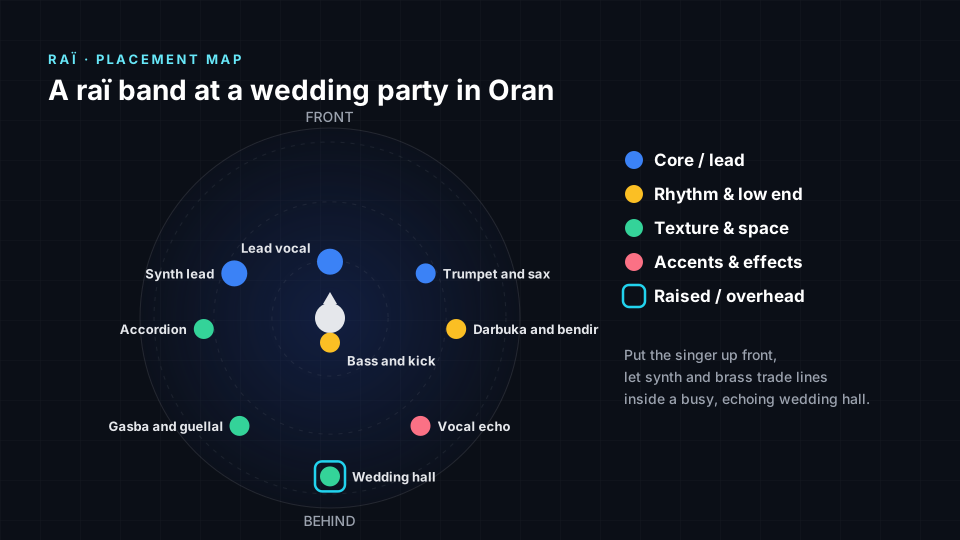
Immersive music for raï: what listeners hear
- A voice that reaches out to you. The singer sits just in front, close and clear, so every bend and ornament in the melody comes through.
- Melodies trading across the stage. The synth answers from the left and the trumpet or saxophone from the right, so the hooks become a conversation.
- A groove you can dance to. The bass and kick hold a steady centre, with the darbuka and bendir adding quick fills from the side.
- A party around you. A lively hall and a ringing vocal echo put you in a wedding or a club, not in front of two speakers.
Where to place each element in a raï mix
| Element | Position | Height | Why it works |
|---|---|---|---|
| Lead vocal | Front centre | Ear level | The singer who carries every song |
| Bass and kick | Centre | Low | The steady dance groove underneath |
| Synth lead | Front left | Ear level | Bent, ornamented hooks and fills |
| Trumpet and sax | Front right | Ear level | Brass answers to the vocal line |
| Accordion | Left | Ear level | Chords and melody doubling |
| Darbuka and bendir | Right | Ear level | Quick hand drum fills and accents |
| Gasba and guellal | Behind left | Ear level | The flute and drum of old raï |
| Vocal echo | Behind right | Ear level | The classic raï delay on the voice |
| Wedding hall | Behind | Raised | A busy room around the band |
The psychoacoustics behind raï placement
Every position in the table above follows how the ear and brain locate sound. Here is the reason behind the main choices for raï.
- Bass and kick stay centred. The ear finds almost no direction in frequencies below roughly 80 to 100 Hz, so the bass gains nothing from being spread and keeps the groove solid for dancers (Blauert).
- Synth and brass on opposite sides. The brain groups sounds into streams by pitch, timing and direction. This is auditory stream segregation (Bregman). Setting the synth and the trumpet apart lets the ear hear each ornament instead of one thick melody line.
- A voice that cuts through the party. Listeners can pick out one voice among many when it comes from a different direction. This is the cocktail party effect (Bronkhorst). Keeping the singer in front and the crowd and hall around them keeps every word clear.
- An echo that does not blur the voice. When a sound and its echo arrive close together, the ear locates the sound from the first arrival. This is the precedence effect (Litovsky and colleagues). Placing the delay behind the singer adds the classic raï echo without pulling the voice off centre.
The immersion profile for raï
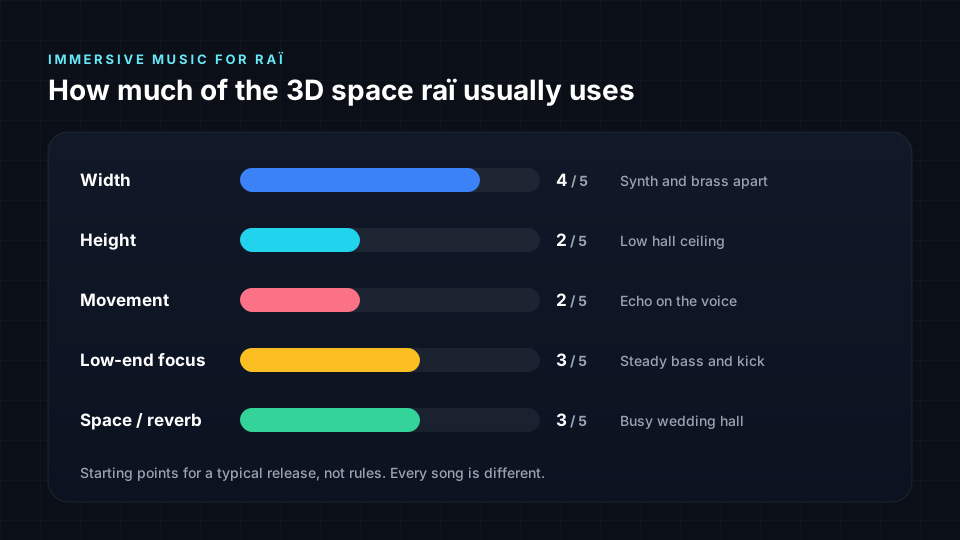
Width scores 4 because the synth, brass, accordion and darbuka spread across a wide stage around the singer. Low-end focus is 3, since the bass and drum machine carry a steady dance groove without the heavy sub bass of club music. Space is 3: raï lives in wedding halls, cafés and clubs, which are lively but not huge. Movement is 2, coming mostly from the echo on the voice and the trading of melodic lines rather than sounds flying around. Height is 2, from the reflection of a low hall ceiling.
Tips for an immersive raï mix
- Keep the voice in front. The singer is the heart of raï, so give the lead vocal the clearest position, just in front of the listener.
- Split the melody instruments. Put the synth on one front side and the trumpet or saxophone on the other, so their ornaments do not collide.
- Hold the groove in the middle. Keep the bass and kick centred and tight, so the dance beat stays steady under all the ornaments.
- Place the echo behind. Send the vocal delay to the rear, so it fills the room without smearing the words.
- Use a lively, mid-sized room. A hall reverb with clear early reflections suits raï, but keep the tail moderate so the darbuka fills stay crisp.
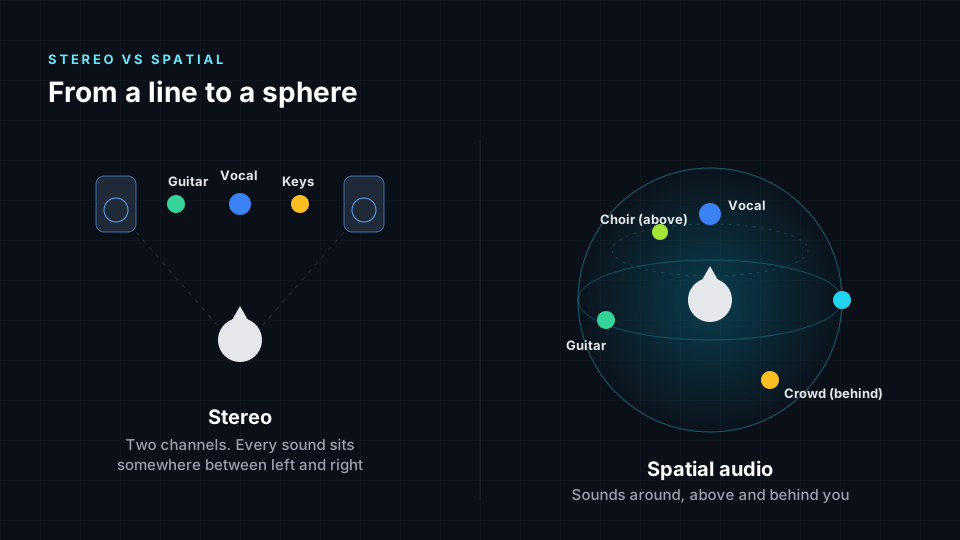
Raï styles: Cheb raï, pop-raï and raï'n'B
The core placement holds for every style here: the voice at the front, the groove anchored in the middle. What changes is the mix of acoustic and electronic instruments, the size of the production and how much room the style needs.
Cheb Raï
Cheb raï is the sound of the young singers of Oran in the late 1970s and 1980s, who took the old songs of the cheikhs and played them with synthesizers, drum machines, electric guitar and bass. Records were made quickly and sold on cassettes, and studios in Oran and Tlemcen, such as that of the producer Rachid Baba Ahmed, shaped the sound. Love, drink and freedom were common themes. Seat the singer front centre, the synth front left, any trumpet or accordion front right and the bass and drum machine in the middle, with a strong echo on the voice behind. A lively club or wedding hall suits the style.
Pop-Raï
Pop-raï is the bigger, international sound that grew in the late 1980s and 1990s, when raï singers worked with pop producers in France and beyond. Khaled's Didi in 1992 and Aïcha in 1996 became hits across Europe, and Cheb Mami sang on Sting's Desert Rose in 1999. The productions added live drums, string sections, guitars and polished keyboards. This style can take a wider layout: keep the voice in front and the bass and kick in the centre, then spread strings and pads around the sides and slightly raised, with the synth and brass hooks on the front sides.
Raï'n'B
Raï'n'B blends raï vocals and melodies with French R&B and hip hop beats. The name became widely known through the 2004 French compilation Raï'n'B Fever, produced by Kore and Skalp, which paired raï singers with rappers and R&B vocalists. Place the raï singer and any guest rapper or R&B vocalist close to the front, on slightly different angles, with the 808 bass and kick centred and tight. Synth hooks, strings and vocal echoes can move around the sides and back, and a tighter club room suits the music.
Related styles such as the older wahrani song of Oran and the Moroccan raï of Oujda follow the same idea: keep the voice at the front, the groove anchored in the middle and the hall around the listener.
How to make immersive raï from stereo
Spatial9 can create spatial audio from a stereo track in a few steps:
- Upload your stereo master or your stems.
- Spatial9's AI separates and places each part, pulling the voice, synth, brass, darbuka and bass apart even from old cassette recordings, and setting the melody instruments across a wide stage with the groove in the centre.
- Preview it in binaural on headphones.
- Export Eclipsa Audio, ADM, binaural or Ambisonics.
- Publish a video. Create a YouTube-ready video with your immersive audio and publish it directly.
For related guides, read spatial audio for Arabic pop and spatial audio for Gnawa music. Every guide is listed in spatial audio and immersive music by genre.
Frequently asked questions
Does this guide cover Cheb Raï, Pop-Raï and Raï'n'B?
Yes. Cheb raï seats the singer, synth, brass and drum machine across a lively club or wedding hall. Pop-raï uses a wider layout with strings and pads around the sides. Raï'n'B keeps the voices close at the front and the bass tight in the centre, with hooks and echoes moving around the listener.
Can I make a raï mix in Dolby Atmos or Eclipsa Audio?
Yes. The placements in this guide work for both. Spatial9 exports ADM, the standard file used by Dolby Atmos studios, as well as Eclipsa Audio for YouTube, so one immersive raï mix covers both. If you plan to release the Atmos version on Apple Music, build it from your original stems or multitracks, because Apple does not accept Atmos made from a finished stereo master. See where to publish spatial audio. You may also hear this called a 3D raï mix or raï in spatial audio.
Is spatial audio good for raï?
Yes. Raï is built on one strong voice and several melody instruments that answer it over a dance groove. Spatial audio gives each instrument its own place, so the ornaments stay clear and the voice stays in front.
Where should the synthesizer go in an immersive raï mix?
Put the synth lead front left at ear level, opposite the trumpet or saxophone. If the song has no brass, the synth can move a little closer to the centre, just to one side of the voice.
How much echo should the voice have?
A clear echo on the voice is part of the raï sound. Keep the dry voice in front and send the delay behind and to the side, so it adds space and movement without making the words harder to follow.
How is raï different from Arabic pop in spatial audio?
Raï comes from the dance halls of western Algeria, with a rougher voice, a strong echo and synth and brass trading lines, so it suits a lively, mid-sized room. Arabic pop often uses larger string sections and polished studio production, so it suits a wider, more orchestral layout.
Can I convert a 1980s raï cassette to spatial audio?
Yes. Spatial9 uses AI to separate the voice, synth, brass, darbuka and bass from a stereo or mono master. Separation is never perfect with worn cassette recordings, so keep the layout simple and the room moderate.
Dolby and Dolby Atmos are trademarks of Dolby Laboratories. Spatial9 is not affiliated with or endorsed by Dolby Laboratories.
Sources
- Blauert, J. (1997). Spatial Hearing: The Psychophysics of Human Sound Localization, revised edition. MIT Press. Low-frequency, elevation, distance and motion cues.
- Mills, A. W. (1958). On the minimum audible angle. Journal of the Acoustical Society of America, 30(4), 237-246.
- Bronkhorst, A. W. (2000). The cocktail party phenomenon: a review of research on speech intelligibility in multiple-talker conditions. Acta Acustica united with Acustica, 86, 117-128.
- Litovsky, R. Y., Colburn, H. S., Yost, W. A. and Guzman, S. J. (1999). The precedence effect. Journal of the Acoustical Society of America, 106(4), 1633-1654.
- Barron, M. and Marshall, A. H. (1981). Spatial impression due to early lateral reflections in concert halls. Journal of Sound and Vibration, 77(2), 211-232.
- Bregman, A. S. (1990). Auditory Scene Analysis: The Perceptual Organization of Sound. MIT Press.
- Virolle, M. (1995). La chanson raï: de l'Algérie profonde à la scène internationale. Karthala.
- Langlois, T. (1996). The local and global in North African popular music. Popular Music, 15(3), 259-273.
Feel the party
Upload a track to Spatial9 and hear the voice, synth and trumpet fill a wedding hall around you in minutes. Then export it or publish it straight to YouTube.