
Spatial Audio & Immersive Music for Steelpan: Steel Band, Panorama & Pan Jazz
Spatial9 Team · · 11 min read
Part of the series Spatial audio and immersive music by genre.
Key takeaways
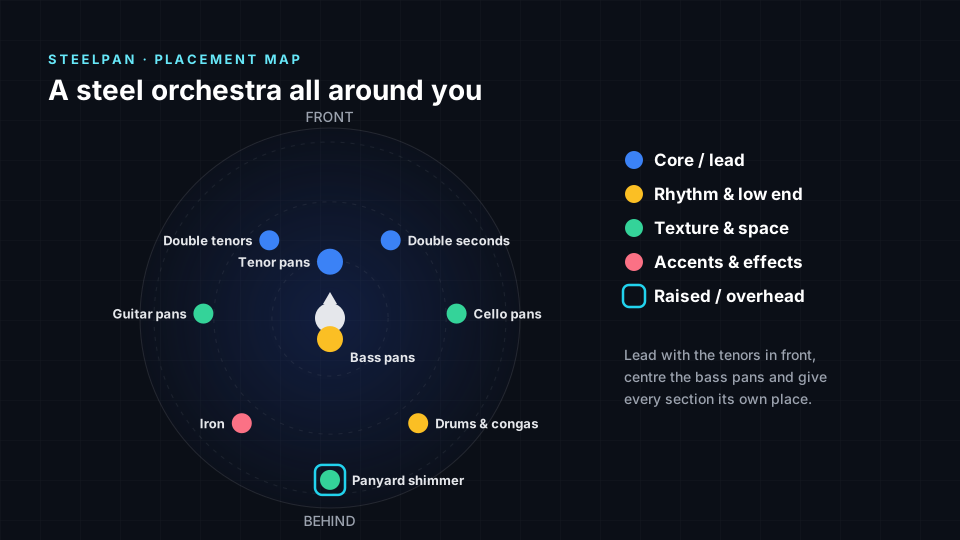
- In a spatial steelpan music mix the tenor pans lead from the front and the bass pans sit at the centre, while the double tenors, double seconds, guitar and cello pans form a wide arc and the engine room drives from behind.
- Because every section of a steel band shares almost the same timbre, direction becomes a key cue for telling them apart, an effect known as auditory stream segregation.
- Steelpan music grew up in the open-air panyards of Trinidad, so the space should be bright and open, with the ringing overtones lifted slightly above the band.
- The steelpan music immersion profile scores width 5, height 3, movement 2, low-end focus 3 and space 4 out of 5.
The steelpan is the national instrument of Trinidad and Tobago, a family of tuned steel drums invented in the twentieth century that grew into a full orchestra. It grew in the poor neighbourhoods of Port of Spain in the 1930s and 1940s, after colonial restrictions on drumming had pushed carnival bands toward bamboo stamping tubes and then toward anything metal: biscuit tins, paint cans, dustbins. Players found that hammering a metal surface into notes could make a melody. Pioneers such as Winston "Spree" Simon and Ellie Mannette shaped the first tuned pans, and after the Second World War the 55-gallon oil drums left by the oil industry became the standard. Anthony Williams of the Pan Am North Stars developed the circle of fourths and fifths note layout used on many tenor pans, and in 1951 the Trinidad All Steel Percussion Orchestra, TASPO, took the music to the Festival of Britain. A full steel band spreads from high tenor pans down to bass pans made from whole drums, with an engine room of percussion keeping time. It is an orchestra laid out in space, which is why it suits spatial audio. This guide covers how spatial audio for steelpan music works, where to place each element and how to make an immersive steelpan music mix. For the basics, see what spatial audio is.
Why steelpan music works in spatial audio
A steel band is an orchestra in which almost every instrument shares one sound: struck, tuned steel. The tenors play the melody, the double tenors and double seconds play harmony and counter-melodies, the guitar and cello pans strum chords, and the bass pans hold the low end. Because the timbre is so similar, in stereo the sections blur into one shimmering wash. In the panyard, though, each section stands in its own place, and the listener hears the music arrive from every side. An immersive mix can rebuild that layout, so each voice is clear and the ring of steel surrounds the listener.
The rule: melody in front, bass at the centre and every section in its own place around you. Keep the tenors leading from the front, set the middle pans in a wide arc, put the engine room behind and let the bright overtones rise a little above.
Immersive music for steelpan music: what listeners hear
- The melody straight ahead. The tenor pans sit in front, bright and clear, carrying the tune.
- Harmony all around. Double tenors, double seconds, guitar and cello pans each come from their own direction instead of one wash of steel.
- An engine room at your back. The iron, drums and congas drive the band from behind, as in a real panyard.
- A shimmer above. The ringing overtones of the pans bloom slightly overhead, like sound under a panyard roof on a warm night.
Where to place each element in a steelpan music mix
| Element | Position | Height | Why it works |
|---|---|---|---|
| Tenor pans | Front centre | Ear level | The lead melody of the steel band |
| Bass pans | Centre | Below ear level | Whole-drum basses that hold the low end |
| Double tenors | Front left | Ear level | Harmony and counter-melody just below the tenors |
| Double seconds | Front right | Ear level | Middle harmony and fast runs |
| Guitar pans | Left | Ear level | Strummed chords in the middle range |
| Cello pans | Right | Ear level | Lower chords and moving inner lines |
| Iron | Behind left | Ear level | The brake drum that drives the engine room |
| Drums & congas | Behind right | Ear level | Kit, congas and percussion keeping time |
| Panyard shimmer | Behind | Raised | Ringing overtones under the roof of the panyard |
The psychoacoustics behind steelpan music placement
Every position in the table above follows how the ear and brain locate sound. Here is the reason behind the main choices for steelpan music.
- Bass pans stay centred and low. The ear finds almost no direction in frequencies below roughly 80 to 100 Hz, so the deepest notes of the bass pans gain nothing from being spread. Their bright attack can sit slightly wider, but the weight belongs in the middle.
- Each section in its own direction. The brain groups sounds into streams by pitch, timing and direction. This is auditory stream segregation (Bregman). Every section of a steel band has almost the same timbre, so direction becomes one of the strongest cues for telling them apart.
- Overtones lifted above. The outer ear shapes the high frequencies of a sound differently depending on its height, and the brain reads these changes as elevation. These are spectral elevation cues (Hebrank and Wright). The bright, ringing overtones of the pans are easy to lift slightly above the band.
- A panyard with side reflections. Early reflections arriving from the sides make a sound feel wider and more enveloping. This is spatial impression from early lateral reflections (Barron and Marshall). Light reflections from the sides give a large band its size without blurring fast runs.
The immersion profile for steelpan music
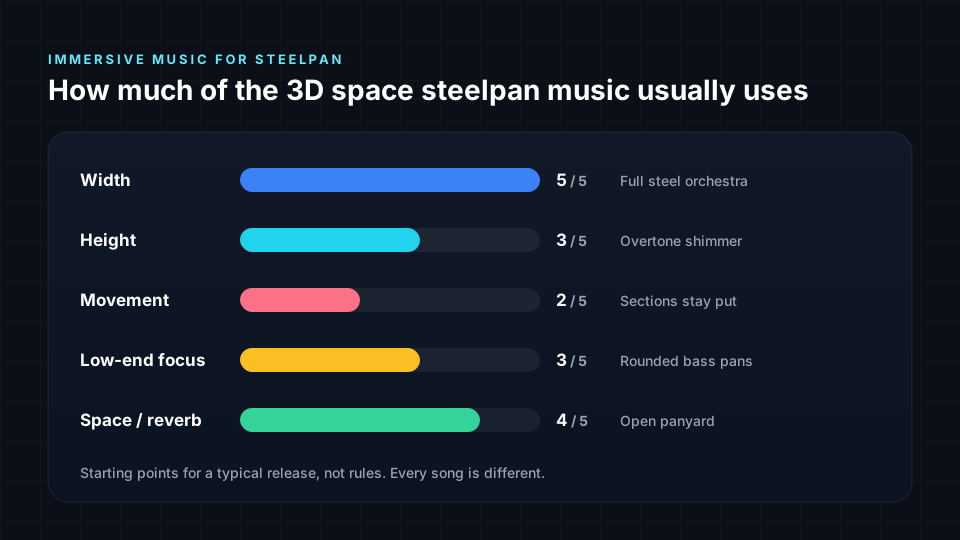
Width scores 5 because a large steel band surrounds the listener with sections on every side. Space is 4: the ringing pans need an open, lively space like a panyard or a stage at the Savannah. Height scores 3, from the shimmer of overtones rising above the band. Low-end focus is 3, a full but rounded bass from the pans rather than a heavy electronic low end. Movement is only 2, because the sections stay in their places and the motion is in the fast runs of the music itself.
Tips for an immersive steelpan music mix
- Lead with the tenors in front. The melody section should be the clearest voice in the mix.
- Give every section its own place. Spread the double tenors, double seconds, guitar and cello pans around the listener so their parts do not merge.
- Keep the bass pans centred. Hold the low weight in the middle, with only their attack spread slightly.
- Put the engine room behind. Iron, drums and congas behind the listener make the band feel like a real panyard.
- Let the shimmer rise. Use a bright, open reverb and lift the overtones slightly; avoid dark, long halls that cloud the steel.
Steelpan styles: steel band, panorama and pan jazz
The core placement holds for every style here: melody in front, bass at the centre and the sections around the listener. What changes is the size of the band, the speed of the arrangement and how much room the music needs.
Steel Band
The steel band, or steel orchestra, is the home of the steelpan, from small neighbourhood groups to large community bands with their own panyards. Bands play calypso and soca for carnival, and also classical pieces, film themes and pop songs arranged for steel. Bands such as Desperadoes, Renegades, Trinidad All Stars and Phase II Pan Groove have long histories in Port of Spain. Lay the band out by section in a wide arc, with the tenors in front, the bass pans at the centre and the engine room behind. A natural, open space suits it best.
Panorama
Panorama is the national steel band competition of Trinidad and Tobago, first held at carnival in 1963. Large bands of around a hundred players perform a long arrangement of a calypso or soca song, full of key changes, fast runs and dramatic builds, written by arrangers such as Jit Samaroo, Ray Holman and Len "Boogsie" Sharpe. It is the steel band at its biggest. Use the full width around the listener, keep each section clear in its own direction and let the builds grow toward the listener as the band reaches its climax.
Pan Jazz
Pan jazz brings the steelpan into small jazz groups, with one or two pans as the lead voice alongside piano, bass and drums. Players such as Othello Molineaux, Robert Greenidge, Len "Boogsie" Sharpe and the American Andy Narell developed the style from the 1970s. Treat the pan as a jazz soloist: place it in front and slightly to one side, with piano opposite, bass centred and drums behind. A smaller, warm room suits the more intimate sound.
Related styles such as single pan bands, pan round the neck and steelpan in soca and calypso recordings follow the same idea: lead with the melody in front, centre the bass and spread the rest around the listener.
How to make immersive steelpan music from stereo
Spatial9 can create spatial audio from a stereo track in a few steps:
- Upload your stereo master or your stems.
- Spatial9's AI separates and places each part, pulling the tenor pans, harmony pans, bass pans and engine room apart and setting each section of the steel band in its own place around the listener.
- Preview it in binaural on headphones.
- Export Eclipsa Audio, ADM, binaural or Ambisonics.
- Publish a video. Create a YouTube-ready video with your immersive audio and publish it directly.
For related guides, read spatial audio for soca and calypso and spatial audio for Latin jazz. Every guide is listed in spatial audio and immersive music by genre.
Frequently asked questions
Does this guide cover steel band, panorama and pan jazz?
Yes. Steel band music lays the orchestra out by section in a wide arc. Panorama uses the full width around the listener for large bands and dramatic builds. Pan jazz treats the pan as a soloist in a small jazz group with a warmer room.
Can I make a steelpan music mix in Dolby Atmos or Eclipsa Audio?
Yes. The placements in this guide work for both. Spatial9 exports ADM, the standard file used by Dolby Atmos studios, as well as Eclipsa Audio for YouTube, so one immersive steelpan music mix covers both. If you plan to release the Atmos version on Apple Music, build it from your original stems or multitracks, because Apple does not accept Atmos made from a finished stereo master. See where to publish spatial audio. You may also hear this called a 3D steelpan music mix or steelpan music in spatial audio.
Is spatial audio good for steelpan music?
Yes. A steel band is many sections with almost the same timbre, which blur together in stereo. Spatial audio gives each section its own direction, so the melody, harmony and bass all come through clearly.
Where should the tenor pans go in an immersive mix?
Put them in front and close to the centre at ear level. They carry the melody, so they should be the clearest and most direct sound in the mix.
Where should the engine room go?
Behind the listener, with the iron on one side and the drums and congas on the other. In a panyard the engine room often sits among or behind the pans, driving the band from the back.
How is steelpan music different from soca in spatial audio?
Soca puts a singer and a heavy kick and bass at the centre with the band around. A steel band is an acoustic orchestra with the melody played on pans, so it needs a wider layout by section, a lighter low end and a brighter, more open space.
Can I convert an old steel band recording to spatial audio?
Yes. Spatial9 uses AI to separate the high pans, middle pans, bass pans and percussion from a stereo master. Because the sections share one timbre, separation is never perfect, so keep the layout simple and the melody clear in front.
Dolby and Dolby Atmos are trademarks of Dolby Laboratories. Spatial9 is not affiliated with or endorsed by Dolby Laboratories.
Sources
- Blauert, J. (1997). Spatial Hearing: The Psychophysics of Human Sound Localization, revised edition. MIT Press. Low-frequency, elevation, distance and motion cues.
- Mills, A. W. (1958). On the minimum audible angle. Journal of the Acoustical Society of America, 30(4), 237-246.
- Hebrank, J. and Wright, D. (1974). Spectral cues used in the localization of sound sources on the median plane. Journal of the Acoustical Society of America, 56(6), 1829-1834.
- Bronkhorst, A. W. (2000). The cocktail party phenomenon: a review of research on speech intelligibility in multiple-talker conditions. Acta Acustica united with Acustica, 86, 117-128.
- Litovsky, R. Y., Colburn, H. S., Yost, W. A. and Guzman, S. J. (1999). The precedence effect. Journal of the Acoustical Society of America, 106(4), 1633-1654.
- Barron, M. and Marshall, A. H. (1981). Spatial impression due to early lateral reflections in concert halls. Journal of Sound and Vibration, 77(2), 211-232.
- Neuhoff, J. G. (1998). Perceptual bias for rising tones. Nature, 395, 123-124.
- Bregman, A. S. (1990). Auditory Scene Analysis: The Perceptual Organization of Sound. MIT Press.
- Dudley, S. (2008). Music from Behind the Bridge: Steelband Spirit and Politics in Trinidad and Tobago. Oxford University Press.
Step into the panyard
Upload a track to Spatial9 and hear the steel band ring out around you in minutes. Then export it or publish it straight to YouTube.