Spatial Audio & Immersive Music for Mahraganat: Electro-Shaabi, Egyptian Shaabi & Egyptian Rap
Spatial9 Team · · 11 min read
Part of the series Spatial audio and immersive music by genre.
Key takeaways
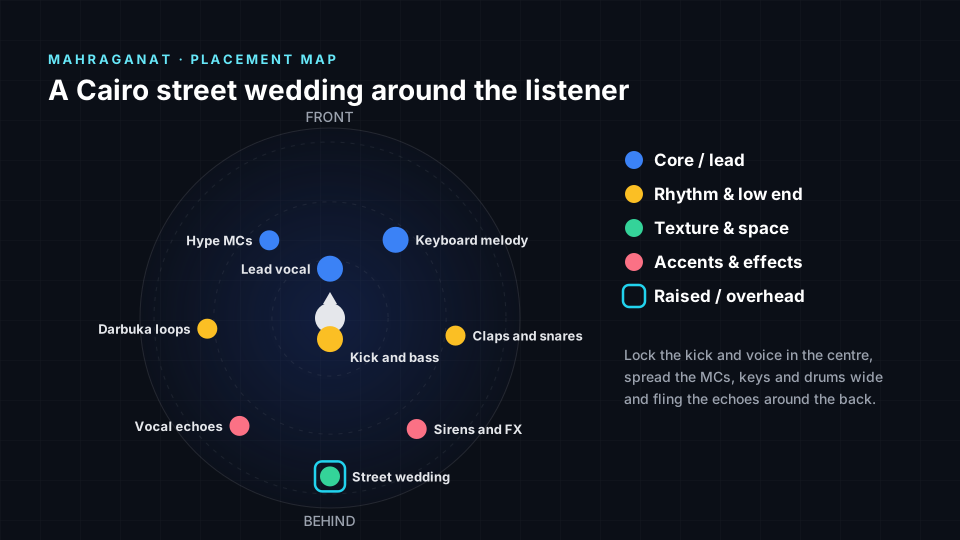
- In a spatial mahraganat mix the Auto-Tuned lead voice sits front centre with the kick and bass locked underneath, the hype MCs front left, the keyboard melody front right and the darbuka loops and claps spread to the sides.
- Because the ear finds almost no direction in deep bass, the heavy kick and sub of mahraganat belong in the centre, where they hit hardest and keep the dancers together.
- Mahraganat is loud street wedding music, so the space should be short and punchy, with vocal echoes, sirens and effects flying around the back rather than a large reverb.
- The mahraganat immersion profile scores width 4, height 2, movement 4, low-end focus 5 and space 2 out of 5.
Mahraganat is the electronic street music of Cairo. The name means festivals in Arabic, and the music grew up at weddings and street parties in the informal, working class neighbourhoods of the city, such as Salam City, Matariya and Ain Shams, from the mid 2000s. Young producers made it on home computers, often with cracked copies of FL Studio, a keyboard and a microphone, and leaned heavily on Auto-Tune. The songs spread on CDs, on phones passed from hand to hand, on YouTube and from the speakers of tuk tuks and microbuses. Its roots lie in Egyptian shaabi, the popular urban song that Ahmed Adaweyah made famous in the 1970s, but mahraganat swapped the accordion and violin for drum machines, sampled darbuka, synth keyboards and rapid fire vocals. Duos and crews such as Sadat and Alaa 50, Okka and Ortega and Islam Chipsy with his keyboard trio carried the sound beyond Cairo after the 2011 revolution. In 2020 Hassan Shakosh and Omar Kamal's Bint El Geran became one of the most streamed songs in the Arab world, and in the same year the Egyptian Musicians' Syndicate tried to stop mahraganat singers performing in licensed venues. Mahraganat suits spatial audio because it is built from many short, loud parts fighting for attention over a pounding beat. This guide covers how spatial audio for mahraganat works, where to place each element and how to make an immersive mahraganat mix. For the basics, see what spatial audio is.
Why mahraganat works in spatial audio
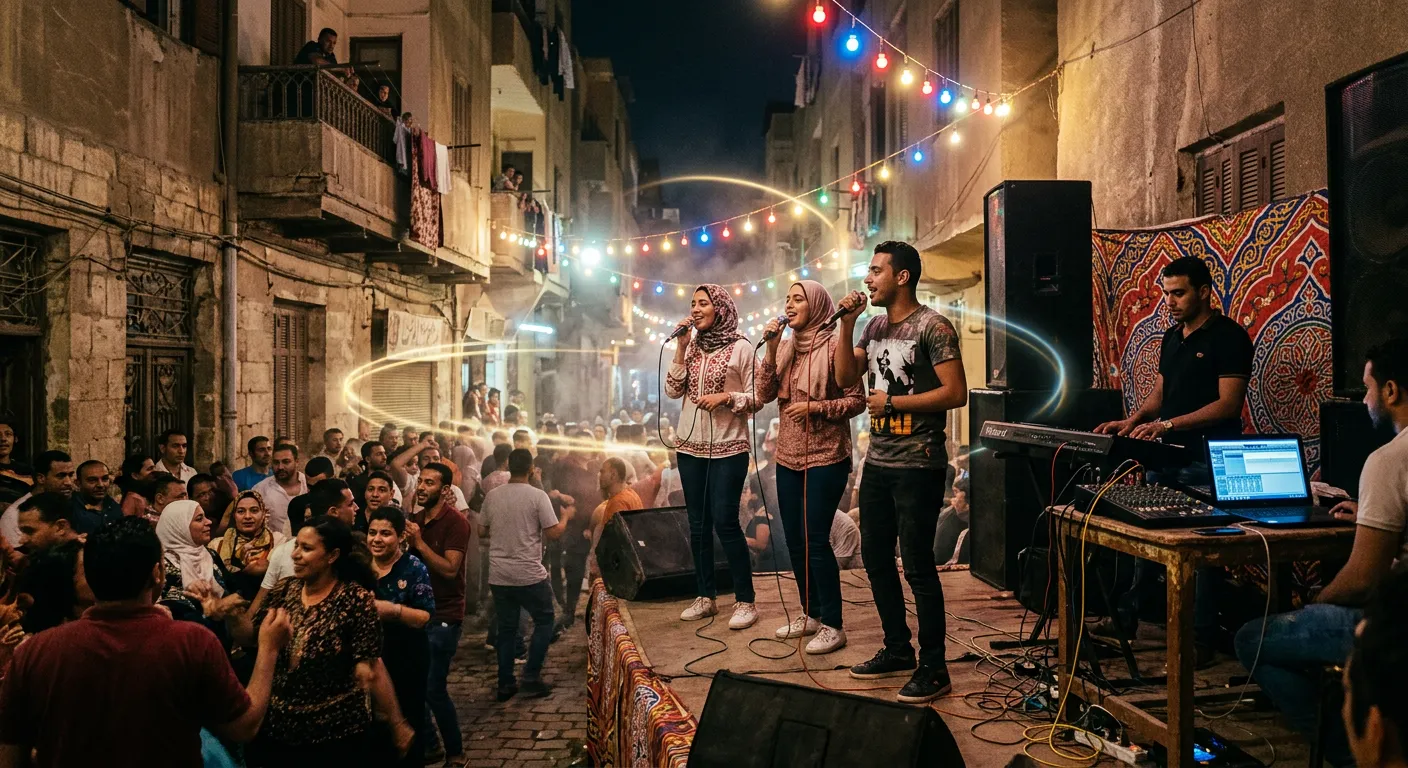
Mahraganat is crowded on purpose. A lead singer chants the hook through hard Auto-Tune while two or three MCs shout greetings, boasts and call outs to friends in the crowd. A synth keyboard plays fast, ornamented lines in Egyptian scales, darbuka samples rattle through the rhythm and claps and snares crack on top. Producers add sirens, gunshot samples, laser zaps and long echo tails on the voices. In stereo all of this crushes into a narrow, loud wall between the speakers. In an immersive mix the voice and kick hold the centre, the MCs and keyboard face each other at the front and the effects get the space behind and around the listener.
The rule: kick and voice locked in the centre, the crowd of parts spread around it. Keep the low end and the hook solid in the middle, give every MC, loop and effect its own direction and set it all in a short, punchy outdoor space rather than a large hall.
Immersive music for mahraganat: what listeners hear
- A kick you feel in your chest. The kick and bass sit dead centre, so the beat stays heavy and clear however busy the rest of the track gets.
- A crowd of voices with room to breathe. The lead hook stays in front, while the hype MCs call from the left, so every shout and greeting can be heard.
- A keyboard that cuts through. The fast synth melody sits front right, answering the voices instead of fighting them for the same spot.
- Effects that fly past. Vocal echoes, sirens and risers sweep around the back and sides, like sound bouncing off the walls of a packed street.
Where to place each element in a mahraganat mix
| Element | Position | Height | Why it works |
|---|---|---|---|
| Lead vocal | Front centre | Ear level | The Auto-Tuned hook that carries the song |
| Kick and bass | Centre | Ear level | The pounding pulse that drives the dancers |
| Hype MCs | Front left | Ear level | Shouts, greetings and rapid call outs |
| Keyboard melody | Front right | Ear level | Fast synth lines in Egyptian scales |
| Darbuka loops | Left | Ear level | Sampled hand drum rolls and patterns |
| Claps and snares | Right | Ear level | Sharp hits on top of the beat |
| Vocal echoes | Behind left | Ear level | Long delay tails thrown off the voice |
| Sirens and FX | Behind right | Ear level | Sirens, zaps, risers and drops |
| Street wedding | Behind | Raised | A short, loud outdoor space with a crowd |
The psychoacoustics behind mahraganat placement
Every position in the table above follows how the ear and brain locate sound. Here is the reason behind the main choices for mahraganat.
- Kick and bass stay centred. The ear finds almost no direction in frequencies below roughly 80 to 100 Hz, so heavy sub bass gains nothing from being spread (Blauert). Keeping it in the middle makes it hit harder and keeps the low end tight on any system.
- Lead vocal and MCs in different places. The brain groups sounds into streams by pitch, timing and direction. This is auditory stream segregation (Bregman). Moving the MCs away from the lead lets the ear follow the hook and the shouts at the same time instead of hearing one blurred block of voices.
- Echoes behind do not pull the voice away. When the same sound arrives twice in quick succession, the ear locates it at the first arrival. This is the precedence effect (Litovsky and colleagues). The lead stays fixed at the front while its delayed echoes fill the space behind.
- Risers that rush toward you. Listeners hear sounds that grow louder as moving closer, and they overestimate how near a rising sound has come. This is the looming effect for rising intensity (Neuhoff). Mahraganat builds and sirens already carry this sense of approach, so they work best with small moves rather than wild panning.
The immersion profile for mahraganat
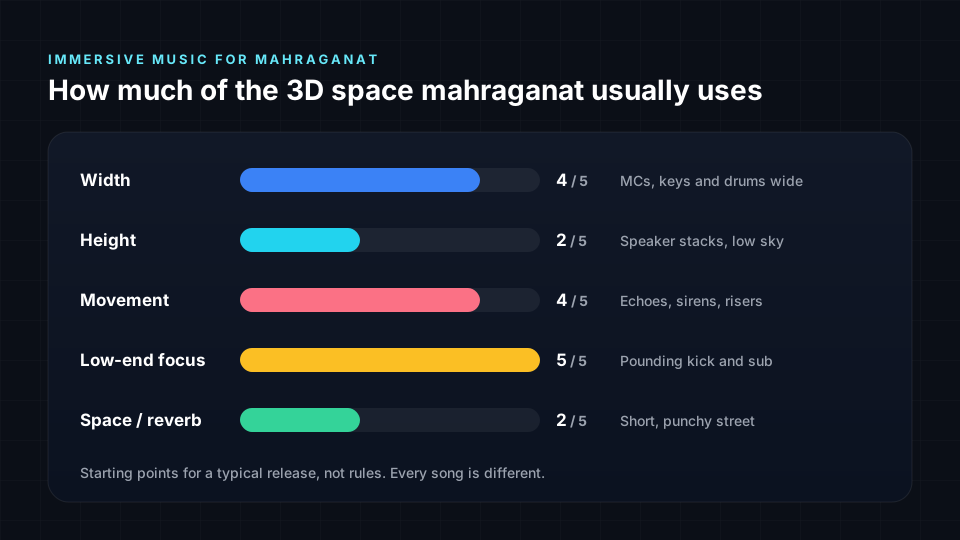
Low-end focus scores 5 because the kick and sub bass are the engine of mahraganat, and the music is made to shake wedding speaker stacks. Width scores 4, since the lead, the MCs, the keyboard and the percussion loops all need their own direction. Movement is also 4: vocal echoes, sirens, risers and sudden drops keep the sound moving around the listener. Height is 2, coming only from the speaker stacks and the open sky over a street party. Space is 2, because mahraganat is played outdoors or in small, packed rooms, and a large reverb would wash out its punch.
Tips for an immersive mahraganat mix
- Lock the kick and voice together. Keep both in the centre so the hook and the beat land as one.
- Give the MCs their own side. Move the hype vocals off centre, so the lead hook never fights with them.
- Set the keyboard against the voices. Place the synth melody front right, opposite the MCs, so the call and answer is easy to follow.
- Throw the effects to the back. Let echoes, sirens and risers move behind and beside the listener, and keep the core still.
- Keep the space short and dry. Use small, bright reflections and tight delays instead of a long reverb, so the drums stay hard.
Mahraganat styles: Electro-shaabi, Egyptian shaabi and Egyptian rap
The core placement holds for every style here: the voice and the low end in the centre, the supporting parts spread around them. What changes is how electronic the sound is, how many voices take part and how much room the style needs.
Electro-Shaabi
Electro-shaabi is the name often used outside Egypt for mahraganat, and it was the title of a 2013 documentary by Hind Meddeb about the scene. It also points to the keyboard driven side of the music, heard in Islam Chipsy's wild live synth playing with two drummers. The sound mixes drum machine beats, sampled darbuka, heavy Auto-Tune and fast keyboard improvisation. Keep the kick and lead in the centre, the keyboard front right and big, and the live drums or loops to the sides. Let delays and synth sweeps move around the back.
Egyptian Shaabi
Shaabi means of the people, and it is the urban popular song of Cairo's working class districts. Ahmed Adaweyah made it famous in the 1970s with cassette tapes and wedding gigs, and singers such as Hakim and Shaaban Abdel Rahim kept it popular through the 1990s and 2000s. Its band is a mix of acoustic and electric: darbuka and riq, accordion, violin, ney or kawala flute and the org, an electric keyboard able to play Arabic quarter tones. Place the singer front centre, the accordion or org front left, the violin front right and the percussion close to the centre and sides, with a warm, medium sized room.
Egyptian Rap
Egyptian rap grew in Cairo and Alexandria in the 2000s, with groups such as Arabian Knightz, and became much bigger after 2011. In the late 2010s a new trap wave led by rappers such as Wegz and Marwan Pablo began to share stages, beats and audiences with mahraganat singers. The beats use deep 808 bass, hi hats and dark synths, often with Egyptian samples. Hold the rapper and the 808 in the centre, spread ad libs and backing vocals to the sides and keep the space tight and close.
Related sounds such as Arabic pop, Algerian rai and East African singeli follow the same idea: keep the voice and the beat in the centre, spread the loops and hype voices wide and let effects move around the listener.
How to make immersive mahraganat from stereo
Spatial9 can create spatial audio from a stereo track in a few steps:
- Upload your stereo master or your stems.
- Spatial9's AI separates and places each part, pulling the lead vocal, MCs, keyboard, darbuka, claps and kick apart even from loud, heavily compressed masters, and setting the voice and bass in the centre with the loops and effects around them.
- Preview it in binaural on headphones.
- Export Eclipsa Audio, ADM, binaural or Ambisonics.
- Publish a video. Create a YouTube-ready video with your immersive audio and publish it directly.
For related guides, read spatial audio for Arabic pop and spatial audio for gengetone and singeli. Every guide is listed in spatial audio and immersive music by genre.
Frequently asked questions
Does this guide cover Electro-Shaabi, Egyptian Shaabi and Egyptian Rap?
Yes. Electro-shaabi uses the full mahraganat layout, with the keyboard big at the front and effects around the back. Egyptian shaabi uses a warmer band layout with accordion, violin and percussion around the singer. Egyptian rap keeps the rapper and 808 in the centre in a tight, close space.
Can I make a mahraganat mix in Dolby Atmos or Eclipsa Audio?
Yes. The placements in this guide work for both. Spatial9 exports ADM, the standard file used by Dolby Atmos studios, as well as Eclipsa Audio for YouTube, so one immersive mahraganat mix covers both. If you plan to release the Atmos version on Apple Music, build it from your original stems or multitracks, because Apple does not accept Atmos made from a finished stereo master. See where to publish spatial audio. You may also hear this called a 3D mahraganat mix or mahraganat in spatial audio.
Is spatial audio good for mahraganat?
Yes. Mahraganat stacks many loud voices, loops and effects on top of a heavy beat. Spatial audio gives each part its own direction, so the track stays powerful but becomes far easier to follow.
Where should the Auto-Tuned vocal go in an immersive mahraganat mix?
Put the lead vocal front centre at ear level, close to the listener. Auto-Tune already makes the voice bright and steady, so it does not need extra width. Send its echoes to the back instead.
How loud should the bass be in spatial mahraganat?
The kick and sub should stay as strong as in the stereo version, because they drive the dancing. Keep them in the centre and avoid spreading them, so they stay tight on headphones and on small speakers.
How is mahraganat different from rai in spatial audio?
Rai comes from western Algeria and often keeps a band feel with synths, drum machines and sometimes live instruments, built around one singer. Mahraganat is denser and more electronic, with several voices and heavy effects, so it needs a wider spread and more movement around a harder centre.
Can I convert an old mahraganat YouTube rip to spatial audio?
Yes. Spatial9 uses AI to separate the voices, keyboard, drums and effects even from a heavily compressed stereo file. Low quality copies give weaker separation, so start from the best master you can find and keep the layout simple.
Dolby and Dolby Atmos are trademarks of Dolby Laboratories. Spatial9 is not affiliated with or endorsed by Dolby Laboratories.
Sources
- Blauert, J. (1997). Spatial Hearing: The Psychophysics of Human Sound Localization, revised edition. MIT Press. Low-frequency, elevation, distance and motion cues.
- Mills, A. W. (1958). On the minimum audible angle. Journal of the Acoustical Society of America, 30(4), 237-246.
- Bronkhorst, A. W. (2000). The cocktail party phenomenon: a review of research on speech intelligibility in multiple-talker conditions. Acta Acustica united with Acustica, 86, 117-128.
- Litovsky, R. Y., Colburn, H. S., Yost, W. A. and Guzman, S. J. (1999). The precedence effect. Journal of the Acoustical Society of America, 106(4), 1633-1654.
- Neuhoff, J. G. (1998). Perceptual bias for rising tones. Nature, 395, 123-124.
- Bregman, A. S. (1990). Auditory Scene Analysis: The Perceptual Organization of Sound. MIT Press.
- Armbrust, W. (1996). Mass Culture and Modernism in Egypt. Cambridge University Press.
Join the street wedding
Upload a track to Spatial9 and hear the kick, the voices and the keyboard spread around you in minutes. Then export it or publish it straight to YouTube.