Spatial Audio & Immersive Music for Qawwali: Sufi Qawwali, Ghazal & Sufi Rock
Spatial9 Team · · 13 min read
Part of the series Spatial audio and immersive music by genre.
Key takeaways
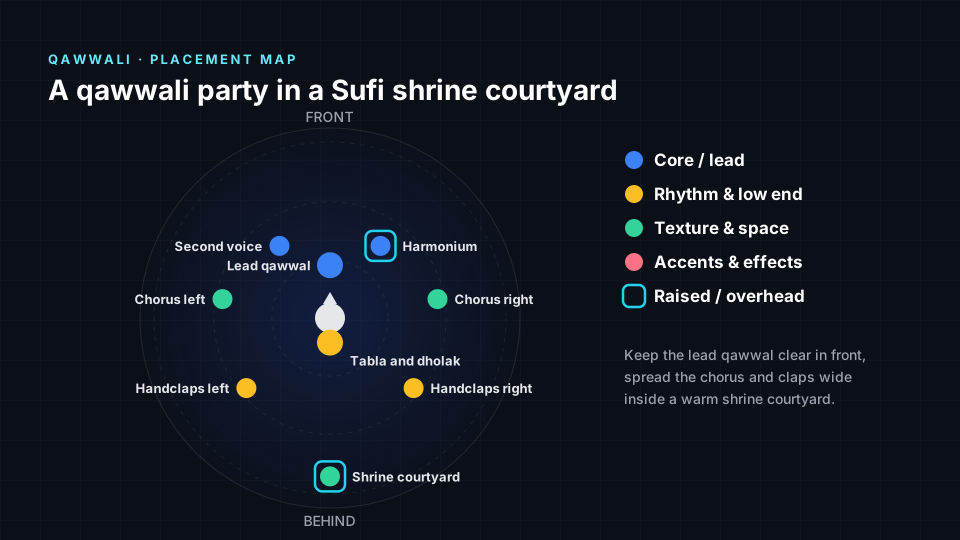
- Spatial audio for qawwali places the lead qawwal at front centre, the harmonium and second singer just to either side, the tabla and dholak low in the middle and the chorus and handclaps in a wide arc around the listener, inside a raised shrine courtyard.
- The cocktail party effect means listeners follow one voice among many more easily when the voices come from different directions, so setting the chorus to the sides keeps the words of the lead qawwal clear.
- Keep the party seated and still as it is at a real gathering of sama, and let the long rise in tempo, claps and chorus create the movement inside a moderate, warm room.
- The qawwali immersion profile scores width 4, height 3, movement 2, low-end focus 2 and space 3 out of 5.
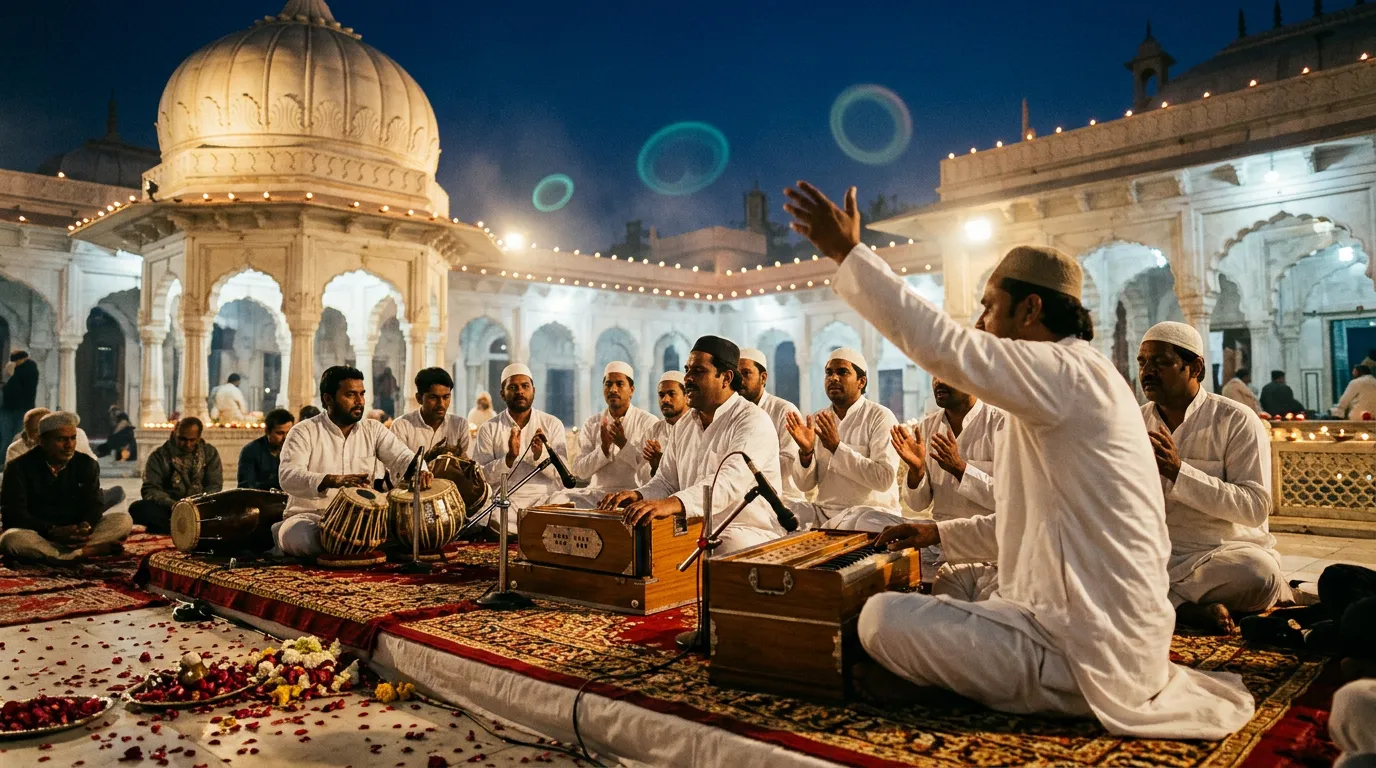
Qawwali is the devotional music of the Sufi tradition in South Asia, sung in Urdu, Punjabi, Persian, Hindi and Braj Bhasha. Tradition traces its shape to Amir Khusrau (1253 to 1325), the poet and musician of Delhi who was a disciple of the Chishti saint Nizamuddin Auliya. It grew up at Sufi shrines, the dargahs, where it is sung at gatherings of sama, or spiritual listening, and at the urs festivals that mark a saint's death anniversary, from Nizamuddin in Delhi and Ajmer in Rajasthan to Pakpattan and Lahore in Punjab. The music is carried by hereditary families of qawwals. A qawwali party is led by one or two lead singers, who often also play the harmonium, with a second harmonium, tabla or dholak, and a row of chorus singers who repeat key lines and keep time with handclaps. The harmonium arrived in South Asia in the nineteenth century and became central to the sound in the twentieth. Songs praise God (hamd), the Prophet (naat) and the saints (manqabat), and many use the ghazal form. The Sabri Brothers became the first qawwals to perform in the United States, at Carnegie Hall in 1975, and from the 1980s Nusrat Fateh Ali Khan (1948 to 1997) carried qawwali across the world through WOMAD and Real World Records. Qawwali suits spatial audio because it is sung in a seated circle, with words, call and response and a long build that all need room to breathe. This guide covers how spatial audio for qawwali works, where to place each element and how to make an immersive qawwali mix. For the basics, see what spatial audio is.
Why qawwali works in spatial audio
A qawwali performance is built in layers that grow over a long time. It often opens with a slow, free introduction on the harmonium and a sung verse without rhythm. Then the tabla or dholak enters, the chorus begins to clap and the lead qawwal sings a line that the group repeats again and again. The singers trade improvised passages, add extra verses and lift the energy toward a peak that can bring listeners to a state of spiritual rapture. In stereo the lead voice, two harmoniums, the chorus and the claps all crowd the middle, and the words of the poem can get lost. In an immersive mix the lead singer and harmonium hold the front, the chorus and claps open into a wide arc and the courtyard gives the long build somewhere to grow.
The rule: the poem at the centre, the circle around it. Keep the lead qawwal and the harmonium clear and in front, set the tabla low in the middle and let the chorus and claps answer from both sides inside a moderate courtyard.
Immersive music for qawwali: what listeners hear
- A voice that carries the words. The lead qawwal sits close and in front, so every line of the poetry stays clear, even when the whole party sings at once.
- A chorus on both sides. The repeating voices answer from left and right, so call and response feel like a conversation across the circle.
- Clapping all around you. The handclaps sit wide and a little behind, wrapping the listener in the steady pulse of the gathering.
- A long rise toward the peak. As the tempo and volume grow, the whole party seems to come closer, with only a gentle sway in the clapping and no need to throw sounds around the room.
Where to place each element in a qawwali mix
| Element | Position | Height | Why it works |
|---|---|---|---|
| Lead qawwal | Front centre | Ear level | The voice that carries the poem and leads each song |
| Second voice | Front left | Ear level | The partner singer who trades improvised lines |
| Harmonium | Front right | Slightly raised | The melody and drone that follow the singers |
| Tabla and dholak | Centre | Low | The drums that set and lift the tempo |
| Chorus left | Left | Ear level | One side of the repeated refrain |
| Chorus right | Right | Ear level | The other side of the refrain |
| Handclaps left | Behind left | Ear level | Part of the clapped pulse of the gathering |
| Handclaps right | Behind right | Ear level | The rest of the clapped pulse |
| Shrine courtyard | Behind | Raised | A moderate space around the seated party |
The psychoacoustics behind qawwali placement
Every position in the table above follows how the ear and brain locate sound. Here is the reason behind the main choices for qawwali.
- Tabla and dholak stay centred. The ear finds almost no direction in frequencies below roughly 80 to 100 Hz, so the deep strokes of the bayan, the left-hand tabla drum, and the low head of the dholak gain nothing from being spread. Keeping them centred holds the tempo steady (Blauert).
- The lead voice apart from the chorus. Listeners follow one voice among many more easily when the voices come from different directions. This is the cocktail party effect and its spatial release from masking (Bronkhorst). Setting the lead qawwal in front and the chorus to the sides keeps the words of the poem easy to follow.
- Harmonium and voice as separate lines. The brain groups sounds into streams by pitch, timbre and direction. This is auditory stream segregation (Bregman). A small offset between the harmonium and the lead voice lets the ear hear the reed melody shadowing the singer instead of one blended tone.
- A build that seems to approach. Listeners hear sounds that grow louder as moving closer, and they overestimate how near a rising sound has come. This is the looming effect for rising intensity (Neuhoff). The long crescendo of a qawwali already carries this feeling, so it needs very little panning.
The immersion profile for qawwali
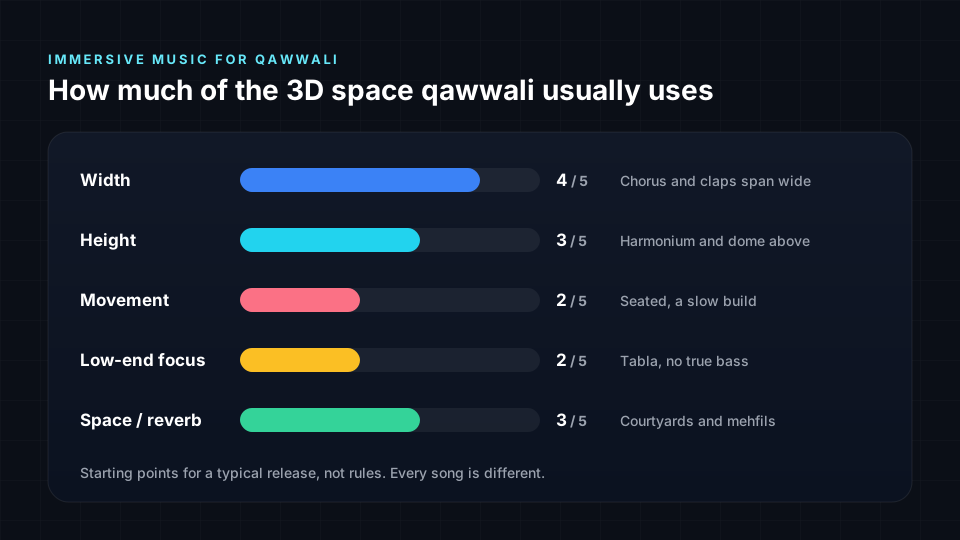
Width scores 4 because the party sits in a broad row or circle, with the chorus and clapping spread from one side to the other. Height is 3, from the reedy harmonium and the sustained voices rising into the dome or the open sky of a shrine courtyard. Movement is 2, because the players stay seated and the motion comes from the slow rise in tempo and intensity, with only a gentle sway in the claps. Low-end focus scores 2: there is no true bass instrument, and the weight comes from the tabla and dholak, which should be steady but never heavy. Space is 3, since qawwali is heard in shrine courtyards, mehfil rooms and concert halls of moderate size, where the room adds warmth without blurring the words.
Tips for an immersive qawwali mix
- Protect the poetry. Keep the lead qawwal close and centred, with gentle compression, so every word is clear from the first verse to the peak.
- Split the chorus. Place the repeating voices on both sides, a little further back than the lead, so the refrain surrounds the listener without covering the soloist.
- Give the harmonium its own spot. Offset it slightly to one side and a little higher than the voice, so the reed drone fills the space while the singer stays in front.
- Let the build do the moving. Keep the party seated in place and let the rising tempo, louder claps and stronger chorus carry the listener toward the peak.
- Use a modest, warm room. A medium courtyard or hall reverb suits qawwali, but keep its tail short on the tabla and claps so the rhythm stays crisp.
Qawwali styles: Sufi qawwali, ghazal and Sufi rock
The core placement holds for every style here: the lead voice in front, the rhythm low in the centre and the group around it. What changes is the size of the ensemble, the amount of electric sound and how much room the style needs.
Sufi Qawwali
Sufi qawwali is the traditional form sung at shrines and gatherings of sama, above all in the Chishti order, where music is a path toward remembrance of God. A performance often opens with a hamd or a naat, moves through songs for the saints and may close with the rang, a song attributed to Amir Khusrau that celebrates the bond between disciple and master. Families such as the qawwal bachche of Delhi, the Sabri Brothers of Karachi and the party of Nusrat Fateh Ali Khan from Faisalabad kept and spread the tradition, and today groups such as Fareed Ayaz and Abu Muhammad continue it. Seat the lead qawwal at front centre with the second singer just to one side, the harmonium front right and the tabla low in the middle. Spread the chorus and clappers in a wide arc on both sides, and set the party inside a warm, moderate courtyard. Treat the music with care: in a shrine recording, the voices of listeners and the life of the room are part of the devotion, so keep them natural rather than turning them into effects.
Ghazal
The ghazal is a poetic form of rhyming couplets with a repeated refrain, carried from Arabic and Persian poetry into Urdu by poets such as Mir Taqi Mir and Mirza Ghalib, and later Faiz Ahmad Faiz. Qawwals often sing ghazals, and the form also grew into a refined concert and film style of its own. Begum Akhtar in India and Mehdi Hassan and Farida Khanum in Pakistan were among its great voices, while Ghulam Ali and, from the 1970s, Jagjit Singh brought the ghazal to a very wide audience with softer arrangements. A ghazal is more intimate than a qawwali party. Keep the singer close and centred, the harmonium just to one side, a sarangi, violin or guitar on the other side and the tabla low in the centre. A small, warm room with short reflections suits the style, so the listener feels seated near the singer.
Sufi Rock
Sufi rock sets Sufi poetry and qawwali singing against electric guitars, bass and a drum kit. The Lahore band Junoon, formed in 1990 by the guitarist Salman Ahmad, made the sound famous across Pakistan and India, especially with the album Azadi and the song Sayonee in 1997. In India, Rabbi Shergill's Bulla Ki Jaana, from 2004, set the words of the poet Bulleh Shah to guitar, and from 2008 Coke Studio Pakistan paired qawwals and Sufi singers with studio rock bands. Keep the lead voice at front centre and the kick and bass guitar centred and low, under the tabla rather than fighting it. Spread the electric guitars wide left and right, keep the harmonium and claps in their usual places and use a slightly larger concert room around the band.
Related traditions such as Sufi kafi singing in Punjab and Sindh, the devotional singing of Abida Parveen and Sufi music across the wider Islamic world follow the same idea: keep the voice and the words at the centre, the rhythm steady below and the gathering around the listener.
How to make immersive qawwali from stereo
Spatial9 can create spatial audio from a stereo track in a few steps:
- Upload your stereo master or your stems.
- Spatial9's AI separates and places each part, pulling the lead qawwal, harmonium, tabla, chorus and handclaps apart even from older shrine or concert recordings, and setting the chorus and claps around a clear lead voice.
- Preview it in binaural on headphones.
- Export Eclipsa Audio, ADM, binaural or Ambisonics.
- Publish a video. Create a YouTube-ready video with your immersive audio and publish it directly.
For related guides, read spatial audio for Indian classical music and spatial audio for bhangra. Every guide is listed in spatial audio and immersive music by genre.
Frequently asked questions
Does this guide cover Sufi Qawwali, Ghazal and Sufi Rock?
Yes. Sufi qawwali seats the lead qawwal and harmonium in front with the chorus and claps in a wide arc inside a courtyard. The ghazal uses a smaller, closer layout around one singer. Sufi rock adds drums, bass and electric guitars around a centred voice in a larger concert room.
Can I make a qawwali mix in Dolby Atmos or Eclipsa Audio?
Yes. The placements in this guide work for both. Spatial9 exports ADM, the standard file used by Dolby Atmos studios, as well as Eclipsa Audio for YouTube, so one immersive qawwali mix covers both. If you plan to release the Atmos version on Apple Music, build it from your original stems or multitracks, because Apple does not accept Atmos made from a finished stereo master. See where to publish spatial audio. You may also hear this called a 3D qawwali mix or qawwali in spatial audio.
Is spatial audio good for qawwali?
Yes. Qawwali is sung by a seated party, with a lead voice, harmonium, drums, chorus and claps that answer each other over a long build. Spatial audio keeps the words clear and puts the listener inside the gathering rather than in front of a flat wall of sound.
Where should the lead singer go in an immersive qawwali mix?
Put the lead qawwal at front centre, close to the listener and at ear level. The poetry is the heart of qawwali, so the voice should never move or be buried by the chorus.
Should the chorus and handclaps move around the listener?
Only a little. The party stays seated in a real performance, so a gentle sway in the claps is enough. The sense of motion should come from the rising tempo and the growing chorus, not from panning.
How is qawwali different from gospel in spatial audio?
Both are devotional music built on a lead voice and an answering group. Qawwali uses a small seated party with harmonium, tabla and claps in a shrine courtyard, so it suits a close circle with a moderate room. Gospel often uses a large choir, organ and band in a church, so it suits a wider front stage and a bigger, more reverberant space.
Can I convert an old qawwali recording to spatial audio?
Yes. Spatial9 uses AI to separate the voices, harmonium, tabla and claps from a stereo or mono recording. Separation is never perfect with crowded live recordings, so keep the layout simple and the room moderate.
Dolby and Dolby Atmos are trademarks of Dolby Laboratories. Spatial9 is not affiliated with or endorsed by Dolby Laboratories.
Sources
- Blauert, J. (1997). Spatial Hearing: The Psychophysics of Human Sound Localization, revised edition. MIT Press. Low-frequency, elevation, distance and motion cues.
- Mills, A. W. (1958). On the minimum audible angle. Journal of the Acoustical Society of America, 30(4), 237-246.
- Hebrank, J. and Wright, D. (1974). Spectral cues used in the localization of sound sources on the median plane. Journal of the Acoustical Society of America, 56(6), 1829-1834.
- Bronkhorst, A. W. (2000). The cocktail party phenomenon: a review of research on speech intelligibility in multiple-talker conditions. Acta Acustica united with Acustica, 86, 117-128.
- Barron, M. and Marshall, A. H. (1981). Spatial impression due to early lateral reflections in concert halls. Journal of Sound and Vibration, 77(2), 211-232.
- Neuhoff, J. G. (1998). Perceptual bias for rising tones. Nature, 395, 123-124.
- Bregman, A. S. (1990). Auditory Scene Analysis: The Perceptual Organization of Sound. MIT Press.
- Qureshi, R. B. (1986). Sufi Music of India and Pakistan: Sound, Context and Meaning in Qawwali. Cambridge University Press.
Join the gathering
Upload a track to Spatial9 and hear the lead qawwal in front with the chorus and handclaps answering around you in minutes. Then export it or publish it straight to YouTube.