
Spatial Audio & Immersive Music for Bossa Nova & MPB: Complete Guide
Spatial9 Team · · Updated
Part of the series Spatial audio and immersive music by genre.
Bossa nova and MPB (música popular brasileira) are among the most refined forms of popular music. Soft vocals, intricate nylon-string guitar and gentle rhythms leave a lot of space in the arrangement. Spatial audio does not need to fill that space. Instead, it can make the closeness and warmth of the performance feel real. This guide covers how spatial audio for bossa nova and MPB works, where to place each element and how to make an immersive mix. For the basics, see what spatial audio is.
Why bossa nova needs a gentle 3D mix
Bossa nova is intimate music. Singers often perform almost in a whisper, and the guitar carries both rhythm and harmony. Pushing those sounds far away or spinning them around would destroy the mood. The best immersive bossa nova mixes use space to add warmth, not drama.
The rule: closeness first. Voice and guitar sit near the listener, everything else gives them room.
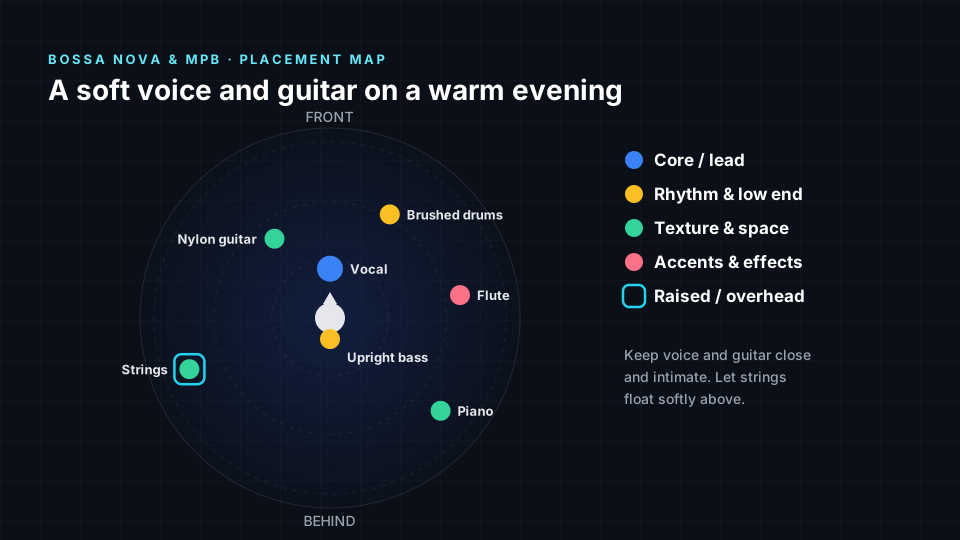
Immersive music for bossa nova: what listeners hear
- A voice right beside you. Soft vocals feel close and personal.
- A guitar you can almost touch. Every finger movement on the nylon strings is clear.
- A gentle rhythm. Brushes and bass sway softly without pushing.
- Strings like a breeze. Orchestral arrangements float above and behind.
Where to place each element in a bossa nova mix
| Element | Position | Height | Why it works |
|---|---|---|---|
| Vocal | Front centre, close | Ear level | Intimate and personal |
| Nylon guitar | Front left, close | Ear level | Rhythm and harmony in one |
| Brushed drums | Front right | Ear level | Soft swing |
| Upright bass | Centre | Ear level | Warm foundation |
| Flute | Right | Ear level | Melodic answers |
| Piano | Behind right | Ear level | Harmonic colour |
| Strings | Behind left | Raised | A soft, floating lift |
The psychoacoustics behind Bossa Nova & MPB placement
Every position in the table above follows how the ear and brain locate sound. Here is the reason behind the main choices for Bossa Nova & MPB.
- Vocal and nylon guitar close. Distance is heard through level, high-frequency detail and how much room sound surrounds a source, so less reverb brings a part closer and more reverb sets it back. Bossa nova is sung softly, almost whispered, and dry close placement recreates that intimacy.
- Brushed drums right, guitar left. When two sounds share a frequency range, separating them in direction makes each one easier to hear. Researchers call this spatial release from masking, the same effect that lets you follow one voice at a busy party. Brushes and nylon strings share delicate mid and high detail, so they need their own sides.
- Upright bass centred. In real rooms and on most playback systems, sub-bass below roughly 80 to 100 Hz gives the brain very little usable direction, which is why a single subwoofer can serve a whole speaker layout. The gentle bass line holds the harmony together from the middle.
- Strings behind, raised. Sound arriving from the sides, slightly different at each ear, creates the feeling of being inside the music. Acousticians call this envelopment. A soft halo of strings around the listener adds warmth without crowding the voice.
The immersion profile for bossa nova and MPB
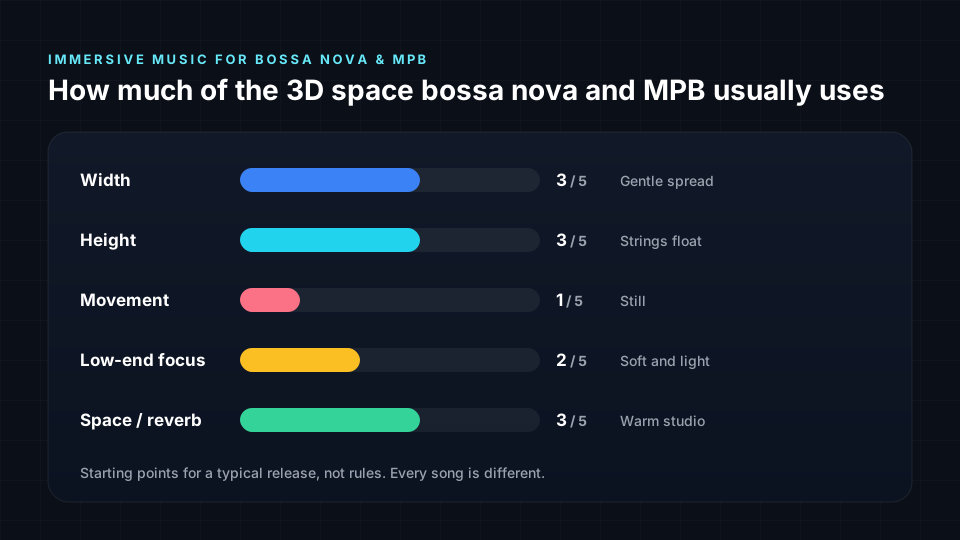
Bossa nova scores low on movement and low end, and moderate on width and height. It is a genre where restraint sounds best.
Tips for an immersive bossa nova mix
- Keep voice and guitar close. Distance kills the intimacy.
- Do not move anything. Fixed positions sound natural and calm.
- Float the strings. A little height makes orchestral parts feel like a soft breeze.
- Use a warm, small room. Big reverbs push the music too far away.
- Keep the bass light. Upright bass should support, not dominate.
How to make immersive bossa nova from stereo
Spatial9 can create spatial audio from a stereo track in a few steps:
- Upload your stereo master or your stems.
- Spatial9's AI separates and places each part, keeping voice and guitar close.
- Preview it in binaural on headphones.
- Export Eclipsa Audio, ADM, binaural or Ambisonics.
- Publish a video. Create a YouTube-ready video with your immersive audio and publish it directly.
For related guides, read spatial audio for jazz and spatial audio for Latin music. Every guide is listed in spatial audio and immersive music by genre.
Frequently asked questions
Can I make a bossa nova mix in Dolby Atmos or Eclipsa Audio?
Yes. The placements in this guide work for both. Spatial9 exports ADM, the standard file used by Dolby Atmos studios, as well as Eclipsa Audio for YouTube, so one immersive bossa nova or MPB mix covers both. You may also hear this called a 3D bossa nova mix or MPB in spatial audio.
Is spatial audio good for bossa nova?
Yes, when it is used gently. A 3D mix can make the voice and guitar feel close and warm, like a private performance.
Should sounds move in a bossa nova mix?
No. Bossa nova is calm and intimate, so fixed positions work best.
Can classic bossa nova recordings be remixed in spatial audio?
Yes. Spatial9 can separate a stereo recording into its parts and place them in 3D, even without the original multitracks.
Can I convert a finished MPB track to spatial audio?
Yes. Spatial9 uses AI to generate an immersive mix from a stereo master and exports it as Eclipsa Audio, ADM, binaural or Ambisonics.
Does immersive bossa nova work on normal headphones?
Yes. The mix is rendered binaurally, so the intimate feel works on any regular headphones.
Dolby and Dolby Atmos are trademarks of Dolby Laboratories. Spatial9 is not affiliated with or endorsed by Dolby Laboratories.
Sources
- Blauert, J. (1997). Spatial Hearing: The Psychophysics of Human Sound Localization, revised edition. MIT Press. Low-frequency, elevation, distance and motion cues.
- Mills, A. W. (1958). On the minimum audible angle. Journal of the Acoustical Society of America, 30(4), 237-246.
- Hebrank, J. and Wright, D. (1974). Spectral cues used in the localization of sound sources on the median plane. Journal of the Acoustical Society of America, 56(6), 1829-1834.
- Bronkhorst, A. W. (2000). The cocktail party phenomenon: a review of research on speech intelligibility in multiple-talker conditions. Acta Acustica united with Acustica, 86, 117-128.
- Litovsky, R. Y., Colburn, H. S., Yost, W. A. and Guzman, S. J. (1999). The precedence effect. Journal of the Acoustical Society of America, 106(4), 1633-1654.
- Barron, M. and Marshall, A. H. (1981). Spatial impression due to early lateral reflections in concert halls. Journal of Sound and Vibration, 77(2), 211-232.
- Neuhoff, J. G. (1998). Perceptual bias for rising tones. Nature, 395, 123-124.
- Bregman, A. S. (1990). Auditory Scene Analysis: The Perceptual Organization of Sound. MIT Press.
Bring your listeners closer
Upload a track to Spatial9 and hear your bossa nova or MPB wrap around you in minutes. Then export it or publish it straight to YouTube.