Spatial Audio & Immersive Music for Arabic Classical Music: Tarab, Maqam & Muwashshah
Spatial9 Team · · 12 min read
Part of the series Spatial audio and immersive music by genre.
Key takeaways
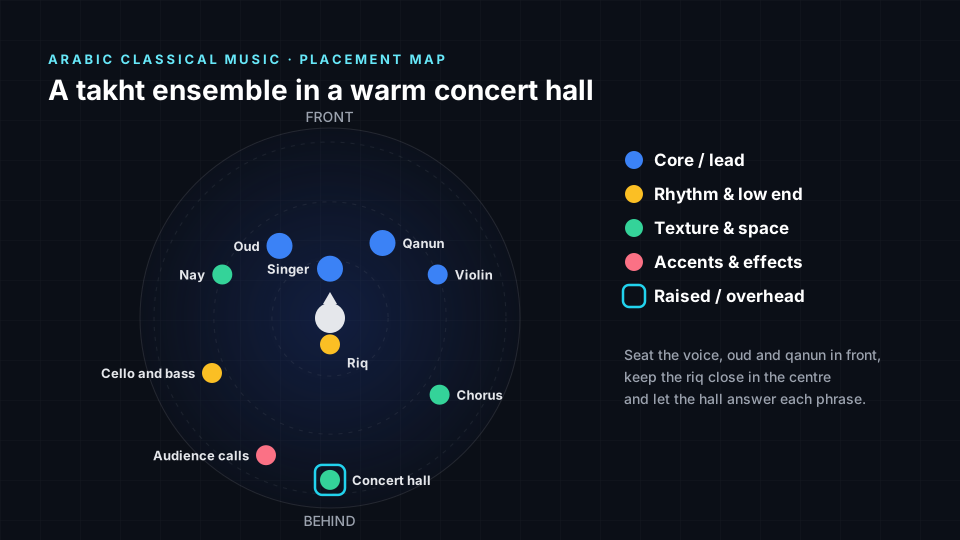
- In a spatial Arabic classical music mix the singer sits front centre with the oud front left and the qanun front right, the nay and violin a little wider, the riq close in the middle and a warm hall around the takht.
- Because the brain separates sounds that come from different directions, an effect known as auditory stream segregation, the oud, qanun and violin can each be heard playing their own version of the same melody instead of one blurred line.
- Arabic classical music is slow, modal and built on held phrases and silences, so the space should be a resonant hall with clean early reflections and very little movement.
- The Arabic classical music immersion profile scores width 3, height 2, movement 1, low-end focus 2 and space 4 out of 5.
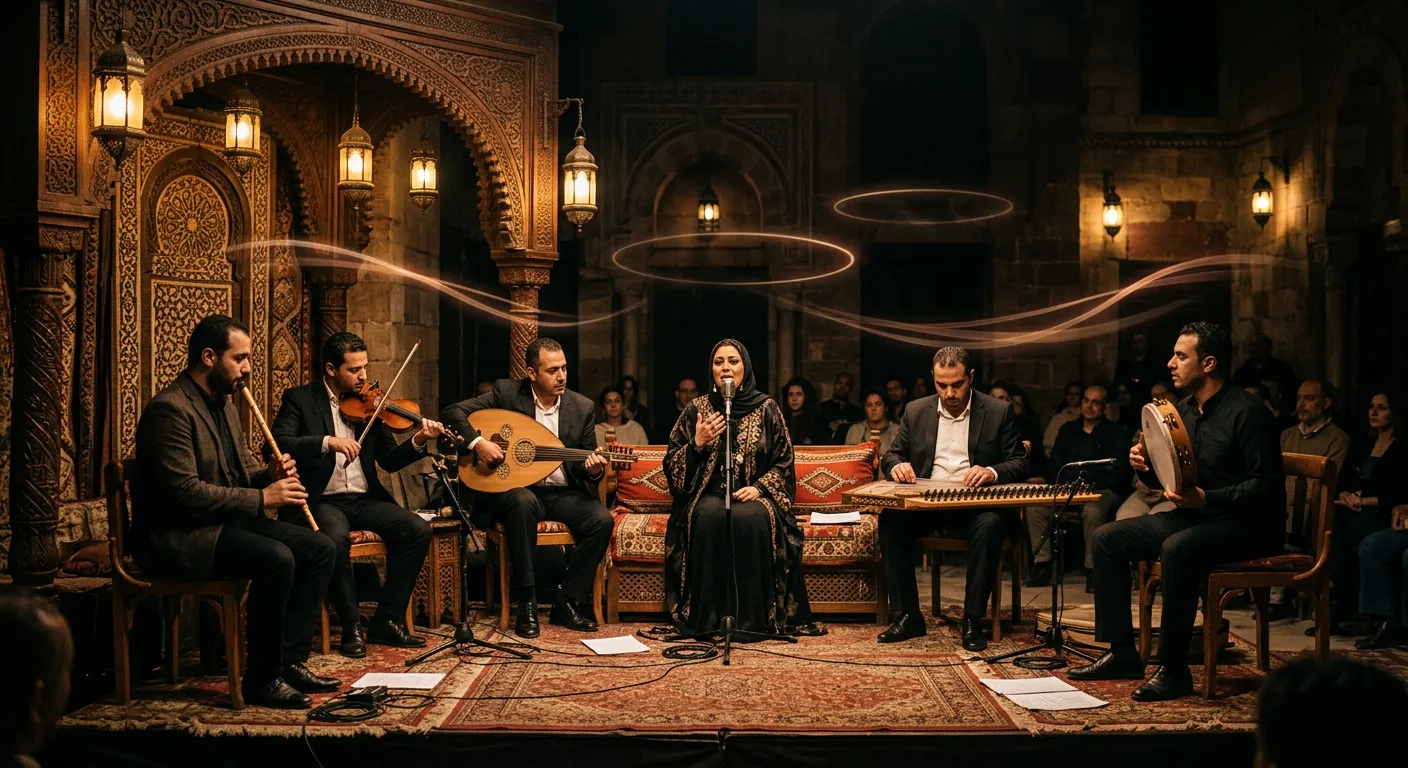
Arabic classical music grew from the court music of Umayyad Damascus and Abbasid Baghdad in the 8th to 10th centuries, where singers and oud players worked within a theory of modes later written down by scholars such as al-Kindi and al-Farabi. In the 9th century the musician Ziryab took the oud and the Baghdad style west to Córdoba, and the strophic sung poetry of al-Andalus, the muwashshah, travelled back east to North Africa, Aleppo and Damascus. In 19th century Cairo, during the cultural revival known as the Nahda, singers such as Abduh al-Hamuli shaped a refined urban style performed by the takht: a small ensemble of oud, qanun, nay, violin and riq around a solo singer. In 1932 the Cairo Congress of Arab Music gathered musicians and scholars to discuss maqam scales, rhythms and recording. From the 1930s to the 1970s Umm Kulthum, with composers such as Mohammed Abdel Wahab, Riad Al Sunbati and Zakariyya Ahmad, turned the long song into a national event, with monthly concerts broadcast across the Arab world and her ensemble expanded with strings. The music rests on the maqam, a system of melodic modes that uses intervals between the Western semitones, and on the iqa', a set of rhythmic cycles played on the riq and darbuka. Arabic classical music suits spatial audio because it is a close conversation between a voice and a few instruments, and the room and the listeners are part of the performance. This guide covers how spatial audio for Arabic classical music works, where to place each element and how to make an immersive Arabic classical music mix. For the basics, see what spatial audio is.
Why Arabic classical music works in spatial audio
Arabic classical music is heterophonic. The oud, qanun, nay and violin all play the same melody at once, but each player bends it in their own way, adding ornaments, slides and small delays. The singer leads, the instruments echo the end of each line, and a soloist steps out for a taqsim, a free improvisation in the maqam. Between phrases there are silences, and the audience fills them with calls of approval. In mono or narrow stereo the instruments fuse into one thick line and the small differences that give the music its life disappear. In an immersive mix each instrument takes its own seat in a gentle arc, the voice stays clear in front and the hall carries the long held notes.
The rule: a close takht arc around the voice, with the hall breathing behind it. Keep the ensemble compact and in front, separate the melodic instruments just enough to hear each version of the melody, and set everything in a warm room that rewards long notes and silence.
Immersive music for Arabic classical music: what listeners hear
- A voice that holds the room. The singer sits clearly in front, close enough to hear every ornament and breath, with the hall extending each long note.
- One melody, many voices. The oud, qanun, nay and violin each play their own shading of the same line, and spatial separation lets you follow every one.
- Taqsim from a single seat. When an instrument improvises, it speaks from its own place in the arc, so the solo feels like one musician leaning forward.
- A listening audience. Soft calls of approval and applause behind you place you inside a concert where the room responds to the music.
Where to place each element in an Arabic classical music mix
| Element | Position | Height | Why it works |
|---|---|---|---|
| Singer | Front centre | Ear level | The lead voice that the takht follows |
| Riq | Centre | Ear level | The rhythmic cycle, close and steady |
| Oud | Front left | Ear level | The warm heart of the ensemble |
| Qanun | Front right | Ear level | Bright plucked runs and tremolos |
| Nay | Wide left | Ear level | A breathy reed flute for long phrases |
| Violin | Wide right | Ear level | Sliding lines that shadow the voice |
| Cello and bass | Left, slightly behind | Ear level | A soft low floor in larger ensembles |
| Chorus | Behind right | Ear level | The answering refrain in a muwashshah |
| Audience calls | Behind left | Ear level | Cries of approval that complete tarab |
| Concert hall | Behind | Raised | A warm, resonant room around the takht |
The psychoacoustics behind Arabic classical music placement
Every position in the table above follows how the ear and brain locate sound. Here is the reason behind the main choices for Arabic classical music.
- The singer and lead instruments sit in front. Our ability to tell two nearby directions apart is sharpest straight ahead, where a shift of about one degree can be heard, and weakest at the sides. This is the minimum audible angle (Mills). Keeping the voice, oud and qanun in front lets the ear catch the fine ornaments and microtonal inflections of the maqam.
- Melodic instruments on separate seats. The brain groups sounds into streams by pitch, timbre, timing and direction. This is auditory stream segregation (Bregman). Giving the oud, qanun, nay and violin their own positions lets the ear hear four versions of one melody rather than a single smeared line.
- The voice stays anchored in a reverberant room. When the same sound arrives first directly and then as reflections, the ear locates it from the first arrival and suppresses the later echoes. This is the precedence effect (Litovsky and colleagues). A generous hall can surround the listener without pulling the singer away from the centre.
- A warm hall with side reflections. Early reflections arriving from the sides make a sound feel wider and more enveloping. This is spatial impression from early lateral reflections (Barron and Marshall). Strong side reflections give a small takht the scale of a concert hall without spreading the musicians apart.
The immersion profile for Arabic classical music
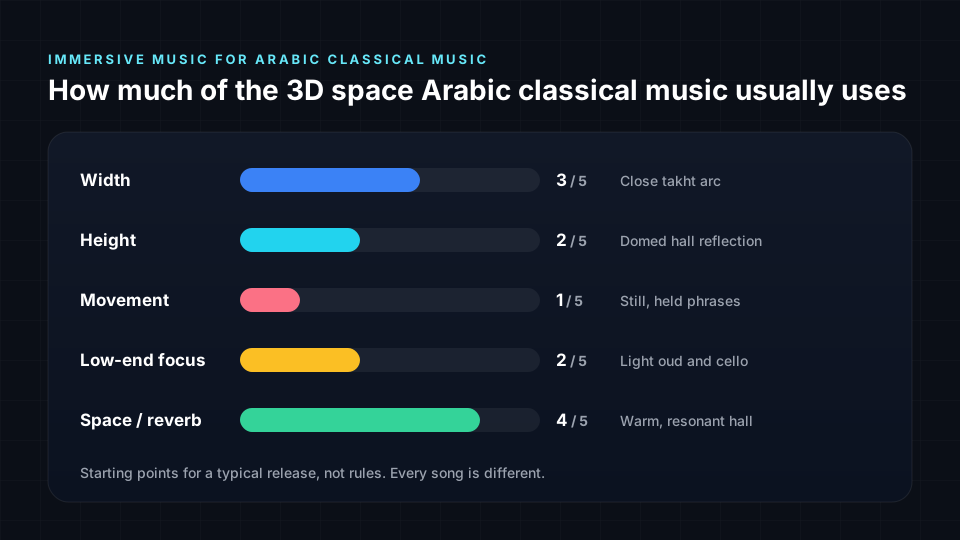
Space scores 4 because the music lives in resonant halls and long held notes, and the room carries the feeling of tarab. Width is 3: the takht sits in a close arc in front of the listener, wide enough to separate each instrument but never spread around the head. Low-end focus is 2, since the oud and, in larger ensembles, the cello and double bass give warmth rather than weight, and the riq and darbuka are light and crisp. Height is 2, coming only from the reflection of a high ceiling or dome. Movement is 1, because the musicians stay seated and still, and the drama comes from melody, ornament and silence rather than motion.
Tips for an immersive Arabic classical music mix
- Keep the takht compact. Set the oud and qanun about 35 degrees either side of the voice, with the nay and violin a little wider, so the ensemble feels like one group.
- Respect the microtones. Avoid heavy pitch effects, chorus or modulation that would blur the intervals between semitones that define each maqam.
- Hold the riq close and steady. Keep the frame drum near the centre so the rhythmic cycle stays clear without dominating the voice.
- Let the solo speak from its seat. During a taqsim, raise the soloist a little in level rather than moving it, so the arc stays stable.
- Use a warm hall and keep the audience. A long, smooth reverb suits the music, and the calls of the listeners belong in the mix, placed softly behind.
Arabic classical music styles: tarab, maqam and muwashshah
The core placement holds for every style here: the voice in front, the instruments in a close arc and a warm room around them. What changes is the size of the ensemble, the role of the chorus and how much space each style needs.
Tarab
Tarab names both a repertoire and a feeling: the state of musical ecstasy that a great singer and an attentive audience create together. It is linked above all with the Egyptian song of the 20th century, from the takht of the early recording era to the long concert songs of Umm Kulthum such as Enta Omri in 1964 and Al Atlal in 1966. The ensemble grew from a few instruments to an orchestra with a string section, accordion and sometimes electric instruments, but the voice always led. Place the singer front centre, the oud and qanun either side, the violin section in a wider arc to the front right and the cellos and bass behind left. Keep the audience calls soft behind the listener and use a large, warm hall.
Maqam
Maqam is the modal system that shapes all of this music, with families such as Rast, Bayati, Hijaz, Saba, Sikah and Nahawand, each with its own scale, typical phrases and mood. In Iraq the word also names a sung art, the Iraqi maqam, performed by a singer with the chalghi ensemble of santur hammered dulcimer, joza spike fiddle, tabla and daff, which UNESCO proclaimed a masterpiece of intangible heritage in 2003. Instrumental forms such as the sama'i and bashraf, and the free taqsim, also belong here. For a chalghi group, place the singer front centre, the santur front right and the joza front left, with the drums close and low. A warm, medium hall keeps the improvisations intimate.
Muwashshah
The muwashshah is a form of strophic sung poetry that began in al-Andalus around the 10th and 11th centuries and was preserved and set to music in North Africa, Aleppo and Damascus. Muwashshahat are often sung by a chorus in unison with the takht, in long rhythmic cycles such as the samai thaqil in ten beats, with a soloist taking certain verses. Aleppo became known for the form, kept alive by singers such as Sabah Fakhri. Place the solo voice front centre and the chorus in a soft arc behind and to the sides, with the oud, qanun and violin in front and the riq close in the middle. A larger, brighter hall suits the choral sound.
Related styles such as the Andalusian nuba of the Maghreb, Turkish makam music and Persian classical music follow the same idea: keep the voice and lead instruments in front, the ensemble compact and the room warm around the listener.
How to make immersive Arabic classical music from stereo
Spatial9 can create spatial audio from a stereo track in a few steps:
- Upload your stereo master or your stems.
- Spatial9's AI separates and places each part, pulling the singer, oud, qanun, nay, violin and riq apart even from old mono recordings, and setting the takht in a close arc around the voice.
- Preview it in binaural on headphones.
- Export Eclipsa Audio, ADM, binaural or Ambisonics.
- Publish a video. Create a YouTube-ready video with your immersive audio and publish it directly.
For related guides, read spatial audio for Arabic pop and spatial audio for Indian classical music. Every guide is listed in spatial audio and immersive music by genre.
Frequently asked questions
Does this guide cover tarab, maqam and muwashshah?
Yes. Tarab seats the singer in front of a takht or a larger orchestra in a warm hall. Maqam covers the modal system, its instrumental forms and the Iraqi maqam with its chalghi ensemble. Muwashshah adds a chorus in a soft arc behind the solo voice and the takht.
Can I make an Arabic classical music mix in Dolby Atmos or Eclipsa Audio?
Yes. The placements in this guide work for both. Spatial9 exports ADM, the standard file used by Dolby Atmos studios, as well as Eclipsa Audio for YouTube, so one immersive Arabic classical music mix covers both. If you plan to release the Atmos version on Apple Music, build it from your original stems or multitracks, because Apple does not accept Atmos made from a finished stereo master. See where to publish spatial audio. You may also hear this called a 3D Arabic music mix or tarab in spatial audio.
Is spatial audio good for Arabic classical music?
Yes. The music depends on hearing several instruments shade the same melody at once, and on a room that carries long notes and silences. Spatial audio separates the instruments gently and gives the hall and the audience a real place around the listener.
Where should the oud and qanun go in an immersive mix?
Put the oud front left and the qanun front right, both at ear level and about the same distance from the listener. This mirrors how many takht ensembles sit on stage and keeps the two main melodic instruments in balance on either side of the voice.
Should I keep the audience reactions in the mix?
Yes, in most live recordings. Calls of approval are part of tarab, showing the bond between singer and listeners. Place them softly behind and to one side, below the music, so they surround the listener without covering the voice.
How is Arabic classical music different from Indian classical music in spatial audio?
Both are modal traditions built on improvisation, but Indian classical music rests on a constant drone from the tanpura and a soloist with tabla, so it suits a very small, centred layout. Arabic classical music has no fixed drone and uses several melodic instruments playing together, so it needs a slightly wider arc to separate them.
Can I convert an old 78 rpm or radio recording to spatial audio?
Yes. Spatial9 uses AI to separate the voice, oud, qanun, violin and percussion from a mono master. Separation is never perfect with older recordings, so keep the arc narrow, the instruments close to the voice and the hall moderate.
Dolby and Dolby Atmos are trademarks of Dolby Laboratories. Spatial9 is not affiliated with or endorsed by Dolby Laboratories.
Sources
- Blauert, J. (1997). Spatial Hearing: The Psychophysics of Human Sound Localization, revised edition. MIT Press. Low-frequency, elevation, distance and motion cues.
- Mills, A. W. (1958). On the minimum audible angle. Journal of the Acoustical Society of America, 30(4), 237-246.
- Bregman, A. S. (1990). Auditory Scene Analysis: The Perceptual Organization of Sound. MIT Press.
- Litovsky, R. Y., Colburn, H. S., Yost, W. A. and Guzman, S. J. (1999). The precedence effect. Journal of the Acoustical Society of America, 106(4), 1633-1654.
- Barron, M. and Marshall, A. H. (1981). Spatial impression due to early lateral reflections in concert halls. Journal of Sound and Vibration, 77(2), 211-232.
- Racy, A. J. (2003). Making Music in the Arab World: The Culture and Artistry of Tarab. Cambridge University Press.
- Danielson, V. (1997). The Voice of Egypt: Umm Kulthum, Arabic Song, and Egyptian Society in the Twentieth Century. University of Chicago Press.
Step into the hall
Upload a track to Spatial9 and hear the voice, oud and qanun take their seats around you in minutes. Then export it or publish it straight to YouTube.