
Spatial Audio & Immersive Music for Corridos Tumbados: Corridos Bélicos, Sierreño & Trap Corridos
Spatial9 Team · · 11 min read
Part of the series Spatial audio and immersive music by genre.
Key takeaways
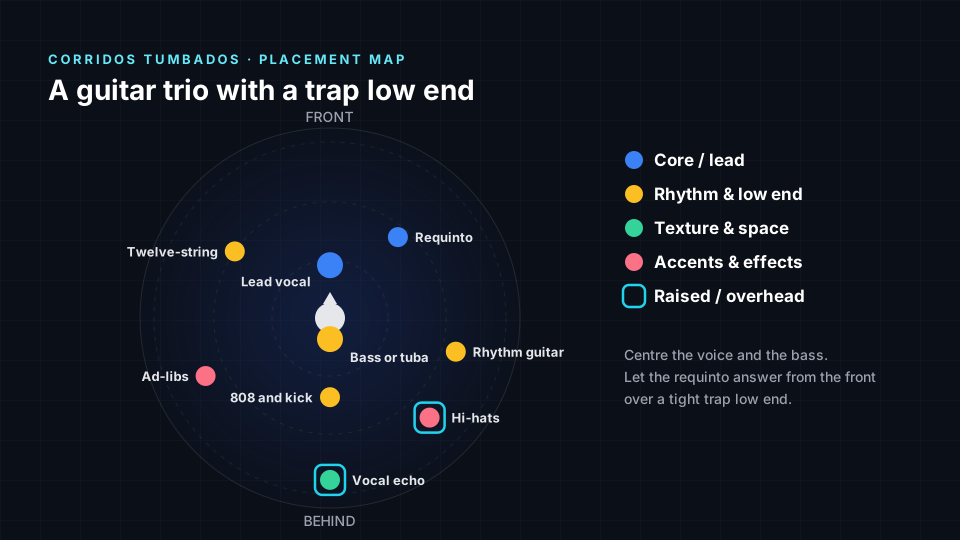
- In a spatial corridos tumbados mix the lead vocal and the bass or tuba stay centred, while the requinto answers from the front right and the twelve-string and rhythm guitars hold the sides.
- Because the brain sorts sounds into separate streams by pitch and direction, an effect known as auditory stream segregation, splitting the requinto from the twelve-string keeps two bright guitars from blurring into one.
- Corridos tumbados pair a guitar trio with trap production, so the space should stay small and dry, with 808s and hi-hats added only where the track calls for them.
- The corridos tumbados immersion profile scores width 3, height 2, movement 2, low-end focus 4 and space 2 out of 5.
Corridos tumbados are a modern branch of Mexican regional music that broke through in the late 2010s. The corrido itself is old: a narrative ballad that told the news of the Mexican Revolution, later carried into the narcocorridos of Los Tigres del Norte in the 1970s and Chalino Sánchez in the 1980s and early 1990s. The new style took its name from Natanael Cano's 2019 album Corridos Tumbados, and it spread fast with artists such as Junior H, Peso Pluma, Fuerza Regida and Eslabon Armado, reaching the global charts in 2023 with Ella Baila Sola. The core band is small: a requinto, a small lead guitar that plays fast runs between the lines, a twelve-string guitar or docerola strumming chords, and an acoustic bass guitar or a tuba. Singers bring a relaxed, half-spoken delivery and lyrics shaped by hip hop and trap, and many tracks add 808 bass, hi-hats and vocal effects. Most songs sit in a swinging 6/8 or a bouncing 3/4 feel, with the requinto filling every gap. Corridos tumbados suit spatial audio because a trio of guitars, a booming bass and a close voice are easy to set apart around the listener. This guide covers how spatial audio for corridos tumbados works, where to place each element and how to make an immersive corridos tumbados mix. For the basics, see what spatial audio is.
Why corridos tumbados works in spatial audio
Corridos tumbados are built on a dialogue between the singer and the requinto. The voice tells the story, and the requinto replies with quick runs and slides at the end of each line, while the twelve-string keeps a steady, ringing strum and the bass or tuba walks underneath. In stereo the two guitars share the same bright range and tend to merge with the vocal. In an immersive mix the voice and bass hold the centre, the requinto sits just to the front right, and the strummed guitars spread a little wider so each part keeps its own place.
The rule: a centred voice and bass, a requinto answering from the front, and a tight low end underneath. Keep the guitar trio in a close arc in front of the listener, let the requinto step forward slightly for its runs, and keep the room small and dry so the voice stays intimate.
Immersive music for corridos tumbados: what listeners hear
- A voice close to the ear. The lead vocal sits in the centre, near and dry, keeping the relaxed, conversational delivery of the style.
- A requinto that talks back. The fast runs come from just in front and to the right, answering each line like a second voice.
- Guitars with room to ring. The twelve-string strum and the rhythm guitar come from their own sides instead of one bright block.
- A low end you can feel. The tuba or acoustic bass and any 808 sit low and centred, giving the trio the weight of a trap record.
Where to place each element in a corridos tumbados mix
| Element | Position | Height | Why it works |
|---|---|---|---|
| Lead vocal | Front centre | Ear level | The story and the focus of every corrido |
| Bass or tuba | Centre | Ear level | The walking bass line that carries the groove |
| Requinto | Front right, stepping in for runs | Ear level | Fast lead lines that answer the voice |
| Twelve-string | Front left | Ear level | The ringing strum of the docerola |
| Rhythm guitar | Right | Ear level | A second strum that thickens the chords |
| 808 and kick | Centre, behind | Ear level | Trap weight under the acoustic trio |
| Hi-hats | Behind right | Raised | Rolling trap hats above the guitars |
| Ad-libs | Behind left | Ear level | Shouts and doubles around the main vocal |
| Vocal echo | Behind | Raised | A short delay that keeps the voice dry |
The psychoacoustics behind corridos tumbados placement
Every position in the table above follows how the ear and brain locate sound. Here is the reason behind the main choices for corridos tumbados.
- Bass, tuba and 808 stay centred. The ear finds almost no direction in frequencies below roughly 80 to 100 Hz, so spreading the low end only weakens it. Keeping it central gives the trio its weight.
- Requinto and twelve-string on opposite sides. The brain groups sounds into streams by pitch, timing and direction. This is auditory stream segregation (Bregman). Both guitars are bright and plucked, and separating them lets the ear follow the runs and the strum as two parts.
- A voice that stays clear over the band. Listeners can pick out one voice among competing sounds when it comes from a different direction. This is the cocktail party effect (Bronkhorst). Moving the ad-libs behind and to the side keeps the lead vocal easy to follow.
- A short, raised echo. When a sound and its echo arrive close together, the ear hears the first as the source. This is the precedence effect (Litovsky). A short delay placed behind and above adds space without pulling the voice away from the centre.
The immersion profile for corridos tumbados
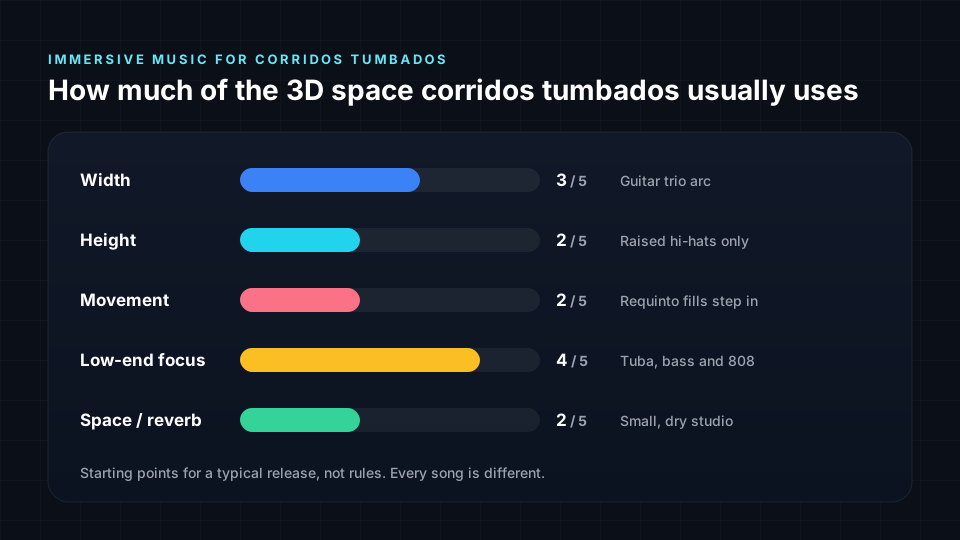
Width scores 3 because the trio sits in a close arc, not across a wide stage. Low-end focus scores 4: the tuba or bass, often doubled by an 808, is the backbone of the sound. Space is low at 2, since the style is recorded close and dry, with only a short echo on the voice. Height is 2, coming mainly from raised hi-hats and the echo. Movement scores 2, from the requinto stepping forward for its runs rather than sounds circling the head.
Tips for an immersive corridos tumbados mix
- Keep the lead vocal front and centre. The story comes first, so the singer never moves.
- Split the requinto and the twelve-string. Set them on opposite front sides so the runs and the strum stay clear.
- Keep the low end in one place. Hold the tuba, bass and 808 in the centre and make sure they do not fight in the same range.
- Use trap elements as a layer, not a stage. Raise the hi-hats slightly and keep them behind, so the acoustic trio stays in front.
- Keep the room dry. A short, close space suits the conversational voice; long reverbs make the style sound distant.
Corridos Tumbados styles: corridos bélicos, sierreño and trap corridos
The core placement holds for every style here: voice and bass in the middle, guitars in a close arc in front. What changes is the weight of the low end, the amount of trap production and how much room the style needs.
Corridos Bélicos
Corridos bélicos, or warlike corridos, are the hardest edge of the movement, with lyrics about conflict and power and a more aggressive delivery. They draw on the movimiento alterado of the late 2000s and on artists such as Fuerza Regida and Peso Pluma. Arrangements often add a tuba and sometimes brass to the guitars, with a heavy, driving bass. Keep the tuba firmly in the centre, put any trumpets slightly wider at the front and give the vocal a little more edge. The room stays small and punchy.
Sierreño
Sierreño is the older, guitar-led sound from the rural north of Mexico, built on a requinto, a twelve-string or rhythm guitar and a bass, which can be an upright tololoche, an acoustic bass guitar or, in the sierreño con tuba variant, a tuba. Many corridos tumbados are sierreño arrangements with new lyrics and a modern vocal style. Keep the trio close and natural: requinto front right, twelve-string front left and bass in the centre, with a light, wooden room and no electronic layers.
Trap Corridos
Trap corridos blend the guitar trio with the sound of trap: 808 bass, rolling hi-hats, snares and claps, vocal effects and ad-libs. Natanael Cano and Junior H helped shape the crossover, and collaborations with Latin trap artists pushed it further. This style can take a slightly larger layout: keep the guitars in front, place the 808 and kick centred behind, raise the hi-hats a little and set the ad-libs around the sides and back. Keep the space dry so the beat stays tight.
Related styles such as corridos verdes and requinto-led sad sierreño follow the same idea: centre the voice and bass, then keep the guitars close in front of the listener.
How to make immersive corridos tumbados from stereo
Spatial9 can create spatial audio from a stereo track in a few steps:
- Upload your stereo master or your stems.
- Spatial9's AI separates and places each part, pulling the vocal, requinto, twelve-string, bass or tuba and any 808 and hi-hats apart, then setting the guitar trio in a close arc with the low end anchored in the centre.
- Preview it in binaural on headphones.
- Export Eclipsa Audio, ADM, binaural or Ambisonics.
- Publish a video. Create a YouTube-ready video with your immersive audio and publish it directly.
For related guides, read spatial audio for regional Mexican music and spatial audio for Latin trap. Every guide is listed in spatial audio and immersive music by genre.
Frequently asked questions
Does this guide cover corridos bélicos, sierreño and trap corridos?
Yes. Corridos bélicos add a centred tuba and sometimes brass in a punchy room. Sierreño keeps a close, natural guitar trio with no electronic layers. Trap corridos add a centred 808, raised hi-hats and ad-libs around the sides and back.
Can I make a corridos tumbados mix in Dolby Atmos or Eclipsa Audio?
Yes. The placements in this guide work for both. Spatial9 exports ADM, the standard file used by Dolby Atmos studios, as well as Eclipsa Audio for YouTube, so one immersive corridos tumbados mix covers both. If you plan to release the Atmos version on Apple Music, build it from your original stems or multitracks, because Apple does not accept Atmos made from a finished stereo master. See where to publish spatial audio. You may also hear this called a 3D corridos tumbados mix or corridos tumbados in spatial audio.
Is spatial audio good for corridos tumbados?
Yes. The style layers two or three bright guitars, a booming bass and a close voice in a narrow range. Spatial audio gives each part its own direction, so the requinto runs, the strum and the lyrics all come through more clearly.
Where should the requinto go in an immersive corridos tumbados mix?
Put it at the front right at ear level, opposite the twelve-string, a little closer than the other guitars. It can step slightly forward for its runs and intro, then sit back under the verse.
Should the tuba or bass be spread around the listener?
No. Keep it centred and close. Low frequencies carry little direction, and the bass line is the engine of the song, so a single, solid position gives the strongest result.
How are corridos tumbados different from Latin trap in spatial audio?
Corridos tumbados keep an acoustic guitar trio at the front, so the layout is a close arc with the beat as a layer behind. Latin trap is built around the beat and vocal, so it can use a wider electronic stage with more movement and effects.
Can I convert an older corrido recording to spatial audio?
Yes. Spatial9 uses AI to separate the vocal, guitars and bass from a stereo or mono master. Separation is never perfect with older recordings, so keep the layout simple, close and centred.
Dolby and Dolby Atmos are trademarks of Dolby Laboratories. Spatial9 is not affiliated with or endorsed by Dolby Laboratories.
Sources
- Blauert, J. (1997). Spatial Hearing: The Psychophysics of Human Sound Localization, revised edition. MIT Press. Low-frequency, elevation, distance and motion cues.
- Mills, A. W. (1958). On the minimum audible angle. Journal of the Acoustical Society of America, 30(4), 237-246.
- Hebrank, J. and Wright, D. (1974). Spectral cues used in the localization of sound sources on the median plane. Journal of the Acoustical Society of America, 56(6), 1829-1834.
- Bronkhorst, A. W. (2000). The cocktail party phenomenon: a review of research on speech intelligibility in multiple-talker conditions. Acta Acustica united with Acustica, 86, 117-128.
- Litovsky, R. Y., Colburn, H. S., Yost, W. A. and Guzman, S. J. (1999). The precedence effect. Journal of the Acoustical Society of America, 106(4), 1633-1654.
- Barron, M. and Marshall, A. H. (1981). Spatial impression due to early lateral reflections in concert halls. Journal of Sound and Vibration, 77(2), 211-232.
- Neuhoff, J. G. (1998). Perceptual bias for rising tones. Nature, 395, 123-124.
- Bregman, A. S. (1990). Auditory Scene Analysis: The Perceptual Organization of Sound. MIT Press.
- Wald, E. (2001). Narcocorrido: A Journey into the Music of Drugs, Guns, and Guerrillas. Rayo, HarperCollins.
Bring the trio into the room
Upload a track to Spatial9 and hear the requinto, twelve-string and bass gather around you in minutes. Then export it or publish it straight to YouTube.