Genre guides
How spatial approaches change by genre, with links to more than 200 genre-specific guides.
This page explains how the spatial approach to an immersive mix changes from one genre to another. It covers the general principles that apply to every genre, the five dimensions used to score each style, how to read a placement map, and the typical approach for each of the six genre families. Each family section links to its overview post and to a selection of the more than 200 genre-specific guides.
It is intended for artists, engineers and producers who want a starting point for their own music, whether they mix stems by hand or generate an immersive version from a stereo file with Spatial9. The scores and placements described here are starting points, not strict rules.
General principles
Spatial audio places sound all around the listener, including behind and above, instead of on a flat line between two speakers. Each style has its own rules about what the listener should focus on, and those rules remain in force in 3D.
Four principles determine most genre differences:
- Focus. In pop, country and hip-hop the vocal is the song, so it stays anchored in front of the listener. In ambient and electronic music, the whole space can act as the instrument.
- Low end. Bass-driven genres such as hip-hop, EDM and reggaeton keep the kick and sub bass centred and steady. Moving the bass makes a mix feel weak.
- Realism. Classical, jazz and acoustic music usually recreate a real room. Electronic genres are free to build spaces that could not exist physically.
- Movement. Some genres benefit from sounds that travel around the listener. In others, any movement sounds like a gimmick.
Genres with dense arrangements or a strong sense of space, such as EDM, ambient, classical and orchestral music, usually gain the most from an immersive mix.
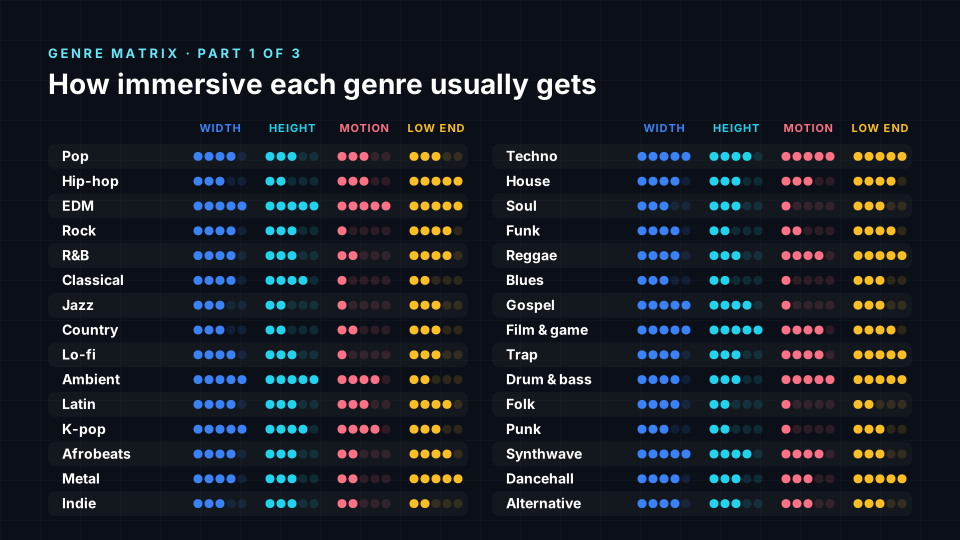
Five dimensions of an immersive mix
Every genre guide scores five dimensions from 1 (barely used) to 5 (used to the full).
| Dimension | Definition | Low score | High score |
|---|---|---|---|
| Width | How far sound spreads around the listener | Mostly in front | Full 360 degrees |
| Height | How much sound comes from above | Ear level | Strong overhead layer |
| Movement | How often sounds travel through the space | Static | Constant motion |
| Low-end focus | How much the mix depends on kick and bass | Light | Bass-driven |
| Space / reverb | How big and reflective the room feels | Dry and close | Huge and lush |
How to read a placement map
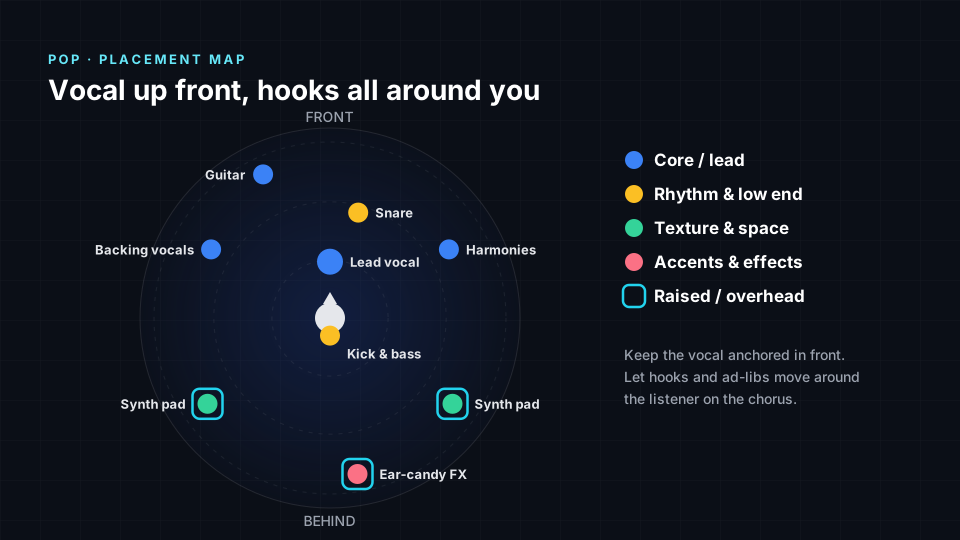
Each genre guide includes a top-down placement map. The listener is in the centre, facing the front, and coloured dots show where each part of the arrangement typically sits.
| Marker | Meaning |
|---|---|
| Blue | Core of the song, usually the lead vocal or lead instrument |
| Amber | Rhythm and low end: drums, bass, 808s |
| Green | Texture and space: pads, strings, room sound, ambience |
| Pink | Accents and effects: ad-libs, risers, ear candy |
| Cyan square | The element is raised or placed overhead |
How approaches change across families
The guides are grouped into six families. The table lists the number of guides and the average score per dimension for each family, as published in the family overview posts.
| Family | Guides | Width | Height | Movement | Low end | Space |
|---|---|---|---|---|---|---|
| Electronic and dance | 64 | 4.4 | 3.4 | 3.7 | 4.1 | 3.5 |
| Hip-hop, R&B and pop | 16 | 3.9 | 3.0 | 2.9 | 3.9 | 2.8 |
| Rock and metal | 26 | 4.2 | 3.2 | 2.5 | 3.7 | 3.5 |
| Jazz, blues, country and folk | 27 | 3.6 | 2.1 | 1.8 | 2.6 | 3.2 |
| Classical, vocal and ambient | 17 | 4.2 | 3.5 | 1.7 | 2.1 | 4.3 |
| Latin, African and world | 70 | 3.9 | 2.5 | 2.4 | 3.4 | 3.1 |
The anchored element and the parts that open up also differ per family:
| Family | Anchored element | What opens up |
|---|---|---|
| Electronic and dance | Kick and sub bass | Pads, percussion, risers, effects |
| Hip-hop, R&B and pop | Lead vocal and 808 or bass | Ad-libs, harmonies, hooks |
| Rock and metal | Vocal, kick, snare, bass | Guitar walls, cymbals, room |
| Jazz, blues, country and folk | Every player in a fixed position | Natural room reverb |
| Classical, vocal and ambient | Ensemble in front | Hall reflections, choirs, pads overhead |
| Latin, African and world | Lead vocal, bass, main beat | Percussion and call-and-response parts |
Electronic and dance
Electronic and dance music can use 3D space more freely than any other family, because its sounds are designed rather than recorded in a room.
- Fixed, centred foundation. The kick and sub bass stay centred and steady in almost every style. Moving them weakens the groove and can sound strange on club systems and headphones.
- Movement as a musical tool. Filter sweeps, risers and delays travel around and above the listener. Build-ups often rise in height, and drops often open in width.
- Designed space. Reverbs are effects, not real halls, so each style chooses its own space, such as a dark warehouse for techno or an open sky for trance.
- Binaural translation. Many listeners hear these mixes on headphones first, so the guides favour clear placements that still work when rendered binaurally.
House styles keep a tight centre, a strong low end and gentle motion. Techno, trance, jungle and bass music use the most movement. Hard dance styles such as hardcore, hard techno and footwork keep the room dry and the kick in charge. Trance, festival styles and dark psytrance add the most height, while dub techno, dark ambient, IDM and electroacoustic music rely on space and detail.
Overview: Electronic and dance genres (64 guides).
| Guide | Focus |
|---|---|
| House | Four on the floor, warmth all around |
| Deep House | Warm chords and a soulful vocal |
| Techno | A locked kick, sounds that orbit |
| Trance | Euphoric leads over a wide sky |
| EDM | The drop surrounds, the kick stays put |
| Drum & Bass | Breaks up front, rolling bass |
| Dubstep | Wobbles across the room |
| Synthwave | Neon synths across a wide skyline |
Hip-hop, R&B and pop
In hip-hop, R&B and pop the vocal is the song. Most listeners hear these genres on earbuds, so the mix must keep a clear, close vocal and a low end that hits hard.
- Vocal in front. Lead vocals and raps sit at the centre and slightly forward. Ad-libs and doubles are what move.
- Heavy, centred low end. 808s, kicks and bass lines stay in the middle and mono-compatible so they keep their punch on phones, earbuds and in cars.
- Contrast between sections. Verses stay focused and narrow; choruses and hooks open up in width and height.
- Short, intimate spaces. Most styles use tight rooms, with reverb used for colour rather than distance.
Hip-hop, trap, drill and phonk keep the tightest, driest space and the strongest low end. Soul and R&B place a singer or band in a warm room with almost no movement. Pop styles from K-pop to hyperpop are the widest and use the most movement, and hyperpop scores the maximum for movement.
Overview: Hip-hop, R&B and pop genres (16 guides).
| Guide | Focus |
|---|---|
| Hip-hop | Heavy centre, wide stage for the beat |
| Trap | 808s centred, hi-hats in the air |
| R&B | An intimate vocal in a warm cloud |
| Pop | Vocal up front, hooks all around |
| K-pop | Every member and hook in its own place |
| Hyperpop | A vocal inside a storm of glitches |
Rock and metal
Immersive rock and metal mixes usually place the listener in front of the band, as if in the front row.
- Band in front. Lead vocal, kick, snare and bass stay in the centre.
- Wide guitar walls. Double-tracked rhythm guitars spread hard left and right and can wrap slightly toward the sides. Lead guitars and solos stay nearer the centre.
- Height from cymbals and room. Overheads, room microphones and reverb rise above the listener.
- Little movement. Solos, delays and effects can move briefly, but most of the mix stays fixed.
Classic and arena rock use a big, natural room. Punk, rockabilly, thrash and death metal keep a tight, aggressive space. Psychedelic rock, post-rock, shoegaze and symphonic rock can surround the listener completely, and doom and black metal go furthest into reverb.
Overview: Rock and metal genres (26 guides).
| Guide | Focus |
|---|---|
| Rock | The band on stage, you in the front row |
| Shoegaze | A wall of guitars to sink into |
| Post-Rock | Slow builds that rise around you |
| Psychedelic Rock | A steady core in a swirling room |
| Metal | A wall of guitars, a felt punch |
| Doom Metal | Crushing riffs in a vast dark hall |
Jazz, blues, country and folk
These genres are played together by musicians in a room, so the best immersive mixes recreate a real room with real players.
- Real positions. Each player stays in one place. Only free jazz and jazz fusion let solos travel around the listener.
- Natural rooms. Reverb represents a real club, studio or church and provides height and depth without sounding processed.
- Focused front. The singer or soloist stays in front so stories and solos stay clear.
- Moderate low end. Bass sits centred but is rarely heavy; jazz fusion and acid jazz are the exceptions.
Big band, brass band, Latin jazz and free jazz use the widest stage. Delta blues and singer-songwriter music are the most intimate, often a voice, a guitar and a quiet room, and zydeco keeps the driest sound. Bluegrass gathers the band around one microphone, Celtic folk places melody players around the listener like a pub session, and sea shanties put the lead singer in front with the crew answering from all sides.
Overview: Jazz, blues, country and folk genres (27 guides).
| Guide | Focus |
|---|---|
| Jazz | A small club, every player in place |
| Big Band | A whole band across the stage |
| Blues | A small band in a warm room |
| Country | Story-first vocal, band in a half circle |
| Bluegrass | A string band around one microphone |
| Singer-Songwriter | A voice and an instrument |
Classical, vocal and ambient
In this family, spatial audio creates a believable or beautiful space. Concert music was written for halls that already surround the audience, and ambient music was written to be a space.
- Space as the main ingredient. Natural halls, churches and long, soft reverbs matter more here than in any other family.
- Generous height. Hall reflections, choirs and pads rise above the listener.
- Gentle low end. Bass is present but rarely dominant.
- Calm movement. Elements move slowly, if at all.
Classical, opera and film scores place the orchestra in front with the hall around and above, and film scores add the most height and movement. Baroque and chamber music bring a smaller ensemble into a tight arc a few metres in front of the listener. Choral music fills a stone vault, with voices in an arc and soloists slightly forward. Ambient and sleep music drop the stage and surround the listener, provided nothing moves suddenly, while lo-fi stays cosy and still.
Overview: Classical, vocal and ambient genres (17 guides).
| Guide | Focus |
|---|---|
| Classical | Orchestra in front, hall all around |
| Chamber Music | A quartet and piano in a small hall |
| Choral Music | A choir under a cathedral vault |
| Film & Game Scores | Orchestra and sound design all around |
| Ambient | No front, no back |
| Lo-fi | A cosy room to sit inside |
Latin, African and world
Latin, African, Caribbean, Middle Eastern, Asian, European and Pacific styles are mostly built on layered rhythm and large ensembles, which suit a mix that surrounds the listener.
- Percussion all around. Hand drums, shakers, guiros and bells spread around and slightly behind the listener, while the main pulse, such as the clave, stays clear.
- Anchored centre. Lead vocal, bass and the main beat stay in front so the dance groove stays solid.
- Call and response. Choruses, horn sections and backing singers can answer from the sides.
- Respect for the room. Traditional styles keep a natural space; urban and club styles such as afrobeats, reggaeton, dembow and Brazilian funk use tighter rooms.
Dub is the most spatial genre in the family and scores the maximum for width, movement, low end and space. Salsa, samba, Afrobeat, taiko, gamelan and Balkan brass spread the widest. Dembow, Latin trap and amapiano push the bass hardest. Bolero, fado and Indian classical music stay the most intimate, with a few players close to the listener.
Overview: Latin, African and world genres (70 guides).
| Guide | Focus |
|---|---|
| Latin & Reggaeton | Dembow centred, percussion around |
| Salsa | A full orquesta with percussion around |
| Samba | Singer and surdo in a percussion ring |
| Afrobeats | Percussion around a smooth vocal |
| Amapiano | Log drums centred, keys around |
| Dub | Echoes flying all around |
| Fado | One voice and two guitars |
| Gamelan | An ensemble in a Javanese pendopo |
Next steps
- Mixing best practices: apply the ten rules for a release-ready immersive mix in any genre.
- Creative thinking: develop placement and movement ideas beyond the genre defaults.
- Exporting stems: prepare clean stems before you spatialize a track.
- Spatializer for music: generate an immersive version of your song from stereo.