Spatial Audio & Immersive Music for Ambient: Complete Guide
Spatial9 Team · · Updated
Part of the series Spatial audio and immersive music by genre.
Ambient music has always been about space. Its pioneers described it as music to be part of the environment, not something you stare at. Spatial audio for ambient finally makes that literal. Sound can come from every direction, including above, and slowly move around you. This guide shows how. For the basics, read what spatial audio is.
Why ambient is the most immersive genre
Most genres need a front: a singer, a lead instrument, a stage. Ambient does not. There is often no single focus, just layers of texture that rise and fall. That makes it the genre that can use the full sphere most freely, with every dimension of the space open.
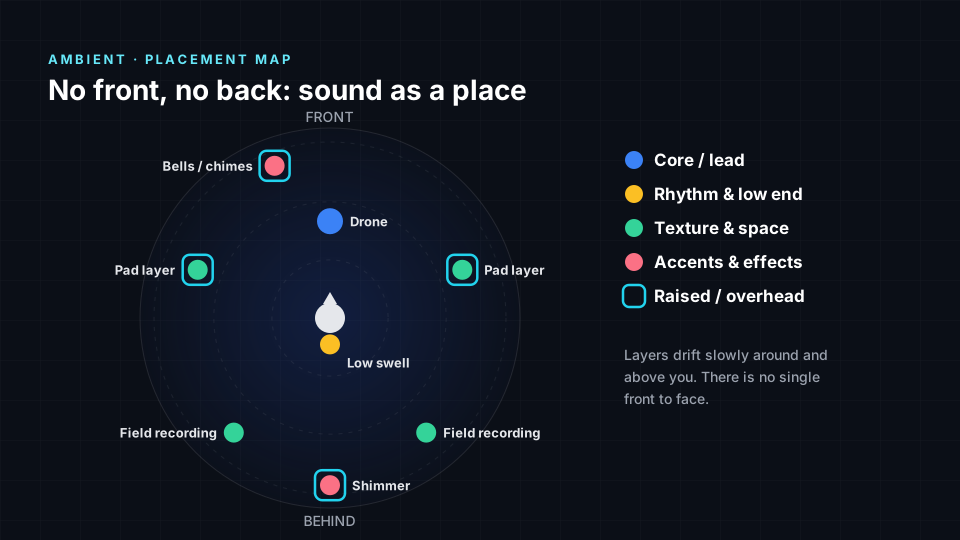
Immersive music for ambient: what listeners hear
- No edges. The music seems to fill the whole room, with no clear source.
- Slow motion. Pads and drones drift around the listener over many seconds, so the space keeps changing.
- Height as atmosphere. Bells, shimmer and high textures float overhead, like light coming through a ceiling.
Where to place each element in an ambient mix
| Element | Position | Height | Movement |
|---|---|---|---|
| Main drone | Front, wide | Ear level | Slow drift |
| Pad layers | Left and right | Raised | Slow orbit around the listener |
| Field recordings | Behind left and right | Ear level | Mostly still, like a real environment |
| Bells and chimes | Front left | Overhead | Occasional, gentle |
| Shimmer | Behind | Overhead | Slow fade in and out |
| Low swell | Centre | Ear level | Still |
The psychoacoustics behind ambient placement
Every position in the table above follows how the ear and brain locate sound. Here is the reason behind the main choices for ambient.
- Low swell centred, width from the higher layers. In real rooms and on most playback systems, sub-bass below roughly 80 to 100 Hz gives the brain very little usable direction, which is why a single subwoofer can serve a whole speaker layout. Its direction is barely audible anyway, so the sense of space comes from the pads and textures above it.
- Pad layers left and right, raised. Sound arriving from the sides, slightly different at each ear, creates the feeling of being inside the music. Acousticians call this envelopment. Slightly different pads on each side are what make an ambient piece feel like a place.
- Bells, chimes and shimmer overhead. Height is heard mainly through treble: the folds of the outer ear colour frequencies above roughly 4 kHz differently for each elevation, so airy, bright parts are the ones that truly sound overhead. These are the brightest sounds in the piece, so they are the ones that truly read as height.
- Field recordings behind. Direction behind the head is less precise and front-back mix-ups are common, which makes the rear ideal for diffuse sounds that should wrap around you rather than point at you. Nature and room sounds should surround rather than point, which is exactly what the rear does best.
The immersion profile for ambient
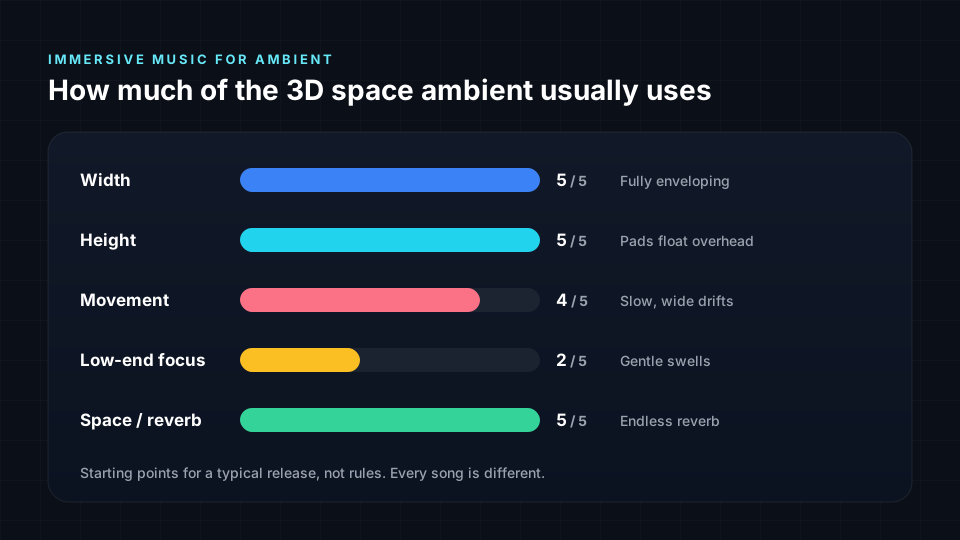
Ambient uses nearly every dimension at full strength. The difference from EDM is speed. Ambient movement is slow, measured in many seconds or even minutes, not in beats. The low end is gentle and steady, a foundation rather than a punch.
Ambient and Ambisonics
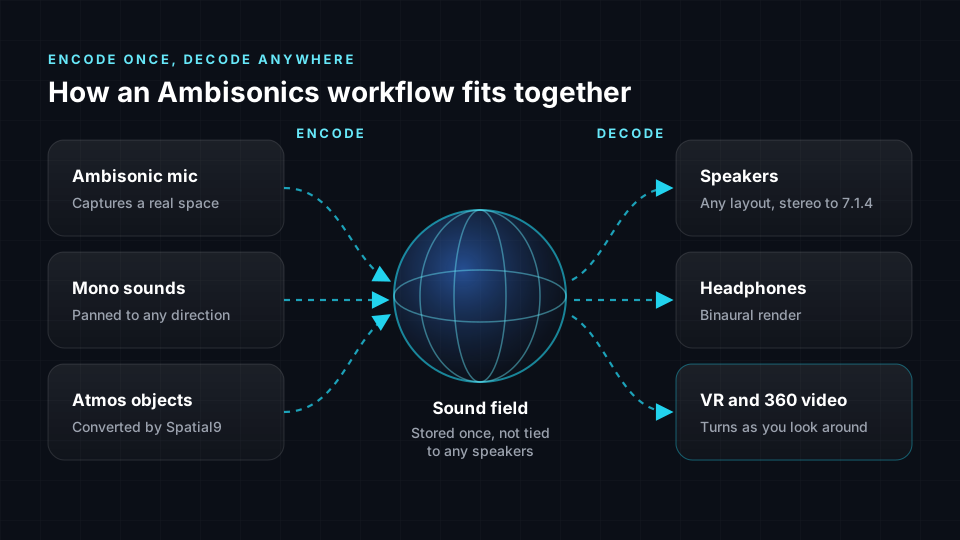
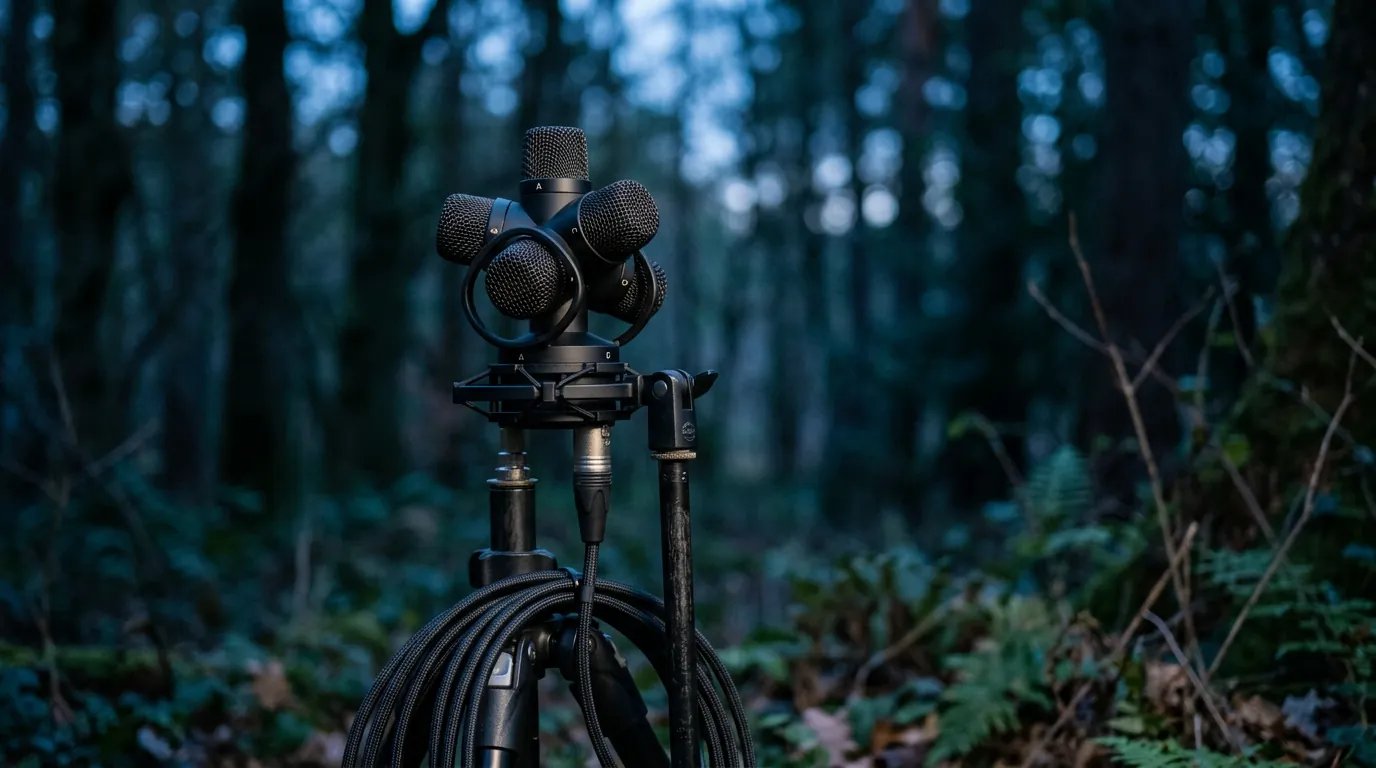
Many ambient artists work with field recordings, and Ambisonics is a natural way to capture and deliver them. An Ambisonic recording holds the whole sound field, so a forest, a beach or a city at night can be dropped around the listener exactly as it sounded.
Tips for an immersive ambient mix
- Forget the front. Let the music surround the listener evenly.
- Move slowly. Drifts that take many seconds feel natural. Fast motion pulls the listener out of the mood.
- Use height generously. High textures, bells and shimmer belong overhead.
- Keep the low end calm. A steady, gentle swell grounds the piece.
- Listen for long periods. Ambient is often played for hours, so check how the mix feels over time, at low volume and on headphones through binaural rendering.
How to make immersive ambient music from a stereo piece
Spatial9 can create spatial audio from a stereo piece:
- Upload your stereo master, or stems for each layer.
- Spatial9's AI separates the layers and places them in 3D, with movement that follows the music.
- Listen in binaural on headphones.
- Export Eclipsa Audio, ADM, binaural or Ambisonics. Third-order Ambisonics keeps a lot of spatial detail.
- Publish a long-form video. Create a YouTube-ready video with your immersive audio and your own visuals, and publish it directly.
For the high-energy side of electronic music, read spatial audio for EDM. For cosy, beat-based mood music, see spatial audio for lo-fi. Every genre is in spatial audio and immersive music by genre.
Frequently asked questions
Can I make an ambient mix in Dolby Atmos or Eclipsa Audio?
Yes. The placements in this guide work for both. Spatial9 exports ADM, the standard file used by Dolby Atmos studios, as well as Eclipsa Audio for YouTube, so one immersive ambient mix covers both. You may also hear this called a 3D ambient mix or ambient in spatial audio. It is the same idea.
Is spatial audio good for ambient music?
Yes. Ambient is arguably the best genre for spatial audio, because it has no need for a front or a stage. Layers can surround the listener and drift slowly through the space.
How fast should sounds move in an immersive ambient mix?
Slowly, over many seconds or longer. Slow drifts feel natural and calming, while fast motion breaks the mood.
Is Ambisonics good for ambient music?
Yes. Ambisonics captures and delivers a full sound field, which suits field recordings and enveloping textures. It can be decoded for headphones or any speaker layout.
Can I convert a stereo ambient track to spatial audio?
Yes. Spatial9 uses AI to create an immersive mix from a stereo file and exports it as Eclipsa Audio, ADM, binaural or Ambisonics.
Does immersive ambient music work on headphones?
Yes. Binaural rendering lets listeners hear the full 3D space on any regular headphones.
Dolby and Dolby Atmos are trademarks of Dolby Laboratories. Spatial9 is not affiliated with or endorsed by Dolby Laboratories.
Sources
- Blauert, J. (1997). Spatial Hearing: The Psychophysics of Human Sound Localization, revised edition. MIT Press. Low-frequency, elevation, distance and motion cues.
- Mills, A. W. (1958). On the minimum audible angle. Journal of the Acoustical Society of America, 30(4), 237-246.
- Hebrank, J. and Wright, D. (1974). Spectral cues used in the localization of sound sources on the median plane. Journal of the Acoustical Society of America, 56(6), 1829-1834.
- Bronkhorst, A. W. (2000). The cocktail party phenomenon: a review of research on speech intelligibility in multiple-talker conditions. Acta Acustica united with Acustica, 86, 117-128.
- Litovsky, R. Y., Colburn, H. S., Yost, W. A. and Guzman, S. J. (1999). The precedence effect. Journal of the Acoustical Society of America, 106(4), 1633-1654.
- Barron, M. and Marshall, A. H. (1981). Spatial impression due to early lateral reflections in concert halls. Journal of Sound and Vibration, 77(2), 211-232.
- Neuhoff, J. G. (1998). Perceptual bias for rising tones. Nature, 395, 123-124.
- Bregman, A. S. (1990). Auditory Scene Analysis: The Perceptual Organization of Sound. MIT Press.
Step into your music
Upload a piece to Spatial9 and hear it surround you in an immersive mix in minutes.