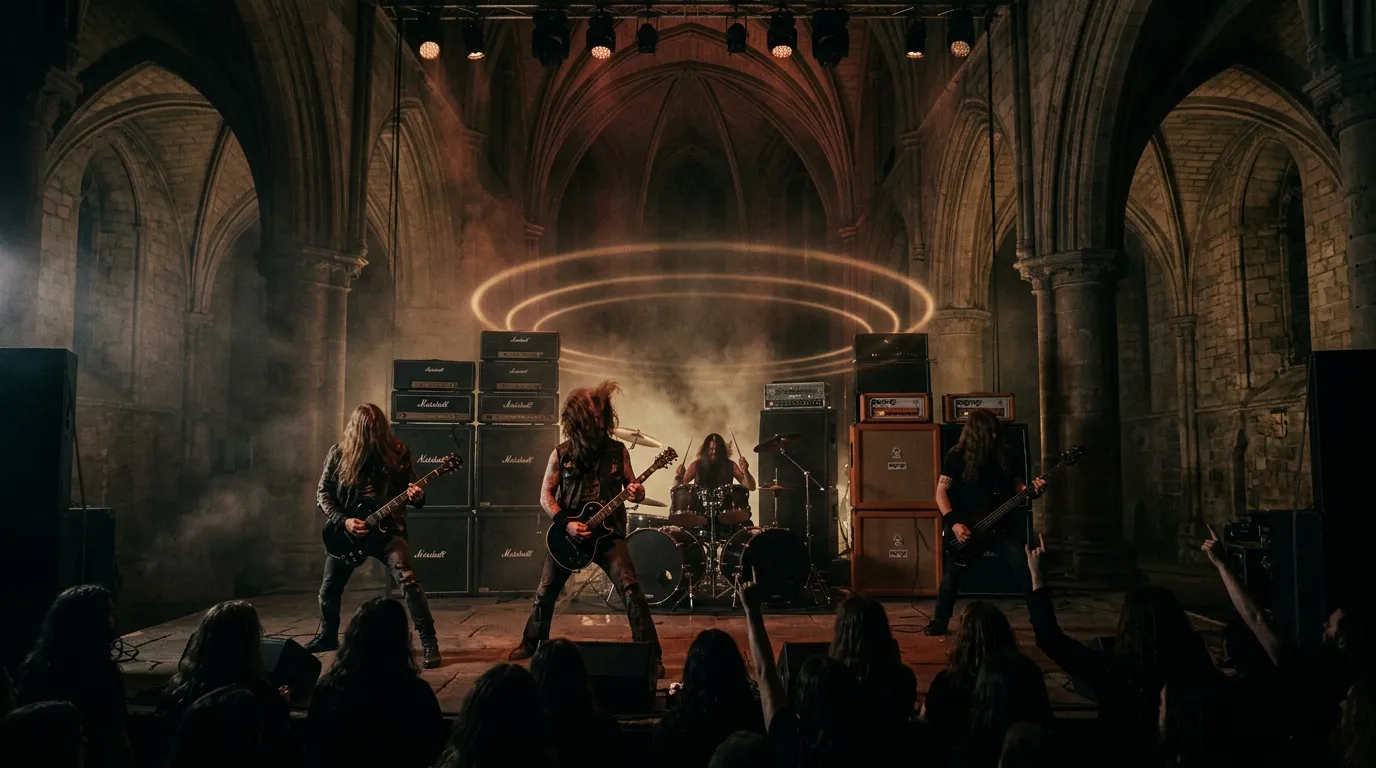
Spatial Audio & Immersive Music for Doom Metal: Funeral Doom, Sludge Metal, Drone Metal & Epic Doom
Spatial9 Team · · 10 min read
Part of the series Spatial audio and immersive music by genre.
Key takeaways
- In a spatial doom metal mix the kick, snare and detuned bass stay locked in the centre, while two guitar walls fill the sides and organ, cymbals, drones and reverb rise above and behind.
- Placing two separate guitar takes far left and far right creates a true wall of riff, because early lateral energy makes a sound feel wide and enveloping.
- Bright, sustained sounds such as cymbal decays and choir pads lift convincingly overhead, because the outer ear uses high-frequency cues to judge height.
- The doom metal immersion profile scores width 5, height 4, movement 2, low-end focus 5 and space 5 out of 5.
Doom metal takes its sound from the slowest, heaviest moments of early 1970s heavy metal, especially the tritone riffs and grim mood of Black Sabbath. Through the late 1970s and 1980s bands such as Pentagram, Saint Vitus and Trouble in the United States and Candlemass in Sweden turned that crawl into a genre of its own, and the early 1990s added funeral doom in Finland, sludge in the American South and the drone experiments of Earth in Seattle. The sound is slow, often 40 to 70 BPM, with guitars tuned down, amps pushed into thick saturation and riffs left to ring until the notes decay. Because doom leaves so much room between the hits, every decay, drone and echo becomes audible, which makes it one of the best fits for spatial audio. This guide covers how spatial audio for doom metal works, where to place each element and how to make an immersive doom metal mix. For the basics, see what spatial audio is.
Why doom metal works in spatial audio
Doom is built on weight and decay. In stereo the guitars, bass, cymbal wash and reverb pile into the same space, and the slow riffs turn into a grey smear. In an immersive mix the drums and bass stay solid in the middle, the guitar takes become walls on each side, and the long tails of cymbals, organ and feedback rise above and behind the listener.
The rule: a centred, crushing low end inside a vast dark room. The drums, bass and riff walls never wander, while drones, decays and reverb fill the height and the space behind.
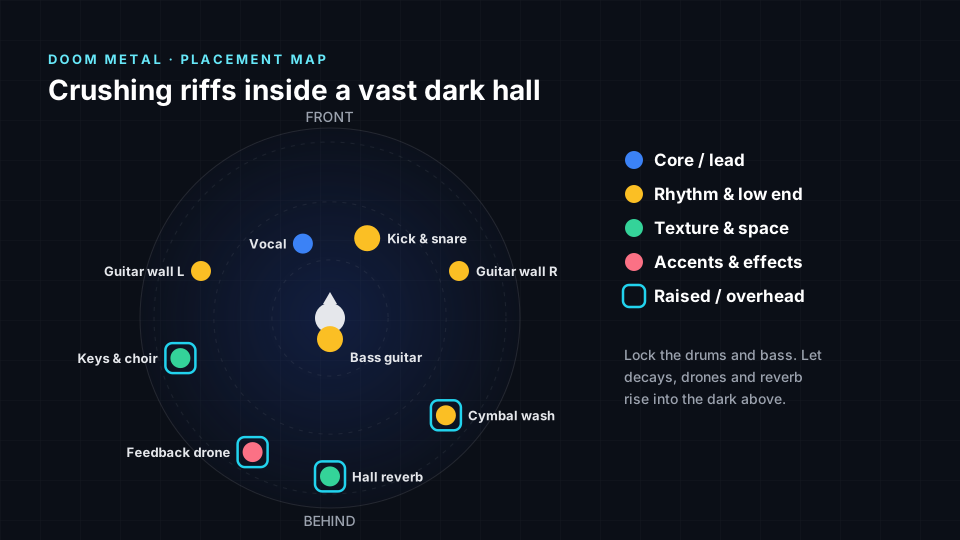
Immersive music for doom metal: what listeners hear
- A riff that surrounds you. Two guitar walls press in from both sides at once.
- Bass you feel in the floor. The detuned low end stays centred, steady and enormous.
- Decays that hang overhead. Cymbals, organ and choirs ring out above the band.
- Drones that drift behind. Feedback and noise move slowly through a huge, dark room.
Where to place each element in a doom metal mix
| Element | Position | Height | Why it works |
|---|---|---|---|
| Vocal | Front, just left of centre | Ear level | Clean or growled lines close and clear |
| Kick & snare | Front centre | Ear level | Slow hits that set the pace |
| Bass guitar | Centre | Ear level | Detuned weight under every riff |
| Guitar wall L | Left | Ear level | One take of the doubled riff |
| Guitar wall R | Right | Ear level | A second, separate take |
| Keys & choir | Behind left | Raised | Organ and choirs above the riff |
| Cymbal wash | Behind right | Raised | Long decays ring overhead |
| Feedback drone | Behind left, moving | Raised | Feedback that drifts slowly |
| Hall reverb | Behind | Raised | A huge, dark room around the band |
The psychoacoustics behind doom metal placement
Every position in the table above follows how the ear and brain locate sound. Here is the reason behind the main choices for doom metal.
- Bass and kick stay centred. The ear finds almost no direction in frequencies below roughly 80 to 100 Hz, so a detuned doom bass gains nothing from being spread. Keeping it centred and mono keeps it crushing on any system.
- Two guitar takes on opposite sides. Two takes of the same riff played at different moments arrive at each ear with slightly different timing and tone. Placed far left and far right, they form a wide wall rather than one blurred guitar, and early lateral energy like this is what makes a sound feel broad and enveloping (Barron and Marshall).
- Organ, choirs and cymbals above. The outer ear shapes the high frequencies of a sound differently depending on its height. These elevation spectral cues (Hebrank and Wright) work best on bright, sustained sounds, which is why cymbal decays and choir pads lift convincingly while the dark riff stays at ear level.
- Vocal off the riff. A voice and a distorted guitar share the same midrange. Two sounds mask each other far less when they come from different directions, an effect called spatial release from masking, so a vocal slightly forward and off centre stays clear inside the wall.
The immersion profile for doom metal
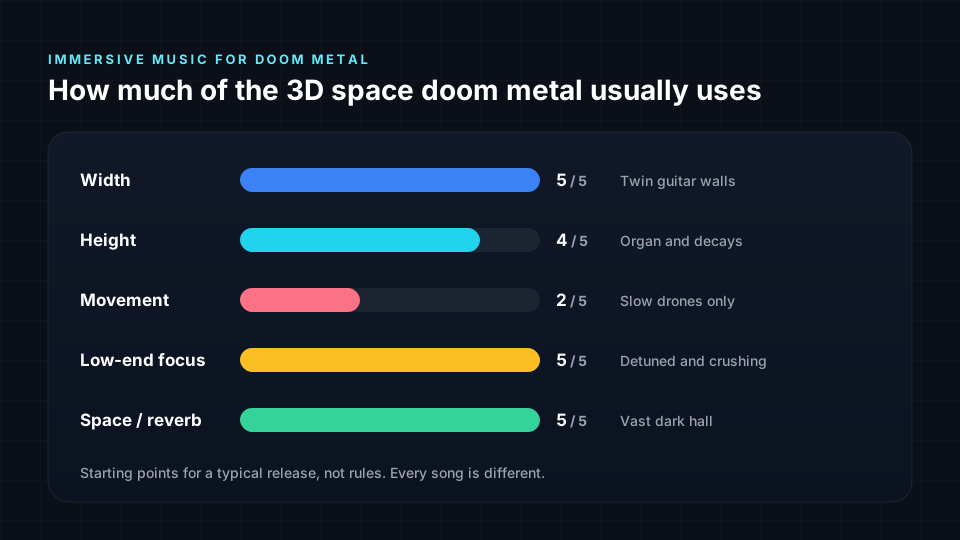
Width, low-end focus and space are all at maximum because doom is a wall of guitars over a detuned bass inside a vast, reverberant room. Height is high because organ, choirs and decays belong above the band. Movement stays low: doom is slow and deliberate, so only a feedback drone or a long swell drifts, and the riff itself never moves.
Tips for an immersive doom metal mix
- Keep the low end mono. Bass, kick and the lowest guitar energy belong in the centre.
- Track the riff twice. Two real takes, not one copied, give the wall true width.
- Give the decays room. Let cymbals, chords and feedback ring into the height channels.
- Move slowly or not at all. A moving drone should travel over many bars.
- Keep the reverb dark. Roll off the bright top so the hall feels heavy and cold.
Doom Metal styles: funeral doom, sludge metal, drone metal and epic doom
The core placement holds for every doom metal style: drums and bass in the middle, guitar walls on the sides, decays and drones above and behind. What changes is the tempo, the amount of grit and how much of the track is pure atmosphere.
Funeral Doom
Funeral doom emerged in Finland in the early 1990s and slows doom to an almost static crawl, with deep growled vocals, mournful keyboards and riffs that last for minutes. It needs the most space of any doom style. Wrap organ and synth pads around and above the listener, and let reverb tails fill the room completely between each slow hit. Keep the growl close and centred so it feels intimate against the scale of the room. Hold the bass and kick dead centre and mono, and keep every guitar take steady rather than moving.
Sludge Metal
Sludge metal grew in the late 1980s and 1990s, with New Orleans as its best-known home, mixing doom riffs with hardcore punk aggression, screamed vocals and harsh feedback. It is dirtier and drier than classic doom, so use less reverb and a smaller, closer room. Keep the guitar walls wide and hard, the bass thick and centred, and the screamed vocal forward. Feedback squeals and amp noise can sit raised behind, moving briefly between riffs. Tighten the space for fast hardcore sections.
Drone Metal
Drone metal strips doom down to sustained, heavily amplified chords with few or no drums, a sound shaped by Earth in the early 1990s. Here the space is the music. Spread the sustained guitar layers into a full circle around the listener, with the brightest harmonics raised overhead. Let a single drone layer travel very slowly through the room so the texture keeps shifting. Keep the deepest fundamental centred and mono so the floor stays solid while overtones bloom above.
Epic Doom
Epic doom, defined by Candlemass in the mid 1980s, pairs slow riffs with operatic clean vocals, choirs and a grand, almost ceremonial mood. The voice is the lead, so place it front and close, slightly above the riff for a sense of stature. Choirs and organ belong raised behind, wide and steady, like a church around the band. Keep the guitar walls wide but controlled so the melody can soar, and give the drums a big, natural hall.
Related styles such as stoner doom and death doom follow the same idea: lock the drums and bass, widen the riff, then fill the height with decay and atmosphere.
How to make immersive doom metal from stereo
Spatial9 can create spatial audio from a stereo track in a few steps:
- Upload your stereo master or your stems.
- Spatial9's AI separates and places each part, locking the drums and detuned bass in the centre, spreading the guitar walls and lifting organ, cymbals and drones into a dark hall.
- Preview it in binaural on headphones.
- Export Eclipsa Audio, ADM, binaural or Ambisonics.
- Publish a video. Create a YouTube-ready video with your immersive audio and publish it directly.
For related guides, read spatial audio for stoner rock and spatial audio for black metal. Every guide is listed in spatial audio and immersive music by genre.
Frequently asked questions
Does this guide cover funeral doom, sludge metal, drone metal and epic doom?
Yes. Funeral doom wraps organ and reverb around a static riff. Sludge metal uses a drier, closer room. Drone metal spreads sustained guitars in a full circle. Epic doom puts an operatic vocal in front with choirs raised behind.
Can I make a doom metal mix in Dolby Atmos or Eclipsa Audio?
Yes. The placements in this guide work for both. Spatial9 exports ADM, the standard file used by Dolby Atmos studios, as well as Eclipsa Audio for YouTube, so one immersive doom metal mix covers both. If you plan to release the Atmos version on Apple Music, build it from your original stems or multitracks, because Apple does not accept Atmos made from a finished stereo master. See where to publish spatial audio. You may also hear this called a 3D doom metal mix or doom metal in spatial audio.
Is spatial audio good for doom metal?
Yes. Doom fills the long gaps between its hits with decay, feedback and reverb. Spatial audio gives that atmosphere height and depth while the riff and bass stay centred.
How is doom metal different from stoner rock in spatial audio?
Stoner rock is groovier and warmer, with a tighter room and more movement from fuzz leads. Doom metal is slower and darker, so its mix leans on wide guitar walls, long decays and a vast reverb.
Should the guitar walls move in an immersive doom metal mix?
No. Keep both guitar takes fixed on their sides, because the listener feels the riff as the ground under the song. Let feedback, drones and swells carry any movement, slowly and over many bars.
Can I convert a finished doom metal track to spatial audio?
Yes. Spatial9 uses AI to generate an immersive mix from a stereo master and exports it as Eclipsa Audio, ADM, binaural or Ambisonics.
Does immersive doom metal work on normal headphones?
Yes. The mix is rendered binaurally, so the guitar walls and overhead decays work on any regular headphones.
Dolby and Dolby Atmos are trademarks of Dolby Laboratories. Spatial9 is not affiliated with or endorsed by Dolby Laboratories.
Sources
- Blauert, J. (1997). Spatial Hearing: The Psychophysics of Human Sound Localization, revised edition. MIT Press. Low-frequency, elevation, distance and motion cues.
- Mills, A. W. (1958). On the minimum audible angle. Journal of the Acoustical Society of America, 30(4), 237-246.
- Hebrank, J. and Wright, D. (1974). Spectral cues used in the localization of sound sources on the median plane. Journal of the Acoustical Society of America, 56(6), 1829-1834.
- Bronkhorst, A. W. (2000). The cocktail party phenomenon: a review of research on speech intelligibility in multiple-talker conditions. Acta Acustica united with Acustica, 86, 117-128.
- Litovsky, R. Y., Colburn, H. S., Yost, W. A. and Guzman, S. J. (1999). The precedence effect. Journal of the Acoustical Society of America, 106(4), 1633-1654.
- Barron, M. and Marshall, A. H. (1981). Spatial impression due to early lateral reflections in concert halls. Journal of Sound and Vibration, 77(2), 211-232.
- Neuhoff, J. G. (1998). Perceptual bias for rising tones. Nature, 395, 123-124.
- Bregman, A. S. (1990). Auditory Scene Analysis: The Perceptual Organization of Sound. MIT Press.
Step inside the riff
Upload a track to Spatial9 and hear your guitar walls and drones fill a vast, dark room. Then export it or publish it straight to YouTube.