Spatial Audio & Immersive Music for Film & Game Scores: Complete Guide
Spatial9 Team · · Updated
Part of the series Spatial audio and immersive music by genre.
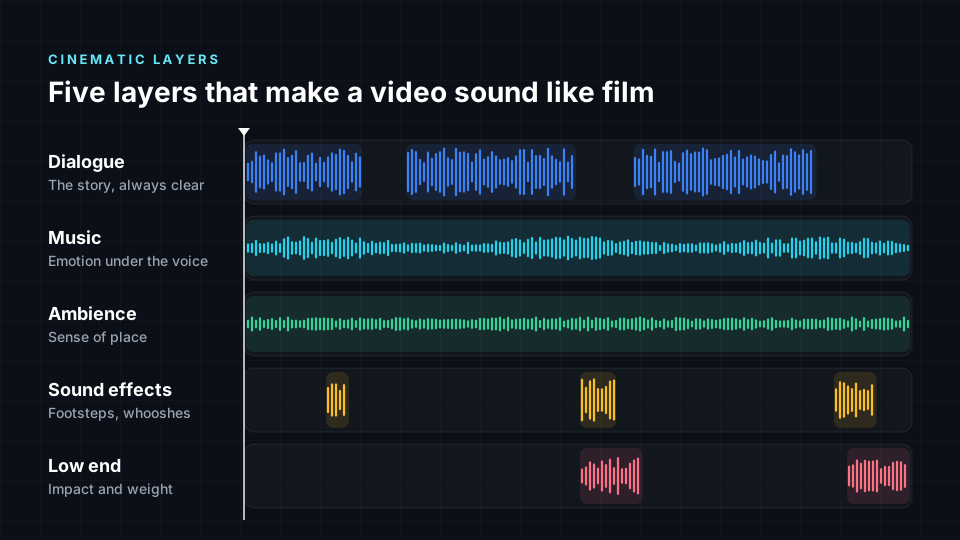
Film and game music was made for big spaces. Composers already think in layers: a theme, an orchestra, a choir, sound design and huge hits. In stereo, all of that has to fit between two speakers. In spatial audio, each layer gets its own place, and sound can move with the action on screen. This guide covers how spatial audio for film and game scores works, where to place each element and how to make an immersive score from a stereo mix. For the basics, see what spatial audio is.
Why film and game scores benefit from spatial audio
Cinemas have used surround sound for decades, and modern games react to where the player looks. Spatial audio brings that same depth to headphones, phones, TVs and YouTube, so a score can feel as big at home as it does in a theatre.
The rule: keep the theme clear, then use the whole sphere. The story leads, and the space supports it.
Immersive music for film and game scores: what listeners hear
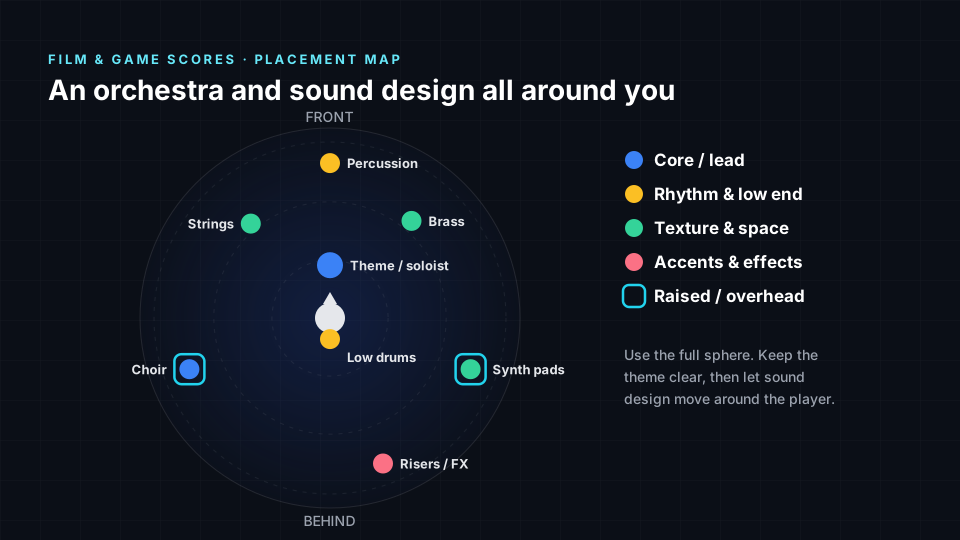
- A theme you can always find. The main melody stays focused in front.
- An orchestra laid out like a stage. Strings and brass spread across the front.
- Voices and pads above. Choir and synths rise overhead for a sense of scale.
- Sound that follows the story. Risers and effects sweep around the listener on big moments.
Where to place each element in a score
| Element | Position | Height | Why it works |
|---|---|---|---|
| Theme or soloist | Front centre | Ear level | Always easy to follow |
| Strings | Front left | Ear level | Orchestral stage layout |
| Brass | Front right | Ear level | Power and fanfare |
| Percussion | Far front | Ear level | Depth behind the orchestra |
| Low drums and hits | Centre | Ear level | Impact you feel |
| Choir | Left side | Raised | Scale and emotion |
| Synth pads | Right side | Raised | Modern atmosphere |
| Risers and effects | Moving, behind | Varies | Builds tension |
The psychoacoustics behind film & game scores placement
Every position in the table above follows how the ear and brain locate sound. Here is the reason behind the main choices for film & game scores.
- Theme or soloist in front. The ear's directional resolution is finest in front of the face and much coarser to the sides and behind, so the part you must follow belongs in front. The theme carries the story and must stay easy to follow under dialogue and effects.
- Strings left, brass right. When two sounds share a frequency range, separating them in direction makes each one easier to hear. Researchers call this spatial release from masking, the same effect that lets you follow one voice at a busy party. Splitting the sections keeps big orchestral moments clear instead of a single wall of sound.
- Choir and synth pads raised at the sides. Concert hall research shows that reflections from the sides, not from the front, create the sense of width and of being surrounded (Barron and Marshall, 1981). Sound from the sides and above creates the scale that film and game music needs.
- Risers and effects moving behind. Sounds that grow louder or rise in pitch are heard as approaching, and listeners tend to overestimate that change (Neuhoff, 1998). That bias is why rising sounds build tension so well. Approaching, rising sounds are one of the strongest tension tools a composer has.
The immersion profile for film and game scores
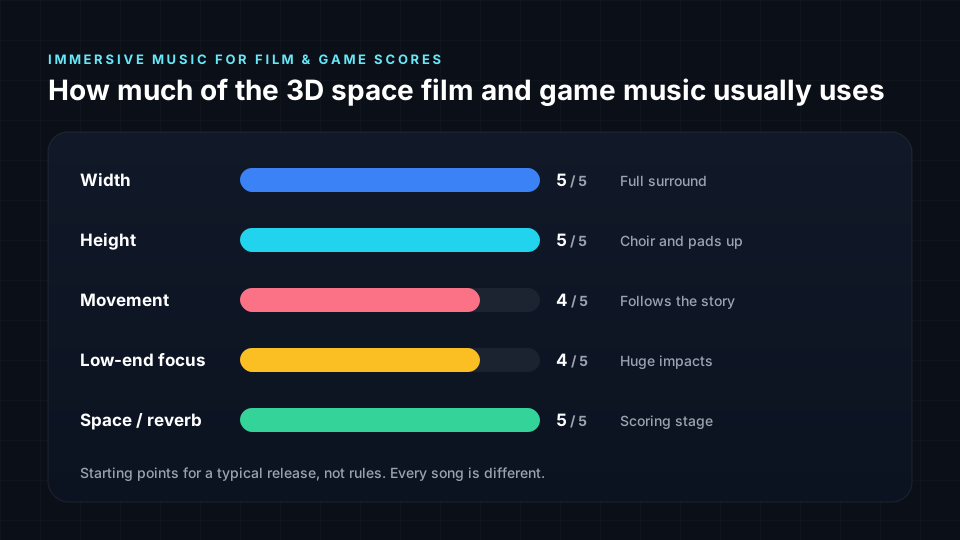
Scores score at the top on almost everything. They are the most immersive style of music, because they are built to support a picture or a world. Movement is high, but always tied to the action.
Tips for an immersive score
- Lay out the orchestra first. A natural stage layout gives the listener a strong anchor.
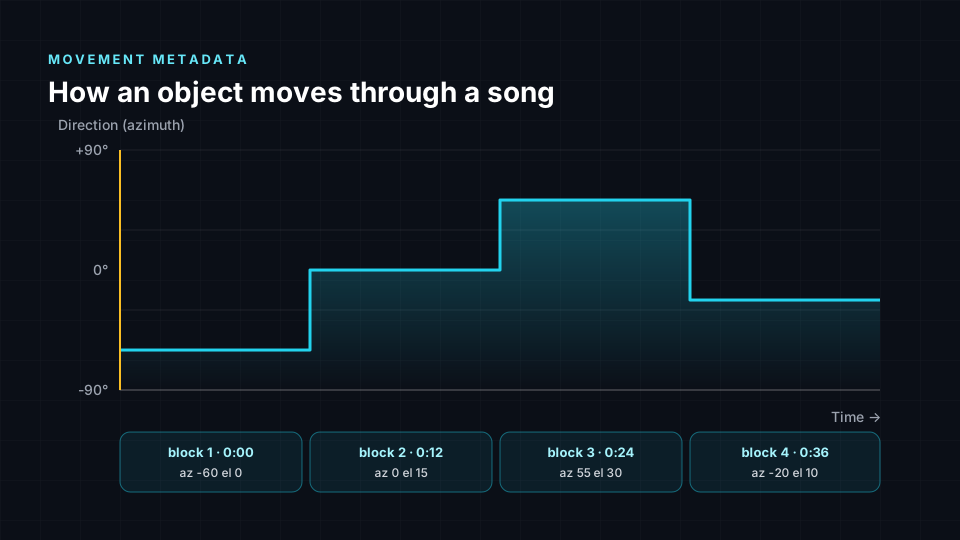
- Save movement for key moments. A sweep on a reveal or a jump scare has more power if the rest stays still.
- Use height for scale. Choir and pads above make a moment feel epic.
- Keep dialogue space in mind. For film, leave the front centre clear when characters speak.
- Think about every device. Players use headphones, TVs and phones, so check the binaural version.
How to make an immersive score from stereo
Spatial9 can create spatial audio from a stereo track in a few steps:
- Upload your stereo score or your stems.
- Spatial9's AI separates orchestra, choir and sound design and places each part in the sphere.
- Preview it in binaural on headphones.
- Export Eclipsa Audio, ADM, binaural or Ambisonics. Ambisonics works well for games and VR.
- Publish a video. Create a YouTube-ready video with your immersive audio and publish it directly.
If your score is already mixed in Dolby Atmos, you can also convert a Dolby Atmos mix to Eclipsa Audio for free.
For related guides, read spatial audio for classical music and spatial audio for ambient music. Every guide is listed in spatial audio and immersive music by genre.
Frequently asked questions
Can I make a film and game score mix in Dolby Atmos or Eclipsa Audio?
Yes. The placements in this guide work for both. Spatial9 exports ADM, the standard file used by Dolby Atmos studios, as well as Eclipsa Audio for YouTube, so one immersive film and game score mix covers both. You may also hear this called a 3D film and game score mix or film and game score in spatial audio. It is the same idea.
Is spatial audio good for film and game music?
Yes. Scores are built in layers and designed for big spaces, so they gain more from spatial audio than almost any other style.
Which format is best for game audio?
Ambisonics is popular for games and VR because it rotates smoothly with the player's head. Spatial9 can export Ambisonics as well as Eclipsa Audio and ADM.
Can I make a soundtrack album immersive?
Yes. Upload the stereo album or the stems, and Spatial9 creates an immersive version ready for streaming and YouTube.
Should the orchestra move around in 3D?
Usually not. Keep the orchestra in a stable stage layout and let only effects and key moments move.
Does an immersive score work on regular headphones?
Yes. Devices render the mix binaurally, so the 3D effect works on any regular headphones.
Dolby and Dolby Atmos are trademarks of Dolby Laboratories. Spatial9 is not affiliated with or endorsed by Dolby Laboratories.
Sources
- Blauert, J. (1997). Spatial Hearing: The Psychophysics of Human Sound Localization, revised edition. MIT Press. Low-frequency, elevation, distance and motion cues.
- Mills, A. W. (1958). On the minimum audible angle. Journal of the Acoustical Society of America, 30(4), 237-246.
- Hebrank, J. and Wright, D. (1974). Spectral cues used in the localization of sound sources on the median plane. Journal of the Acoustical Society of America, 56(6), 1829-1834.
- Bronkhorst, A. W. (2000). The cocktail party phenomenon: a review of research on speech intelligibility in multiple-talker conditions. Acta Acustica united with Acustica, 86, 117-128.
- Litovsky, R. Y., Colburn, H. S., Yost, W. A. and Guzman, S. J. (1999). The precedence effect. Journal of the Acoustical Society of America, 106(4), 1633-1654.
- Barron, M. and Marshall, A. H. (1981). Spatial impression due to early lateral reflections in concert halls. Journal of Sound and Vibration, 77(2), 211-232.
- Neuhoff, J. G. (1998). Perceptual bias for rising tones. Nature, 395, 123-124.
- Bregman, A. S. (1990). Auditory Scene Analysis: The Perceptual Organization of Sound. MIT Press.
Make your score feel like a world
Upload a score to Spatial9 and hear it fill the whole space in minutes. Then export it or publish it straight to YouTube.