Spatial Audio & Immersive Music for Jazz, Blues, Country & Folk Genres: Big Band, Delta Blues, Bluegrass & Celtic Folk
Spatial9 Team · · 9 min read
Key takeaways
- Jazz, blues, country and folk sound best in 3D when they recreate a real room with real players.
- Each instrument keeps a stable position and the singer or soloist stays in front; only free jazz and jazz fusion let solos move around the listener.
- Big band, brass band, Latin jazz and free jazz use the widest stage, while Delta blues and singer-songwriter music are the most intimate; bluegrass, Celtic folk and sea shanties sit close, like a session or a crew singing together.
- Height and depth come from natural room reverb rather than effects, from a small blues room to a ballroom for big band.
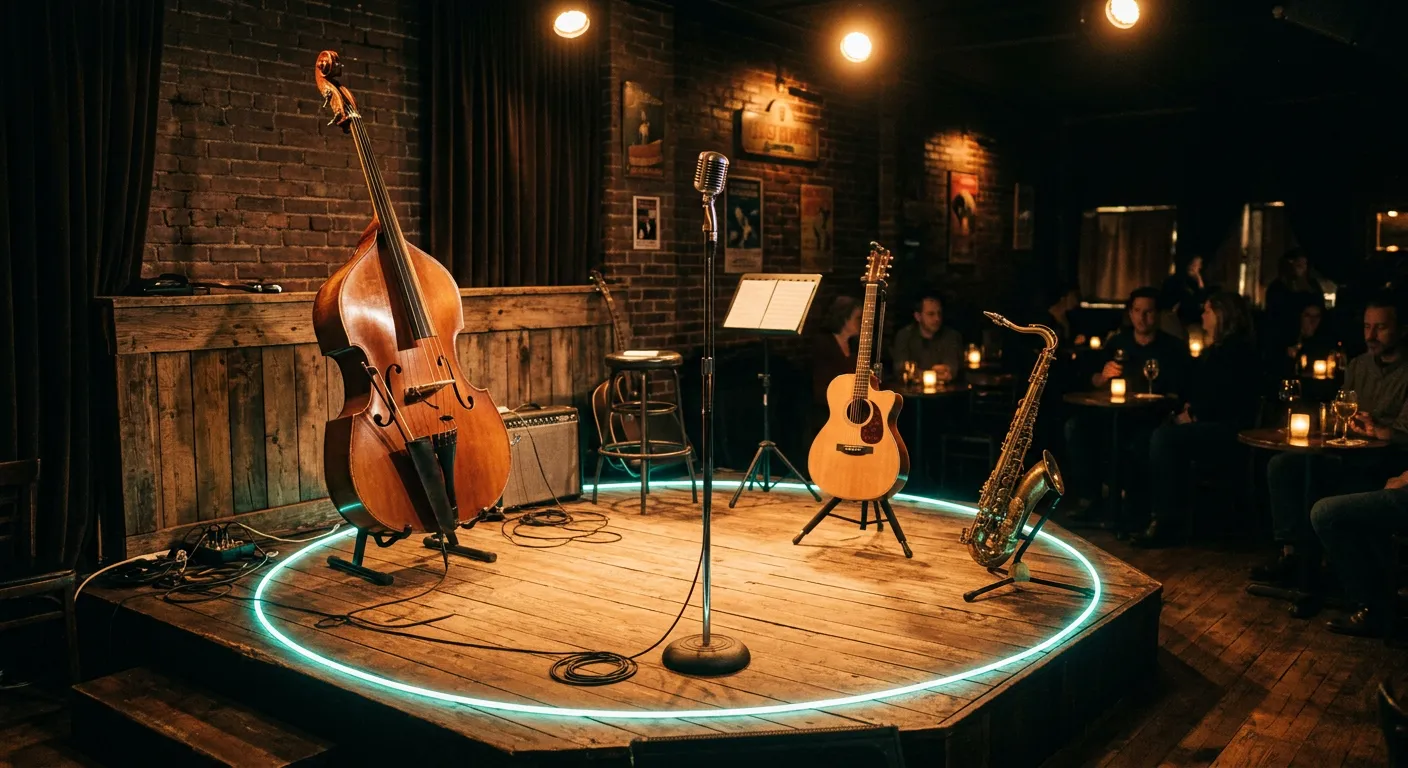
These genres were made by musicians playing together, from a lone Delta bluesman on a porch and a bluegrass band around one microphone to a 17-piece big band on a ballroom stage. Spatial audio can put the listener inside that room: the drummer behind, the bass to one side, the guitar or piano across, and the singer close in front.
This overview covers 27 genre guides. Each one has its own placement map, immersion profile and step-by-step tips. If you are new to 3D sound, start with what spatial audio is, or see how every genre changes a spatial mix.
What these genres have in common in 3D
- Real positions. Each player stays in one place, like a band on a stage. Only free jazz and jazz fusion let solos travel around the listener.
- Natural rooms. Reverb represents a real club, studio or church, which gives height and depth without sounding processed.
- A focused front. The singer or soloist stays in front so stories and solos stay clear.
- Moderate low end. Upright and electric bass sit centred but are rarely as heavy as in electronic or hip-hop music. Jazz fusion and acid jazz are the exceptions, with a deeper groove under the band.
Immersion scores for every genre in this family
Every genre guide scores five dimensions from 1 (barely used) to 5 (used to the full): width, height, movement, low-end focus and space or reverb. The table compares them side by side.
| Genre | Styles covered | Width | Height | Movement | Low end | Space |
|---|---|---|---|---|---|---|
| Acid Jazz | Nu Jazz, Broken Beat & Jazztronica | 4 | 2 | 3 | 4 | 3 |
| Americana | Alt-Country, Roots Rock & Country Soul | 3 | 2 | 1 | 2 | 3 |
| Big Band | Swing Era, Jazz Orchestra & Neo-Swing | 5 | 3 | 2 | 3 | 4 |
| Bluegrass | Old-Time, Newgrass & Appalachian Music | 3 | 2 | 2 | 2 | 3 |
| Blues | Chicago, Electric, Texas & Blues Rock | 3 | 2 | 1 | 3 | 4 |
| Boogie-Woogie | Barrelhouse, Stride Piano & Piano Blues | 3 | 2 | 1 | 3 | 3 |
| Brass Band | Marching Band, Second Line & Balkan Brass | 5 | 2 | 2 | 3 | 3 |
| Celtic Folk | Irish Trad, Scottish Folk & Celtic Rock | 4 | 2 | 2 | 2 | 4 |
| Country | Country Pop, Contemporary, Red Dirt & Texas Country | 3 | 2 | 2 | 3 | 3 |
| Delta Blues | Country Blues, Piedmont Blues & Acoustic Blues | 2 | 2 | 1 | 2 | 3 |
| Dixieland | New Orleans Jazz, Hot Jazz & Ragtime | 4 | 2 | 2 | 2 | 3 |
| Folk | Contemporary, Psychedelic, Freak Folk & Neofolk | 4 | 2 | 1 | 2 | 4 |
| Folk Pop | Indie Folk & Stomp-Clap Folk-Pop | 3 | 2 | 1 | 2 | 3 |
| Folk Rock | Jangling guitars and harmonies on a live stage | 4 | 2 | 1 | 3 | 3 |
| Free Jazz | Avant-Garde Jazz, Spiritual Jazz & Free Improvisation | 5 | 3 | 4 | 2 | 4 |
| Gypsy Jazz | Jazz Manouche, Hot Club Swing & Jazz Waltz | 3 | 2 | 2 | 2 | 3 |
| Jazz | Bebop, Hard Bop, Cool & Modal Jazz | 3 | 2 | 1 | 3 | 4 |
| Jazz Fusion | Jazz Rock, Jazz Funk & Electric Jazz | 4 | 3 | 4 | 4 | 3 |
| Latin Jazz | Afro-Cuban Jazz, Cubop & Latin Big Band | 5 | 2 | 3 | 3 | 3 |
| Rhythm & Blues | Jump Blues, Early R&B & New Orleans R&B | 3 | 2 | 2 | 3 | 3 |
| Sea Shanties | Work Songs, Forebitters & Maritime Folk | 4 | 2 | 1 | 2 | 3 |
| Singer-Songwriter | Acoustic, New Acoustic & Alternative Folk | 2 | 2 | 1 | 1 | 3 |
| Smooth Jazz | Contemporary Jazz, Jazz Pop & Crossover Jazz | 4 | 3 | 2 | 3 | 3 |
| Soul Jazz | Organ Trio, Groove Jazz & Boogaloo | 3 | 2 | 2 | 3 | 3 |
| Vocal Jazz | Jazz Standards, Scat & Crooner Ballads | 3 | 2 | 1 | 2 | 3 |
| Western Swing | Texas Swing, Cowboy Jazz & Honky-Tonk Swing | 4 | 2 | 2 | 2 | 3 |
| Zydeco | Cajun, Swamp Pop & Swamp Blues | 3 | 2 | 2 | 3 | 2 |
Average across the family: width 3.6, height 2.1, movement 1.8, low-end focus 2.6, space or reverb 3.2.
Where the genres differ most
- Width: highest (5 out of 5) in 4 genres, including Big Band, Brass Band and Free Jazz, lowest in Delta Blues and Singer-Songwriter (2 out of 5).
- Height: highest (3 out of 5) in 4 genres, including Big Band, Free Jazz and Jazz Fusion, lowest (2 out of 5) in 23 genres, including Acid Jazz, Americana and Bluegrass.
- Movement: highest in Free Jazz and Jazz Fusion (4 out of 5), lowest (1 out of 5) in 11 genres, including Americana, Blues and Boogie-Woogie.
- Low-end focus: highest in Acid Jazz and Jazz Fusion (4 out of 5), lowest in Singer-Songwriter (1 out of 5).
- Space or reverb: highest (4 out of 5) in 6 genres, including Big Band, Blues and Celtic Folk, lowest in Zydeco (2 out of 5).
Big band, brass band, Latin jazz and free jazz spread a full ensemble across the widest stage, and big band, free jazz, jazz fusion and smooth jazz add the most height. Free jazz and jazz fusion move the most, letting solos circle the listener. Delta blues and singer-songwriter music are the most intimate, often just a voice, a guitar and a quiet room, while zydeco keeps the driest, tightest dance-floor sound. Among the folk traditions, bluegrass gathers the band around a single microphone, Celtic folk rings melody players around a session table, and sea shanties put a lead singer in front with the whole crew answering from all sides.
The genre guides, section by section
Jazz and blues
Jazz and blues from the earliest New Orleans bands and Delta porches to swing orchestras, Latin jazz, fusion, free jazz and the acid jazz dance floor, plus the dance-hall sounds of rhythm and blues, boogie-woogie, western swing and zydeco. In all of them, the room and the interplay between players matter as much as any single instrument.
- Acid Jazz: A live band and a DJ on one dance floor.
- Big Band: A whole band laid out across the stage.
- Blues: A small band in a warm, close room.
- Boogie-Woogie: Two hands rolling on one piano.
- Brass Band: A marching band of horns and drums around the listener.
- Delta Blues: One singer and a guitar in a wooden room.
- Dixieland: Three horns weaving over a two-beat rhythm.
- Free Jazz: A circle of players improvising around you.
- Gypsy Jazz: A lead guitar between two pompe guitars.
- Jazz: A small club, every player in their spot.
- Jazz Fusion: A centred lead with solos circling around.
- Latin Jazz: A wide percussion line under a centred horn.
- Rhythm & Blues: A jump band live in a small studio.
- Smooth Jazz: A centred sax in a soft, wide studio.
- Soul Jazz: An organ combo in a small club.
- Vocal Jazz: A close singer in front of a quiet trio.
- Western Swing: A Texas dance hall band across the stage.
- Zydeco: An accordion band on a small dance floor.
Country and folk
Country, folk, bluegrass, Celtic folk, sea shanties, Americana and singer-songwriter music, built on storytelling vocals and acoustic instruments, from intimate solo songs and Appalachian string bands to Irish pub sessions, crew-sung work songs and full roots-rock bands.
- Americana: A roots band gathered on a wooden porch.
- Bluegrass: A string band around one microphone.
- Celtic Folk: A pub session circle around the listener.
- Country: Story-first vocal, the band in a half circle.
- Folk: Sitting in a circle with the musicians.
- Folk Pop: A warm voice and acoustic guitar with a gentle band around it.
- Folk Rock: Jangling guitars and harmonies on a live stage.
- Sea Shanties: A shantyman and his crew around the listener.
- Singer-Songwriter: Just you, a voice and an instrument.
How to make immersive jazz, blues, country and folk music from stereo
You do not need an immersive studio or the original multitrack session. Spatial9 uses AI to turn a stereo song into spatial audio. It separates the arrangement, places each element in 3D space following the profile of your genre, and exports a finished mix as Eclipsa Audio, ADM, binaural for headphones or Ambisonics. If you have stems, export them cleanly for even more control.
Frequently asked questions
Does jazz sound good in spatial audio?
Yes. Jazz is one of the most natural fits, because the listener can hear each player in a real position on a small stage, with the room around them, just like in a club.
Should instruments move in an immersive country or folk mix?
Rarely. These genres sound best when every instrument keeps a stable, natural position. Movement is saved for small details such as a fiddle fill or a pedal steel swell.
How much reverb should an immersive acoustic mix use?
Enough to suggest a real room around the listener. A short club or studio space works for jazz and blues; a slightly larger hall suits folk ballads and gospel-tinged country.
Which jazz styles change the immersive mix the most?
Big band, free jazz and jazz fusion change it the most. A big band needs a wide stage with saxophones, trombones and trumpets in rows, free jazz gives every improviser their own place in a full circle, and jazz fusion adds electric bass, synths and solos that can move around the listener.
How is an immersive blues mix different from a jazz mix?
Blues is usually smaller and closer. Delta blues can be a single voice and guitar in a wooden room, and electric or rhythm and blues adds a tight band with the vocal and lead guitar or sax in front. Jazz tends to use a slightly larger club room, with more space between the players.
How should bluegrass, Celtic folk and sea shanties be placed in 3D?
Keep them close and natural. Bluegrass works best with the vocal and bass centred and banjo, fiddle, mandolin and Dobro in a half circle, each soloist stepping forward for their break. Celtic folk places fiddle, flute, pipes and guitar around the listener like a pub session, and sea shanties put the shantyman in front with the crew chorus answering from all around.
Can I create immersive audio from an old stereo jazz or blues recording?
Yes. Spatial9 separates the instruments with AI and places them in a natural 3D layout, then exports Eclipsa Audio, ADM, binaural or Ambisonics.
Hear your genre in 3D
Pick the guide closest to your music above, then upload a track to Spatial9 to hear an immersive version in minutes.
Dolby and Dolby Atmos are trademarks of Dolby Laboratories. Spatial9 is not affiliated with or endorsed by Dolby Laboratories.