Spatial Audio & Immersive Music for Choral Music: Sacred Choral, Gregorian Chant & Choir
Spatial9 Team · · 10 min read
Part of the series Spatial audio and immersive music by genre.
Key takeaways
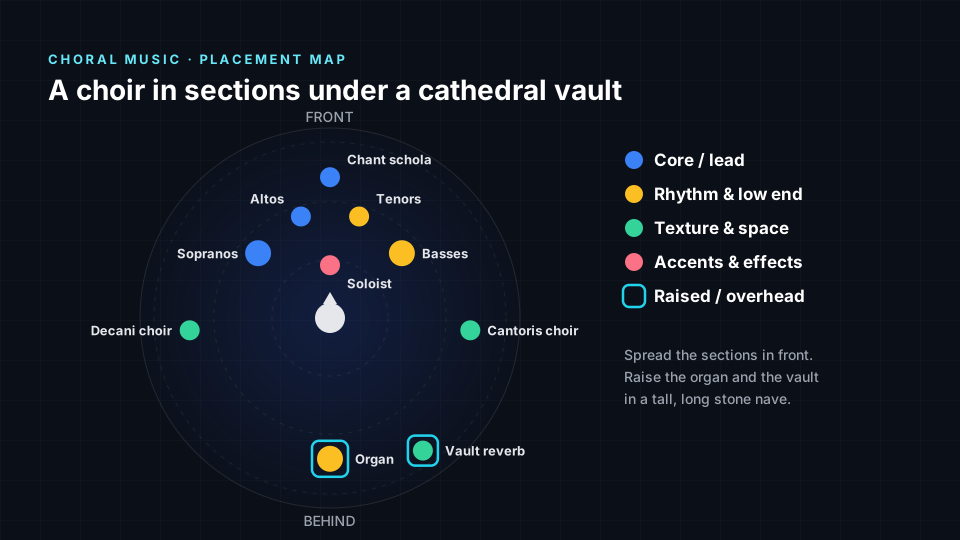
- In a spatial choral music mix the sections spread across a wide front arc, sopranos and altos on the left and tenors and basses on the right, with soloists close at the centre.
- Because the brain locates a sound by its first arrival, an effect known as the precedence effect, the choir stays clearly placed in front even inside a cathedral reverb lasting several seconds.
- Choral music was written for tall stone buildings, so a raised, long reverb and a gallery organ above and behind matter more than any movement.
- The choral music immersion profile scores width 5, height 4, movement 1, low-end focus 1 and space 5 out of 5.
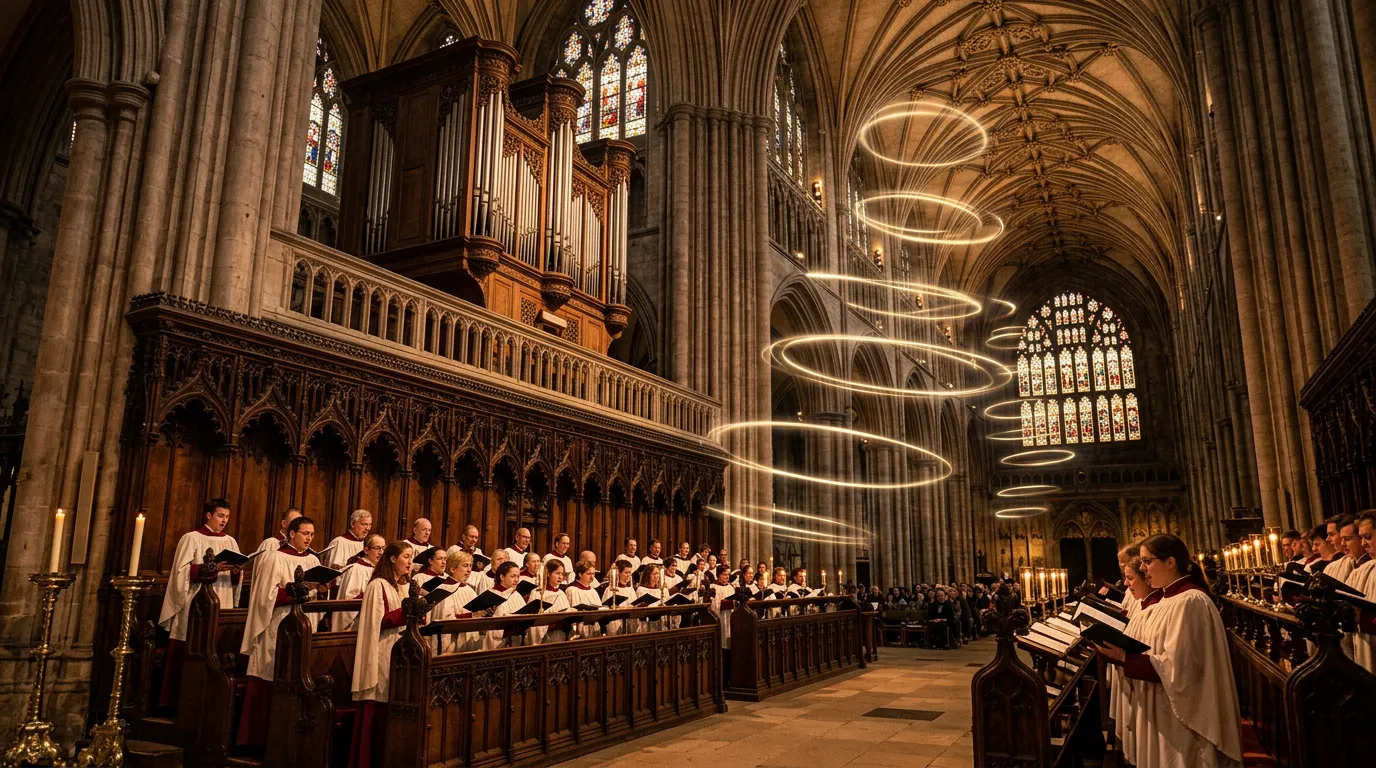
Choral music is music for a choir, with several singers on each part, and it began in the churches of medieval Europe. Gregorian chant, the unaccompanied Latin plainchant of the Western Church, took shape in the 8th and 9th centuries and was later named after Pope Gregory I. From around 1200 the singers of Notre-Dame in Paris added parts above the chant, and polyphony grew through the masses and motets of Josquin, Palestrina, Tallis and Byrd. In Venice, Giovanni Gabrieli wrote for divided choirs placed apart in St Mark's Basilica, and later came Bach's Passions, Handel's Messiah and the great requiems. Most choirs sing in four parts, soprano, alto, tenor and bass, at tempos shaped by the text and the breath. Recordings run from mono LPs to stereo sessions in cathedrals and chapels from the late 1950s. Choral music suits spatial audio because the building is part of the music, and an immersive mix can restore the height and depth that stereo flattens. This guide covers how spatial audio for choral music works, where to place each element and how to make an immersive choral music mix. For the basics, see what spatial audio is.
Why choral music works in spatial audio
Choral music is written for big, resonant spaces. In a cathedral the voices reach the listener directly, then bounce off pillars and a high stone vault for several seconds. Polyphony weaves four or more lines, and some composers wrote for choirs placed apart. Stereo squeezes all of this between two speakers, with the reverb stacked on the voices. In an immersive mix the sections spread across the front, the reverb rises above and behind, and divided choirs can face each other across the listener.
The rule: a wide choir in front, a tall stone space all around. Keep the sections steady in a broad front arc at ear level, and give the room height and a long tail so the listener stands inside the building.
Immersive music for choral music: what listeners hear
- A choir across the whole front. Each section has its own place, so the parts never merge into one block.
- Polyphony you can follow. Entries pass from sopranos to tenors to basses across the arc.
- A vault overhead. The reverb blooms above you, like standing under a stone ceiling.
- Choirs answering each other. In antiphonal music, one side sings and the other replies across the listener.
Where to place each element in a choral music mix
| Element | Position | Height | Why it works |
|---|---|---|---|
| Sopranos | Front left | Ear level | The top line, in the usual concert seat |
| Altos | Front left of centre | Ear level | The inner harmony beside the sopranos |
| Tenors | Front right of centre | Ear level | The upper male line, clear of the altos |
| Basses | Front right | Ear level | The foundation of the harmony |
| Soloist | Front centre, close | Ear level | Solo lines in masses, oratorios and anthems |
| Chant schola | Centre, further back | Ear level | A small unison group deep in the nave |
| Decani choir | Left side | Ear level | One half of a divided or antiphonal choir |
| Cantoris choir | Right side | Ear level | The answering half across the choir stalls |
| Organ | Behind | Raised | A gallery organ filling the building |
| Vault reverb | Behind right | Raised | The long tail of a high stone ceiling |
The psychoacoustics behind choral music placement
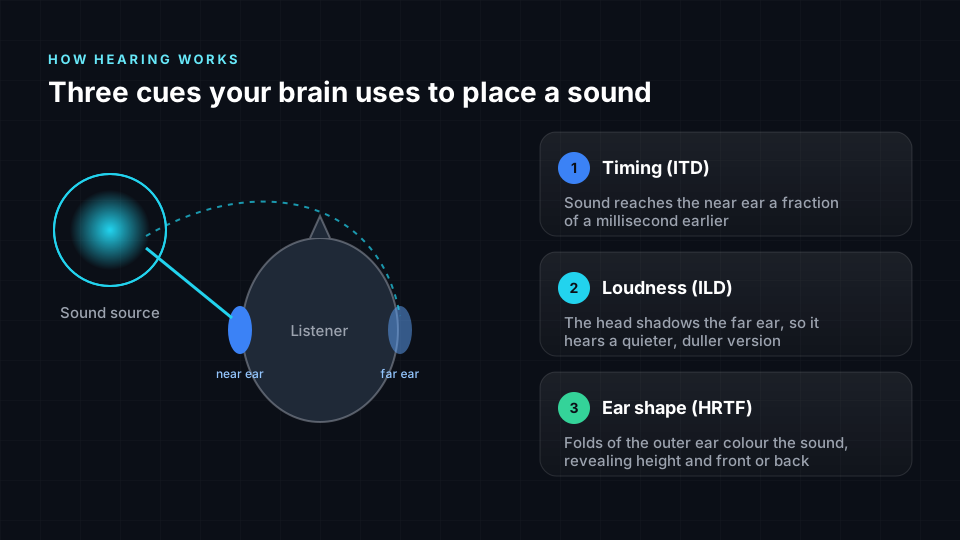
Every position in the table above follows how the ear and brain locate sound. Here is the reason behind the main choices for choral music.
- Sections split across the arc. The brain groups sounds into streams by pitch, timbre and direction. This is auditory stream segregation (Bregman). Giving each section its own direction lets the ear follow every line of a motet.
- Voices clear inside a long reverb. When a sound and its reflections arrive close together, the brain places it by the first arrival. This is the precedence effect. Keeping the direct voices in front lets the choir stay located while the tail fills the room.
- A vault you hear above you. The outer ear shapes the spectrum of a sound differently depending on its height. These are elevation spectral cues (Hebrank and Wright). Raised reverb and organ give the mix a real sense of a high ceiling.
- A nave that wraps around. Reflections from the sides soon after the direct sound make a room feel wide and enveloping. This is spatial impression from early lateral reflections (Barron and Marshall). They place the listener inside the building rather than in front of it.
The immersion profile for choral music
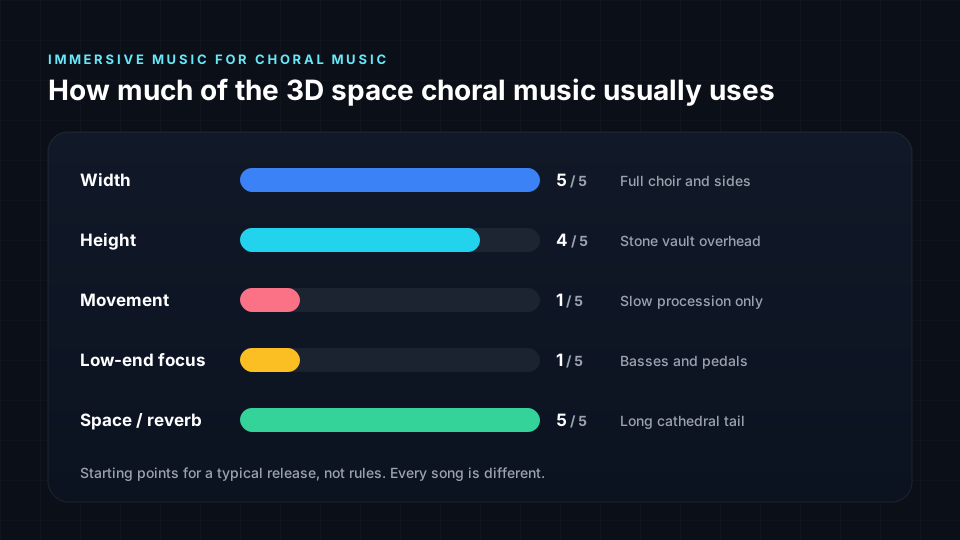
Space scores 5 because the room is part of the music: much choral writing was made for stone churches whose reverb lasts several seconds. Width scores 5: a full choir spreads across the front and antiphonal choirs reach the sides. Height scores 4, from the vault reverb and a gallery organ above. Low-end focus is 1 because the basses and organ pedals carry the low notes with no rhythm section. Movement scores 1, as choirs stand still and only a slow procession ever moves.
Tips for an immersive choral music mix
- Spread the sections across the front. Give sopranos, altos, tenors and basses their own steady places.
- Keep soloists close and centred. A soloist should sit in front of the choir, never lost in the reverb.
- Raise the reverb and the organ. Height turns a flat recording into a real nave or chapel.
- Let the tail be long but behind. Keep the direct voices clear in front and the decay around and above.
- Use space for divided choirs. Put antiphonal or polychoral groups on opposite sides of the listener.
Choral music styles: sacred choral, Gregorian chant and choir
The core placement holds for every style in this guide: voices steady in front, a tall, reverberant space around and above. What changes is the number of singers, the number of parts and how the singers are divided.
Sacred Choral
Sacred choral music covers masses, motets, anthems and requiems, from Palestrina and Byrd to Bach, Mozart, Bruckner and the English cathedral tradition. Place the sections in a wide arc in front, with the organ raised behind as if in a west gallery. In an English cathedral the choir sits in two halves facing each other, decani on the south side and cantoris on the north, so set the two halves on the left and right. For Venetian polychoral works or Tallis's forty-part Spem in alium, written for eight choirs of five voices, spread the choirs around the listener.
Gregorian Chant
Gregorian chant is sung in unison, without instruments, by a small group of monks, nuns or a schola, on Latin texts that follow the rhythm of the words. There is only one line, so the space is the main event. Place the schola at the centre, a little further back than a full choir, and keep it narrow, like a group standing together in an abbey church. Let the reverb rise high above. Bring a solo cantor slightly closer, and keep any procession slow and rare.
Choir
The concert choir, choral society and chamber choir sing everything from Handel's Messiah and Brahms's German Requiem to folk song arrangements and new commissions, often with orchestra or piano. Choirs stand either sopranos, altos, tenors and basses from left to right, or with women in front and men behind. With an orchestra, keep the players in front and the choir raised and further back, as on a concert platform. Use a shorter, warmer reverb than a cathedral, but keep plenty of height.
Related styles such as Orthodox liturgical chant, Byzantine chant and the carol service follow the same idea: keep the voices steady in front and let a tall, reverberant space surround the listener.
How to make immersive choral music from stereo
Spatial9 can create spatial audio from a stereo track in a few steps:
- Upload your stereo master or your stems.
- Spatial9's AI separates and places each part, pulling the sections, soloists, organ and room sound apart even from old mono or early stereo recordings and setting the choir in front with the reverb rising around and above.
- Preview it in binaural on headphones.
- Export Eclipsa Audio, ADM, binaural or Ambisonics.
- Publish a video. Create a YouTube-ready video with your immersive audio and publish it directly.
For related guides, read spatial audio for a cappella and spatial audio for gospel. Every guide is listed in spatial audio and immersive music by genre.
Frequently asked questions
Does this guide cover sacred choral, Gregorian chant and choir?
Yes. Sacred choral music spreads the sections in front with the organ raised behind and divided choirs at the sides. Gregorian chant puts a small unison schola at the centre under a tall, long reverb. Concert choirs follow the stage layout, with a warmer hall around them.
Can I make a choral music mix in Dolby Atmos or Eclipsa Audio?
Yes. The placements in this guide work for both. Spatial9 exports ADM, the standard file used by Dolby Atmos studios, as well as Eclipsa Audio for YouTube, so one immersive choral music mix covers both. If you plan to release the Atmos version on Apple Music, build it from your original stems or multitracks, because Apple does not accept Atmos made from a finished stereo master. See where to publish spatial audio. You may also hear this called a 3D choral music mix or choral music in spatial audio.
Is spatial audio good for choral music?
Yes. Choral music was written for tall, resonant buildings, and spatial audio restores that height while giving each section its own place.
Where should the organ go in an immersive choral mix?
Behind and raised, as if in a west gallery. That keeps it from covering the voices and fills the building from above.
How much reverb does immersive choral music need?
More than most genres. A cathedral tail can last five seconds or longer; place it above and behind so the words stay clear.
How do I place antiphonal or polychoral choirs?
Put each choir on its own side of the listener. For three or more choirs, spread them around and keep each one fixed.
Can I convert an old mono choir recording to spatial audio?
Yes. Spatial9 uses AI to separate the voices, organ and room sound from a mono or early stereo master. Separation is never perfect with so many singers, so keep the sections broad and let the reverb carry the height.
Dolby and Dolby Atmos are trademarks of Dolby Laboratories. Spatial9 is not affiliated with or endorsed by Dolby Laboratories.
Sources
- Blauert, J. (1997). Spatial Hearing: The Psychophysics of Human Sound Localization, revised edition. MIT Press. Low-frequency, elevation, distance and motion cues.
- Mills, A. W. (1958). On the minimum audible angle. Journal of the Acoustical Society of America, 30(4), 237-246.
- Hebrank, J. and Wright, D. (1974). Spectral cues used in the localization of sound sources on the median plane. Journal of the Acoustical Society of America, 56(6), 1829-1834.
- Bronkhorst, A. W. (2000). The cocktail party phenomenon: a review of research on speech intelligibility in multiple-talker conditions. Acta Acustica united with Acustica, 86, 117-128.
- Litovsky, R. Y., Colburn, H. S., Yost, W. A. and Guzman, S. J. (1999). The precedence effect. Journal of the Acoustical Society of America, 106(4), 1633-1654.
- Barron, M. and Marshall, A. H. (1981). Spatial impression due to early lateral reflections in concert halls. Journal of Sound and Vibration, 77(2), 211-232.
- Neuhoff, J. G. (1998). Perceptual bias for rising tones. Nature, 395, 123-124.
- Bregman, A. S. (1990). Auditory Scene Analysis: The Perceptual Organization of Sound. MIT Press.
Stand inside the cathedral
Upload a track to Spatial9 and hear the choir spread across the front while the stone vault rings above you in minutes. Then export it or publish it straight to YouTube.