Spatial Audio & Immersive Music for Rock & Metal Genres: Classic Rock, Punk, Post-Rock, Doom & Black Metal
Spatial9 Team · · 8 min read
Key takeaways
- Immersive rock and metal mixes usually recreate a band in front of the listener.
- Lead vocal, kick, snare and bass stay centred; rhythm guitars form a wide wall left and right.
- Cymbals, room sound and reverb add height, while fast movement is used sparingly.
- Psychedelic rock, post-rock, shoegaze, symphonic rock and doom metal are the exceptions that can surround the listener completely.
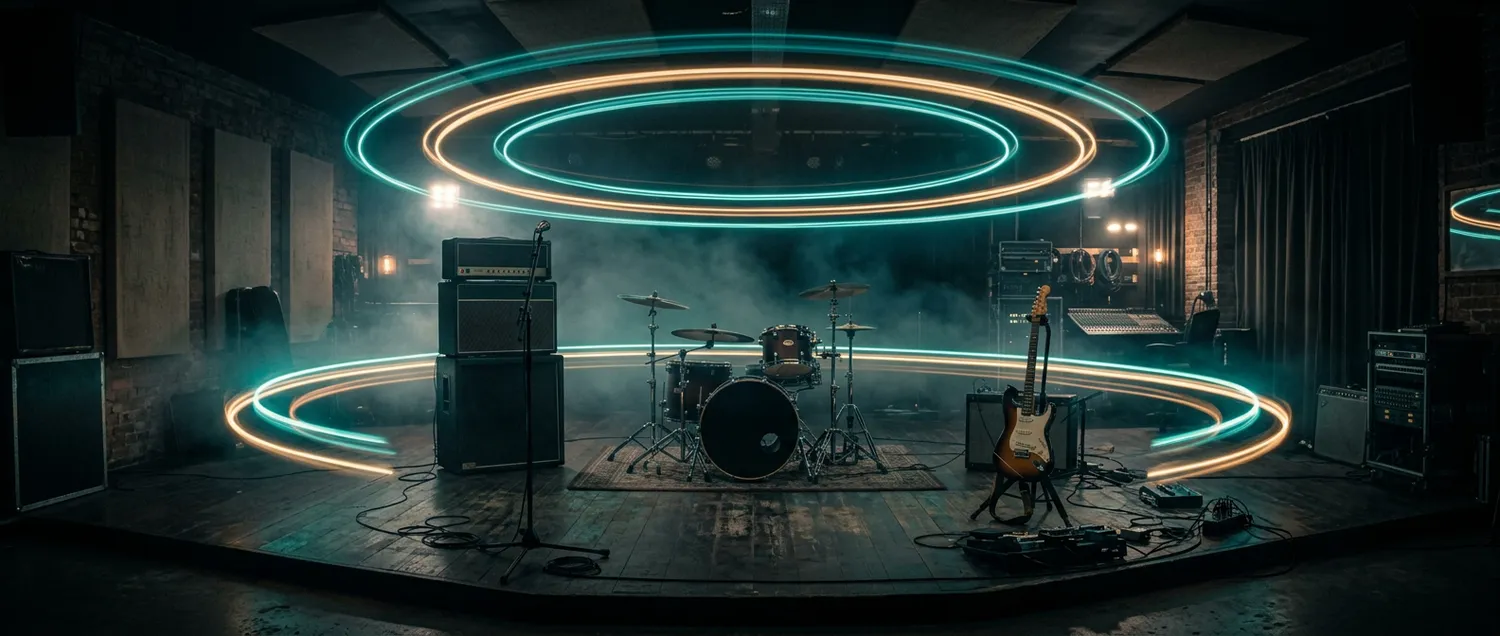
Rock is played by people in a room, and its immersive mixes usually try to recreate that room: the drummer behind the singer, two guitars on either side, the crowd or the hall all around. Metal turns the same picture up to full power, with denser guitars and a heavier low end. A few styles break the picture on purpose: psychedelic rock and post-rock fill the whole room with swirling, rising sound, and black and doom metal turn the hall into a vast, dark space.
This overview covers 26 genre guides, from garage rock and rockabilly to post-punk, post-rock, doom, black and progressive metal. Each one has its own placement map, immersion profile and step-by-step tips. If you are new to 3D sound, start with what spatial audio is, or see how every genre changes a spatial mix.
What these genres have in common in 3D
- A band in front of you. Lead vocal, kick, snare and bass stay in the centre. The listener faces the stage.
- Wide guitar walls. Double-tracked rhythm guitars spread hard left and right, and can wrap slightly toward the sides.
- Height from cymbals and room. Overheads, room microphones and reverb rise above the listener and make the kit feel real.
- Little movement. Solos, delays and effects can move briefly, but most of the mix stays fixed so the energy is not diluted.
Immersion scores for every genre in this family
Every genre guide scores five dimensions from 1 (barely used) to 5 (used to the full): width, height, movement, low-end focus and space or reverb. The table compares them side by side.
| Genre | Styles covered | Width | Height | Movement | Low end | Space |
|---|---|---|---|---|---|---|
| Alternative | Grunge, Britpop & College Rock | 4 | 3 | 3 | 3 | 4 |
| Black Metal | Atmospheric Black Metal, Symphonic Black Metal & Raw Black Metal | 5 | 4 | 3 | 2 | 5 |
| Death Metal | Technical, Melodic & Brutal Death Metal | 5 | 3 | 2 | 5 | 2 |
| Doom Metal | Funeral Doom, Sludge Metal, Drone Metal & Epic Doom | 5 | 4 | 2 | 5 | 5 |
| Emo | Midwest Emo, Screamo & Emo Pop | 4 | 2 | 2 | 3 | 3 |
| Folk Metal | Viking Metal, Pagan Metal & Celtic Metal | 5 | 3 | 2 | 4 | 4 |
| Garage Rock | Proto-Punk, Garage Punk & Garage Rock Revival | 3 | 2 | 2 | 3 | 3 |
| Indie | Indie Rock, Indie Pop, Jangle Pop & Madchester | 3 | 3 | 2 | 2 | 3 |
| Math Rock | Math Pop, Japanese Math Rock & Noise Rock | 4 | 2 | 4 | 3 | 2 |
| Metal | Heavy Metal, NWOBHM, Glam & Groove Metal | 4 | 3 | 2 | 5 | 2 |
| Metalcore | Deathcore, Post-Hardcore & Mathcore | 4 | 3 | 3 | 5 | 3 |
| Nu Metal | Rap Metal, Alternative Metal & Industrial Metal | 4 | 3 | 4 | 5 | 3 |
| Pop Rock | Power Pop & Adult Alternative | 4 | 3 | 2 | 3 | 3 |
| Post-Punk | Gothic Rock, Cold Wave & Post-Punk Revival | 4 | 3 | 3 | 4 | 4 |
| Post-Rock | Slowcore, Post-Metal & Instrumental Rock | 5 | 5 | 3 | 3 | 5 |
| Power Metal | Melodic Power Metal, Euro Power Metal & US Power Metal | 5 | 5 | 3 | 4 | 5 |
| Progressive Metal | Djent, Progressive Metalcore & Avant-Garde Metal | 5 | 4 | 4 | 4 | 4 |
| Psychedelic Rock | Acid Rock, Space Rock, Krautrock & Neo-Psychedelia | 5 | 4 | 5 | 3 | 5 |
| Punk | Hardcore Punk, Pop Punk, Crust & Folk Punk | 3 | 2 | 1 | 3 | 1 |
| Rock | Classic, Hard, Arena & Southern Rock | 4 | 3 | 1 | 4 | 4 |
| Rockabilly | Rock and Roll, Psychobilly & Neo-Rockabilly | 3 | 2 | 1 | 3 | 3 |
| Shoegaze | Dream Pop, Blackgaze & Nu-Gaze | 5 | 4 | 2 | 3 | 5 |
| Stoner Rock | Desert Rock, Heavy Psych & Fuzz Rock | 4 | 3 | 3 | 5 | 3 |
| Surf Rock | Instrumental Surf, Surf Punk & Surf Pop | 4 | 2 | 2 | 3 | 4 |
| Symphonic Rock | Progressive Rock, Art Rock & Symphonic Metal | 5 | 5 | 2 | 4 | 5 |
| Thrash Metal | Speed Metal, Crossover Thrash & Bay Area Thrash | 4 | 2 | 3 | 4 | 2 |
Average across the family: width 4.2, height 3.2, movement 2.5, low-end focus 3.7, space or reverb 3.5.
Where the genres differ most
- Width: highest (5 out of 5) in 10 genres, including Shoegaze, Symphonic Rock and Psychedelic Rock, lowest (3 out of 5) in 4 genres, including Indie, Punk and Garage Rock.
- Height: highest in Symphonic Rock, Post-Rock and Power Metal (5 out of 5), lowest (2 out of 5) in 7 genres, including Punk, Garage Rock and Surf Rock.
- Movement: highest in Psychedelic Rock (5 out of 5), lowest in Rock, Punk and Rockabilly (1 out of 5).
- Low-end focus: highest (5 out of 5) in 6 genres, including Stoner Rock, Metal and Death Metal, lowest in Indie and Black Metal (2 out of 5).
- Space or reverb: highest (5 out of 5) in 7 genres, including Shoegaze, Symphonic Rock and Psychedelic Rock, lowest in Punk (1 out of 5).
Classic and arena rock use a big, natural room. Punk, rockabilly, thrash and death metal keep a tight, aggressive space with little movement. Shoegaze, symphonic rock, psychedelic rock and post-rock are the exceptions: their walls of guitar, swirling effects and slow crescendos can surround the listener completely. Doom and black metal go furthest into reverb, while stoner rock, metalcore and nu metal put the most weight into the low end.
The genre guides, section by section
Rock and alternative
From classic and hard rock to garage rock, rockabilly, surf and punk, the cold spaces of post-punk, the raw feeling of emo, the haze of shoegaze and psychedelic rock, the crescendos of post-rock, the odd metres of math rock, the fuzz of stoner rock and the long-form ambition of symphonic and progressive rock.
- Alternative: Room to experiment with texture and space.
- Emo: A close voice inside a wall of guitars.
- Garage Rock: A loud band crammed into a small room.
- Indie: Intimate vocal, a bedroom-sized room around you.
- Math Rock: Interlocking riffs, each in its own place.
- Pop Rock: A big vocal in front of a wide wall of guitars.
- Post-Punk: A bass and drum spine in a cold room.
- Post-Rock: Slow builds that rise around you.
- Psychedelic Rock: A steady core inside a swirling room.
- Punk: Loud, fast and right in your face.
- Rock: The band on stage, you in the front row.
- Rockabilly: A live band on a small stage.
- Shoegaze: A wall of guitars you can sink into.
- Stoner Rock: A heavy core wrapped in a wall of fuzz.
- Surf Rock: A sharp guitar riding a wave of reverb.
- Symphonic Rock: A rock band in front of an orchestra and choir.
Metal
Heavy styles with dense guitars and a low end you can feel, from heavy metal, thrash and power metal to doom, black and death metal, plus metalcore, nu metal, progressive metal and folk metal.
- Black Metal: Tremolo walls inside a cold storm.
- Death Metal: A riff wall at full speed, locked at the core.
- Doom Metal: Crushing riffs inside a vast dark hall.
- Folk Metal: Folk melodies in front of a guitar wall.
- Metal: A wall of guitars, a punch you can feel.
- Metalcore: Heavy breakdowns under a wide guitar wall.
- Nu Metal: Heavy groove with hip-hop layers around it.
- Power Metal: A metal band under a soaring choir.
- Progressive Metal: Odd metres around a steady centre.
- Thrash Metal: Tight riffs on each side of a fast pit.
How to make immersive rock and metal music from stereo
You do not need an immersive studio or the original multitrack session. Spatial9 uses AI to turn a stereo song into spatial audio. It separates the arrangement, places each element in 3D space following the profile of your genre, and exports a finished mix as Eclipsa Audio, ADM, binaural for headphones or Ambisonics. If you have stems, export them cleanly for even more control.
Frequently asked questions
Does rock music work in spatial audio?
Yes. Rock translates well because it is made of distinct instruments that can be placed like a band on stage, with guitars wide, drums and vocal in the centre and the room around you.
Where should guitars go in an immersive rock or metal mix?
Double-tracked rhythm guitars usually sit wide left and right, slightly toward the sides. Lead guitars and solos stay nearer the centre so they cut through.
Does metal lose its heaviness in 3D?
Not if the kick, bass and low guitar frequencies stay centred and tight. Spreading the low end too far or adding too much reverb is what makes metal feel weaker.
Which rock and metal genres are most immersive?
Psychedelic rock, post-rock, symphonic rock, shoegaze, power metal and doom metal use the 3D space the most, with wide walls of sound, raised layers and long reverbs. Punk, rockabilly and garage rock stay closest to a band in a small room.
Can I make an immersive version of a rock song recorded in stereo?
Yes. Spatial9 separates the band with AI, places drums, bass, guitars and vocals in 3D and exports Eclipsa Audio, ADM, binaural or Ambisonics.
Hear your genre in 3D
Pick the guide closest to your music above, then upload a track to Spatial9 to hear an immersive version in minutes.
Dolby and Dolby Atmos are trademarks of Dolby Laboratories. Spatial9 is not affiliated with or endorsed by Dolby Laboratories.