Spatial Audio & Immersive Music for Psychedelic Rock: Acid Rock, Space Rock, Krautrock & Neo-Psychedelia
Spatial9 Team · · 10 min read
Part of the series Spatial audio and immersive music by genre.
Key takeaways
- In a spatial psychedelic rock mix the lead vocal, drums and bass stay anchored in the centre, while the lead guitar, Leslie organ, sitar drones, phased cymbals and tape echo move around and above the listener.
- A lead guitar that moves while the rhythm guitar stays still is heard as a separate voice, an effect known as auditory stream segregation.
- Tape echo works best behind the listener, because the brain locates a sound by its first arrival, so the original part stays in place while its repeats circle the room.
- The psychedelic rock immersion profile scores width 5, height 4, movement 5, low-end focus 3 and space 5 out of 5.
Psychedelic rock emerged in the mid 1960s in San Francisco, Los Angeles and London, as rock bands absorbed folk, blues, jazz and Indian music and tried to capture altered states in sound. It grew through the Haight-Ashbury scene, London's underground clubs and late 1960s studios, where the desk became an instrument. The toolkit included fuzz pedals, wah, sitar and tanpura drones, Mellotron, rotating Leslie speakers, tape loops, backwards guitar, automatic double tracking, phasing and flanging. Tempos vary widely, from slow, hazy songs around 70 BPM to driving jams above 140 BPM. Psychedelic producers were already playing with space: early stereo mixes threw instruments hard left and right and panned sounds across the speakers, and Pink Floyd used an early quadraphonic system on stage in 1967. Spatial audio finishes that job. This guide covers how spatial audio for psychedelic rock works, where to place each element and how to make an immersive psychedelic rock mix. For the basics, see what spatial audio is.
Why psychedelic rock works in spatial audio
Psychedelic rock is built on movement and space. Phasers sweep, organs rotate, echoes repeat and guitars smear into each other. In stereo all of that motion can only travel left and right. In an immersive mix the swirl can go around and above the listener, while a steady centre of vocal, drums and bass keeps the song from dissolving.
The rule: an anchored core with the effects free to fly. Vocal, drums and bass hold the centre, and the guitars, organ and studio effects carry the movement around and overhead.
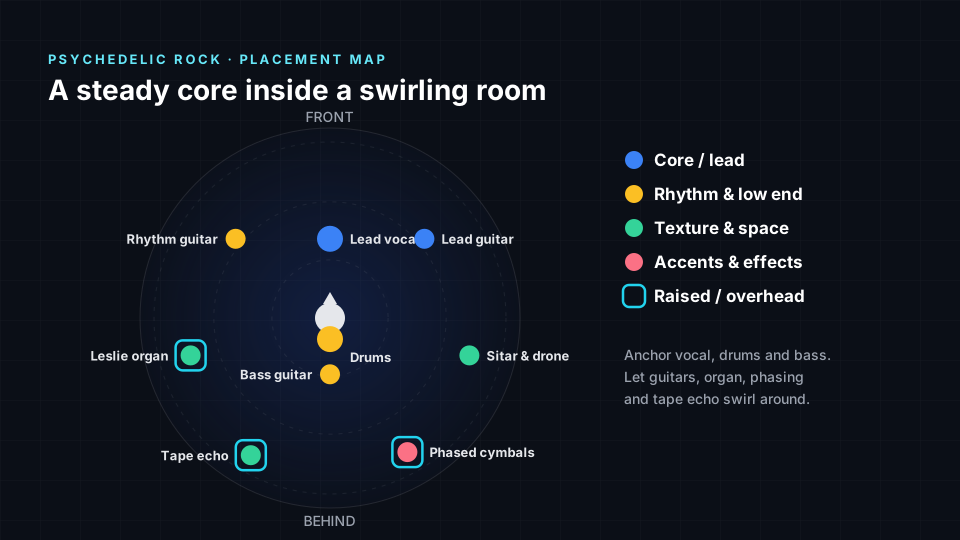
Immersive music for psychedelic rock: what listeners hear
- A voice that stays put. The vocal floats in front, steady while the room moves around it.
- Guitars that wander. Fuzz solos drift across the front instead of sticking to one speaker.
- An organ that spins. The Leslie swirl turns overhead as if the speaker cabinet were above you.
- Echoes and phasing all around. Tape repeats and sweeping cymbals circle behind and above.
Where to place each element in a psychedelic rock mix
| Element | Position | Height | Why it works |
|---|---|---|---|
| Lead vocal | Front centre | Ear level | A dreamy vocal the listener can follow |
| Drums | Centre | Ear level | A steady groove under the swirl |
| Bass guitar | Centre | Ear level | Melodic bass that anchors the trip |
| Rhythm guitar | Left | Ear level | Chords and riffs holding one side |
| Lead guitar | Right, moving | Ear level | Fuzz solos that wander across the front |
| Leslie organ | Behind left, moving | Raised | Rotating organ swirling overhead |
| Sitar & drone | Right | Ear level | Indian colour and long drones |
| Phased cymbals | Behind right, moving | Raised | Phasing and flanging that sweep above |
| Tape echo | Behind left, moving | Raised | Repeats that spin round the room |
The psychoacoustics behind psychedelic rock placement
Every position in the table above follows how the ear and brain locate sound. Here is the reason behind the main choices for psychedelic rock.
- Bass and drums stay centred. The ear finds almost no direction in frequencies below roughly 80 to 100 Hz, so moving the bass gains nothing and only weakens it. A fixed low end also gives the listener a reference point while everything above it moves.
- Moving guitar against fixed rhythm. The brain groups sounds into streams by pitch, timing and direction. This is auditory stream segregation (Bregman). A lead guitar that moves while the rhythm guitar stays still is heard as a separate voice, even when both use the same fuzzy tone.
- Organ and cymbals raised. The outer ear shapes the spectrum of a sound depending on its height, and the brain reads those changes as elevation (Hebrank and Wright). Bright, swirling sources such as a Leslie organ and phased cymbals carry plenty of high-frequency detail, so they sound convincingly overhead.
- Tape echo behind. When a sound and its echoes arrive close together, the brain fixes its position by the first arrival. This is the precedence effect. The original guitar or vocal stays in place, while its repeats can circle behind the listener without dragging it along.
The immersion profile for psychedelic rock
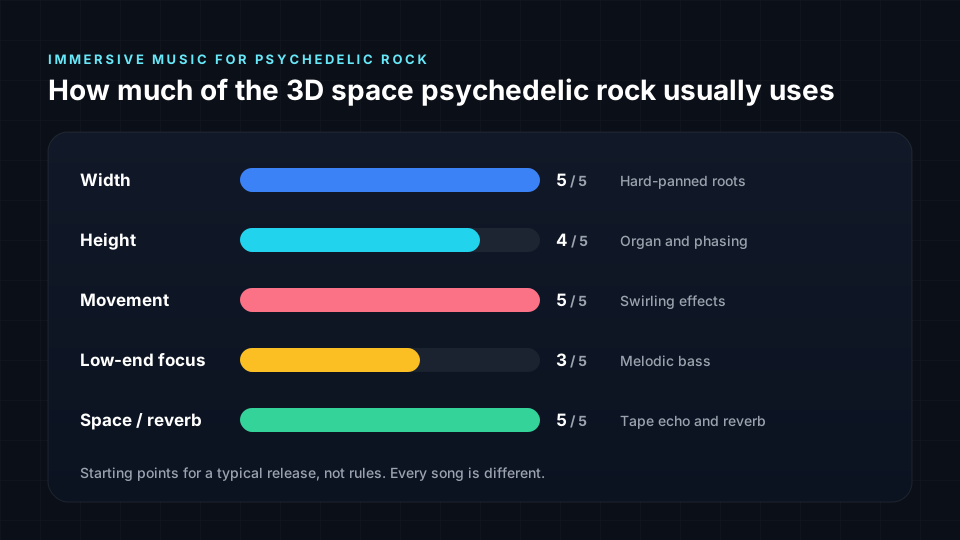
Width, movement and space are at maximum because psychedelic rock was designed around swirling effects, long echoes and sounds that travel. Height is high, as organs, cymbals and effects all suit overhead positions. Low-end focus stays moderate: the bass is melodic and important, but the genre is about texture and colour rather than weight.
Tips for an immersive psychedelic rock mix
- Anchor before you swirl. Fix the vocal, drums and bass first, then add movement around them.
- Move effects, not songs. Let echoes, phasers and solos travel, but keep the main melody easy to follow.
- Follow the tempo. Sync rotations and sweeps to the beat or to a phrase, so the motion feels musical rather than random.
- Use the height for colour. Put the organ, cymbals and shimmering effects above, and keep the guitars and voice at ear level.
- Build the peaks. Open the space wider during long jams and freak-outs, then bring it back close for the next verse.
Psychedelic Rock styles: acid rock, space rock, krautrock and neo-psychedelia
The core placement holds for every psychedelic rock style: vocal, drums and bass anchored, effects moving around them. What changes is how heavy, how cosmic and how hypnotic the music is.
Acid Rock
Acid rock is the heavier, louder side of 1960s psychedelia, with long, improvised guitar jams, heavy fuzz and blues roots, closely tied to the San Francisco scene and to players such as Jimi Hendrix. Keep the drums and bass solid in the centre and let the lead guitar take the main movement, travelling across the front and out to the sides during solos. Rhythm guitar or organ can hold the opposite side. Feedback and wah can swirl behind. Use a large, live room, because these bands sounded best playing loud in ballrooms.
Space Rock
Space rock pushes psychedelia towards the cosmic, with long drones, synthesisers, heavy echo and repetitive riffs, from early Pink Floyd to Hawkwind and beyond. It needs the most height and space of any style here. Raise synth washes, oscillator sweeps and echo trails above the listener and let them circle slowly. Keep the bass and driving drums centred, since the hypnotic pulse matters. Put the vocal a little further back than usual, often with echo, so it feels like a voice in a vast space.
Krautrock
Krautrock came out of West Germany in the late 1960s and 1970s, with bands such as Can, Neu! and Faust mixing rock, electronic music and the avant-garde. Its hallmark is the steady motorik beat. Keep that beat dead centre and unmoving, because the hypnotic repetition is the point. Spread guitars, synths and organ in wide, stable positions around the listener, and let tape effects and electronic sounds drift slowly overhead. Change the space gradually across a long track, opening it up over minutes rather than in sudden jumps.
Neo-Psychedelia
Neo-psychedelia covers the bands since the 1980s that revived the psychedelic sound with newer tools, from the Paisley Underground to modern bedroom producers. Production is often cleaner, with layered synths, heavy compression and lush reverb. Keep the vocal close and centred with the drums and bass, and wrap pads and layered guitars around and above. Phasers and filtered effects can move freely, but keep the modern punch in the low end. A wide, dreamy space suits most of these records.
Related styles such as freakbeat, psych folk and stoner rock follow the same idea: anchor the core, then let the effects travel.
How to make immersive psychedelic rock from stereo
Spatial9 can create spatial audio from a stereo track in a few steps:
- Upload your stereo master or your stems.
- Spatial9's AI separates and places each part, anchoring the vocal, drums and bass and sending guitars, organ, echoes and phasing around and above you.
- Preview it in binaural on headphones.
- Export Eclipsa Audio, ADM, binaural or Ambisonics.
- Publish a video. Create a YouTube-ready video with your immersive audio and publish it directly.
For related guides, read spatial audio for shoegaze and spatial audio for stoner rock. Every guide is listed in spatial audio and immersive music by genre.
Frequently asked questions
Does this guide cover acid rock, space rock, krautrock and neo-psychedelia?
Yes. Acid rock lets the lead guitar roam during loud jams. Space rock raises synths and echoes into a vast space overhead. Krautrock keeps the motorik beat fixed while textures drift. Neo-psychedelia wraps lush pads and guitars around a close, punchy core.
Can I make a psychedelic rock mix in Dolby Atmos or Eclipsa Audio?
Yes. The placements in this guide work for both. Spatial9 exports ADM, the standard file used by Dolby Atmos studios, as well as Eclipsa Audio for YouTube, so one immersive psychedelic rock mix covers both. If you plan to release the Atmos version on Apple Music, build it from your original stems or multitracks, because Apple does not accept Atmos made from a finished stereo master. See where to publish spatial audio. You may also hear this called a 3D psychedelic rock mix or psychedelic rock in spatial audio.
Is spatial audio good for psychedelic rock?
Yes. Psychedelic rock was built on stereo tricks, swirling effects and long echoes. Spatial audio gives that motion a full circle and height to move through, while keeping the song anchored.
How is psychedelic rock different from shoegaze in spatial audio?
Psychedelic rock uses distinct, moving effects such as phasing, Leslie organ and tape echo, so individual sounds travel around the listener. Shoegaze builds a dense wall of blended guitars and reverb, so it works better as a wide, stable wash than as separate moving parts.
How do I treat hard-panned 1960s stereo mixes?
Many early stereo mixes put drums on one side and vocals on the other. Separate the parts, move the vocal, drums and bass to the centre and keep the original panning ideas for the effects.
Can I convert a finished psychedelic rock track to spatial audio?
Yes. Spatial9 uses AI to generate an immersive mix from a stereo master and exports it as Eclipsa Audio, ADM, binaural or Ambisonics.
Does immersive psychedelic rock work on normal headphones?
Yes. The mix is rendered binaurally, so the swirling organ, wandering guitars and circling echoes work on any regular headphones.
Dolby and Dolby Atmos are trademarks of Dolby Laboratories. Spatial9 is not affiliated with or endorsed by Dolby Laboratories.
Sources
- Blauert, J. (1997). Spatial Hearing: The Psychophysics of Human Sound Localization, revised edition. MIT Press. Low-frequency, elevation, distance and motion cues.
- Mills, A. W. (1958). On the minimum audible angle. Journal of the Acoustical Society of America, 30(4), 237-246.
- Hebrank, J. and Wright, D. (1974). Spectral cues used in the localization of sound sources on the median plane. Journal of the Acoustical Society of America, 56(6), 1829-1834.
- Bronkhorst, A. W. (2000). The cocktail party phenomenon: a review of research on speech intelligibility in multiple-talker conditions. Acta Acustica united with Acustica, 86, 117-128.
- Litovsky, R. Y., Colburn, H. S., Yost, W. A. and Guzman, S. J. (1999). The precedence effect. Journal of the Acoustical Society of America, 106(4), 1633-1654.
- Barron, M. and Marshall, A. H. (1981). Spatial impression due to early lateral reflections in concert halls. Journal of Sound and Vibration, 77(2), 211-232.
- Neuhoff, J. G. (1998). Perceptual bias for rising tones. Nature, 395, 123-124.
- Bregman, A. S. (1990). Auditory Scene Analysis: The Perceptual Organization of Sound. MIT Press.
Let the swirl surround you
Upload a track to Spatial9 and hear your organ, guitars and tape echoes spin around a steady groove in minutes. Then export it or publish it straight to YouTube.